RBT Certification in Indiana: BACB Steps, State Licensure, and Medicaid Checks
If you search for RBT certification Indiana, you may be trying to find the state office that issues the credential, understand what an employer expects, or figure out whether Indiana Medicaid changes the path. The clearest answer starts with a boundary: the Registered Behavior Technician credential is issued through the BACB, not by the Indiana Professional Licensing Agency. Indiana still matters because it regulates behavior-analyst licenses and sets payer or provider conditions for covered ABA services.
This guide separates those layers. It gives you a planning map for the current BACB RBT route, explains what Indiana’s licensing information says about RBTs, and highlights the Indiana Medicaid distinctions that can affect supervision, enrollment, billing, and telehealth. Use the linked official sources as the final check for your application date, employer, payer, and service setting.
Table of Contents
Short answer: what RBT certification in Indiana means
For an Indiana candidate, the first source for RBT certification is the BACB RBT page and current RBT Handbook. The BACB describes the RBT as a paraprofessional certification in behavior analysis. RBTs assist in delivering behavior-analytic services under the direction and close supervision of an RBT Supervisor or RBT Requirements Coordinator. Indiana does not turn that national credential into an Indiana behavior-analyst license.
Keep four questions separate:
- Who issues the credential? The BACB controls the RBT certification pathway, including its current eligibility, training, assessment, application, examination, and maintenance steps.
- What does Indiana license? Indiana’s Professional Licensing Agency has a behavior-analyst licensing process for roles such as a Licensed Behavior Analyst or Licensed Assistant Behavior Analyst. That is not the RBT application route.
- What does the payer require? Indiana Medicaid’s IHCP materials define practitioner, enrollment, supervision, billing, and telehealth conditions for covered ABA therapy.
- What does the actual employer or setting require? A clinic, school, provider, or contract can add onboarding, documentation, background, and supervision conditions.
The Indiana PLA’s licensing information answers a common question directly: it does not issue RBT certifications, so a person seeking RBT certification should apply through the BACB. That statement does not mean every Indiana job has identical requirements. It means you should not wait for a separate Indiana RBT license application that is not part of the BACB pathway.
The BACB route for an Indiana candidate
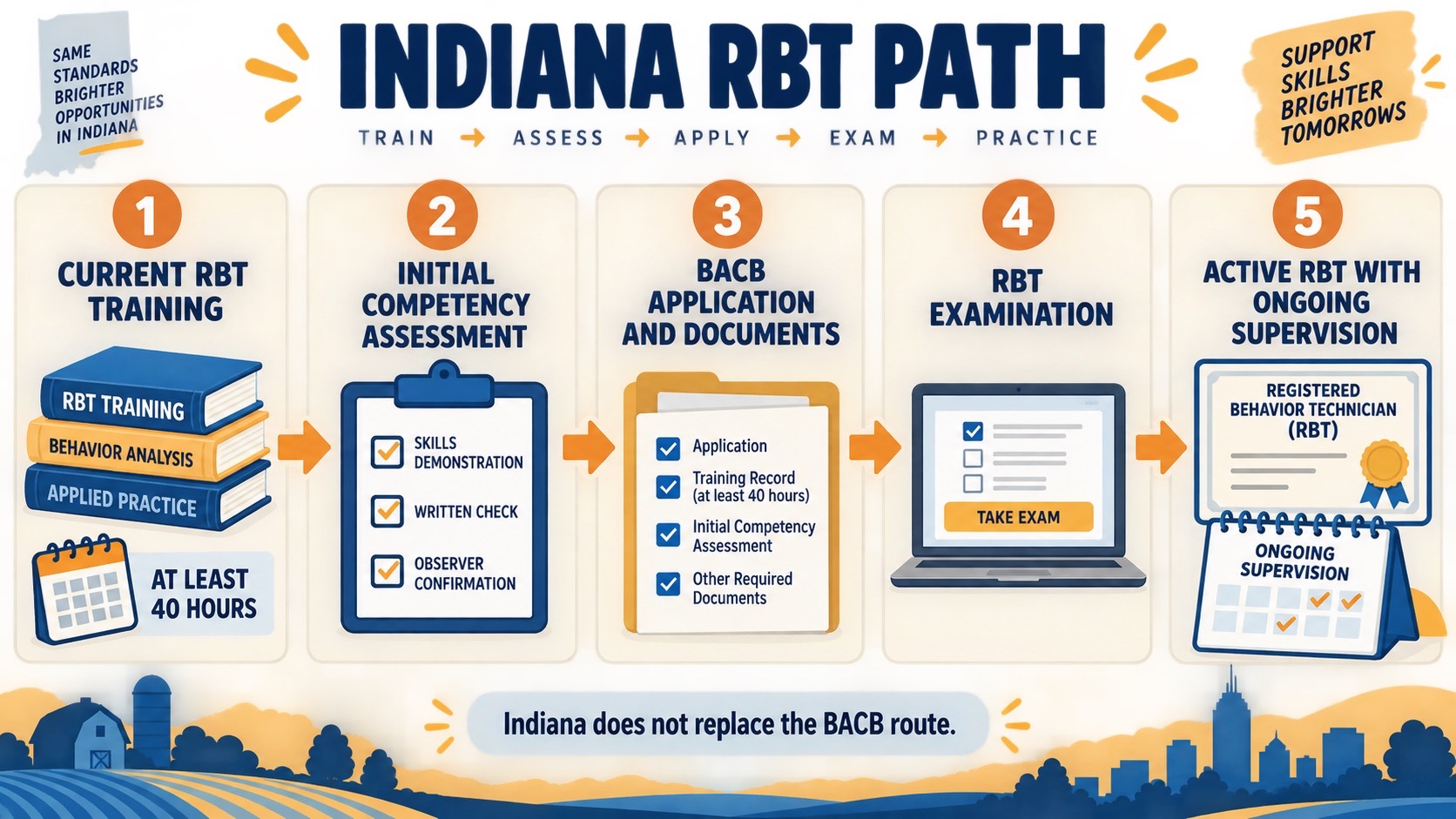
The state location does not remove the national BACB checkpoints. The current handbook is the right place to confirm the exact requirements that apply to your application timing. Save the handbook date you checked, particularly if you are comparing an older training page with current 2026 materials.
- Confirm eligibility. Review the current age, education, background-check, and other requirements. A general ABA certificate or employer course is not automatically a BACB RBT credential.
- Complete qualifying training. Use a program designed to meet the current RBT training requirements, retain its completion record, and check the dates and trainer information before moving on.
- Complete the Initial Competency Assessment. Training and competency assessment are separate. The assessment demonstrates relevant performance and must be completed through the current BACB process.
- Submit the application. Follow the BACB application instructions and keep names, identification, dates, and supporting documents consistent.
- Prepare for the examination. Use the current RBT examination information and content outline. Practice materials can help you rehearse decisions, but they are not secure BACB questions and cannot guarantee a result.
- Maintain the credential. Active practice still involves ongoing supervision, ethics, and current maintenance responsibilities.
Think of these as separate files in your planning folder. One file contains the training record, another the competency assessment, another the application, and another the examination or maintenance record. That organization makes it easier to explain what you have completed to an Indiana employer without saying that a course alone made you an RBT.
The ABA Study Online RBT learning hub can help organize theory review, and the RBT practice-question route can help you rehearse applied decisions. These are independent study resources; they do not replace BACB forms, assessment, examination authorization, or supervision.
What Indiana licenses separately
Indiana’s Professional Licensing Agency publishes application information for behavior analysts and assistant behavior analysts. The materials describe state licensure tied to professional roles and refer applicants to the BACB for the certification examination and certification information. This creates a useful distinction for a job search: an Indiana LBA or assistant behavior-analyst license is not the same credential as an RBT.
A job posting can mention an LBA, BCBA, BCaBA, HSPP, and RBT in the same service team. That is normal when different professionals perform different duties. The employer’s requirement for a licensed or board-certified supervisor does not automatically require the RBT applicant to hold that supervisor’s credential.
Ask the organization to identify the exact role, issuing body, and duty attached to each term. “Behavior analyst,” “behavior technician,” “licensed,” and “credentialed” are not interchangeable labels. If a posting says “Indiana certification,” ask whether it means BACB RBT certification, Indiana professional licensure for another role, an IHCP enrollment classification, or internal onboarding.
Indiana state licensure is also not the same as Medicaid enrollment. A licensed or board-certified behavior analyst may be the enrolled provider whose NPI is used for claims, while an RBT delivers services under the required supervision. Read the provider manual and the job’s supervision arrangement together instead of treating a single title as the entire rule.
Indiana Medicaid, supervision, and telehealth
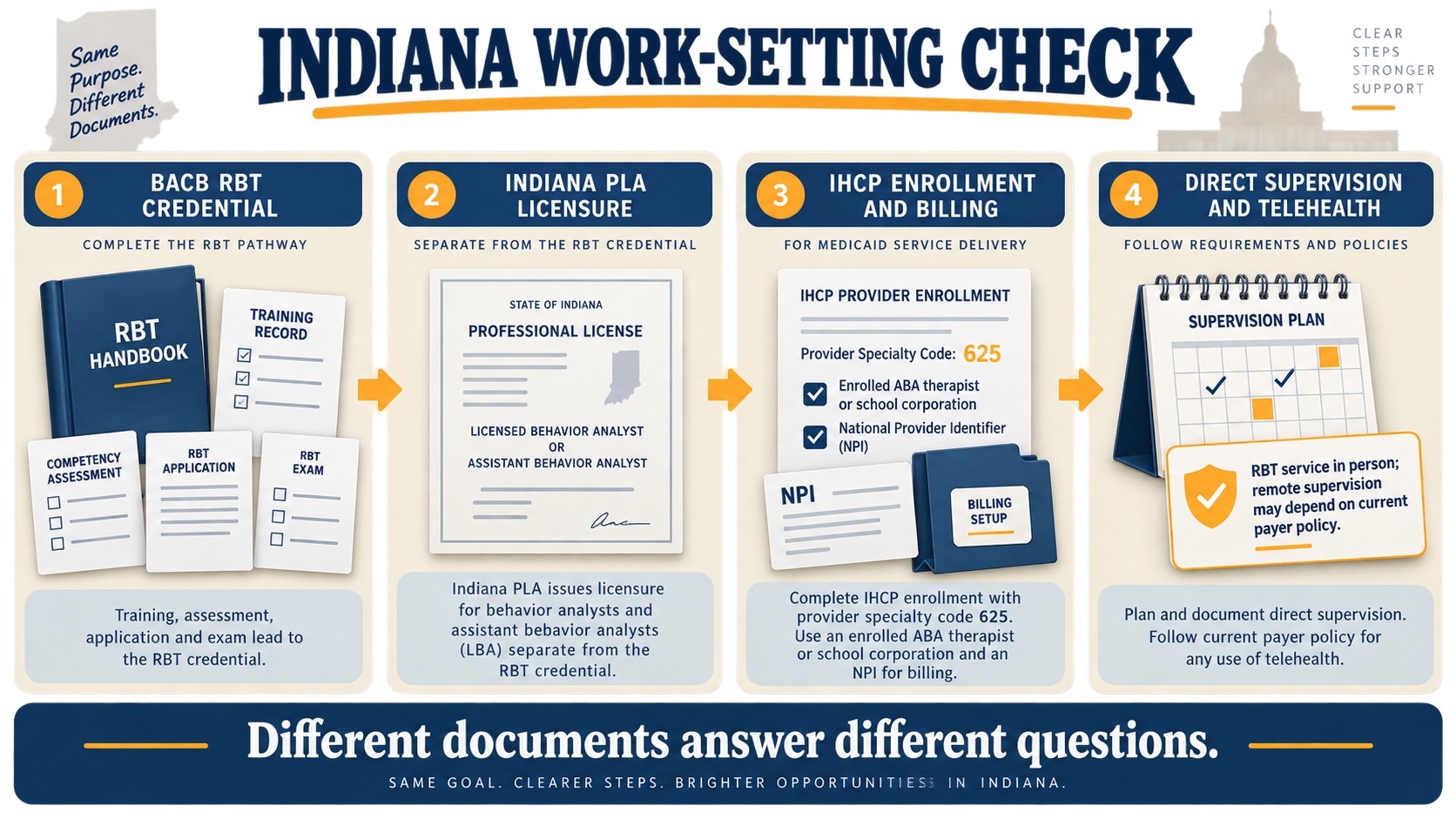
Indiana Medicaid’s current Behavioral Health Services module recognizes a credentialed RBT as an appropriate practitioner for ABA therapy in the IHCP framework. It also states that ABA services performed by a BCaBA or RBT must be under the direct supervision of a BCBA, BCBA-D, or HSPP. The policy is about covered service delivery and reimbursement; it is not a replacement for the BACB certification pathway.
The same module explains an important billing distinction. RBT services are billed under the NPI of an IHCP-enrolled ABA therapist or school corporation. Indiana’s provider-classification page lists specialty 625 for an ABA Therapist (RBT), while other specialties apply to different ABA practitioner levels. An RBT applicant should therefore ask the employer or provider who holds the enrollment, who is responsible for the claim, and how the RBT’s credential and supervision are recorded.
Telehealth requires especially careful reading. Indiana Medicaid’s telehealth bulletin says a credentialed RBT may not deliver ABA service via telehealth. It describes a different arrangement in which an eligible BCBA or HSPP may supervise remotely while the RBT provides adaptive behavioral treatment in person to the member. Present this as an Indiana Medicaid policy boundary for the relevant service and payer—not as a universal statement about every private employer, every platform, or every form of remote communication.
Before accepting a Medicaid-connected role, ask:
- Is the organization enrolled with IHCP under the appropriate ABA provider specialty?
- Who is the enrolled billing provider and whose NPI is used for the service?
- Who provides direct supervision, and how are contacts and observations documented?
- Does the role involve in-person service, remote supervision, or a telehealth service that Indiana Medicaid restricts for RBT delivery?
- Which current IHCP module, bulletin, contract, or employer policy supports the answer?
An Indiana RBT checklist
Use this order when you are planning certification or comparing an Indiana role:
- Start with the BACB. Record the current RBT Handbook version and list the national steps that apply to your application.
- Confirm the assessor and supervisor. Ask who will complete the competency assessment and who will provide ongoing supervision after hire.
- Identify the setting. Mark the role as clinic, school, home-based, early-intervention, private payer, or IHCP/Medicaid-connected service.
- Separate the documents. Label each item BACB credential, Indiana license, provider enrollment, payer requirement, employer onboarding, or supervision record.
- Check billing and telehealth rules. If Medicaid is involved, verify specialty, NPI, direct-supervision, and in-person/remote-delivery requirements with the current source.
- Recheck before starting. Return to the official handbook and Indiana policy pages if your application is delayed or your employer, payer, or service changes.
Common mistakes to avoid
- Looking for an Indiana RBT license application: Indiana PLA says RBT certifications are not issued by that office; the certification application goes through the BACB.
- Confusing LBA or assistant licensure with RBT certification: these are different professional pathways.
- Treating a course as certification: training, competency assessment, application, examination, and maintenance remain separate.
- Ignoring the billing provider: an RBT may render services while claims are billed under an enrolled ABA therapist or school corporation.
- Generalizing Medicaid telehealth language: label the payer and service policy before applying it to a different job or setting.
- Relying on an old bulletin: Indiana Medicaid policy and provider modules can change; verify the current version before acting.
RBT certification Indiana FAQ
Does Indiana issue RBT certifications?
No. Indiana’s licensing information directs people seeking RBT certification to the BACB. Indiana separately licenses behavior analysts and assistant behavior analysts, but that is not a second RBT certification route.
Do I need an Indiana behavior-analyst license to become an RBT?
The LBA and assistant behavior-analyst licenses are different Indiana professional credentials. An RBT candidate should follow the BACB RBT pathway and then verify the employer, school, payer, and supervision conditions for the actual role.
Can an RBT work with Indiana Medicaid?
Indiana Medicaid materials recognize credentialed RBTs as appropriate ABA practitioners in the IHCP framework, subject to the relevant service and provider rules. The current module requires direct supervision and explains that RBT services are billed under an enrolled ABA therapist or school corporation. Confirm the current policy and employer arrangement.
Can an RBT provide ABA through telehealth in Indiana?
For the Indiana Medicaid telehealth policy reviewed here, a credentialed RBT may not deliver the ABA service via telehealth. A qualified supervisor may supervise remotely while the RBT provides treatment in person to the member. This is a payer-specific policy boundary, so verify the current source before generalizing it.
Does a 40-hour course make me an RBT in Indiana?
No. A qualifying training course is one step. The current BACB process also separates the Initial Competency Assessment, application, examination, and ongoing supervision. Course completion alone should not be presented as active RBT certification.
Sources and verification notes
- BACB: RBT certification and application resources
- BACB: Registered Behavior Technician Handbook
- Indiana Professional Licensing Agency: Behavior Analyst Licensing Information
- Indiana Medicaid: Behavioral Health Services provider reference module
- Indiana Medicaid: Provider classification, type, and specialty
- Indiana Medicaid: 2026 ABA provider qualification and supervision bulletin
- Indiana Medicaid: ABA therapy services via telehealth bulletin
- ABA Study Online RBT learning hub and RBT practice questions