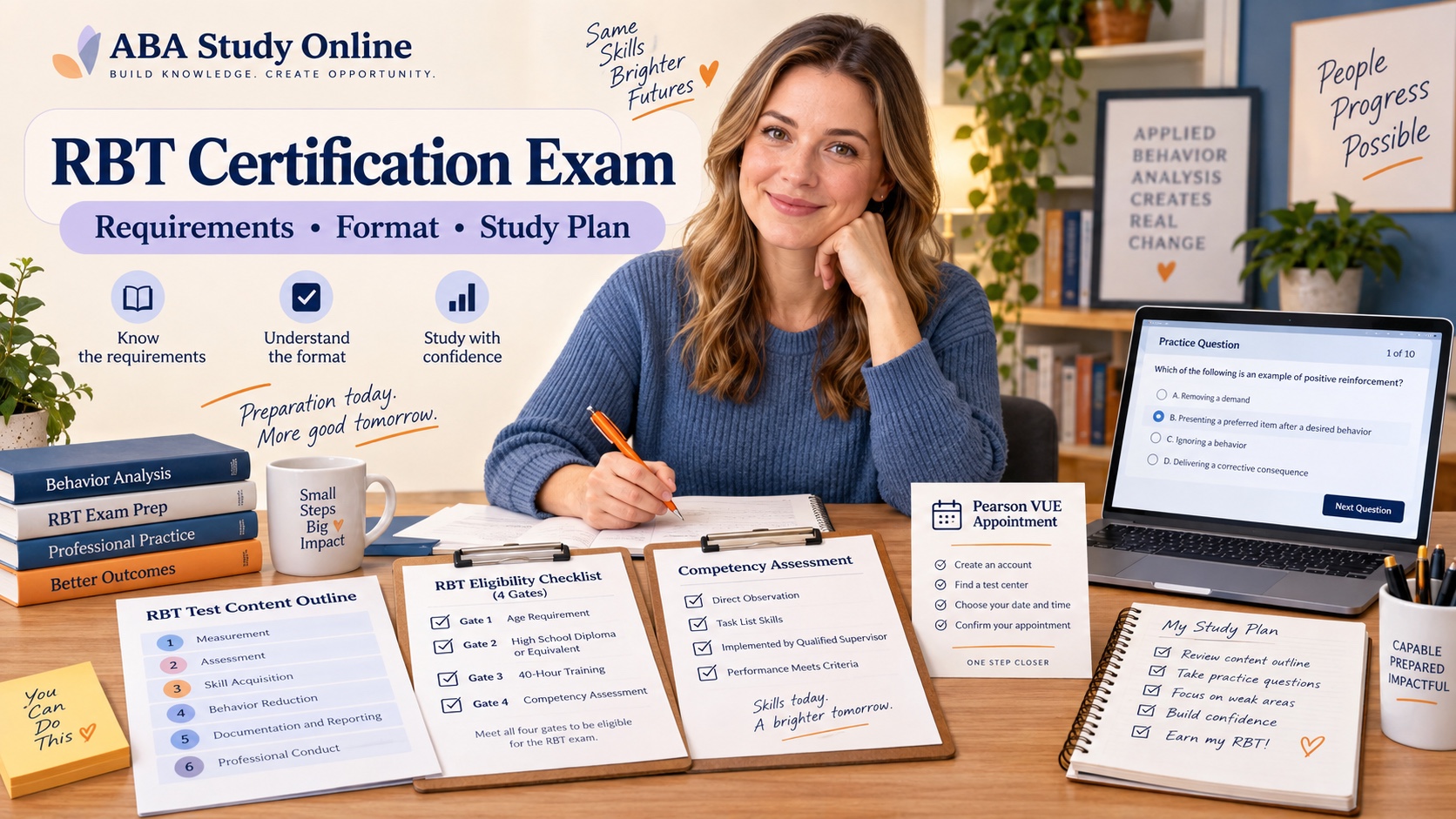
RBT Certification Exam: Requirements, Format, and the Current Content Outline
If you are searching for the RBT certification exam, the most useful starting point is to separate the exam from the steps that come before it. The exam is the BACB assessment you take after you meet the eligibility requirements, complete the required training and competency process, submit your application, and receive approval. It is not the 40-hour training and it is not the RBT Initial Competency Assessment.
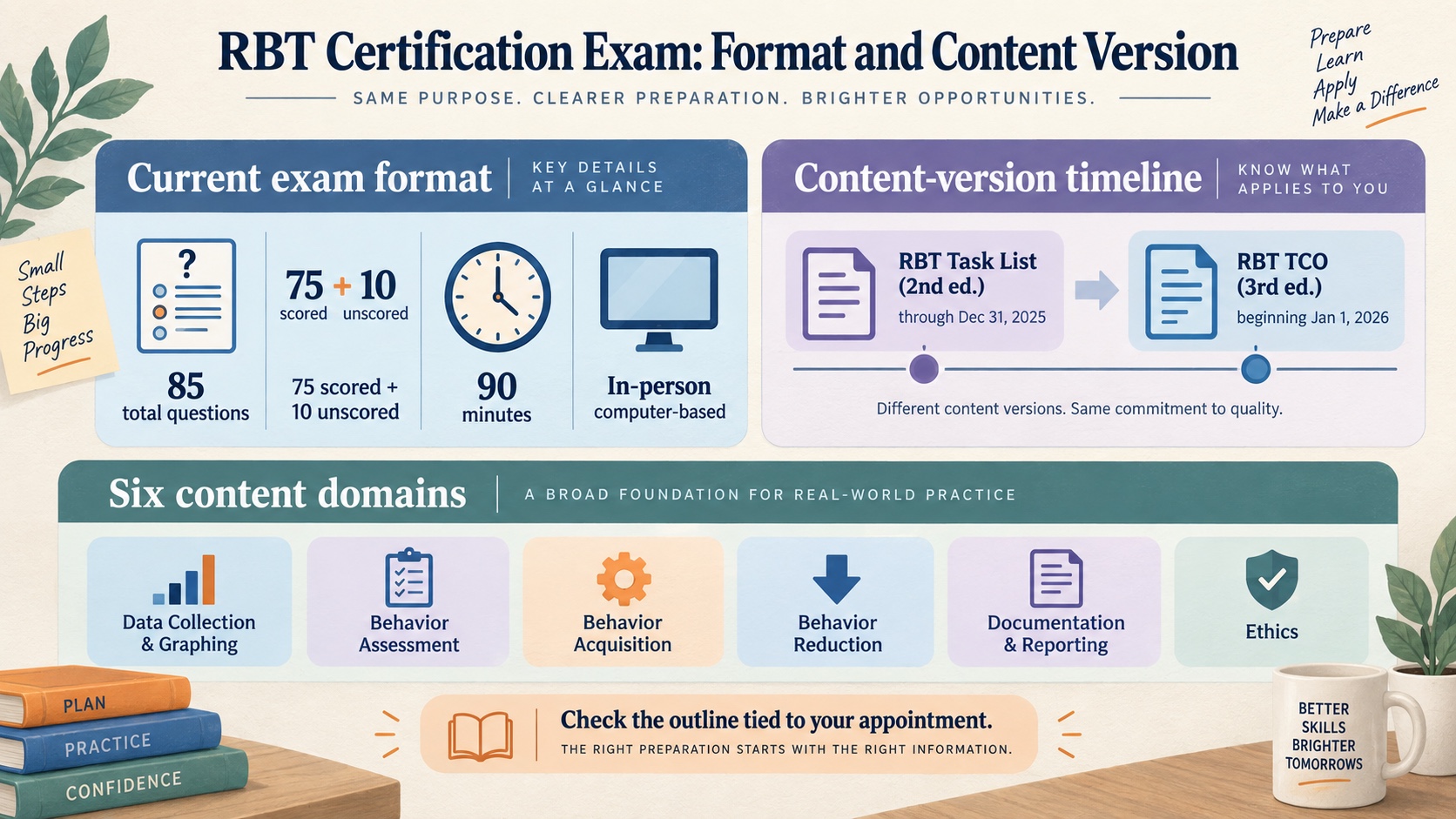
The current exam is delivered in person through Pearson VUE in a computer-based format. It has 85 total questions and a 90-minute time limit. Your study plan should follow the RBT Test Content Outline (3rd ed.) when that is the outline tied to your appointment, while your eligibility work should follow the current RBT Handbook and BACB transition guidance.
Table of Contents
What is the RBT certification exam?
The RBT certification exam evaluates knowledge and skills expected of an entry-level behavior technician. RBTs assist with behavior-analytic services under the direction and close supervision of an RBT Supervisor and/or RBT Requirements Coordinator. Passing the exam does not turn an RBT into an independent practitioner, and it does not replace ongoing supervision or the ethical responsibilities attached to the certification.
The BACB develops the examination from a job-task analysis and a test content outline. That is why the best preparation starts with the official outline and the materials from your qualifying training and competency assessment, not with a random list of remembered questions. Secure examination items are not public, and a practice set should teach the underlying decision rather than claim to reproduce a live form.
What must you complete before the exam?
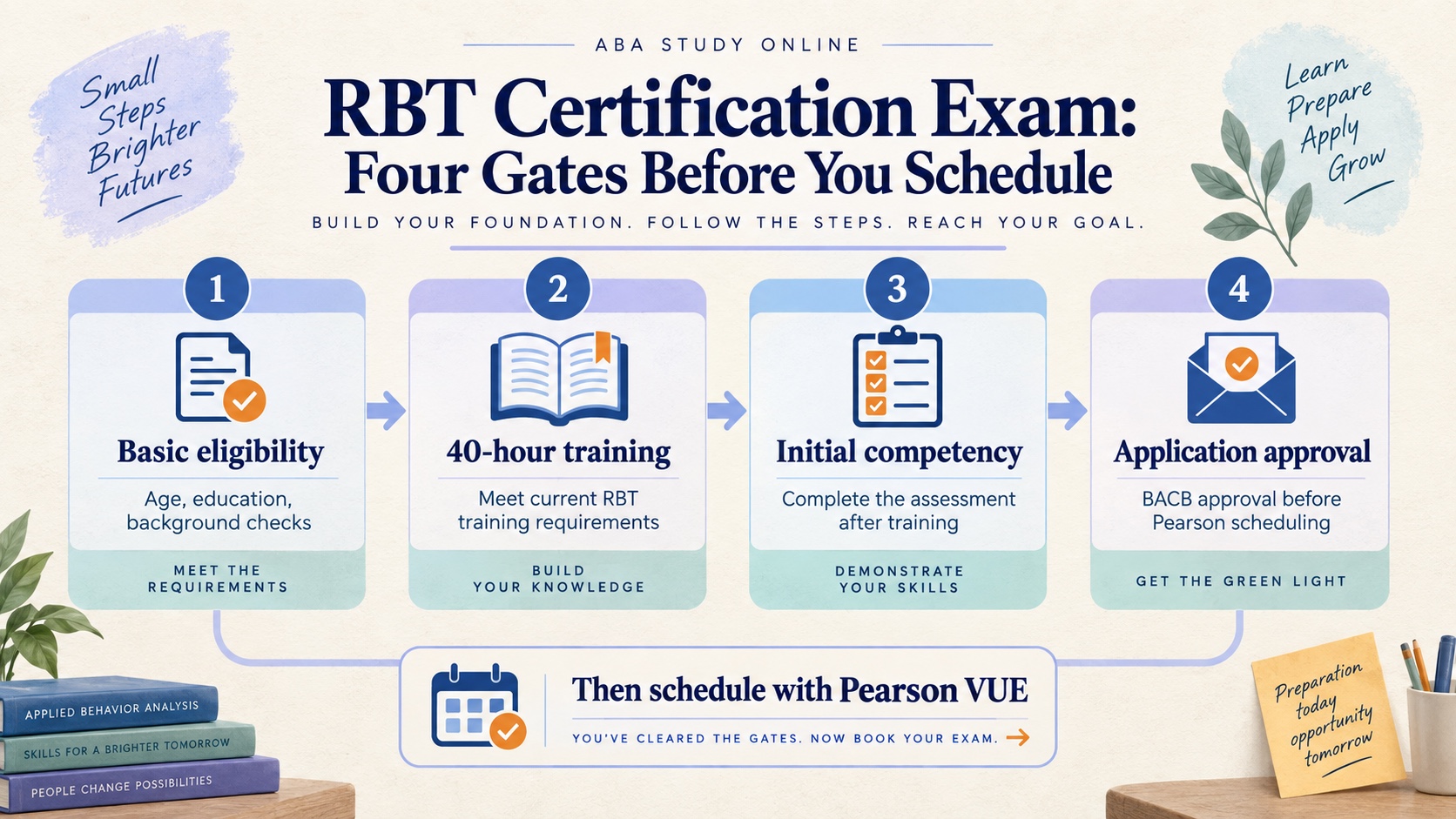
Think of the application as four gates. You move through them in order, even though the details and documents belong to your specific situation.
- Basic eligibility: meet the age and education requirements and complete the required criminal background and abuse-registry checks through the current BACB process.
- Qualifying training: complete a 40-hour training program that meets the applicable RBT training requirements. If you apply under the current requirements, read the wording the training certificate must contain.
- Initial competency: complete the RBT Initial Competency Assessment after the training and within the application rules. This checks practical competency; it is not the certification exam.
- Application approval: submit the required attestation and documents through your BACB account. Only after the application is approved do you receive instructions to schedule the examination with Pearson VUE.
A common mistake is to treat “I finished my 40 hours” as “I am ready to book the exam.” Training is necessary, but it is one gate in the sequence. Another mistake is to confuse a competency demonstration with a written knowledge examination. Keep a folder with your training certificate, competency-assessment records, application information, and BACB messages so you can answer the next question from your own record rather than from a generic checklist.
What is the current exam format?
The current BACB examination information lists the RBT examination as 90 minutes and 85 total questions. The current RBT Handbook breaks that total into 75 scored questions and 10 unscored pilot questions. All questions are multiple choice with four possible answers and one correct answer. Your result is based on the form you receive and the BACB’s scoring process, not on competing with the other candidates in the room.
| Element | Current RBT exam detail | Why it matters for preparation |
|---|---|---|
| Delivery | In person, computer based, through Pearson VUE | Practice reading and selecting answers on screen, then plan for the testing-center process. |
| Total questions | 85 total: 75 scored and 10 unscored | Use the total for pacing; do not try to identify which questions are unscored. |
| Time | 90 minutes | Build accuracy first, then add timed mixed practice. |
| Question style | Four answer choices, one correct answer | Explain why the best answer fits the observable facts and role boundaries. |
Once BACB approves your application, follow the scheduling instructions in your BACB account and the official Pearson VUE BACB page. Appointment availability, payment, cancellation, and rescheduling belong to Pearson VUE. If you need an accommodation, do not schedule until BACB sends the accommodation status and instructions for the appointment.
What does the RBT exam cover?
The RBT Test Content Outline (3rd ed.) organizes the examination into 43 tasks across six domains. The domain weights are a planning signal, not permission to ignore the smaller domains. A learner who only studies behavior acquisition can still miss important questions about data, documentation, ethics, assessment, or behavior reduction.
| Domain | Scored questions | Approximate share | Study lens |
|---|---|---|---|
| A. Data Collection and Graphing | 13 | 17% | Measurement, data entry, graphs, trends, and procedural fidelity |
| B. Behavior Assessment | 8 | 11% | Preference assessment and participation in assessment procedures |
| C. Behavior Acquisition | 19 | 25% | Reinforcement, teaching procedures, prompting, shaping, chaining, and generalization |
| D. Behavior Reduction | 14 | 19% | Function-based support, reduction procedures, extinction effects, and safety boundaries |
| E. Documentation and Reporting | 10 | 13% | Objective notes, communication, data reporting, and escalation |
| F. Ethics | 11 | 15% | Core ethical principles, scope, gifts, cultural humility, and professional conduct |
Study the task verbs. “Implement,” “describe,” “identify,” “calculate,” and “participate” require different kinds of answers. For example, a question about a graph may ask you to identify a trend, while a question about a teaching procedure may ask which action is appropriate for the technician to implement. The RBT role boundary matters in both cases: choose the answer that follows the written plan and supervision structure rather than inventing a new intervention independently.
Which RBT content outline should you study?
The BACB’s outline page distinguishes the RBT Task List (2nd ed.), used through December 31, 2025, from the RBT Test Content Outline (3rd ed.), used beginning January 1, 2026. The current 3rd edition is not a “7th edition.” It is the RBT’s 3rd-edition test content outline, and it is separate from the BCBA and BCaBA 6th-edition outlines.
The 3rd edition keeps six broad areas but refines task language and adds or expands several responsibilities. Its blueprint includes data calculation and graph trends, clearer behavior-reduction effects, and specific ethics tasks such as applying core principles, following gift guidance, and practicing cultural humility and responsiveness. That means older study notes can still contain useful concepts, but they should be checked against the current TCO instead of treated as a complete map.
The safest version rule is this: open the current BACB Test Content Outlines page, confirm the outline linked to your examination, and use the handbook version that applies to your application and appointment. The handbook explains that candidates test under the current outline and that a new edition can apply during an active authorization period. If you plan to test in a future year, recheck the official page before finalizing your study calendar; do not assume that a social-media post or an old PDF is still current.
How do scheduling and retakes work?
After approval, BACB sends instructions for Pearson VUE scheduling. The RBT Handbook states that the initial approval period is one year. The exam is continuously available subject to appointment capacity, and results are provided at the testing site after completion. Keep your own approval deadline visible because a missed deadline can change which requirements apply when you reapply.
If you do not pass and still have time in the authorization period, the current handbook allows up to eight total attempts within the 12-month period following initial approval. You must wait seven days after a previous attempt before taking the exam again. When the authorization period expires, you must reapply and meet the requirements that apply then. These rules are administrative and can be revised, so check the live handbook before planning a retake.
A retake is not a reason to study only the task areas shown on a score report. BACB advises candidates to study all content because a small number of questions about one task may not represent your full understanding. Use the report to choose examples and practice priorities, then return to the complete outline.
How should you prepare?
Start with an outline-led plan rather than a countdown alone. Read each domain, mark the tasks you can explain, and write one observable example for the tasks that still feel vague. Then build practice in three passes:
- Accuracy pass: study one domain at a time and explain why an answer is correct. Keep measurement, assessment, ethics, and documentation in the rotation instead of saving them for the end.
- Application pass: work through short scenarios. Ask what the technician can observe, what the written plan says, when to collect data, and when to contact the supervisor.
- Pacing pass: use mixed timed sets that resemble the 90-minute environment. Review reasoning, not just the letter of the answer, and practice moving on from a question that is taking too long.
Use the ABA Study Online RBT learning path to organize concepts and the RBT question practice area to check retrieval. Free materials can help you build the foundation, but no third-party resource can guarantee a BACB result or replace the current official TCO and handbook.
RBT certification exam FAQ
How many questions are on the RBT exam? The current exam has 85 total questions: 75 scored questions and 10 unscored pilot questions.
How long is the RBT certification exam? Candidates have 90 minutes. The exam is delivered in person through Pearson VUE using a computer-based format.
Is the RBT exam the same as the 40-hour training? No. Training is an eligibility requirement. The Initial Competency Assessment is another prerequisite. The certification examination is a separate BACB assessment after application approval.
What is the current RBT exam edition? The RBT Test Content Outline (3rd ed.) applies beginning January 1, 2026. Confirm the outline connected to your appointment before studying, especially if you schedule in a future year.
Can I retake the RBT exam? Under the current handbook, you may have up to eight attempts within the one-year authorization period, with a seven-day wait after an attempt. Check the current handbook for the rule that applies to your authorization.