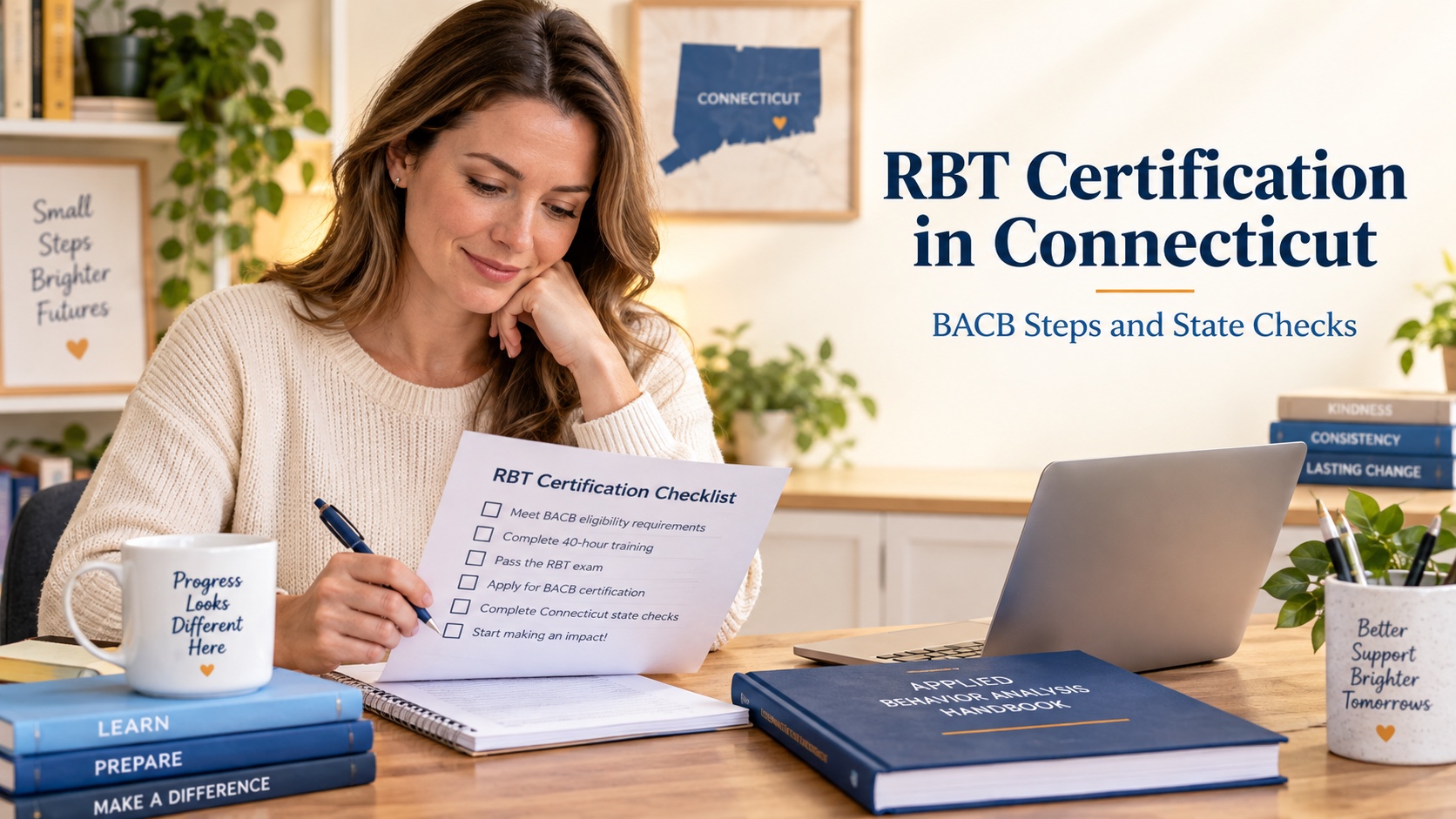
RBT Certification in Connecticut: BACB Steps and State Checks
If you search for RBT certification CT, you are probably trying to answer a practical question: what do I need before I can work as a Registered Behavior Technician in Connecticut? The clearest answer starts with a boundary. RBT certification is a national BACB credential pathway, while Connecticut has separate professional-licensure, school, provider, employer, and payer questions that may affect a particular role. Those layers can interact, but they are not interchangeable.
This guide keeps the layers separate. It explains the BACB route at a useful planning level, shows what Connecticut’s official pages regulate, and gives you questions to ask before paying for training or accepting a position. Because certification rules and program requirements can change, use the linked official sources as the final check for your application.
Table of Contents
Short answer: what RBT certification in Connecticut means
For a Connecticut candidate, the starting point is the current BACB RBT pathway. The BACB describes the Registered Behavior Technician as a paraprofessional certification in behavior analysis. RBTs deliver behavior-analytic services under the direction and close supervision of the responsible credentialed professional. The credential is not the same thing as a Connecticut behavior-analyst license, a school-district hiring approval, or a provider’s payer enrollment.
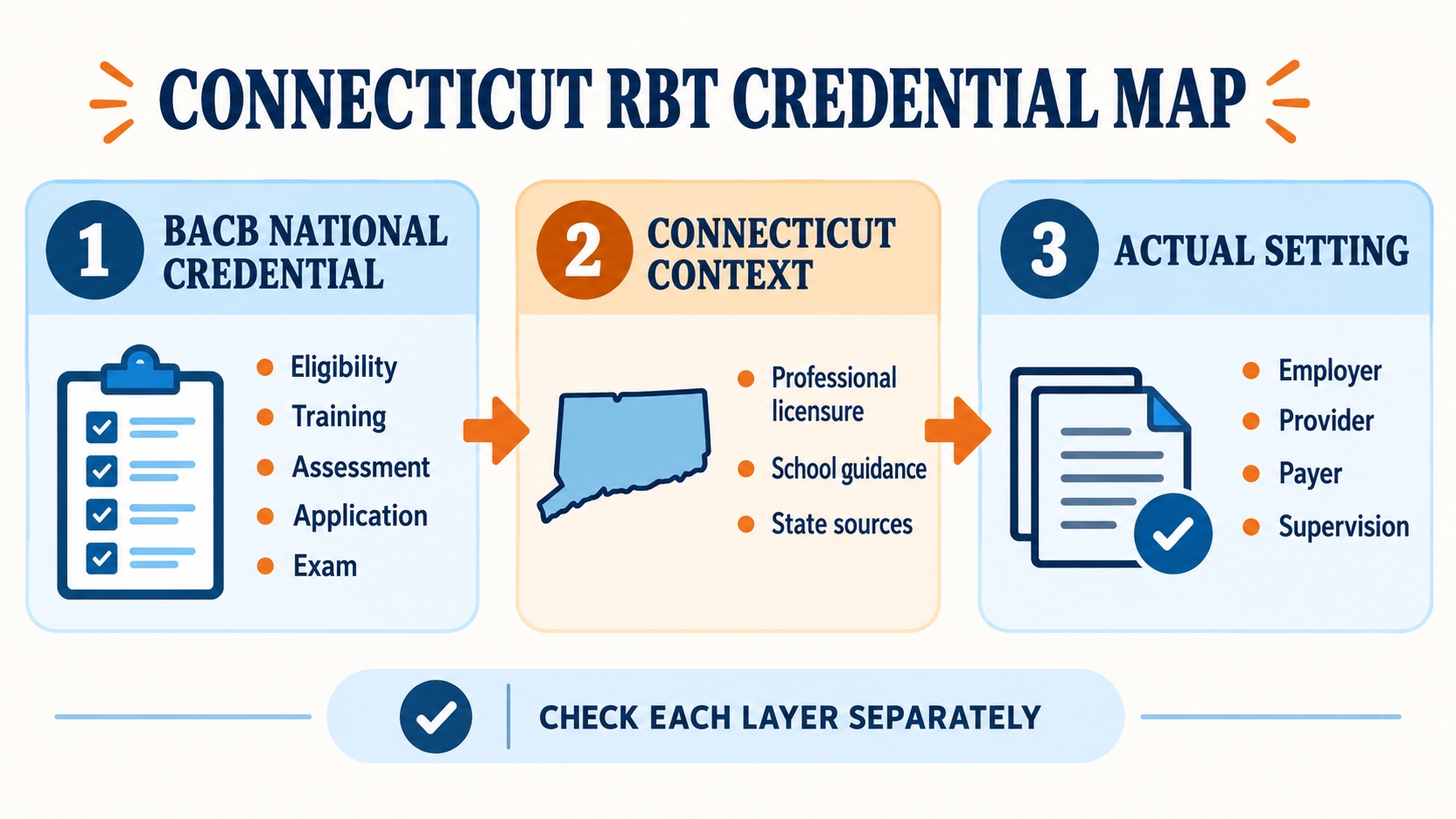
Think of the search as three questions:
- What does the BACB require? This covers the current eligibility, training, initial competency assessment, application, examination, and maintenance pathway.
- What does Connecticut regulate? State pages may address licensed behavior-analyst roles, school services, professional practice, or other regulated settings.
- What does this job or program require? An employer, school, provider, contract, or payer may add screening, supervision, documentation, or onboarding conditions.
This three-question model prevents a common error: taking a rule written for a BCBA, a licensed behavior analyst, or one state-funded program and presenting it as a universal RBT certification requirement. It also gives you a sensible order for research. Start with the BACB, identify the setting, then verify Connecticut and employer-specific details.
The BACB route for a Connecticut candidate
The BACB RBT page and the current RBT Handbook are the primary sources for the credential itself. A Connecticut course provider, job posting, or discussion forum can help you find a question, but it should not replace the current BACB material. Save the handbook version or the date you checked it, especially if your training or application will extend across a requirements change.
At a high level, the route has several separate checkpoints:
- Review eligibility. Confirm the current age, education, background-check, and other eligibility requirements in the handbook. Do not assume that a general “ABA certificate” satisfies every BACB requirement.
- Complete qualifying training. The required RBT training is a defined step. Check that the provider’s program is designed to meet the current BACB requirement and retain the completion record.
- Complete the initial competency assessment. This is a separate demonstration of relevant skills. A training certificate does not prove that the competency assessment has been completed.
- Submit the application and supporting documents. Follow the current BACB instructions, use the required forms, and keep the name and dates on your documents consistent with your account.
- Receive the examination authorization and prepare. Use the current RBT examination information and content outline. Original practice questions can support study, but they are not secure BACB questions and cannot guarantee a passing result.
- Maintain the credential. Certification is not the end of the role. Supervision, ethics, renewal, and ongoing responsibilities still matter after the initial exam.
Keep these checkpoints in separate columns in your notes. One candidate may have completed training but still need an assessment. Another may have submitted an application but be waiting for an examination step. A third may already hold the credential but need a new employer’s supervision or background documentation. Separating the checkpoints makes it easier to see the next action without overstating what a certificate means.
If you are comparing study resources, the ABA Study Online RBT learning hub can help organize concepts, while the RBT practice-question route can help you rehearse decisions. Neither route replaces the BACB application, assessment, examination, or official handbook.
What Connecticut regulates separately
Connecticut’s Department of Public Health maintains official pages for behavioral-analyst licensing. Those pages are important for understanding state-regulated professional roles, but they should not automatically be read as creating a separate Connecticut RBT license. The state licensing materials focus on behavior-analyst licensure and related professional requirements. An RBT and a licensed or certified behavior analyst are different roles with different credential pathways.
That distinction matters when you read a job advertisement. A posting may mention a BCBA, a BCaBA, a behavior analyst license, and an RBT in the same paragraph because a service team includes several roles. The fact that the team needs a licensed professional does not mean the RBT applicant must obtain that professional license. Ask which credential applies to your title and duties.
Connecticut school guidance can add another layer. The Connecticut State Department of Education’s materials about BCBAs in schools describe school-based professional practice and support structures. A school district may therefore have its own hiring, student-safety, documentation, supervision, and collaboration procedures. Those procedures are not automatically a statewide replacement for the BACB RBT pathway, and a school document should not be generalized beyond its stated scope.
The safe language is precise: Connecticut candidates should check the current BACB requirements first, then verify whether their school, provider, contract, or payer has additional rules. If a source uses “licensed,” “certified,” “qualified,” or “credentialed,” identify the issuing body and the exact role before treating the word as a requirement.
Employer, school, provider, and payer checks
Many practical requirements appear at the setting level rather than on the national credential page. A Connecticut clinic may ask for an active RBT credential, a background check, CPR or safety training, health documentation, and a specific availability. A school may require district onboarding, student-record training, mandated-reporter training, or a defined supervision arrangement. A provider serving a payer may have enrollment or staffing rules tied to the contract.
These requirements can be real without being universal. For example, a payer document may describe the staff qualifications accepted for one service benefit. A school district may specify who can work with students and how records are handled. A provider may prefer an RBT credential even when it is willing to support a candidate through the pathway. The source’s audience and scope matter as much as the requirement itself.
Before enrolling in a course, ask the actual hiring or program contact:
- Must the BACB RBT credential be active before the first day of work?
- Does the organization provide or arrange the initial competency assessment?
- Who will provide close supervision, and how will that supervision be documented?
- Are there Connecticut school, provider, payer, background, safety, or health requirements beyond BACB certification?
- Which rule, contract, handbook, or agency document supports the requirement?
Written answers are valuable when a posting uses vague phrases such as “Connecticut certified technician.” Ask whether it means BACB RBT certification, an employer credential, a state license for another role, or simply completion of internal onboarding. That clarification can save you from paying for a course that does not match the job.
A Connecticut RBT checklist
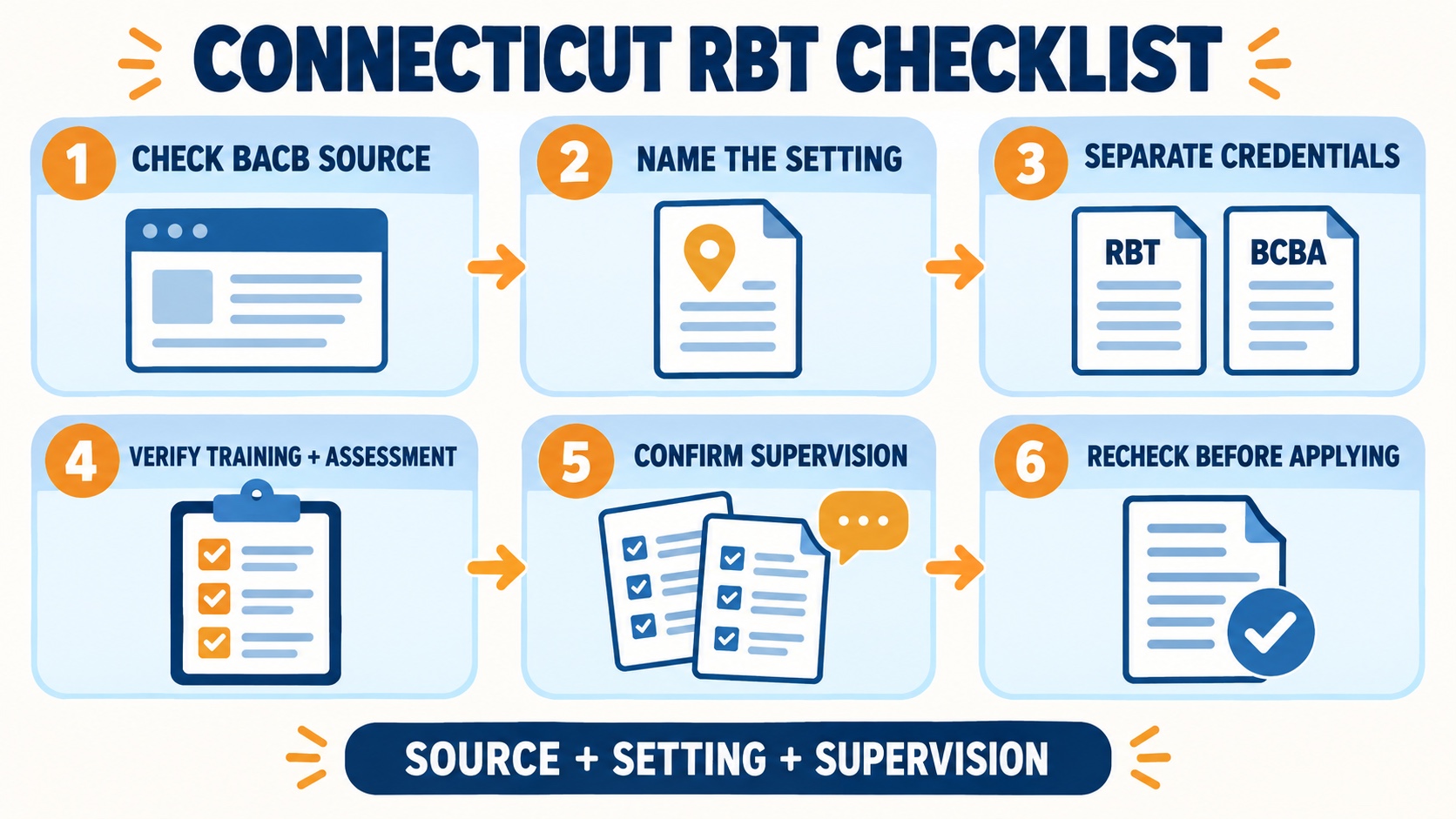
Use this sequence to organize your research:
- Open the current BACB RBT page and handbook. Record the version or date and identify the requirements that apply to your application timing.
- Map your exact setting. Write down whether you are applying to a clinic, home-based provider, school, early-intervention program, hospital-related service, or another arrangement.
- Separate the credentials. Mark each item as BACB RBT certification, Connecticut professional licensure, school/district approval, employer onboarding, or payer/provider documentation.
- Verify training and assessment. Ask the course provider and assessor which current BACB requirement each step satisfies.
- Confirm supervision. Identify the responsible supervisor or requirements coordinator and ask how supervision will be recorded once you work.
- Recheck before submission. Review the official pages again if your application is delayed or if a handbook, fee, form, or examination instruction has changed.
Common mistakes to avoid
- Calling a Connecticut professional license an RBT license: behavior-analyst licensure and RBT certification are different pathways.
- Treating training as certification: training, competency assessment, application, examination, and maintenance are separate checkpoints.
- Generalizing a school or payer rule: label a requirement by the program, contract, or setting that issued it.
- Using an old checklist: return to the current BACB handbook when your application timing changes.
- Assuming a job title answers the credential question: ask the employer to name the issuing body and the exact requirement.
- Expecting a course to guarantee a result: no course or practice bank can guarantee certification or examination performance.
RBT certification CT FAQ
Do I need a Connecticut license to become an RBT?
The Connecticut state sources reviewed for this guide focus on behavior-analyst licensure and related professional practice. They do not establish a universal separate Connecticut RBT license that replaces the BACB credential. A specific employer, school, provider, or payer may still require additional documentation, so verify the actual setting.
Is BACB RBT certification valid in Connecticut?
BACB certification is the national RBT credential route, and Connecticut employers or programs may recognize it as a qualification. Recognition of the credential does not answer every school, payer, supervision, or onboarding question. Confirm the role-specific requirements before you begin work.
Can I work as a behavior technician before I finish RBT certification?
That depends on the employer, setting, and job description. Some organizations may support a candidate while the person completes a pathway; others may require an active credential before the start date. Ask whether the role is conditional, supervised, or limited while the application is pending.
Does a Connecticut school require the same steps as a clinic?
Not necessarily. Both settings may use the BACB route, but a school district and a clinic can have different onboarding, student-safety, documentation, supervision, and employment rules. Treat each setting as a separate verification task.
Where should I check before paying for training?
Start with the current BACB RBT page and handbook. Then ask the Connecticut employer or program which additional requirements apply and review the relevant Connecticut DPH or school source. If the answers conflict, pause and request clarification from the issuing organization before paying or submitting documents.
Sources and verification notes
- BACB: RBT certification and application resources
- BACB: Registered Behavior Technician Handbook
- Connecticut Department of Public Health: Behavioral Analyst Licensing
- Connecticut Department of Public Health: Licensing Requirements
- Connecticut State Department of Education: BCBAs in Schools guidelines
- ABA Study Online RBT learning hub and RBT practice questions