RBT Certification Cost: 2026 Fees, Training, and Hidden Expenses
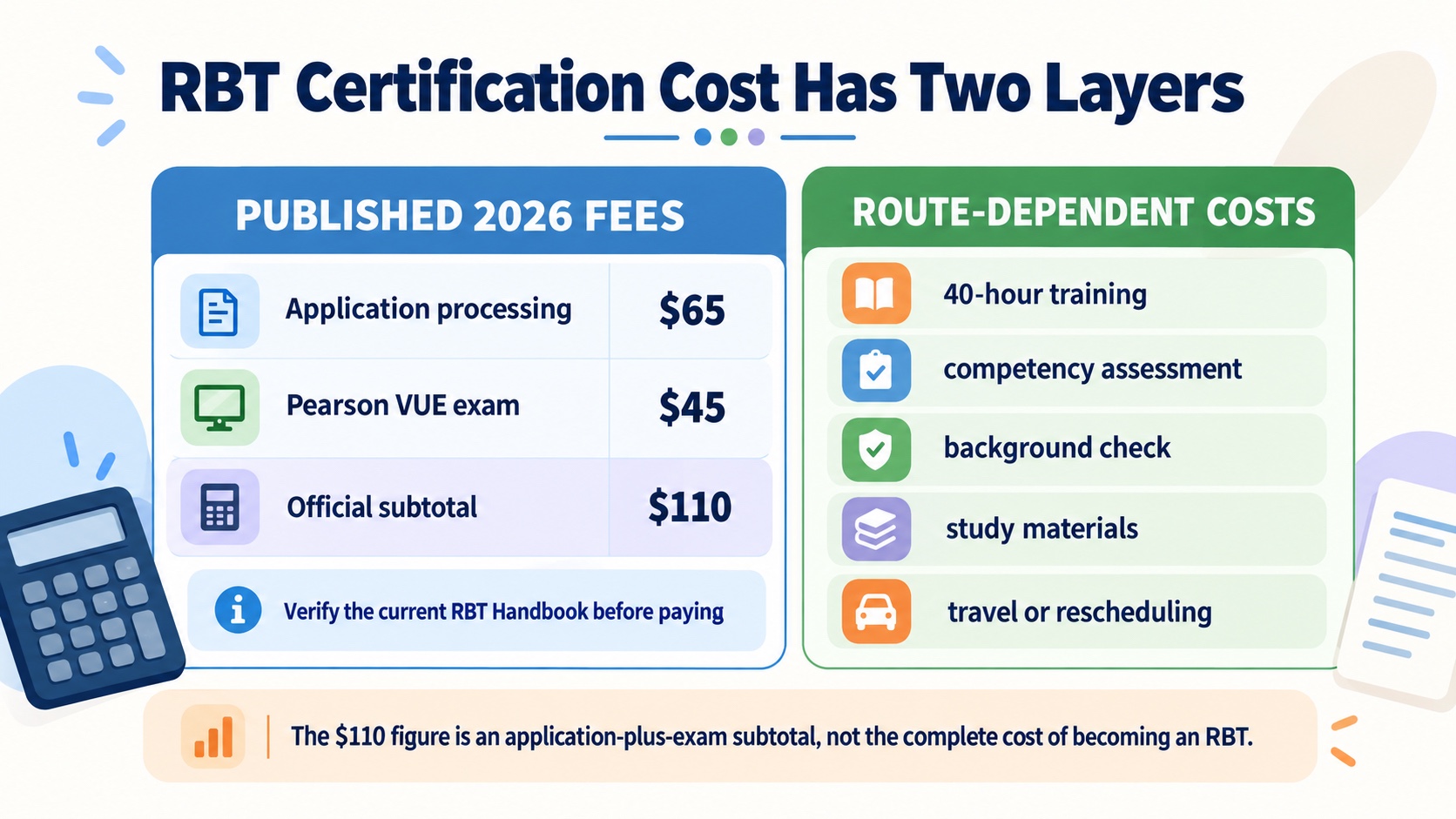
RBT certification cost is easier to understand when you separate the fees paid to the certification and testing organizations from the expenses created by your training route. In the current 2026 RBT Handbook, the certification application processing fee is listed as $65 for 2026 applications and the Pearson VUE examination appointment is listed as $45. That creates a $110 official application-and-exam subtotal before training, assessment, background checks, study materials, travel, or other expenses.
The $110 figure is not a universal total for becoming an RBT. Some employers pay for part of the pathway, some candidates use a free or employer-provided course, and others pay a provider for training or assessment. This guide shows what to put in your budget, what to ask a provider or employer, and why the current RBT Handbook should be checked before payment.
Table of Contents
Official RBT fees
The official fee table is the cleanest starting point because it identifies who receives each payment:
- Certification application processing fee: the 2026 line in the RBT Handbook is $65, paid to the BACB.
- Exam appointment: $45, paid to Pearson VUE after the application is approved and you receive scheduling instructions.
- Official subtotal: $110 for those two listed 2026 charges, before route-dependent costs.
The handbook may also display a non-2026 application-fee line, which is why an older article can show $50 instead of $65. Do not choose a fee from a search snippet. Use the current handbook, your BACB account, and the application period that applies to you. BACB fees are nonrefundable and nontransferable, so confirm the amount and the payee before submitting.
The Pearson VUE charge is an examination appointment, not a payment for the 40-hour training course or competency assessment. Keeping those transactions separate helps you compare providers honestly. A course provider who quotes a “complete package” should identify whether the package includes the official application and exam charges or only the provider’s own services.
Training and competency assessment
The official fees are only one layer because an RBT applicant also has to meet training and competency requirements. The cost of those steps depends on who provides them and what the package includes.
40-hour training
Ask whether the 40-hour training is free, employer-funded, included in a paid course, or purchased separately. A “free RBT course” can mean that the lessons have no tuition charge, but you still need to check the curriculum, completion evidence, provider terms, and whether another organization charges for the competency assessment or application support.
Before enrolling, request the course outline and a written list of what you receive. Ask whether access expires, whether the course includes completion documentation, whether a retake or extension costs extra, and whether the training matches the current RBT requirements and examination version. A lower price is not useful if you later have to repeat training because the record is incomplete.
Initial competency assessment
The competency assessment is a separate step from the 40-hour course and the examination. Some employers or supervisors provide it as part of onboarding; some candidates arrange it with an independent assessor. Ask who performs the assessment, what the fee includes, how scheduling works, and what happens if a skill needs to be demonstrated again.
Do not treat a course completion certificate as proof that the competency assessment is complete. They are different records. Put the course, assessment, application, and exam into separate rows in your budget and document folder.
Other costs people forget
Several expenses may be small individually but meaningful when combined:
- Background or registry checks: the employer, agency, or local process may require a paid check or related documentation.
- Study tools: practice questions, flashcards, printed materials, or tutoring are optional preparation expenses, not automatically BACB fees.
- Transportation: travel to an assessment, testing center, fingerprint appointment, or training location can add up.
- Technology: some online courses require a reliable device, camera, internet access, or printing.
- Rescheduling: changing an appointment close to the exam date may create a fee or a lost appointment, depending on the current rule.
- Reapplication: if the authorization period expires or the application must be submitted again, check the current handbook for the fee and eligibility steps that apply.
These costs are not automatically required for every candidate. Label each one as “required for my route,” “employer-covered,” “optional,” or “only if needed.” This prevents a provider’s optional study bundle from being mistaken for a BACB requirement.
Build an RBT cost plan
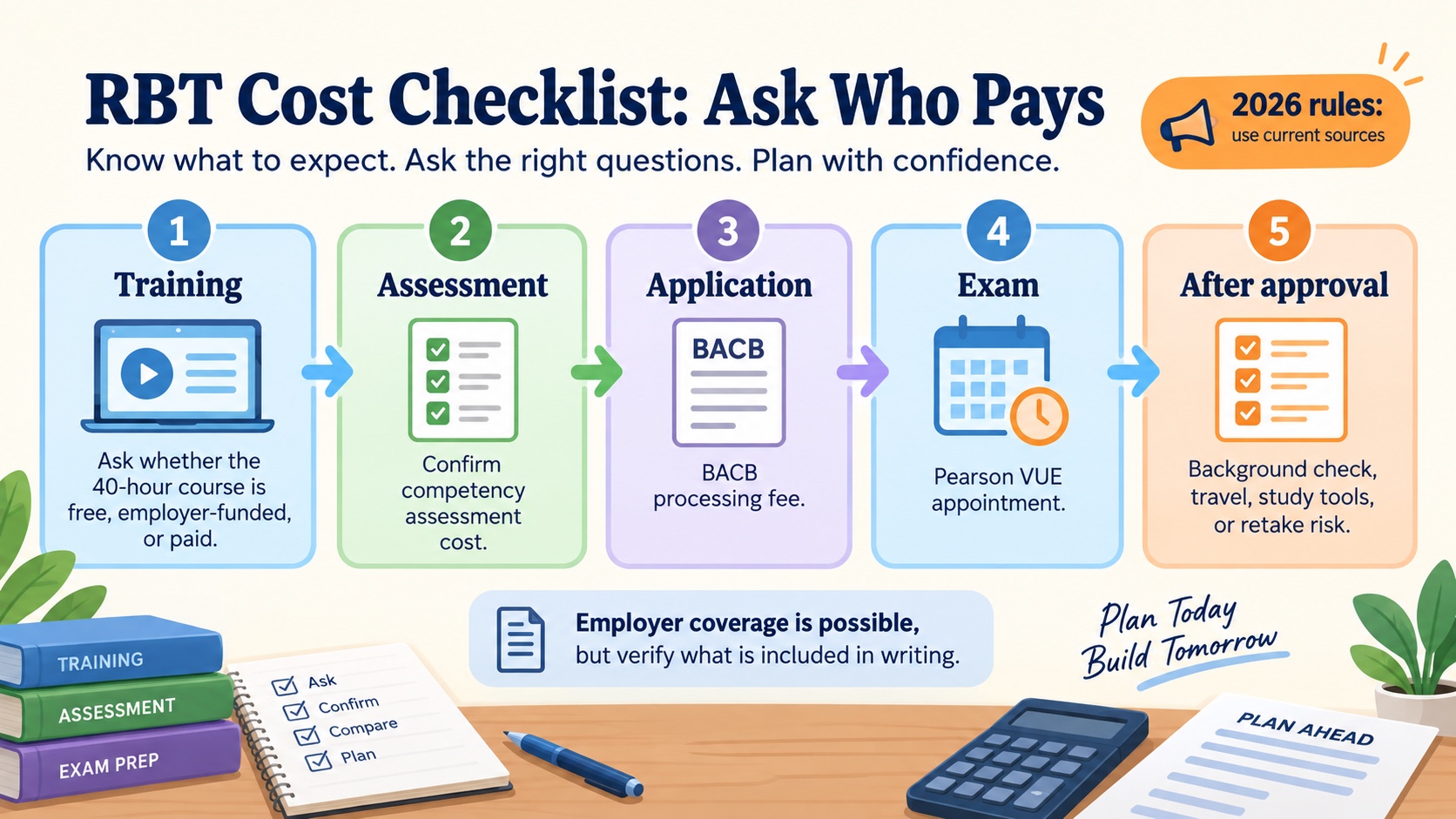
Use a five-row worksheet:
- Training: course price, access period, documentation, and any extension or retake terms.
- Assessment: competency assessment fee, assessor, location, and rescheduling policy.
- Application: current BACB processing fee and payment timing.
- Exam: Pearson VUE appointment, travel, and appointment-change rules.
- After approval: background check, onboarding, study tools, transportation, and possible retake or reapplication contingency.
Place a source beside every amount. Use the current RBT Handbook for official fees, the provider’s written terms for course and assessment charges, and the employer’s written offer for covered expenses. If a recruiter says “everything is free,” ask whether that means the training, assessment, application, exam, background check, or only the lessons.
For independent study, the RBT learning hub can help organize concepts and RBT practice questions can support retrieval. These are learning resources, not BACB-issued training certificates, competency assessments, or exam guarantees.
Free, employer-funded, and paid routes
Free or employer-funded route
A free course may lower the provider portion of your budget, but ask what remains. You may still be responsible for official application and examination fees, assessment scheduling, background documentation, transportation, or study time. Employer funding can also have conditions, such as a required employment period or repayment agreement if you leave early. Read the terms before treating the offer as a zero-cost certification.
Paid course route
A paid route can be reasonable when the curriculum, support, assessment coordination, and documentation are clear. Compare the complete package rather than the headline price. One provider may charge for training only; another may include an assessment but not the BACB application or Pearson VUE appointment. Ask for the price of each layer in writing.
Low-cost does not mean current
RBT requirements and the examination changed in 2026. An inexpensive course built around an older handbook may create a higher cost later if you need to repair documentation or relearn the current exam scope. Check the date, version, and source coverage before buying.
Check the 2026 requirements
The BACB’s current RBT resources direct applicants to the updated RBT Handbook, 2026 transition guidance, the current Initial Competency Assessment Packet, and current training requirements. That matters for cost planning because an older course or assessment packet may not give you the record you need.
Use the official RBT application page and handbook to confirm the current version before paying. If your employer or provider tells you that an old packet is acceptable, ask for the source and compare it with the live BACB resource. A careful check at the beginning is less expensive than rebuilding an application later.
Cost mistakes to avoid
- Calling $110 the complete RBT cost: it is only the 2026 application-plus-exam subtotal.
- Mixing old and current fees: confirm whether the $50 or $65 application line applies to your application period.
- Counting training as assessment: a course certificate and a competency assessment are separate records.
- Trusting “free” without terms: employer funding may cover only selected stages or include a repayment condition.
- Buying an outdated course: check the 2026 requirements and exam transition before paying.
- Assuming a study tool is official: independent articles, apps, and practice questions do not automatically issue BACB credentials.
RBT certification cost FAQ
How much does RBT certification cost in 2026?
The current RBT Handbook lists a $65 2026 certification application processing fee and a $45 Pearson VUE exam appointment, or a $110 official subtotal. Training, competency assessment, background checks, study tools, and travel can change the complete cost.
Is the RBT exam included in the application fee?
No. The application processing fee is paid to the BACB, while the examination appointment is paid to Pearson VUE. Treat them as separate rows in your budget.
Can I become an RBT for free?
You may find employer-funded or no-tuition training, but “free” does not automatically cover the application, exam, assessment, background check, or transportation. Ask exactly which stages are covered.
Do I have to pay for the 40-hour training?
Not necessarily. The course may be employer-funded, included in a program, or paid separately. Verify that the training record and current requirements match your application route.
Can the RBT cost change after 2026?
Yes. Fees, documents, training requirements, and examination rules can change. Use the live RBT Handbook and BACB application resources before paying.