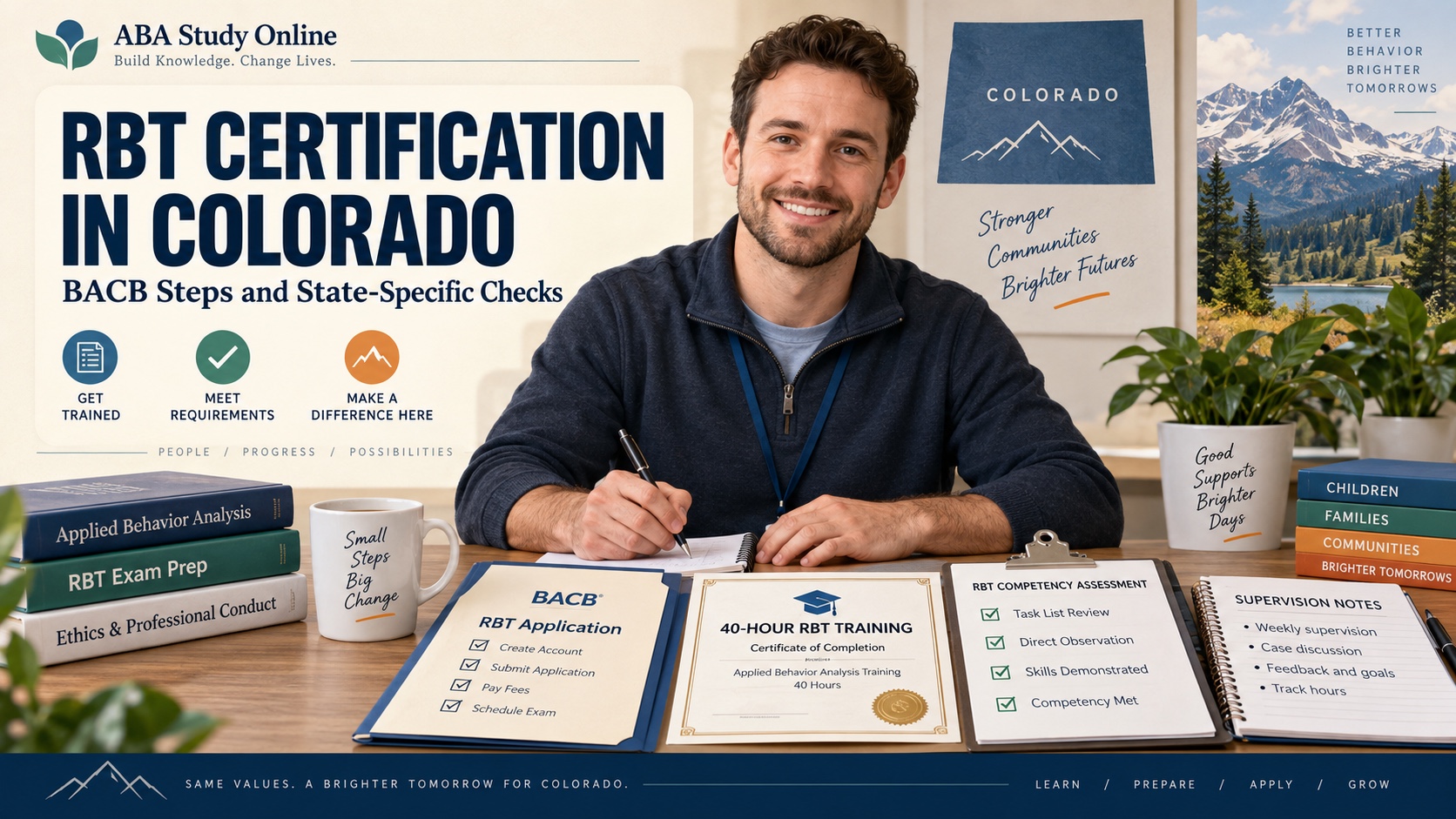
RBT Certification in Colorado: BACB Steps and State-Specific Checks
If you are searching for RBT certification in Colorado, the first distinction is simple: the Registered Behavior Technician credential is obtained through the national BACB certification process. Colorado does not turn the RBT pathway into a separate state exam. However, a Colorado employer, Medicaid payer, or service setting may require additional documentation, supervision, background checks, or active-certification verification.
This guide separates those layers. It explains the BACB route for a Colorado applicant, then shows where Colorado-specific rules enter the picture. Because payer bulletins, employer policies, and state implementation rules can change, use the current BACB Handbook and Colorado source documents before applying, accepting a job, or billing services.
Table of Contents
Short answer: how do you become an RBT in Colorado?
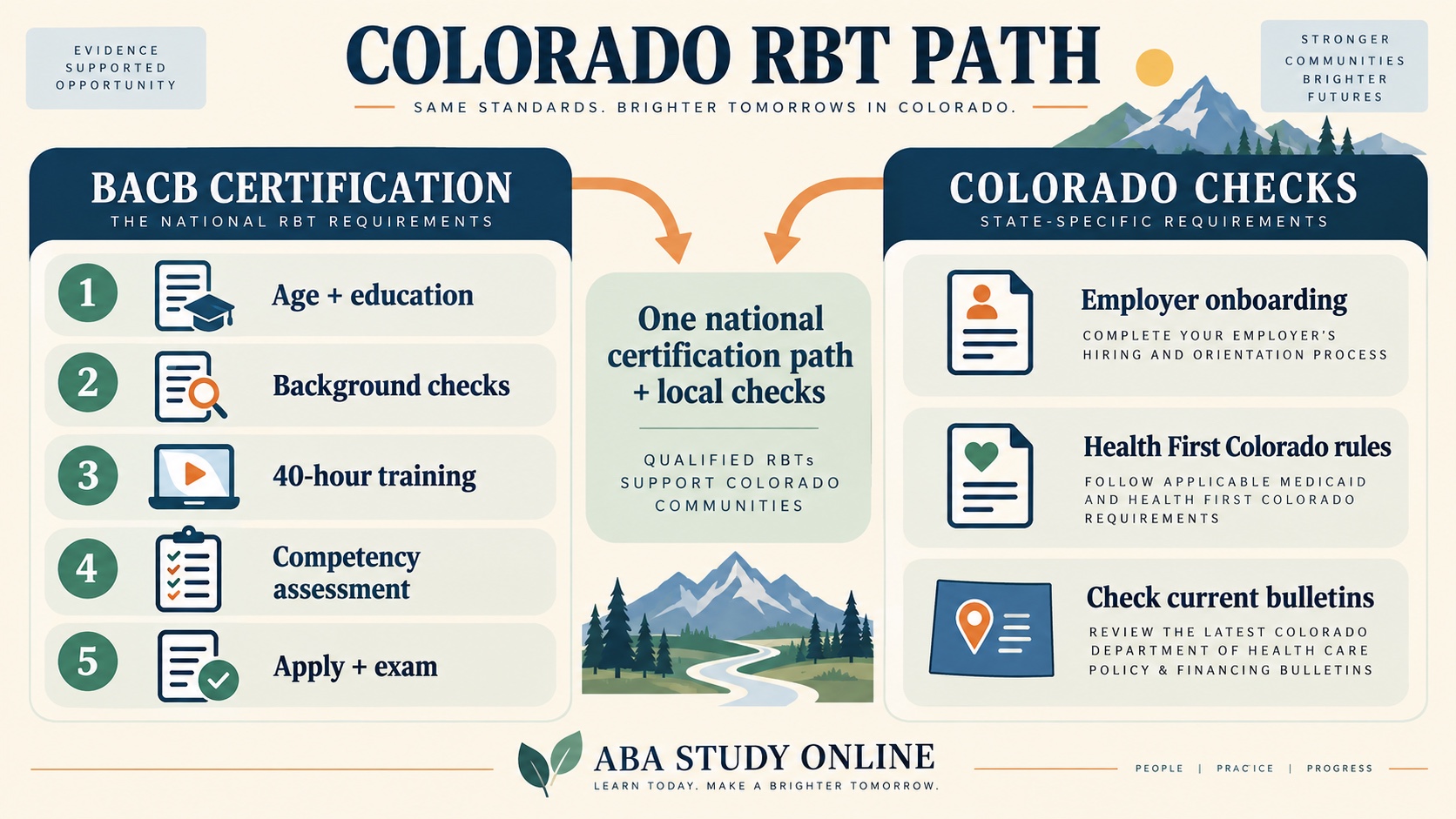
You generally complete the BACB RBT eligibility and application steps, pass the required examination, and then work under the close supervision required for RBT practice. For a current Colorado applicant, the planning sequence is:
- Review the current BACB RBT Handbook and 2026 transition resources.
- Meet the age and education requirements.
- Complete qualifying background and abuse-registry checks.
- Complete the current 40-hour RBT training within the permitted time window.
- Complete the Initial Competency Assessment within the application timing window.
- Submit the BACB application and required evidence.
- Schedule and pass the RBT examination.
- Confirm the Colorado employer, payer, and supervision requirements for the job you will perform.
The credential is not a Colorado professional license by itself. The BACB grants the national RBT certification; Colorado rules and payer policies determine what may be required in a particular practice, employment, or billing context.
The national BACB pathway
Age and education
The BACB RBT Handbook sets the eligibility requirements, including the minimum age and education evidence. A Colorado employer may ask for additional hiring documents, but those requests should not be confused with the BACB’s national eligibility rules. Keep the diploma, transcript, or other accepted education evidence in the format the current handbook describes.
Background and abuse-registry checks
The RBT application includes background and abuse-registry requirements. The BACB handbook explains how the supervisor or RBT Requirements Coordinator confirms the checks and how the application timing works. Fingerprinting is not automatically the same as a BACB requirement: the handbook notes that fingerprinting may vary by state or organization. In Colorado, ask the employer or payer which check is required for the actual setting and keep the date of each check visible.
40-hour training
The training must meet the current RBT training requirements. Do not select a course only because its sales page says “Colorado RBT.” Check the curriculum version, the trainer or provider documentation, the permitted completion window, and the certificate wording. A general ABA course, an employer orientation, or an online study guide is not automatically the BACB 40-hour training.
Initial Competency Assessment
After the qualifying training, the applicant completes the Initial Competency Assessment with an appropriate assessor and within the timing window specified by the current application rules. This is separate from a practice quiz and separate from the RBT examination. Keep the completed assessment and any required attestation with the application materials.
Application, examination, and supervision
The BACB application requires the evidence described in the current handbook. After approval, the candidate follows the examination instructions. Passing the exam is not permission to practice independently: BACB describes RBTs as working under the direction and close supervision of an RBT Supervisor and/or RBT Requirements Coordinator. Colorado job postings may use different titles, but the underlying supervision boundary still matters.
Colorado checks after certification planning
Employer requirements
A Colorado clinic may require an active BACB certification, a background check beyond the minimum application evidence, CPR or safety training, health records, liability coverage, or a particular supervisor arrangement. Those are employment or setting requirements, not automatically new BACB exam requirements. Ask the employer for a written onboarding checklist and label each item as BACB, Colorado law, payer, or company policy.
Health First Colorado and billing
Colorado’s Department of Health Care Policy & Financing has issued provider communications about RBT or technician certification for applicable pediatric behavioral-therapy services under Health First Colorado. One bulletin stated that providers must ensure applicable technicians hold active certification; a later December 2025 update said a previously communicated compliance deadline was no longer in effect and that a new date would be announced. The practical lesson is not to copy an old deadline into a current application plan.
If your goal is to work on a Medicaid-billed case, ask the enrolled provider which credential, supervisor, attestation, and documentation rules apply to that service. The payer’s billing requirement can be stricter or differently timed than the minimum BACB application rule. A candidate who has passed the BACB exam still needs the employer and provider to confirm that the person is eligible to be scheduled and billed in that setting.
Colorado law and the RBT boundary
Colorado HB26-1425 became law in 2026 and creates a state behavior-analyst licensing board. The legislative summary describes licensing provisions for behavior analysts and assistant behavior analysts beginning July 1, 2028, along with rules for ABA services and reimbursement. It does not mean that an RBT applicant should apply for a BCBA or BCaBA license, and it does not create a separate Colorado RBT examination in the BACB pathway.
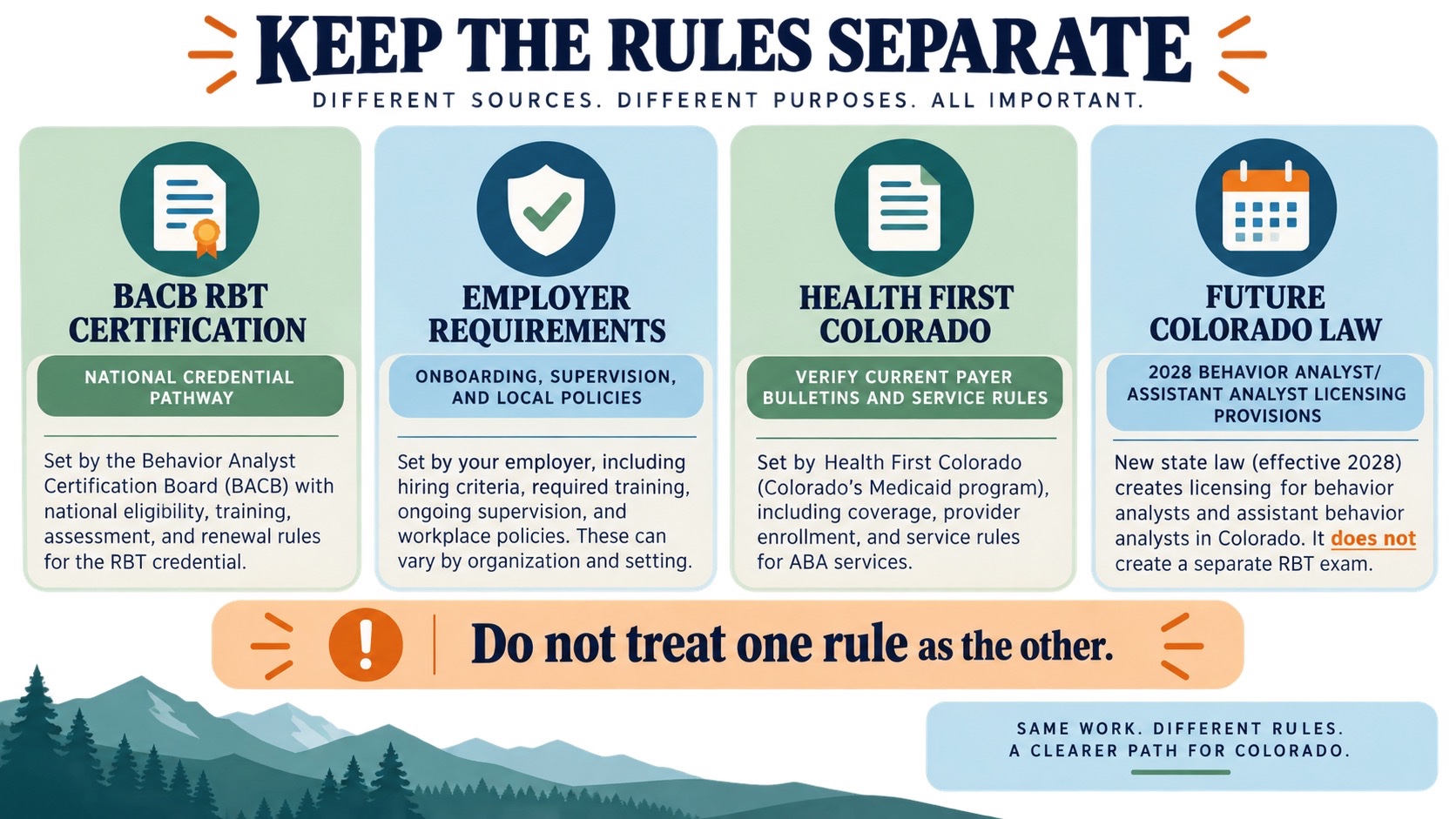
Future state implementation can still affect the workplace. If Colorado publishes rules for technicians, clinics, supervision, or payer enrollment, use those rules for the date and role they cover. Keep three labels separate: BACB certification, Colorado professional licensure for the roles covered by the law, and employer or Medicaid requirements for technician services.
Important 2026 and 2028 boundaries
The BACB RBT page currently highlights 2026 requirement changes and points candidates to an updated handbook, transition guidance, and a current exam. That is a national credential update. The Colorado law timeline is a separate state implementation lane, with the legislative summary identifying July 1, 2028 for the future behavior-analyst licensing provisions. Do not merge the two dates into a claim that the RBT exam changes in Colorado in 2028.
Before using an old blog post or job description, ask:
- Is the rule from the BACB, Colorado, Health First Colorado, or the employer?
- Does it apply to an RBT, a BCaBA, a BCBA, a clinic, or a billing provider?
- Is the date an application deadline, a billing-compliance deadline, or a future law effective date?
- Has the issuing agency published an update that replaces the earlier date?
Common mistakes to avoid
- Searching for a Colorado RBT exam: start with the national BACB RBT pathway.
- Calling a study course certification: training, competency assessment, application, and examination remain separate steps.
- Assuming BACB certification guarantees Medicaid billing: the enrolled provider must verify current payer requirements.
- Using an old HCPF deadline: check the newest provider bulletin and implementation notice.
- Confusing RBT work with BCaBA or BCBA practice: RBT practice remains within its certification and supervision boundary.
- Treating future Colorado licensure as an RBT license: read the role and effective date in the actual law or rule.
Colorado RBT checklist
- Save the current BACB RBT Handbook and 2026 transition page.
- Confirm your education and age evidence.
- Ask the employer which background and abuse-registry checks are required.
- Choose a current qualifying 40-hour training and preserve the certificate.
- Schedule the Initial Competency Assessment in the permitted window.
- Submit the BACB application with the evidence the handbook requires.
- After approval, schedule and prepare for the current RBT examination.
- Before accepting a Colorado caseload, confirm supervisor, employer, payer, and billing requirements in writing.
- Re-check Colorado HCPF and state sources when a policy or effective date affects your work.
RBT certification Colorado FAQ
Is there a separate Colorado RBT certification exam?
The BACB pathway is the national RBT certification route. Colorado-specific employer or payer requirements may still apply, but do not assume they create a separate state RBT exam.
Do I need a Colorado license to become an RBT?
Do not use the BCBA/BCaBA licensure language to answer an RBT question. Check the current BACB handbook, Colorado rules, employer policy, and payer requirements for the technician role and service setting.
Can I work for a Colorado Medicaid provider after passing the exam?
Passing the exam is one part of the credential path. The enrolled provider must confirm current Health First Colorado, supervision, documentation, and active-certification requirements before scheduling or billing services.
Will the 2028 Colorado law change the RBT exam?
The published Colorado law summary describes future licensing provisions for behavior analysts and assistant behavior analysts. It does not by itself announce a new RBT exam. Check future rules from Colorado and current BACB updates separately.