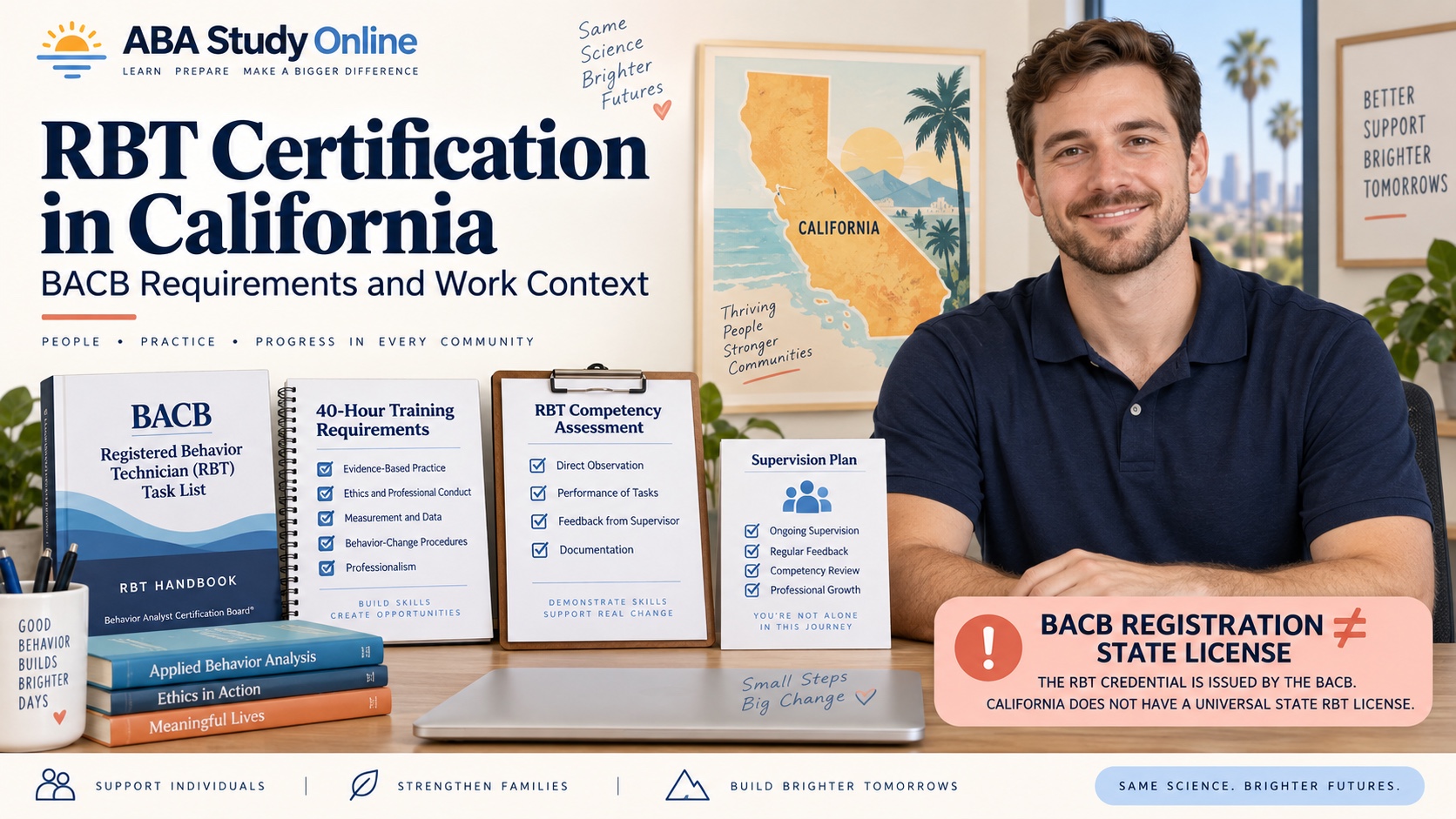
RBT Certification in California: BACB Requirements and Work Context
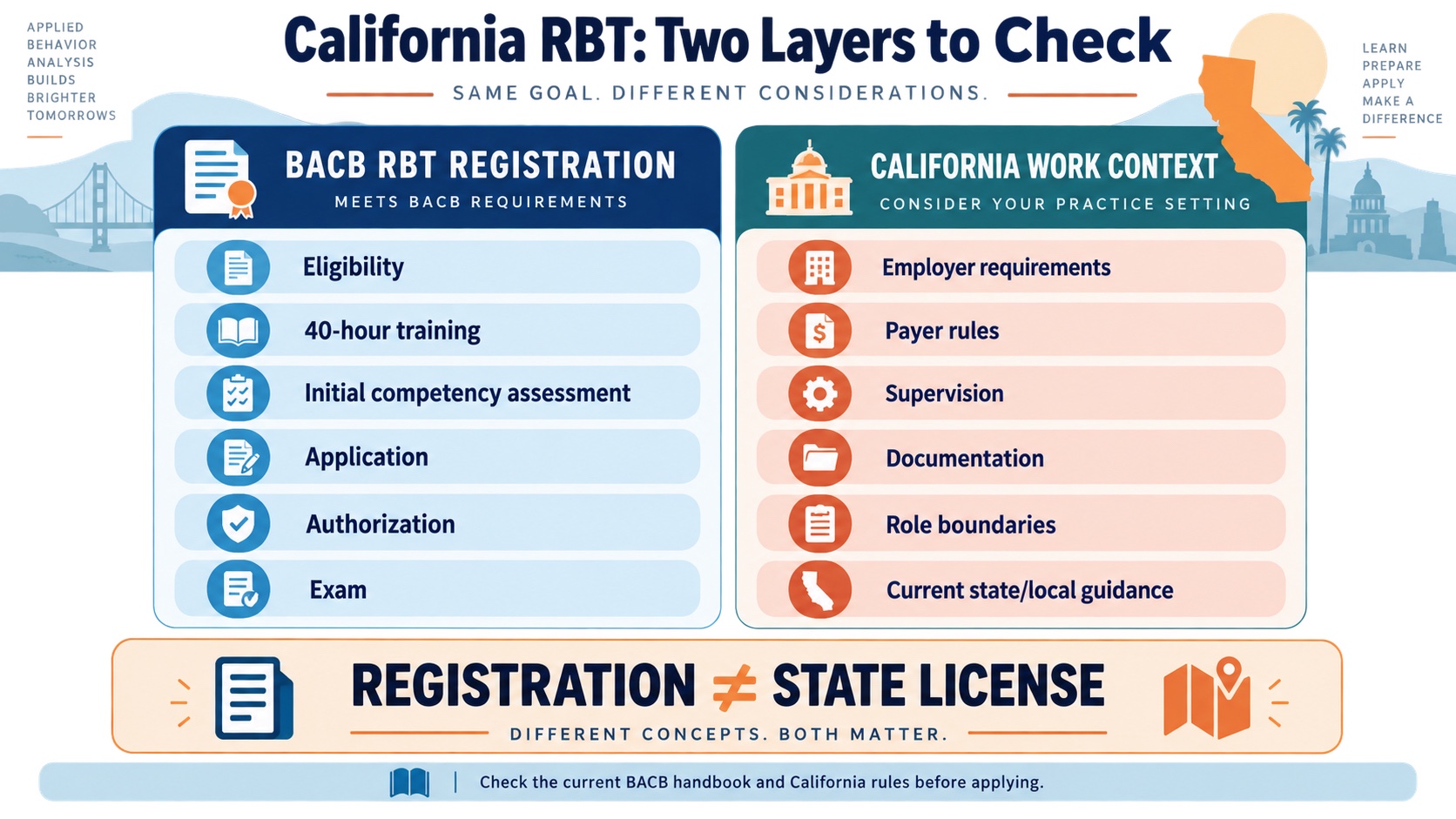
The RBT credential is administered by the Behavior Analyst Certification Board, not created by a California RBT exam. A person seeking RBT certification in California follows the current BACB application, training, competency-assessment, examination, and maintenance requirements. After certification, California program, payer, employer, and supervision rules may affect how the person can work in a particular setting.
That is why the phrase “RBT certification California” can lead to two different questions. One is, “How do I become BACB-registered?” The other is, “What does this California employer or service program require before I can provide direct support?” The first question belongs primarily to the BACB. The second may require California Department of Developmental Services, Department of Health Care Services, program, contract, or employer documents.
This guide maps both layers without making a personal licensure or hiring decision. California rules can differ by service and funding context, so check the current source that governs the role you are actually accepting.
Table of Contents
What RBT certification means in California
The BACB describes the Registered Behavior Technician credential as a paraprofessional certification in behavior analysis. RBTs assist in delivering behavior-analytic services and practice under the direction and close supervision of an RBT Supervisor and/or RBT Requirements Coordinator who is responsible for their work.
California sources may use RBT in different ways. A state regulation can define an RBT for a specific licensed or residential service. A Department of Developmental Services resource can describe a behavior technician paraprofessional position. A Medi-Cal program can describe the qualified providers or supervision structure for a covered behavioral-health service. None of those documents should automatically be treated as a replacement for the BACB RBT Handbook.
California’s official DDS page explains that ABA services are overseen by a qualified and trained behavior analyst, typically a BCBA, who designs and directs the service. A California Title 22 definition for a Registered Behavior Technician describes direct implementation of skill-acquisition and behavior-reduction plans under close, ongoing supervision and says that the RBT may not design intervention or assessment plans. That is a useful example of role boundaries in a particular regulatory context, not a reason to skip the BACB source.
The BACB RBT pathway
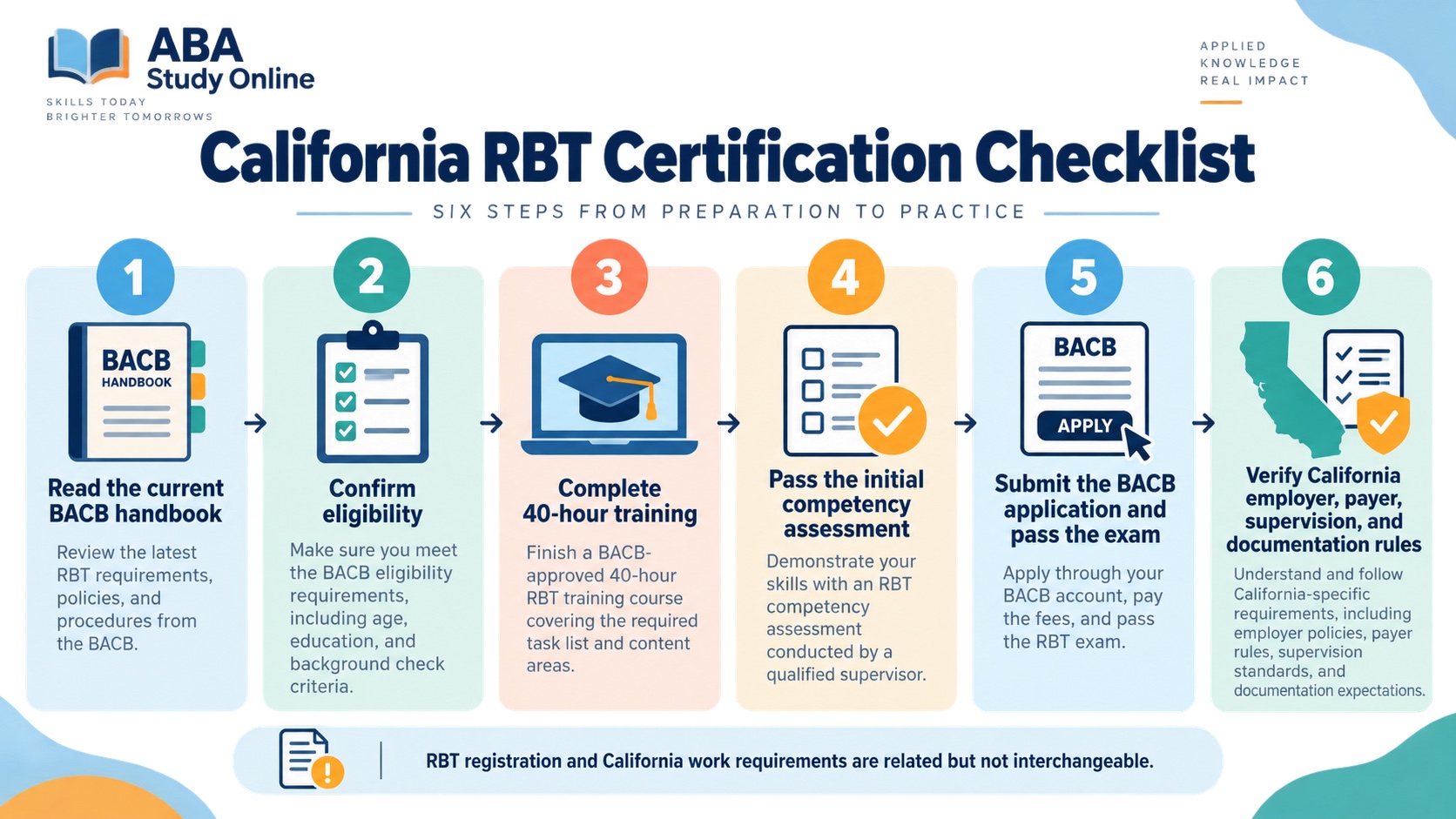
Use the current BACB RBT Handbook for the actual certification process. The broad sequence is:
- Review the current handbook and RBT resources. Confirm the version, application date, transition notes, and current forms.
- Check eligibility. Review the current age, education, background-check, training, and other requirements before paying for a course.
- Complete qualifying training. Use the BACB’s current RBT 40-hour training requirements and curriculum outline. A California employer’s orientation is not automatically the BACB’s required training.
- Complete the Initial Competency Assessment. The assessment is a separate performance step using the current packet and a qualified assessor.
- Submit the BACB application. Use the BACB account and upload the documents or attestations required for the current application.
- Wait for examination authorization. Do not assume that completing the course makes you eligible to schedule the RBT examination.
- Take the examination and maintain certification. After certification, follow current supervision, professional-development, renewal, and ethics requirements.
The current BACB application-processing guidance is the right place to check document versions and processing information. It also warns that BACB cannot decide whether a person’s specific education, coursework, or training experience meets the requirements outside the formal review process. Keep your application evidence and source dates organized.
What California sources add
California’s role is not one single “RBT license page.” Instead, different agencies and programs may define how behavioral services are delivered, who may provide them, and what supervision or training a provider must document.
Department of Developmental Services context
The California Department of Developmental Services describes ABA as a support service for people with intellectual and developmental disabilities and notes that it is overseen by a qualified and trained behavior analyst, typically a BCBA, who designs and directs the service. That helps explain the RBT boundary: an RBT can implement assigned procedures under supervision but is not the person who independently designs the overall service plan.
Program and payer context
California’s behavioral-health and developmental-services systems may use different staff categories, service codes, contracts, and documentation rules. The California Department of Health Care Services describes Behavioral Health Treatment as including ABA and other evidence-based approaches, but the service description does not replace the BACB’s role-specific certification requirements. Ask the provider which program is paying for the service and which document defines the staff qualification.
Behavior technician versus RBT
A California service resource may describe a behavior technician paraprofessional who works under a behavior analyst or behavior management consultant. That job category is not automatically identical to an active BACB RBT. Some organizations use “BT” as an entry-level title while a person is completing the RBT process; others require current RBT registration. Ask which definition the employer uses and when the status must change.
Supervision and role boundaries
RBT certification does not authorize independent practice. The RBT works under close supervision, and the supervisor or requirements coordinator is responsible for the supervision relationship under the applicable BACB rules. California regulations or program documents may also identify a behavior analyst, licensed professional, or other qualified person who directs the service. The exact combination depends on the program.
Before beginning work, ask:
- Who is the BACB RBT Supervisor or RBT Requirements Coordinator?
- Who is responsible for the California service or program, if a separate state or payer rule applies?
- What will direct observation, feedback, supervision contacts, and documentation look like?
- Which activities are implementation, and which decisions must be made by the supervising behavior analyst?
- What should you do if a plan is unclear, a client’s needs change, or you are asked to design a new intervention?
- Which current program or contract document controls the title, training, and status requirements?
A supervisor’s title is not enough evidence. Verify the current credential, the service relationship, the written plan, and the program’s requirements. If an employer says that a short orientation replaces the BACB training or assessment, pause and compare that claim with the current BACB Handbook.
What to verify before accepting work
Keep BACB evidence and California work-context evidence in separate sections of one source folder:
- BACB Handbook and training outline: save the current version used for your application.
- Training certificate: record the provider, dates, hours, and curriculum reference.
- Competency assessment: verify the current packet, assessor, signatures, and date.
- BACB application and status: keep application confirmation and verify active status through the official registry when appropriate.
- Supervision plan: identify the RBT Supervisor, Requirements Coordinator, observation process, and escalation path.
- California program document: identify the DDS, DHCS, residential, school, employer, payer, or contract rule that applies.
- Maintenance records: retain current supervision and professional-development evidence after certification.
A practical California timeline
Imagine that a California provider offers a BT position and says the worker can become an RBT. Before enrolling in a course, ask whether the employer needs an active BACB RBT, a person in the process of certification, or a staff member who meets a separate program definition. Then identify who will provide the required training and competency assessment and who will supervise the work after hire.
Complete the BACB process using the current official documents. Keep the application confirmation and wait for examination authorization before scheduling. Once active, ask the provider how the California program records RBT status, supervision, direct implementation, and any renewal or training evidence. If the role changes from a general BT position to a covered service, re-check the governing document.
This timeline protects against a common confusion: a course certificate, an employer title, a California program enrollment, and an active BACB certification are four different pieces of evidence. They may connect, but one does not automatically replace the others.
Common mistakes
- Searching for a California RBT exam. The RBT certification examination is part of the BACB process and is delivered through its designated testing system.
- Calling a 40-hour course certification. Training is one requirement; competency assessment, application, authorization, examination, and maintenance remain separate.
- Assuming every California program uses the same title. BT, RBT, direct-service staff, and program-specific paraprofessional categories may not be interchangeable.
- Assuming a California program rule changes BACB requirements. State or payer documents can add work conditions, but they do not automatically replace the current RBT Handbook.
- Overstating what an RBT may do. RBTs implement assigned services under supervision; they should not independently design assessment or intervention plans.
- Using an old regulation or job post. Verify the current agency, program, contract, handbook, and supervision documents that govern the position.
FAQ and official sources
Is RBT certification a California state license?
The RBT credential is administered by the BACB. California programs and regulations may recognize or require BACB registration in particular contexts, but a program-specific requirement is not automatically a universal state license rule.
How do I become an RBT in California?
Follow the current BACB path: review the handbook, meet eligibility requirements, complete qualifying training, complete the Initial Competency Assessment, apply, receive authorization, pass the RBT examination, and maintain certification. Then verify the California employer, payer, program, and supervision requirements for the job.
Can an RBT work independently in California?
An RBT is a paraprofessional who works under close supervision. California program documents may identify additional direction or oversight requirements. An RBT should not independently design assessment or intervention plans.
Is a BT the same as an RBT?
Not always. Some employers use BT as a general or pre-certification title, while RBT is a BACB credential. Ask the employer which status the position requires and when active BACB registration must be verified.
Where can I verify the requirements?
Use the BACB RBT page and RBT Handbook for certification. Use the relevant California DDS, DHCS, residential, school, payer, or employer document for the work context. The California DDS ABA page is a useful starting point for the state service context.
ABA Study Online’s RBT study guide and RBT practice questions can organize learning, but they do not decide BACB eligibility, California program enrollment, employer qualifications, or the legality of a specific service arrangement.