RBT Certification Brain Dump: Why to Avoid It
If you searched for an RBT certification brain dump, you may be looking for a fast way to see real or “recalled” examination questions. A brain dump is usually marketed as a collection of questions that someone claims to have remembered, copied, or obtained from a live exam. That is not the same as a legitimate RBT practice exam, study guide, or set of original questions.
The short answer is simple: do not buy, download, share, or study from a brain dump. BACB examination content is confidential, and the current RBT Handbook prohibits unauthorized possession, reproduction, publication, and disclosure of examination materials. Even apart from the integrity problem, dumps are unreliable study tools: they can be outdated, inaccurate, missing explanations, and disconnected from the reasoning the current exam is designed to assess.
Table of Contents
What is an RBT certification brain dump?
In the context of certification testing, “brain dump” usually means an unauthorized collection of supposed live-test questions, answer keys, screenshots, or memorized items. Sellers may use phrases such as “real questions,” “updated dump,” “actual exam,” or “pass guarantee.” Those labels are marketing claims, not evidence that the material is authentic, current, complete, or permitted.
A brain dump is different from an original practice resource. An original question writer creates a new scenario, answer choices, and explanation based on public content boundaries such as the current RBT Test Content Outline. The resource should say that it is unofficial and should not imply access to BACB item banks or secure forms. A brain dump instead relies on the claim that it reproduces protected examination material or someone’s memory of it.
It is also different from retired sample questions made available by the testing organization. When an official organization intentionally publishes a sample or retired item, use it only under the terms and context provided by that organization. Do not assume that a file copied onto a third-party website remains authorized simply because it uses official-looking wording or a familiar title.
Why brain dumps create an exam-security problem
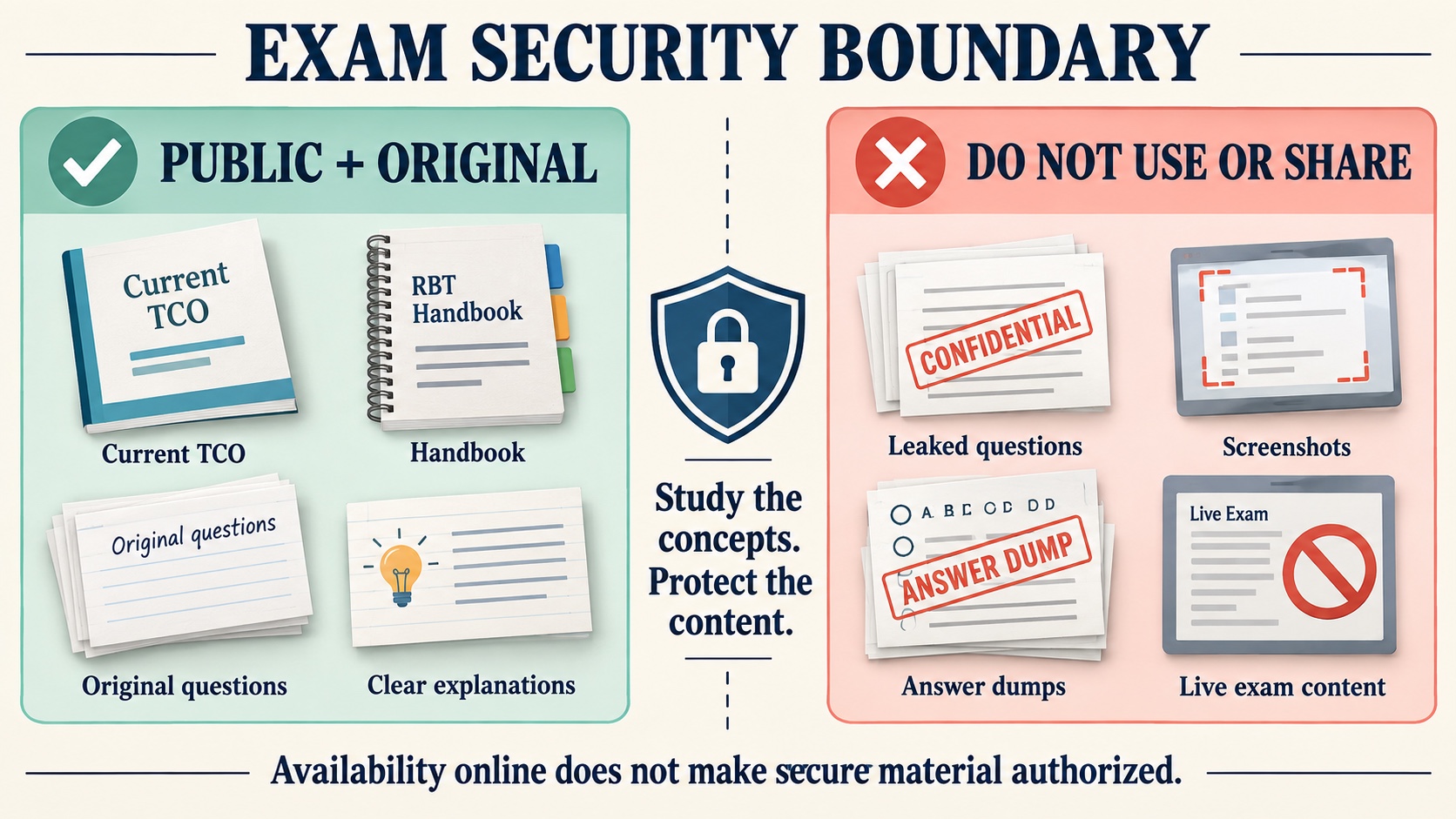
The BACB and Pearson VUE treat examination security as part of the certification system. The current RBT Handbook explains that examination content is confidential and identifies conduct such as cheating, recording or photographing questions, and providing examination content to others as prohibited. Consequences can include termination of an examination, invalidation of results, restrictions on future testing, or other action under the applicable rules.
You do not need to decide whether a seller’s file is “probably real” before avoiding it. The claim itself is the warning sign. If a resource says it contains live, leaked, recalled, or guaranteed-to-appear questions, it is asking you to cross a boundary that a legitimate study product should respect. Do not upload the file to a study group, repost screenshots, or send it to a friend who is testing later.
If you encounter suspected examination misconduct, use the current BACB reporting or contact route rather than investigating or circulating the material yourself. Keep your own preparation focused on public sources and original learning activities.
Why a dump is weak preparation even if it looks accurate
Suppose a dump contains a few questions that resemble topics you expect to see. That still does not make it a good way to learn. The file may omit the conditions that make an answer correct, compress a scenario until an important detail disappears, or attach an answer key that no qualified reviewer has checked. You may memorize a letter without learning the behavior-analytic distinction behind it.
Dumps also age badly. The current RBT examination content moved to the RBT Test Content Outline 3rd edition beginning January 1, 2026. A file copied from an earlier testing period may use retired terminology, incomplete coverage, or a different emphasis. A seller can change the filename without proving that the content follows the current outline.
Another problem is false confidence. A learner can recognize a familiar stem from a dump and mistake recognition for understanding. On a new scenario, the same concept may appear with a different behavior, setting, measurement dimension, or ethical boundary. Good preparation helps you explain why an answer fits and why the alternatives do not.
Finally, a dump does not teach the full study process. You still need to check definitions, practice application, review mistakes, space your retrieval, and identify weak areas across the outline. A shortcut that removes explanations may save reading time while wasting the time you need to build flexible knowledge.
What to use instead
A legitimate RBT preparation stack can be simple:
- Current official boundaries: begin with the RBT Test Content Outline and the current RBT Handbook. These establish what the examination is and what it is not.
- Clear explanations: use a study guide or lesson that explains terms, controlling features, role boundaries, and common distractors in original language.
- Original practice questions: choose questions that disclose they are unofficial, use new scenarios, and provide rationales instead of only an answer letter.
- Targeted retrieval: use flashcards or short quizzes for definitions and discriminations, then apply the concept to a new example.
- Timed rehearsal: use an 85-question practice format when you need to rehearse the current delivered length and 90-minute pacing. Treat the result as study evidence, not an official score.
- Error review: record whether each miss came from knowledge, reading, application, ethics, or pacing, then revisit the underlying concept.
The strongest replacement is not one magical resource. It is a transparent set of resources that works together and keeps the public-source boundary visible.
A legitimate RBT preparation loop
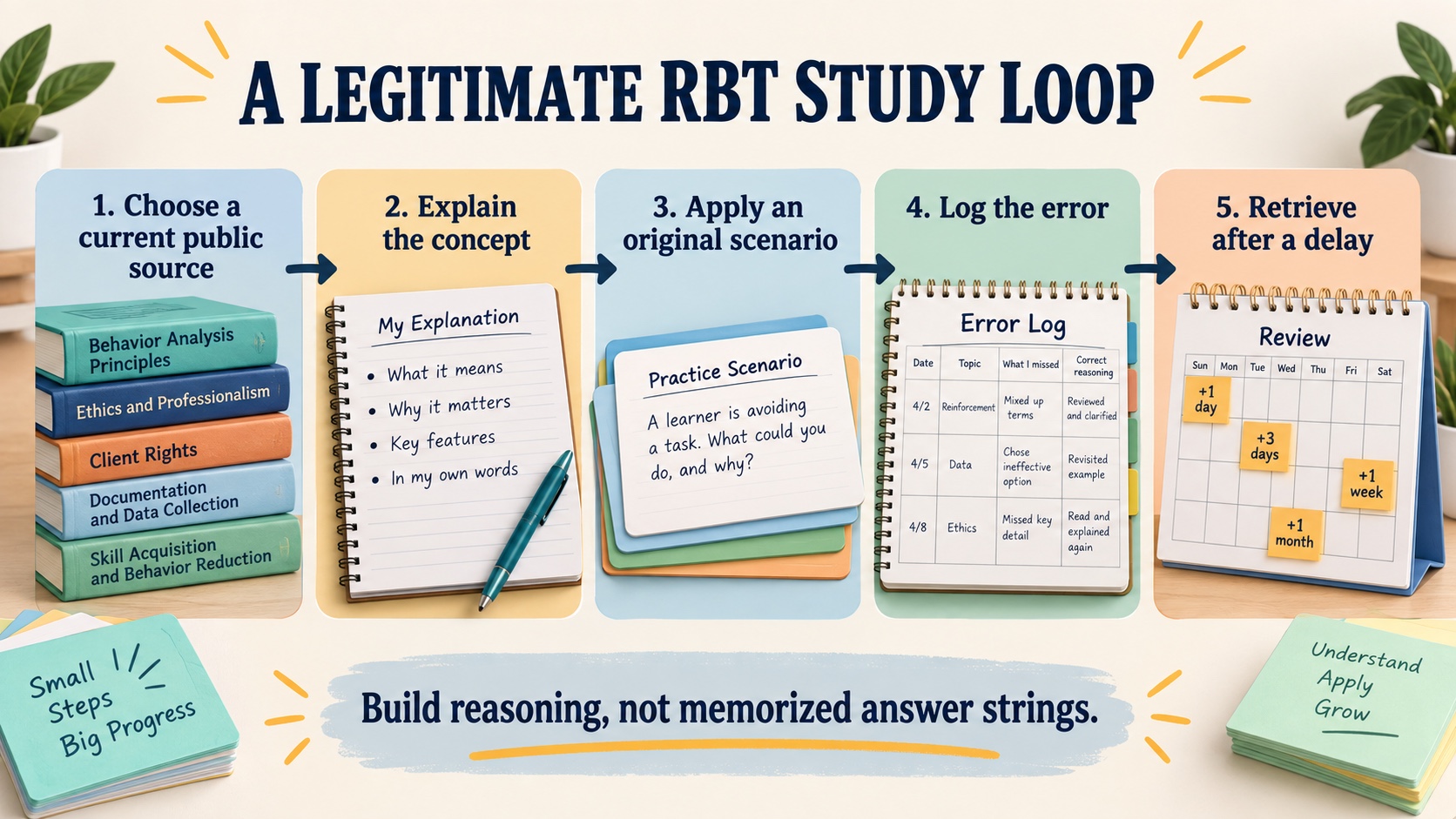
- Choose one current task or concept. Name the source and the RBT domain or task it supports.
- Explain it without looking. State the definition, the key feature, and one boundary in your own words.
- Apply it to an original scenario. Read the entire stem and identify what happened before, what behavior is relevant, and what the question asks.
- Review every option. Do not stop at the correct letter. Explain why the alternatives do not fit the conditions.
- Log the error. Label the problem as knowledge, reading, application, role boundary, ethics, or pacing.
- Return after a delay. Retrieve the idea again and answer a different scenario. Familiarity should not be the only evidence of learning.
This loop is slower than copying a dump, but it prepares you for unfamiliar wording. It also gives you a record of what to review next instead of a folder full of unverified files.
How to check whether a resource is trustworthy
Before using a free or paid RBT resource, ask:
- Does it identify itself as unofficial and independent from BACB?
- Does it name the current outline or date it follows?
- Does it provide original explanations and disclose how questions were written?
- Does it avoid phrases such as “real exam,” “leaked,” “recalled,” “guaranteed pass,” or “100% accurate dump”?
- Does it respect RBT role, supervision, ethics, and examination-security boundaries?
- Can you use the material without signing a promise to redistribute or conceal protected content?
Price is not the test. A free resource can be excellent if it is transparent and current, while a paid file can still be unsafe or inaccurate. Look for public sources, clear limitations, explanations, and a study purpose you can describe.
Common mistakes and safer choices
- “Everyone online has it, so it must be allowed.” Availability does not make confidential content authorized.
- “I will only look at one file.” Do not download or circulate material advertised as live or leaked examination content.
- “The filename says 2026.” A year in a filename is not source verification.
- “I only need answer letters.” New scenarios require reasoning, not recognition of a memorized sequence.
- “My practice percentage proves I will pass.” Unofficial practice forms do not establish an official result.
- “I should study only what I missed once.” Use error review to target weakness, but continue revisiting the full current content outline.
ABA Study Online’s RBT learning resources, free questions, app review tools, and mock-exam area can support the legitimate loop when they are used as original, unofficial study materials. Always compare current requirements and exam-security rules with BACB sources.
FAQ and sources
What is an RBT certification brain dump?
It is usually a file or service claiming to provide memorized, copied, leaked, or live RBT examination questions and answers. That claim is different from an original unofficial practice resource.
Are RBT brain dumps accurate?
You cannot reliably verify their source, answer keys, completeness, or current-edition alignment. Even if a file looks familiar, it may be outdated or wrong, and using it can create examination-security problems.
Can using a brain dump affect RBT certification?
Unauthorized possession, reproduction, publication, disclosure, or cheating can lead to examination or certification consequences under applicable BACB rules. Read the current RBT Handbook and do not share secure examination content.
What is the best alternative to an RBT brain dump?
Use the current public BACB sources, an original study guide, explained practice questions, flashcards, timed practice, and an error-review loop. The goal is flexible understanding rather than memorized answer strings.