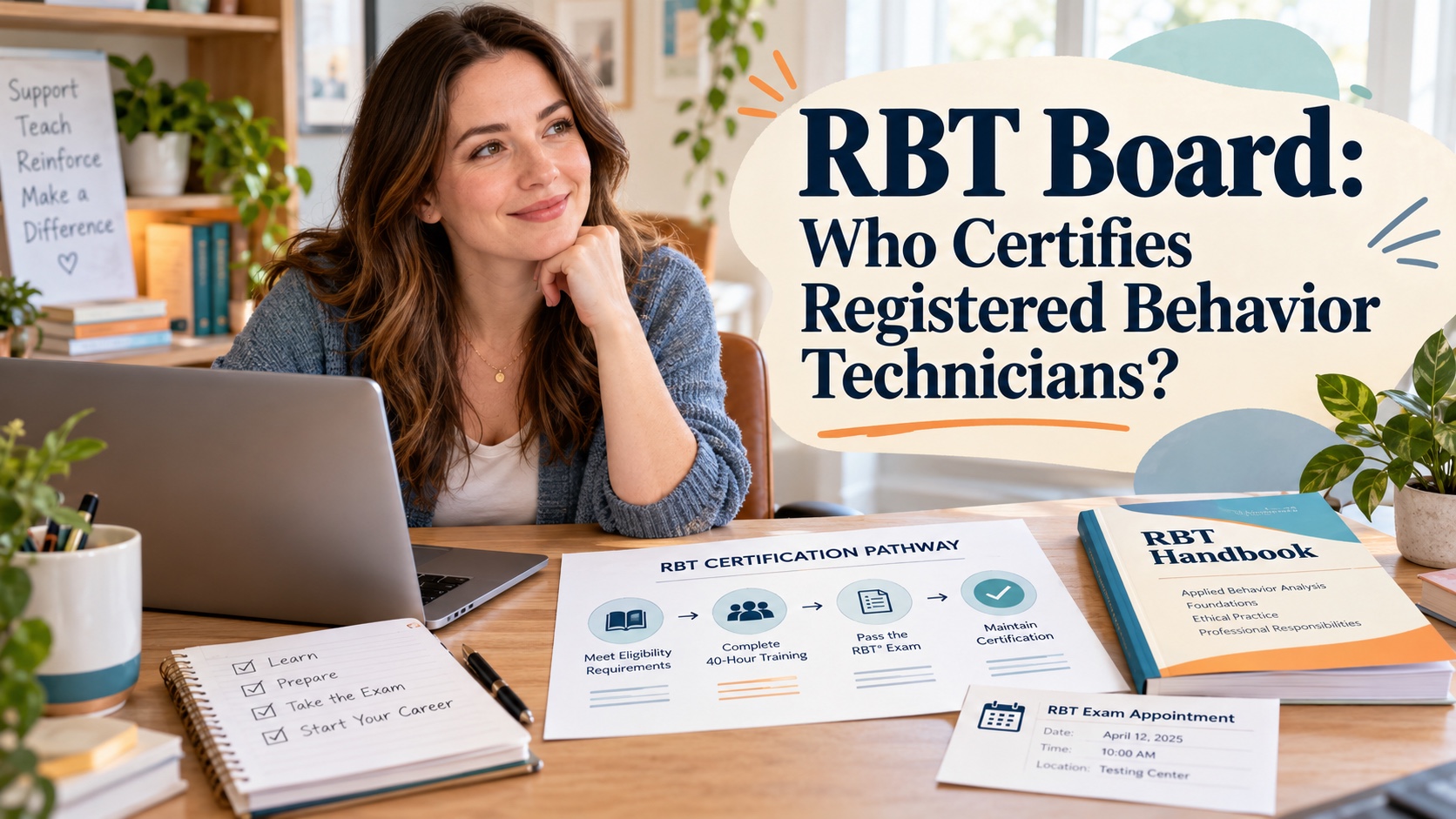
RBT Board: Who Certifies Registered Behavior Technicians?
“RBT board” is a short search phrase, but it can point to several different questions. Someone may be asking which organization issues the Registered Behavior Technician credential, where the examination is delivered, or whether an RBT credential is the same thing as a state license. Those are related questions, not the same question.
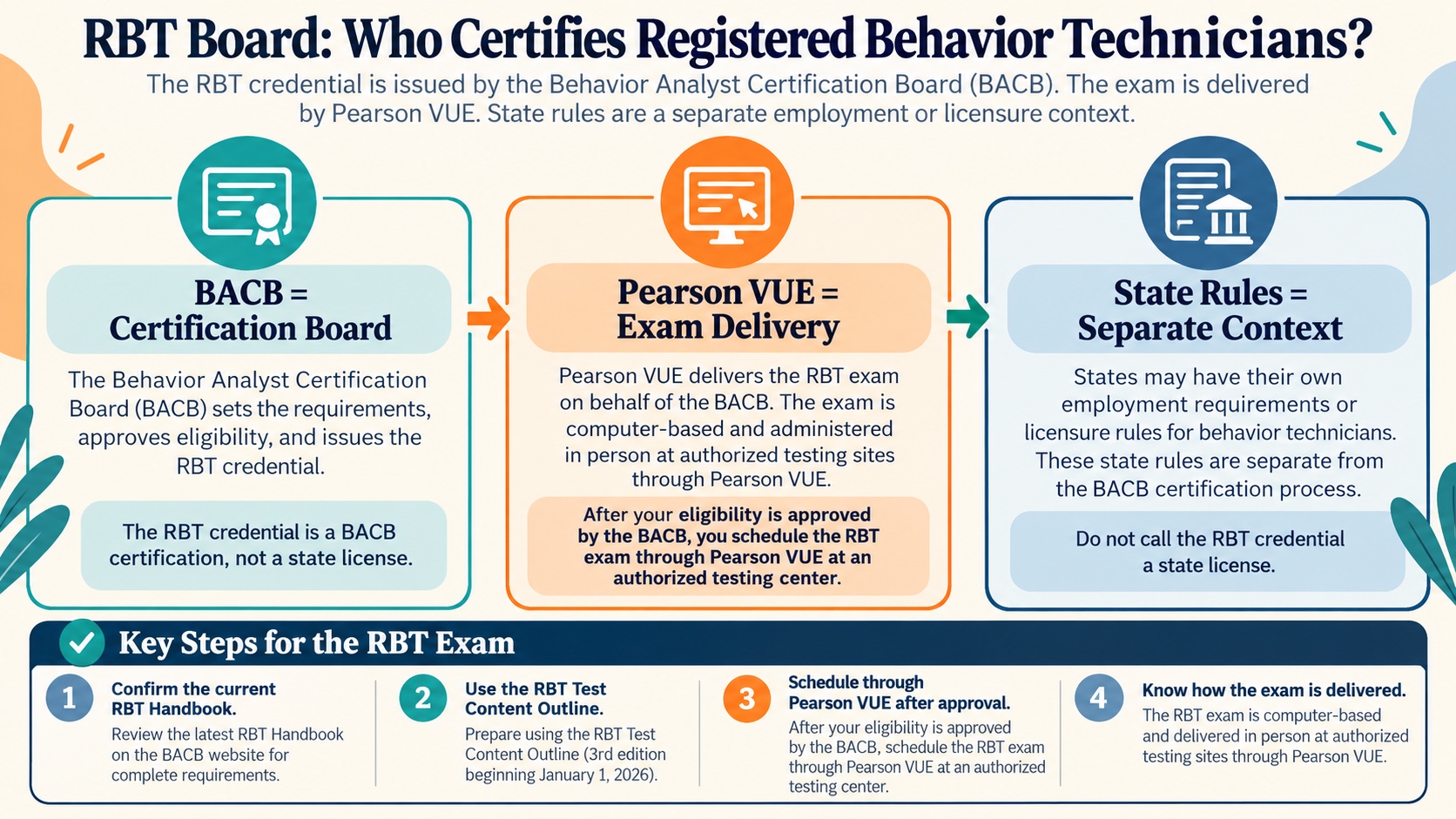
The short answer is that the Behavior Analyst Certification Board, usually called the BACB, administers the RBT certification program. Pearson VUE delivers the computer-based examination for the BACB at authorized testing sites. State employment, Medicaid, or licensure rules may create additional requirements, but they do not turn the BACB credential into a state license.
What people mean by “RBT board”
In everyday conversation, “board” often means the organization that sets a credential’s requirements, receives applications, and maintains the credential. In the RBT context, that organization is the BACB. The BACB describes RBT as a paraprofessional certification in behavior analysis. RBTs assist with behavior-analytic services while practicing under the close supervision of an approved supervisor or requirements coordinator.
That wording matters. An RBT is not an independent behavior analyst, and the credential is not a general authorization to practice without supervision. A job advertisement may use additional language such as technician, behavioral health aide, or registered technician, but the safest way to understand the credential is to begin with the current BACB source rather than a job title.
BACB, Pearson VUE, and state rules
The three parts are easier to remember when they are assigned different jobs:
- BACB: sets certification requirements, reviews eligibility, publishes the applicable Handbook and content outline, and maintains the RBT credential.
- Pearson VUE: provides the examination appointment and computer-based testing environment on behalf of the BACB at authorized testing sites.
- State or payer rules: may affect employment, supervision, registration, background checks, or billing. These rules vary and should be checked with the relevant employer, payer, or state authority.
Confusing the roles can lead to practical errors. For example, a testing-center employee can help with an appointment, but cannot decide whether an applicant meets BACB eligibility requirements. A state employer can ask for a background check, but that employer does not issue the BACB RBT certification. The BACB can maintain the credential, but it does not replace every local employment or funding rule.
How the RBT certification path fits together
Start with the current RBT Handbook, not an old checklist copied into a social-media post. The Handbook explains the requirements and maintenance process that apply to applicants and certificants. It can be revised, so a learner who plans to apply later should verify the version and implementation dates that apply to that application.
Next, identify the examination content. The BACB’s Test Content Outline index lists the RBT Test Content Outline, 3rd edition, beginning January 1, 2026. A study guide may explain the same broad areas, but it should not be treated as the official source. Keep a copy of the current outline beside your notes and label independent explanations as independent.
After the applicable eligibility steps are approved, the candidate schedules the examination through Pearson VUE. The appointment is separate from certification approval: Pearson VUE delivers the test, while the BACB controls the certification program. This is why a testing-center question and an eligibility question may need different answers.
What the examination organization does
The BACB Examination Information page currently describes the RBT examination as 85 multiple-choice questions completed in 90 minutes. It is computer-based and delivered in person at authorized Pearson VUE testing sites. The official page also directs candidates to the RBT Handbook for comprehensive examination policies, preparation information, and what to expect after the test.
For study purposes, use those facts to build a focused routine: learn the current content map, practice retrieving a concept, work through an original scenario, and review why each answer is stronger or weaker. A score from a third-party quiz does not change the official examination rules. It only gives you feedback about that quiz and your current preparation.
A useful way to organize your notes is to keep three columns. In the first, write the official source: Handbook, content outline, ethics code, or examination page. In the second, write the plain-language explanation you are using to understand it. In the third, write an original example or practice question that shows how the idea works. This prevents a colorful study sheet from quietly becoming the source of a certification rule.
If a course, employer, or study group uses the phrase “RBT board,” ask a follow-up question instead of guessing. Do they mean BACB eligibility? Do they mean the Pearson VUE appointment? Are they asking about a state employment requirement? Naming the exact task usually solves the confusion quickly. It also helps you send the person to the right page and avoid giving a confident answer from an outdated checklist.
The same distinction helps after the examination. A testing appointment, a score notification, and maintenance of certification are different events. Keep the emails and documents associated with each event, follow the current Handbook for renewal or supervision duties, and contact the responsible organization when a rule is unclear. A study website can explain terminology and practice decisions, but it should not replace the official source for a personal certification decision.
Do not request, copy, or share secure examination items. Reliable preparation uses publicly available requirements, the current content outline, ethics guidance, explanations, and original practice. If a resource claims to be “official,” check that claim against the BACB website rather than relying on a logo, a course title, or a screenshot.
Common mistakes to avoid
- Calling the credential a license: describe it as an RBT certification and then check local rules separately.
- Asking Pearson VUE about eligibility: the test provider handles delivery and appointments; the BACB source controls certification requirements.
- Using an old outline: for current preparation, verify the RBT Test Content Outline edition and effective date.
- Treating one employer’s checklist as universal: employer, payer, and state requirements can differ.
- Studying only definitions: add original scenarios and explanations so you practice applying a concept.
FAQ
Is there an RBT state board?
The RBT certification program is administered by the BACB. A state may have separate rules for employment, registration, funding, or professional practice, but those rules are not the same thing as the BACB certification process.
Who gives the RBT exam?
Pearson VUE delivers the BACB examination at authorized testing sites. Use the BACB examination and Handbook pages for certification rules, and use Pearson VUE for appointment and testing-center details.
Does passing the RBT exam make someone independent?
No. RBTs are paraprofessionals who work under the close supervision described by the BACB. Passing an examination does not erase supervision, ethics, documentation, or employer requirements.
Official sources
- BACB Registered Behavior Technician page
- BACB RBT Handbook
- BACB Examination Information
- BACB Test Content Outlines for Certifications
For a study route, see the RBT learning path, the RBT certification explainer, the RBT exam guide, and the original practice questions. These are independent learning resources, not BACB certification services or official examination content.