RBT vs BCBA: What Is the Difference?
If you searched RBT BCBA, you may be trying to compare two careers, understand a service team, or decide whether RBT experience fits into a longer BCBA plan. The shortest accurate answer is that an RBT is a paraprofessional certification, while a BCBA is a graduate-level certification associated with independent behavior-analytic practice. They work together, but one credential does not automatically convert into the other.
The distinction matters for more than job titles. It affects who designs and oversees services, what education and fieldwork a person must investigate, how supervision works, and which handbook controls the certification process. The BACB currently describes RBTs as assisting with behavior-analytic services under direction and close supervision. It describes BCBAs as independent practitioners who can provide services and supervise RBTs, BCaBAs, and other professionals who implement interventions.
Table of Contents
Short answer: RBT vs BCBA
An RBT is a paraprofessional who helps deliver behavior-analytic services under the direction and close supervision of an RBT Supervisor and/or RBT Requirements Coordinator. The role is implementation-focused: an RBT may carry out written teaching or behavior-reduction procedures, collect data, communicate observations, and follow the boundaries of the supervising system.
A BCBA is a graduate-level professional who can independently provide behavior-analytic services and supervise the work of RBTs, BCaBAs, and other people who implement interventions. The role has broader responsibility for assessment, planning, clinical decision-making, supervision, documentation, and ethical oversight, subject to applicable laws, payer rules, employer policies, and the current BACB requirements.
These descriptions are role-level summaries, not a promise that every organization divides tasks in exactly the same way. The BACB’s consumer resources also note that organizations have unique structures. A job description should therefore be read alongside the credential handbook and the rules of the service setting.
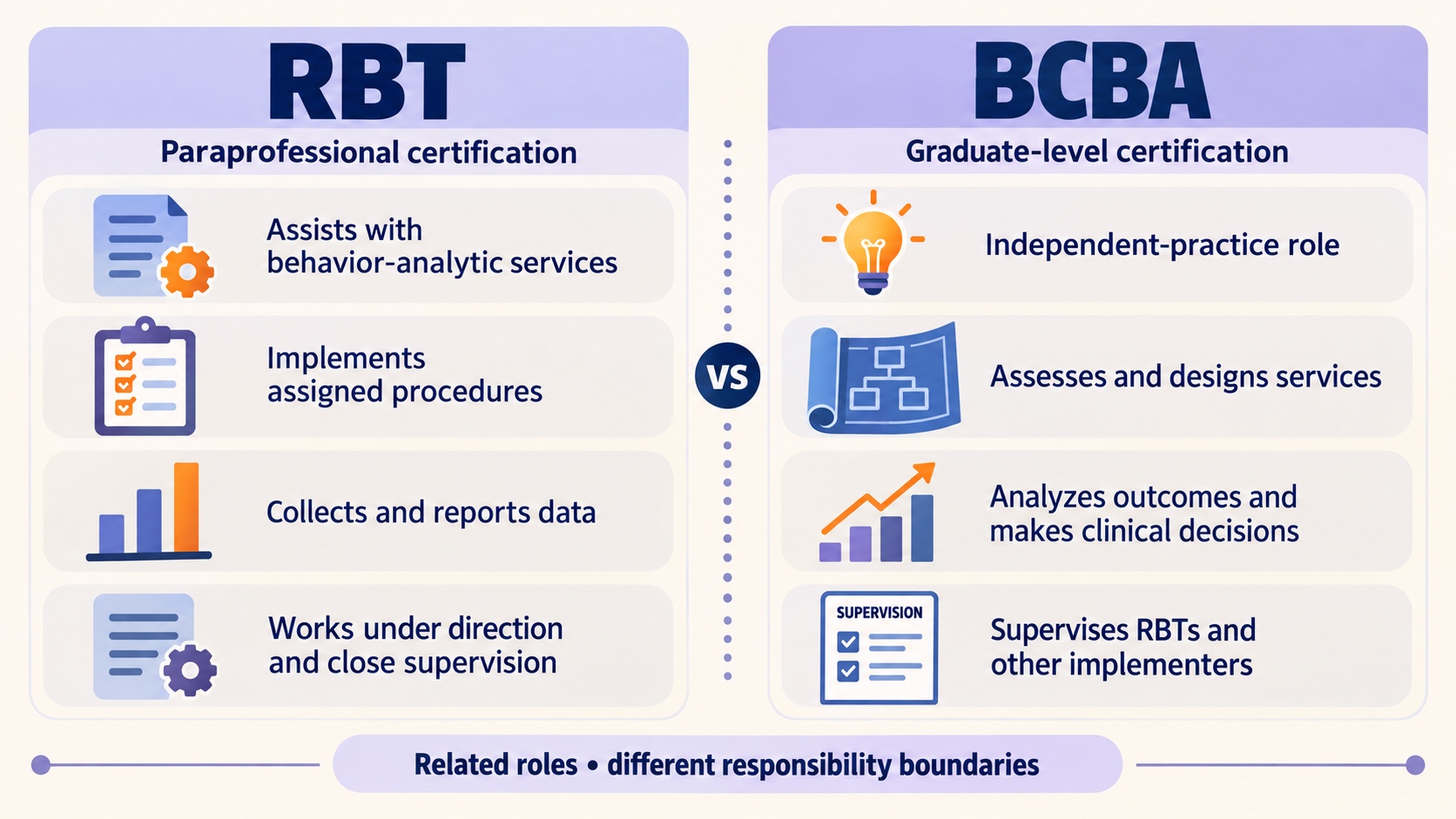
RBT and BCBA side by side
Credential and education level
The RBT certification is designed for a paraprofessional role in behavior analysis. The BCBA certification is a graduate-level certification. That difference does not make one person more valuable than another; it describes the preparation and responsibility attached to the role. An RBT may be the person who spends the most direct time implementing a teaching protocol, while the BCBA may be the person responsible for designing, evaluating, and modifying the broader plan.
Do not infer a BCBA pathway from a job title alone. A person who is called a behavior technician may or may not hold an active RBT certification, and a person studying behavior analysis may or may not be pursuing BCBA certification. Confirm the credential, issuing organization, and current status.
Scope and independence
RBT work is performed within a supervising structure. The technician implements the procedures and responsibilities assigned within that structure and should communicate observations, barriers, and concerns rather than independently redesigning a behavior plan. A BCBA has a broader independent-practice role, although actual authority is still shaped by state licensure, employer policy, payer requirements, and the needs of the client.
A practical example makes the boundary clearer. Suppose a learner’s teaching plan includes a prompt hierarchy and a reinforcement schedule. The RBT may implement the written procedure, record the specified data, and report what occurred. The BCBA may analyze the data, evaluate whether the plan is working, make an authorized clinical change, and train or supervise the people implementing that change. The exact workflow depends on the organization and supervision plan, but the decision responsibility is not interchangeable.
Supervision
The BACB’s supervision materials identify qualified BCBA and BCaBA roles for supervising RBTs, with the relevant training and handbook requirements. The supervisor or requirements coordinator is responsible for the applicable oversight system, while the RBT remains responsible for carrying out the role honestly, following instructions, documenting accurately, and raising concerns within the proper channel.
Supervision is not just a monthly signature. It can include observing performance, giving feedback, reviewing data, addressing ethics and scope, and making sure the RBT has the training needed for assigned tasks. Ask a prospective employer who the RBT Supervisor is, who serves as the Requirements Coordinator if different, how supervision is documented, and how questions are escalated.
How the roles relate on a service team
A healthy service team makes the relationship visible. The BCBA or another authorized professional establishes the clinical direction and supervision system. The RBT contributes direct implementation and observation. Families, teachers, caregivers, and other professionals may add important information about context and generalization. Each person’s contribution is useful, but the roles should not be blurred.
For an RBT, “I noticed the learner was more engaged when the instruction was shorter” is a useful observation to document and share. “I independently changed the treatment plan because I thought the instruction was too long” may cross a role boundary. For a BCBA, the responsibility is not to ask an RBT to improvise a new clinical procedure without training; it is to analyze the information, make decisions within the applicable authority, and supervise implementation.
Organizations can structure teams differently, and a BCaBA may also be part of the supervision system under BCBA supervision. That is why a simple ladder image can be misleading if it suggests that every service setting has only one supervisor or that every RBT job has identical reporting lines.
Is RBT a step toward BCBA?
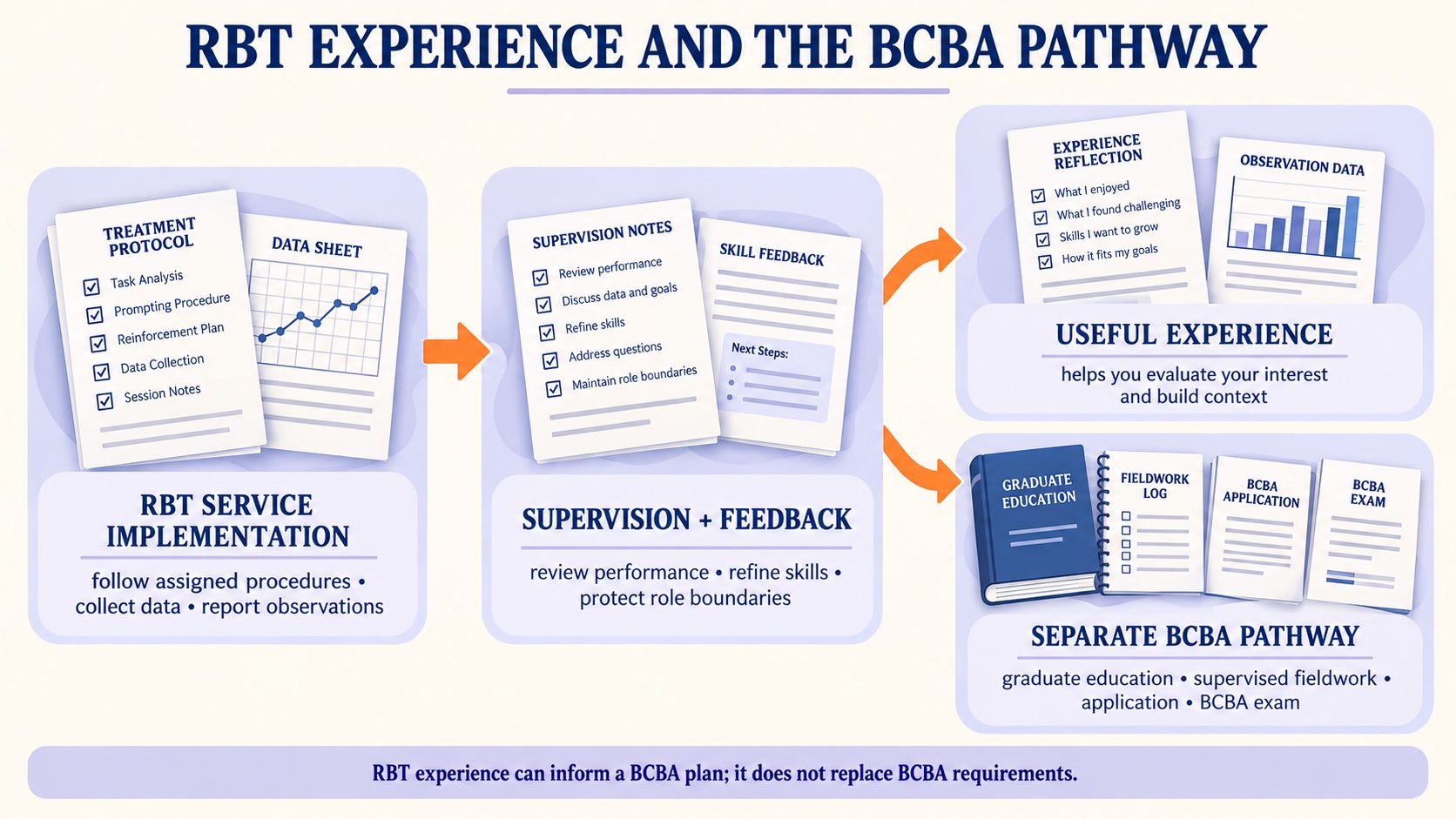
RBT experience can be valuable preparation for someone considering graduate study or a future behavior-analytic role. It can provide exposure to data collection, teaching procedures, behavior-reduction procedures, documentation, family collaboration, and the everyday demands of ethical service delivery. It can also reveal whether the person enjoys the work and wants deeper responsibility.
But RBT certification is not a required automatic step in every BCBA pathway, and it is not a substitute for the BCBA requirements. A future BCBA candidate must investigate the current BCBA Handbook, education route, coursework, supervised fieldwork, application, examination, and maintenance requirements. The BACB currently flags changes to BCBA requirements for 2027, so readers should check the current transition guidance instead of relying on an old pathway chart.
Think of the relationship as “useful experience” rather than “automatic promotion.” An RBT can later pursue the BCBA pathway, but the person must still meet the current BCBA eligibility requirements. Conversely, someone can study toward BCBA without first becoming an RBT. The right choice depends on the person’s education, time, financial situation, supervised opportunities, and professional goals.
How the certification exams differ
The current BACB examination-information page lists different exam structures for the certifications. It lists the RBT examination as 85 multiple-choice questions with 90 minutes, while the BCBA examination is listed as 185 multiple-choice questions with four hours. These numbers help explain why the exams should not be compared as if they test the same level of responsibility or content boundary.
Exam length is not a ranking of people or a guarantee about difficulty. The relevant question is whether your study materials match the certification you are pursuing. An RBT candidate should organize study around current RBT resources and the RBT handbook. A BCBA candidate should use the current BCBA handbook, content outline, ethics requirements, fieldwork rules, and 2027 transition guidance when applicable.
Do not combine an RBT practice test with a BCBA study plan simply because both mention ABA. The vocabulary overlaps, but the role, responsibility, and exam blueprint differ. Use the correct track label on every practice set and record the source version.
How to choose your next research step
- If you want to begin direct implementation work: start with the current RBT page and handbook, then confirm the training, competency, application, examination, supervision, and employer steps.
- If you want to become an independent behavior analyst: start with the current BCBA page and handbook, then investigate the education, fieldwork, application, examination, and 2027 transition requirements.
- If you are comparing a job offer: ask which credential is required, who supervises the role, whether the position is clinical or implementation-focused, and which state, payer, school, or contract rules apply.
- If you are already an RBT: use your experience to identify the skills you want to deepen, but keep a separate checklist for BCBA eligibility rather than assuming the RBT credential completes any BCBA step.
Common comparison mistakes
- Calling RBT an assistant BCBA: RBT is its own paraprofessional certification; BCaBA is a separate undergraduate-level certification.
- Assuming the RBT supervises independently: RBT services occur within the applicable direction and supervision system.
- Assuming every BCBA has the same job: state licensure, employer policies, payer rules, and setting change the practical work.
- Using an old BCBA pathway chart: check current BACB materials, especially when a 2027 requirements transition is identified.
- Choosing by exam length alone: first decide which role and responsibility you are pursuing, then study the matching blueprint.
- Promising that RBT leads directly to BCBA: describe it as potentially useful experience, not an automatic credential ladder.
RBT BCBA FAQ
Is an RBT the same as a BCBA?
No. They are different BACB certifications with different preparation and role boundaries. RBT is a paraprofessional certification; BCBA is a graduate-level certification associated with independent practice and supervision.
Can an RBT become a BCBA?
Yes, an RBT can later pursue BCBA certification if the person meets the current BCBA eligibility requirements. The RBT credential itself does not replace graduate education, supervised fieldwork, application requirements, or the BCBA examination.
Can a BCBA be an RBT supervisor?
The BACB supervision materials identify BCBA and BCaBA roles that may supervise RBTs, subject to the current qualification and training requirements. Confirm the organization’s actual supervision structure and the current handbook.
Which exam is harder, RBT or BCBA?
They are not directly comparable because the certifications test different role levels and responsibilities. The BCBA examination is longer and belongs to a graduate-level certification pathway, while the RBT examination is designed for the paraprofessional credential. Study for the exam that matches the role you intend to pursue.
Should I become an RBT before applying to BCBA programs?
It can be a useful way to gain direct experience and test your interest in behavior-analytic work, but it is not automatically required. Compare the current BCBA program and BACB requirements with your goals, resources, and available supervision.