RBT 40-Hour Training: 2026 Requirements and How to Choose a Course
If you are searching for RBT 40-hour training, you probably want to know two things: what the training must include, and how to tell whether a course is worth your time and money. For RBT applicants applying on or after January 1, 2026, the BACB’s 2026 training requirements describe a minimum of 40 hours, a completion window, required curriculum areas, behavioral-skills-training components, trainer qualifications, and a certificate that becomes part of the application record.
The training is important, but it is not the entire RBT certification process. You still need to meet the other applicable eligibility requirements, complete the initial competency assessment, submit the application, receive authorization, and pass the RBT examination. This guide explains the training boundary so you can compare providers without confusing a course completion certificate with certification, supervision, or an official BACB endorsement.
Table of Contents
What the 40-hour RBT training is
The RBT 40-hour training is the core training requirement for a new RBT applicant. It introduces the knowledge and service-delivery skills needed for behavior-technician work, including data collection, assisting with assessments, behavior-change procedures, documentation, ethics, professionalism, and communication with a supervisor.
The training should be taught in the context of behavior-analytic service delivery. That means a strong course does more than define reinforcement or list measurement types. It shows how a technician prepares for a session, uses an operational definition, follows a written procedure, records data accurately, notices a possible change in a graph, communicates with a supervisor, protects confidentiality, and responds professionally when the situation is unclear.
The word training matters. The course gives instruction and practice, but it does not independently authorize you to provide services, replace supervision, or certify your competence in every task. Your employer, supervisor, and the current BACB requirements determine the other steps that must occur before and after the course.
The 2026 duration, delivery, and trainer requirements
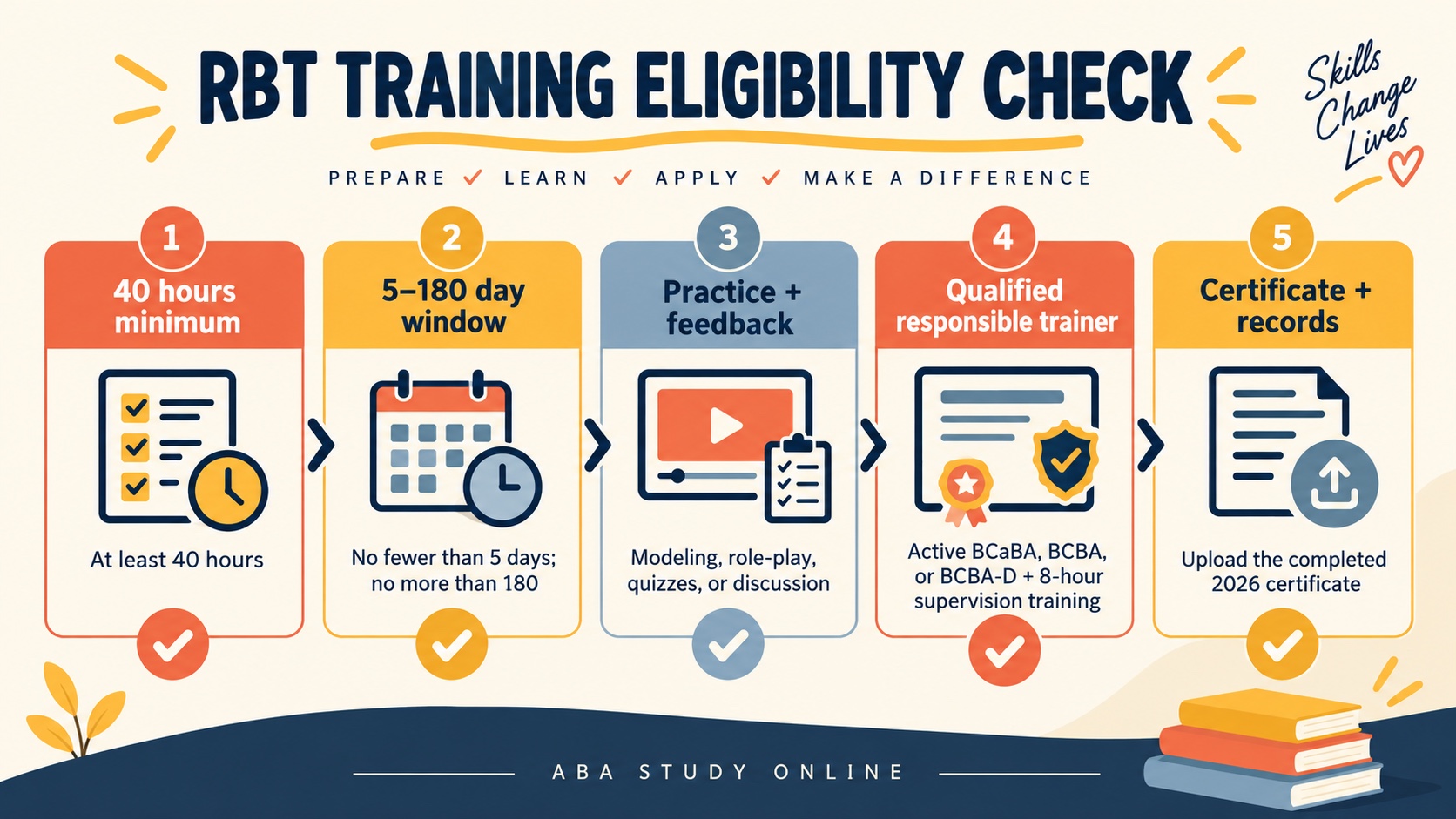
The current BACB outline says the trainee must complete at least 40 hours of training in no fewer than 5 days and no more than 180 days. The minimum curriculum durations add up to 38 hours, and the provider allocates two additional hours to reach the 40-hour requirement. A course that advertises “40 hours” but permits completion in one day does not match the 2026 timing rule.
Training may be delivered in person, online, or as a blend. The key question is not whether the screen is virtual. The training must include behavioral-skills-training components, which can include video instruction, didactic teaching, modeling with examples and nonexamples, in-vivo role-play with feedback, quizzes, interactive activities, or instructor-led discussion. Assigned reading by itself cannot count toward the overall training duration.
The responsible trainer must be an active BCaBA, BCBA, or BCBA-D who has completed the required 8-hour supervision training. The responsible trainer designs and oversees the training, identifies themselves in the training documentation, ensures the requirements are met, maintains records, and is responsible for quality when assistant trainers deliver portions of the program. Assistant trainers may be RBT certified or higher.
The trainer relationship also has boundaries. The responsible trainer and assistant trainers may not be related to, subordinate to, or employed by the trainee during the training. The BACB describes the provider as an individual or organization within its jurisdiction. Ask a provider who the responsible trainer is, what certification they hold, and how the training certificate will identify the training team before you enroll.
What the curriculum must cover
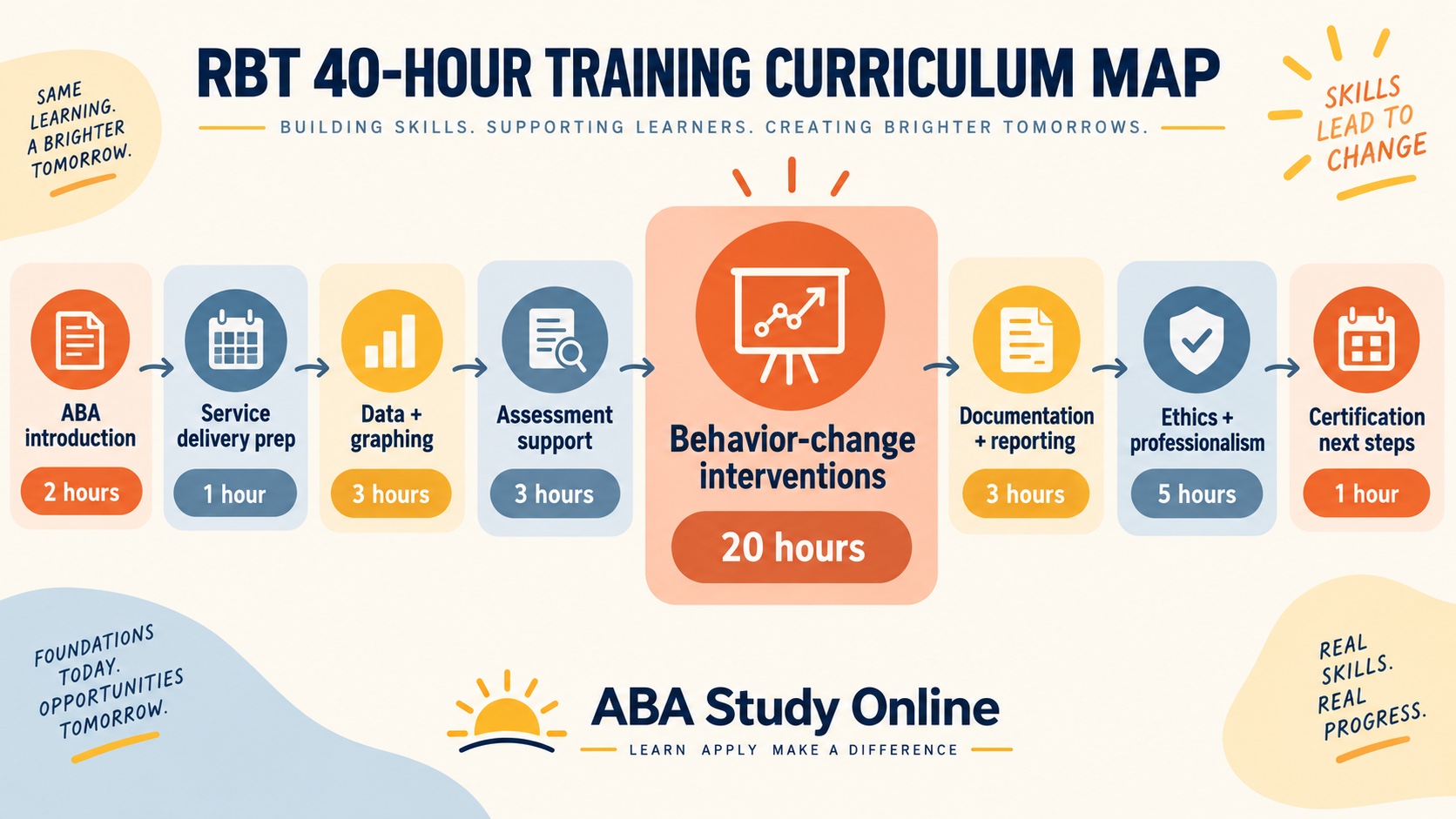
The 2026 curriculum outline has eight sections. The time allocations are minimums, so a provider may spend longer on a topic when the total training still meets the requirement. The largest block is behavior-change interventions, but the smaller sections prevent the course from becoming only a procedure class.
| Curriculum section | Minimum time | What to look for |
|---|---|---|
| Introduction to applied behavior analysis | 2 hours | Three-term contingency, reinforcement, functions of problem behavior, verbal operants, and intervention phases. |
| Preparing for service delivery | 1 hour | Readiness, prior notes, materials, environment, rapport, and assent. |
| Data collection and graphing | 3 hours | Observable descriptions, operational definitions, measurement, calculation, graphs, and reporting changes. |
| Assisting with behavior assessments | 3 hours | Preference, skill-based, and functional assessment support within the technician’s role. |
| Behavior-change interventions | 20 hours | Procedural integrity, reinforcement, teaching, prompting, chaining, discrimination, differential reinforcement, extinction, antecedent strategies, generalization, and crisis intervention. |
| Service delivery documentation and reporting | 3 hours | Confidentiality, objective notes, timely reporting, and seeking supervisor direction. |
| Ethics and professionalism | 5 hours | Ethics codes, dignity, cultural responsiveness, boundaries, public statements, misconduct reporting, and effective supervision. |
| Next steps in certification | 1 hour | Assessment, application, examination, ongoing supervision, ethics, self-reporting, and recertification. |
The 20-hour behavior-change block should still be taught carefully. A list of technique names is not the same as usable training. Look for examples and nonexamples, practice with feedback, discussion of procedural integrity, and reminders that the RBT follows the written plan and supervisor direction. An RBT course should not teach a learner to independently design interventions or make decisions outside the RBT role.
The ethics and documentation sections are equally practical. A course should explain objective notes, confidentiality, accurate representation of credentials, multiple relationships, cultural humility, appropriate communication, and how to bring concerns to a supervisor. These topics connect the training to the real conditions in which technicians work.
When comparing syllabi, look for a visible connection between each lesson and the technician’s actual responsibilities. A course can be engaging and still be incomplete if it omits reporting, supervisor communication, assent, or the limits of delegated work. The strongest outline makes those boundaries easy to find before enrollment.
Certificate and recordkeeping checklist
At the end of the training, the responsible trainer provides a completed RBT 2026 40-Hour Training Certificate. The trainee will upload the certificate as part of the RBT certification application. The certificate is evidence that the training requirement was completed; it is not an RBT credential and does not mean the BACB has endorsed a particular provider.
Before you submit an application, check that the certificate includes:
- Your name and BACB ID.
- The training start date and end date.
- The amount of time you spent engaged in training, such as 40 hours and 15 minutes.
- The responsible trainer’s name and certification number.
- The responsible trainer’s signature or company branding, as allowed by the outline.
- The names and certification numbers of assistant trainers, if applicable.
- The statement that the program is designed to meet the 2026 training eligibility requirement and is offered independent of the BACB.
The responsible trainer must maintain training documentation for at least seven years, including records of people who completed only part of the training. The BACB can audit training materials. Keep your own copy of the certificate, attendance or completion information, payment record, course description, and any communication that helps establish the dates and trainer. If a provider will not identify the responsible trainer or cannot explain its certificate, pause before paying.
What comes after training
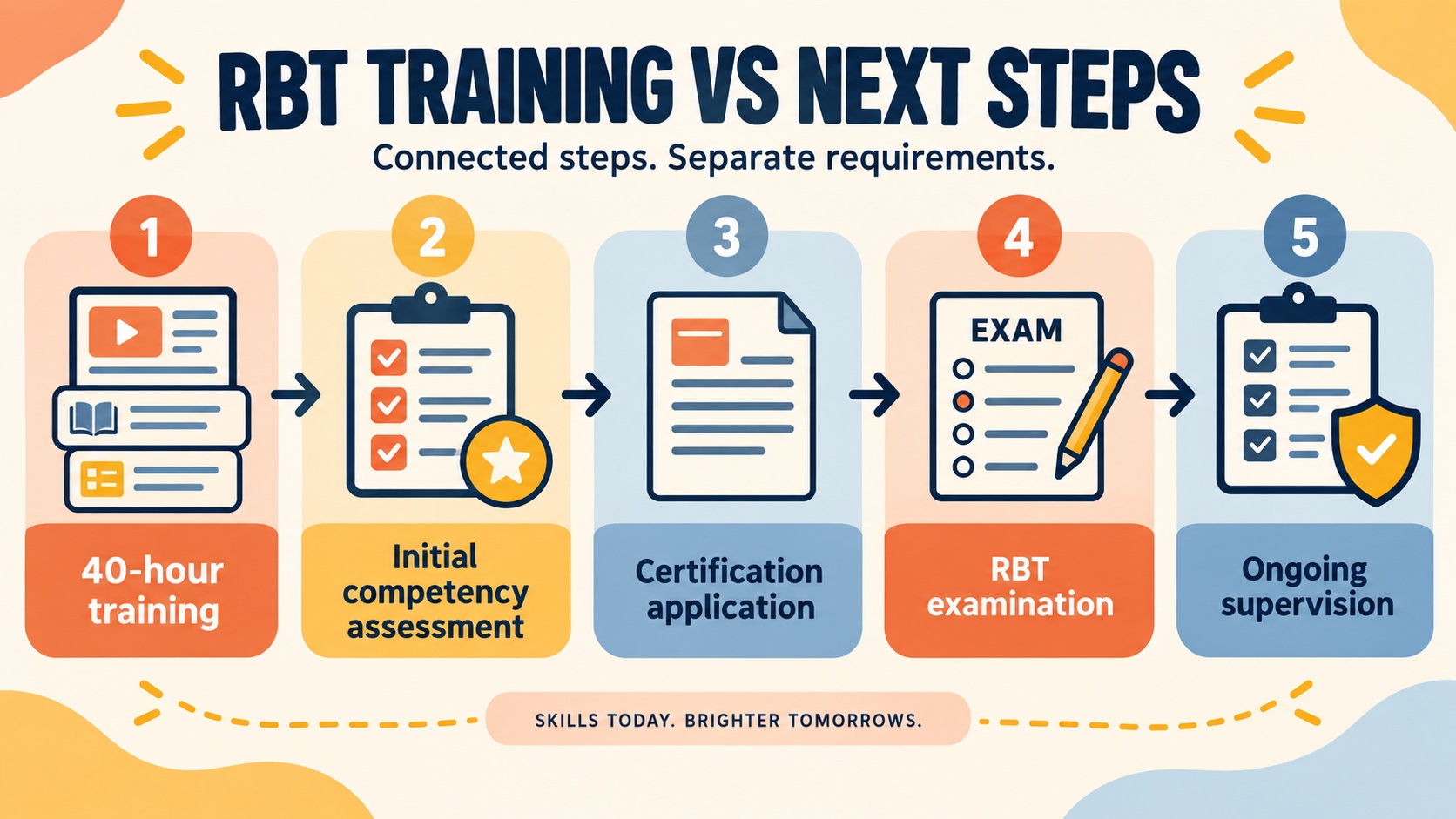
The 40-hour course is one step in a longer sequence. The initial competency assessment is a separate requirement. A qualified assessor evaluates whether you can demonstrate the required skills; the course certificate does not substitute for that assessment. After the other requirements are met, you submit the RBT application and supplemental documents, receive an approved determination and examination authorization, and schedule the examination according to the current BACB process.
Ongoing supervision is also separate. RBTs work under the direction and close supervision of an RBT Supervisor and/or RBT Requirements Coordinator who is responsible for the work. The 40-hour training may introduce supervision expectations, but it does not create a supervisor relationship or fulfill ongoing supervision documentation.
Study materials can support the next steps, but they must be labeled honestly. The BACB currently lists the RBT Test Content Outline (3rd ed.) as beginning January 1, 2026. That examination outline is useful for exam preparation; it is not the same document as the 40-hour training curriculum. A practice question set should not be advertised as the 40-hour course or as recalled official exam content.
How to compare a training provider
Use the official requirements as a purchasing checklist rather than choosing only by the lowest price or the fastest completion promise.
- Check the date and edition. The provider should clearly say that the course is designed for the 2026 training eligibility requirement when that is the requirement you need.
- Check the time window. Confirm that completion takes at least five days and no more than 180 days, with a reliable system for recording training time.
- Check the curriculum hours. Look for all eight sections and at least the required minimums, especially the 20-hour behavior-change-interventions block.
- Check the learning activities. Ask how the course includes modeling, role-play, feedback, quizzes, interaction, or discussion. Reading and passive video alone may not show the full training experience.
- Check the responsible trainer. Ask for the trainer’s name, certification level, 8-hour supervision-training status, and role in overseeing the course.
- Check the certificate before enrollment. The provider should be able to explain how it records your name, BACB ID, dates, duration, trainer, assistants, and the independent-training statement.
- Check the boundary language. A responsible provider should not promise certification, a guaranteed pass, official BACB endorsement, or a substitute for competency assessment and supervision.
Choose your next RBT study step
Once your training plan is clear, use study practice for the part that comes next. ABA Study Online provides independent RBT Theory Blocks, free practice questions, vocabulary support, and practical tools. You can use the RBT learning path to review concepts, the free RBT questions to practice scenario reasoning, the ABA glossary to clarify terms, and the ABC data sheet tool to practice objective documentation.
Keep your RBT preparation moving
Use free RBT questions and the study path to reinforce what you learn in training. These are independent educational resources; they do not replace the required 40-hour training, initial competency assessment, supervisor, application, or RBT examination.
Try free RBT practice questions Continue in the ABA Study Online app
FAQ and official sources
Can I finish the 40-hour training in one weekend?
Not under the 2026 timing rule. The training must take no fewer than five days and no more than 180 days, and it must include the required content and training components.
Does an online course count?
An online or blended format may count when the course meets the current requirements, includes appropriate behavioral-skills-training components, is overseen by a qualified responsible trainer, and provides the required documentation. “Online” by itself is not a quality or eligibility guarantee.
Does the 40-hour training make me an RBT?
No. It is the core training requirement for a new applicant. You still need the other applicable eligibility steps, initial competency assessment, application approval, and examination.
Is ABA Study Online a BACB-approved 40-hour training provider?
This page does not make that claim. ABA Study Online’s linked study resources are independent educational support. Verify the provider, trainer, certificate, and current BACB requirements before enrolling in any 40-hour course.
Where can I verify the current requirements?
Start with the BACB’s 2026 40-Hour Training Requirements and Curriculum Outline, the RBT certification page, the Supervision, Assessment, Training, and Oversight page, and the Test Content Outline index. Recheck the official pages before applying.
A good RBT 40-hour training is complete, paced within the allowed window, grounded in service delivery, taught with opportunities to practice, and documented by a qualified responsible trainer. Use those criteria to compare a course, then keep the next steps separate: competency, supervision, application, and examination. That makes your preparation more reliable and keeps your expectations aligned with the current BACB requirements.