RBT 40-Hour Training Certificate: What It Proves and What It Does Not
If you are searching for an RBT 40-hour training certificate, you may be checking a document from a course provider, preparing an application, or wondering whether finishing the course means you are already certified. Those are related questions, but they are not the same question. The certificate is evidence that you completed qualifying training. The RBT credential follows a larger BACB pathway that also includes competency assessment, application, examination, and ongoing requirements.
This guide focuses on the document itself. It explains what the current 2026 BACB materials say the certificate should contain, how to check it before uploading it, and where the certificate fits in the rest of the RBT process. Use the current BACB handbook and training outline for your application date; a course page or an old checklist should not override the official source.
Table of Contents
Short answer: what the certificate means
The RBT 40-hour training certificate is a provider-issued document that records completion of a training program designed to meet the applicable BACB training eligibility requirement. The current BACB RBT Handbook tells applicants to include a copy of the 40-hour training certificate with the RBT certification application. That makes the certificate an important application document, but it does not make the document an RBT certification card or a substitute for the other requirements.
A useful way to read the document is: “This shows what training I completed, when I completed it, how much time I spent, and who was responsible for the training.” It does not answer every later question about whether you passed the examination, whether your application was approved, whether your credential is active, or how ongoing supervision will be arranged.
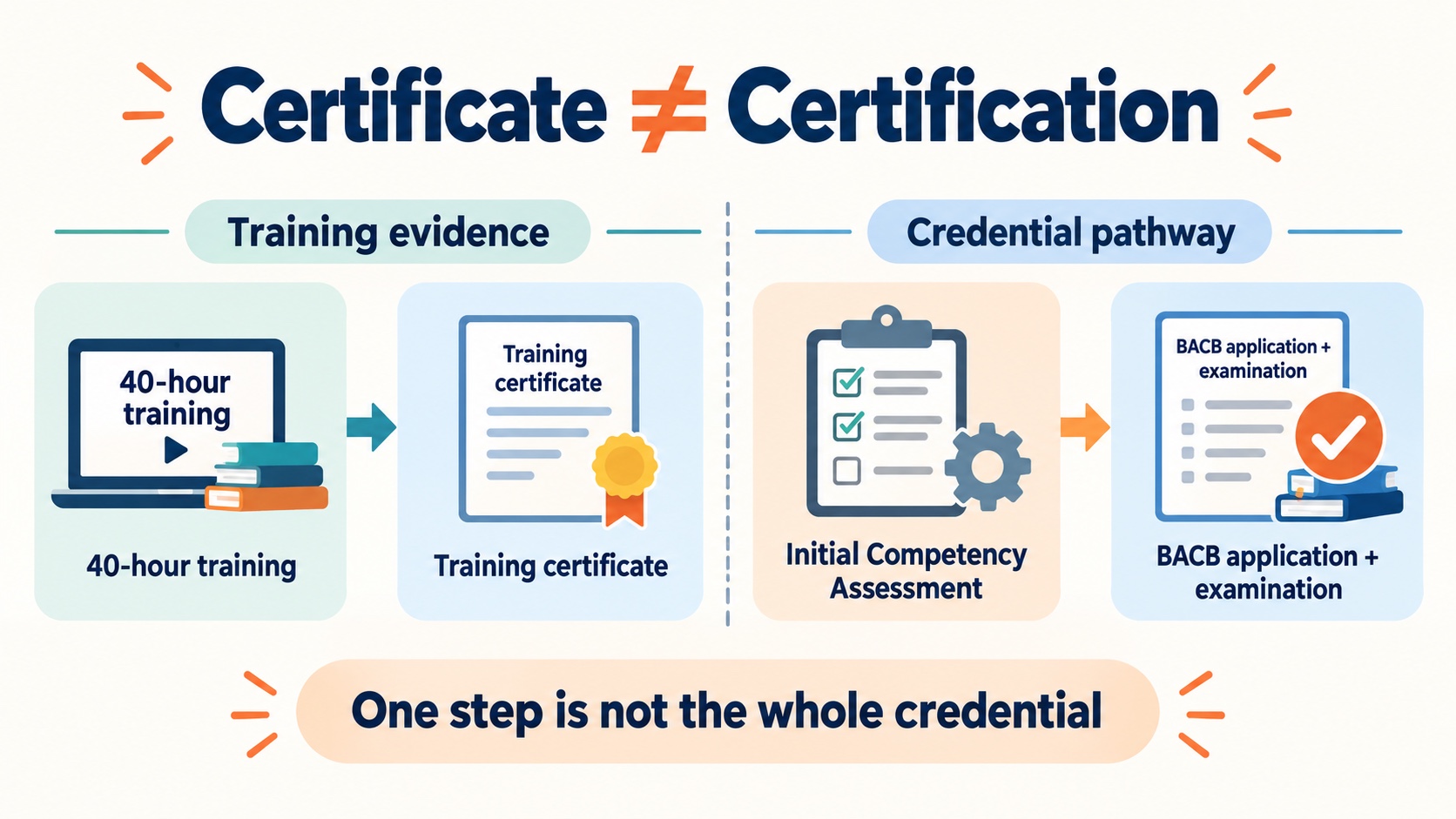
Certificate versus RBT certification
In everyday language, people often use certificate and certification interchangeably. For an RBT applicant, that shortcut can create a costly misunderstanding:
- Training certificate: a record from the training provider showing that you completed the required training program and providing the details needed for the application file.
- Initial Competency Assessment: a separate assessment of whether you can perform the relevant tasks competently. Completing lessons is not the same as demonstrating performance.
- BACB application: the application step where you submit the required documents and information for review.
- RBT examination: the examination step in the current BACB pathway. Practice questions can support preparation, but they are not secure BACB items and cannot guarantee a result.
- Active RBT certification: the credential status that follows the BACB process and remains subject to current maintenance and supervision requirements.
So, “I have my 40-hour certificate” is an accurate statement about training evidence. “I am an active RBT” requires a separate basis. If you are speaking with an employer, say which step you have completed and which steps are still pending. That wording is clearer than calling a course completion certificate an RBT license or credential.
Current 2026 training conditions
The BACB’s RBT 2026 40-Hour Training Requirements and Curriculum Outline describes the training that supports applications made under the 2026 requirements. The training must cover the current curriculum in the context of behavior technician service delivery. It must include at least 40 hours, be completed in no fewer than 5 days and no more than 180 days, and meet the outline’s delivery conditions.
The outline allows in-person, online, or combined delivery, but the format alone does not decide whether a course qualifies. The training must include behavioral skills training components, such as instruction, modeling, role-play with feedback, quizzes, interactive activities, or instructor-led discussion. Assigned readings alone may not count toward the overall training duration.
Trainer qualifications also matter. The training is designed and overseen by a qualified Responsible Trainer, and the current outline describes the role and the conditions under which Assistant Trainers may help. The trainer relationship cannot be treated as a casual detail: the certificate should let a reviewer identify who was responsible for the program and how the training was documented.
Dates deserve special attention. The BACB counts the start and end dates within the permitted window. A certificate that says “40 hours completed” but does not make the training dates clear is harder to verify. Keep the course outline, completion record, and certificate together in the same folder in case an application reviewer or employer asks how the hours were completed.
What the certificate should show
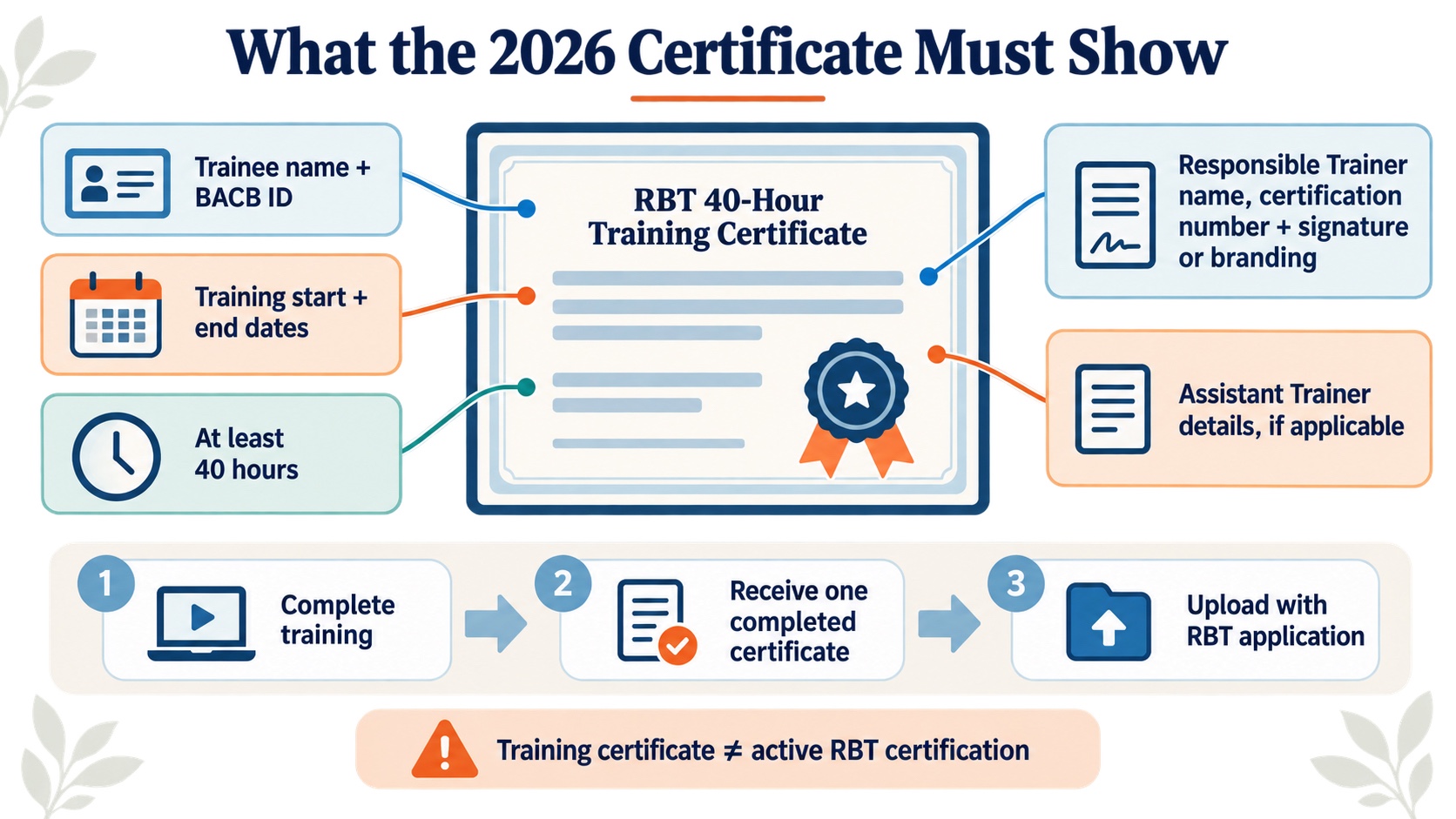
The official 2026 outline says the Responsible Trainer must provide each trainee with a completed, single-document RBT 2026 40-Hour Training Certificate. The provider may use its own design, but the design should not remove the required information. Check for these fields:
- Trainee name and BACB ID: compare the name and ID with the information in your BACB account. A mismatch can create an avoidable document question.
- Training start and end dates: the dates should make the 5-to-180-day completion window reviewable.
- Amount of time engaged in training: the certificate should state the completed time, such as at least 40 hours, rather than relying on a vague “course completed” label.
- Responsible Trainer name and certification number: the person responsible for the training should be identifiable.
- Responsible Trainer signature or company branding: the outline permits the required sign-off or company branding described in the official document.
- Assistant Trainer information, if applicable: include the names and certification numbers when Assistant Trainers participated and the certificate format calls for those details.
- The independent-of-BACB statement: the current outline requires the statement that the program is designed to meet the 2026 training eligibility requirement and is offered independently of the BACB.
The exact sentence matters because a training provider is not the BACB. Do not add BACB branding to make a private course look official, and do not assume that a decorative certificate seal proves eligibility. The safest approach is to compare the certificate with the current BACB outline and ask the provider to correct missing or inconsistent fields before you submit the application.
How the certificate fits the application path
The certificate is one part of a sequence. The current RBT Handbook describes a route that includes eligibility review, qualifying training, the Initial Competency Assessment, application documentation, examination, and maintenance. The order may feel administrative, but each record answers a different question:
- Training: Did you complete the required learning experience within the permitted time window?
- Certificate: Can the provider document the training with the required identity, date, hour, and trainer information?
- Competency assessment: Can you demonstrate the relevant technician tasks under the current assessment process?
- Application: Did you submit the required materials accurately through the BACB process?
- Examination: Did you complete the current examination requirement?
- Maintenance: After certification, are current supervision, ethics, and maintenance obligations being met?
That sequence is why the BACB RBT Handbook should sit beside your personal checklist. The BACB supervision and training page is also useful when you need to identify the roles of trainers, assessors, and supervisors. For study support, the ABA Study Online RBT learning hub can help you review concepts, while RBT practice questions can help you rehearse applied decisions. Those resources support learning; they do not issue the certificate or replace the BACB process.
How to check a certificate before uploading it
Use a short document audit before you upload:
- Confirm the version: ask which BACB requirement year the program was designed to meet. Do not mix an old certificate template with current requirements without checking eligibility.
- Match identity: compare your name and BACB ID with your account and application.
- Check the timeline: verify that the start and end dates and total time are visible and internally consistent.
- Identify the trainer: check the Responsible Trainer’s name, certification number, and sign-off or branding. Add Assistant Trainer details when applicable.
- Read the independence statement: confirm that the certificate identifies the program as independent of the BACB.
- Keep one complete file: if the application field allows one attachment, combine the pages into the required single document without dropping the certificate page, dates, or signatures.
- Save the source record: retain the certificate, curriculum outline, training completion record, and provider contact details for your own records.
If something is missing, contact the training provider before submitting. The BACB does not provide 40-hour training, certificates of completion, or training-provider recommendations, so the provider is the appropriate first contact for a correction to its own document. If the provider cannot explain how the course meets the current outline, pause before treating the certificate as application-ready.
Common mistakes
- Calling the course certificate “RBT certification”: keep training evidence separate from the credential pathway.
- Ignoring the date window: forty hours alone do not show that the training was completed within the current timing requirements.
- Accepting a generic certificate: “completed an online course” may not identify the required trainee, trainer, dates, hours, and independence statement.
- Assuming online means automatically qualifying: online delivery can be permitted, but the course still has to meet the curriculum, duration, delivery, and trainer conditions.
- Using BACB branding without permission: the certificate should not imply that the BACB provided or endorsed a private training program.
- Uploading only a screenshot: submit the complete, readable document requested by the current application process and retain the original file.
RBT 40-hour training certificate FAQ
Is the RBT 40-hour training certificate the same as RBT certification?
No. It documents qualifying training. The RBT certification pathway also includes the Initial Competency Assessment, application, examination, and ongoing requirements.
Who provides the certificate?
The training provider provides the completed certificate. The BACB states that it does not provide 40-hour training, certificates of completion, or training-program recommendations.
How many hours must the training certificate show?
The current 2026 training outline requires at least 40 hours of training. The certificate should identify the amount of time engaged, and the dates should make the permitted completion window reviewable.
Can the training be online?
The current outline allows in-person, online, or combined delivery, but the course must still meet the curriculum, duration, behavioral-skills-training, trainer, and documentation conditions.
What if my certificate is missing my BACB ID or trainer information?
Contact the provider and request a corrected document before uploading it. Do not fill in missing official fields yourself or add BACB branding to a private certificate.
Can I take the RBT examination with only the certificate?
The certificate is one application document, not the whole pathway. Review the current RBT Handbook for the Initial Competency Assessment, application, examination, and other requirements that apply to your situation.
Sources and verification notes
- BACB: RBT Handbook
- BACB: RBT 2026 40-Hour Training Requirements and Curriculum Outline
- BACB: 2026 RBT 40-Hour Training Curriculum Outline PDF
- BACB: Supervision, Assessment, Training, and Oversight
- BACB: Registered Behavior Technician resources
- ABA Study Online RBT learning hub, RBT practice questions, and free resources