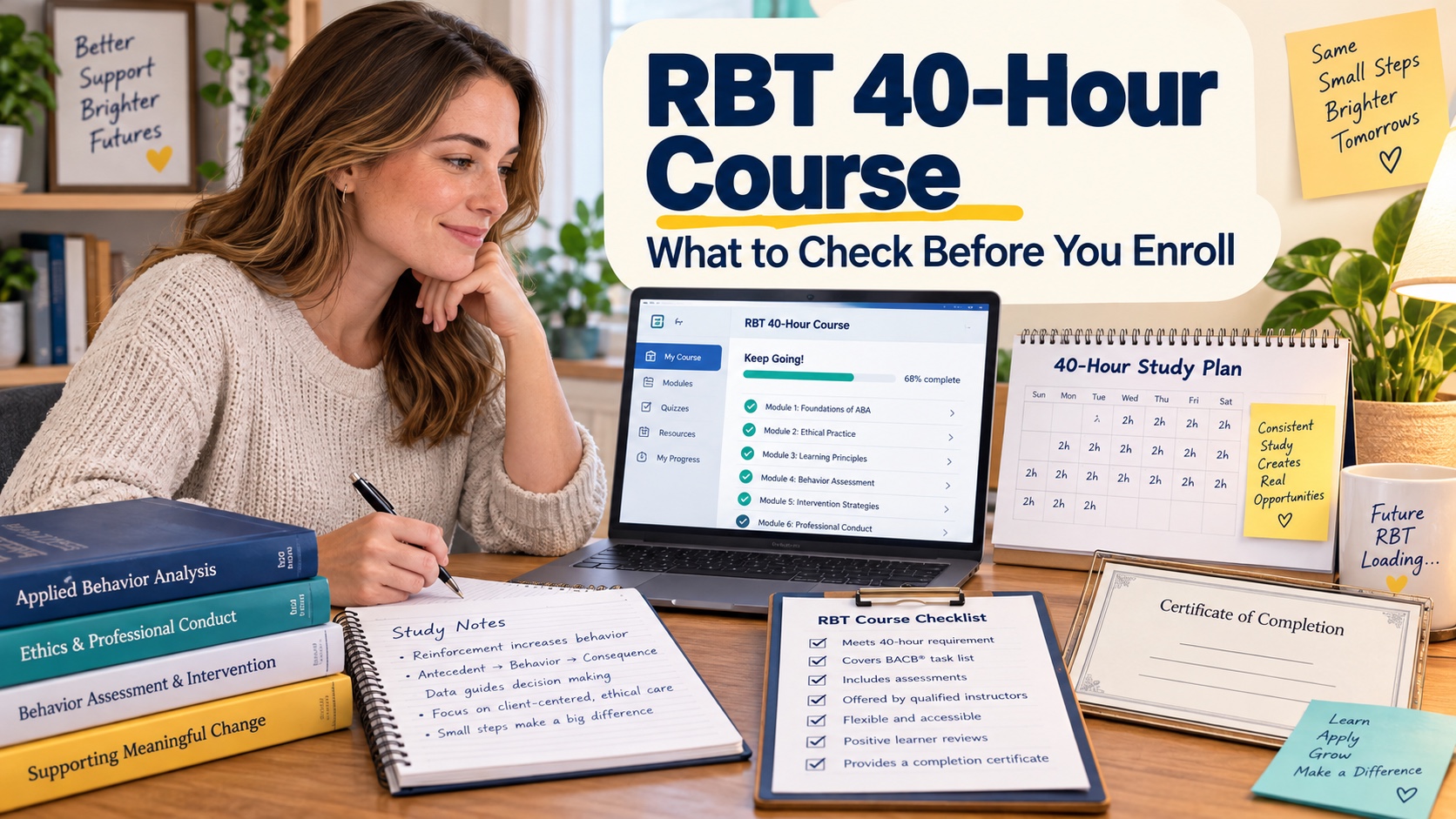
RBT 40-Hour Course: What to Check Before You Enroll
Searching for an RBT 40-hour course is usually the first step in a larger process. You are not only choosing videos or a class schedule. You are trying to find training that meets the current Registered Behavior Technician requirements, fits the required completion window, gives you usable documentation, and prepares you for the next certification steps. A course certificate by itself does not make someone an RBT.
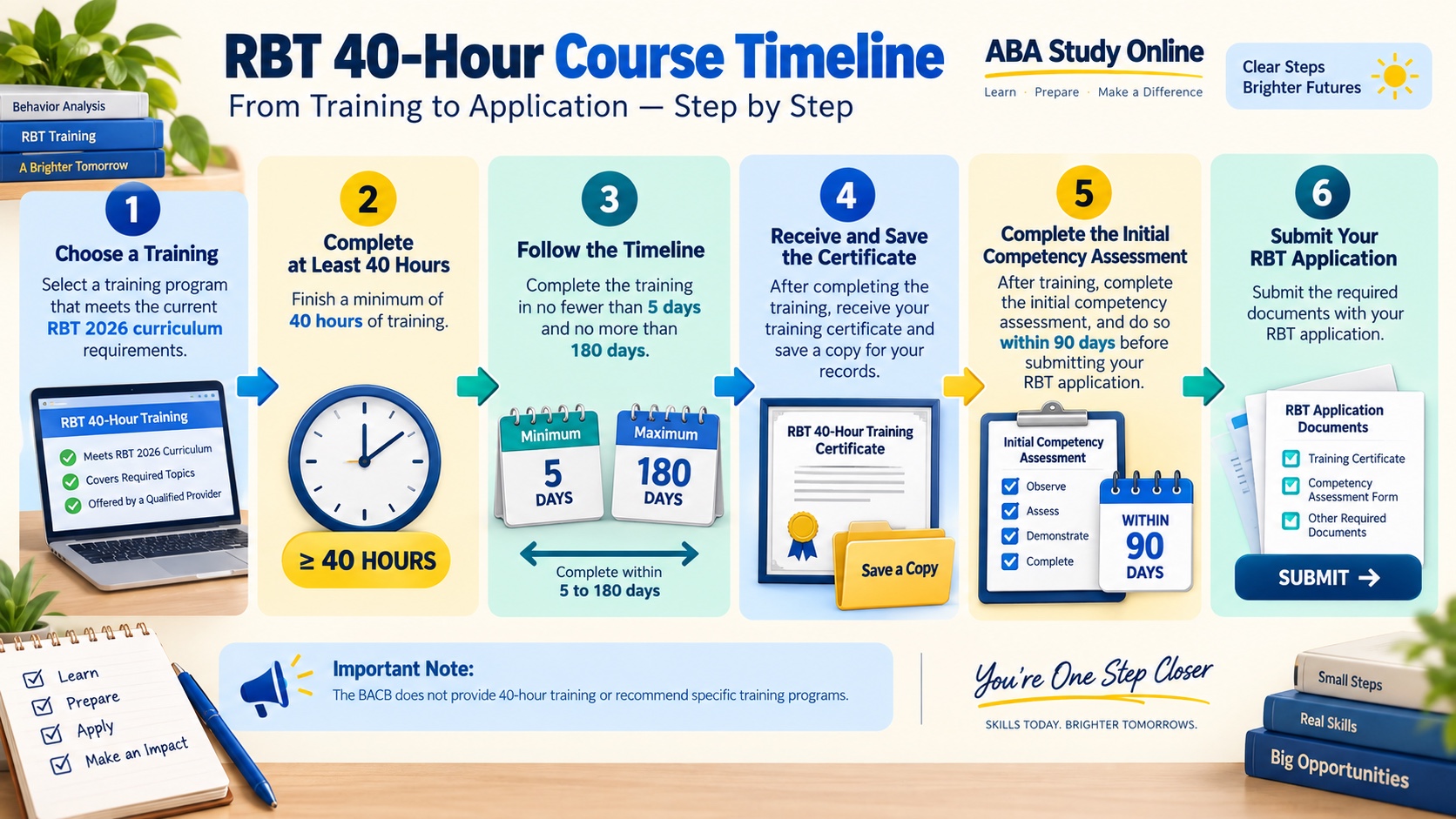
For applicants applying on or after January 1, 2026, the BACB’s current RBT materials point to the RBT 2026 40-Hour Training Requirements and Curriculum Outline. The training must include at least 40 hours, be completed in no fewer than 5 days and no more than 180 days, and cover the required curriculum. After training, the applicant must complete the initial competency assessment and submit the required application documents. Use the current BACB handbook and training outline as the authority when a course page makes a vague or outdated claim.
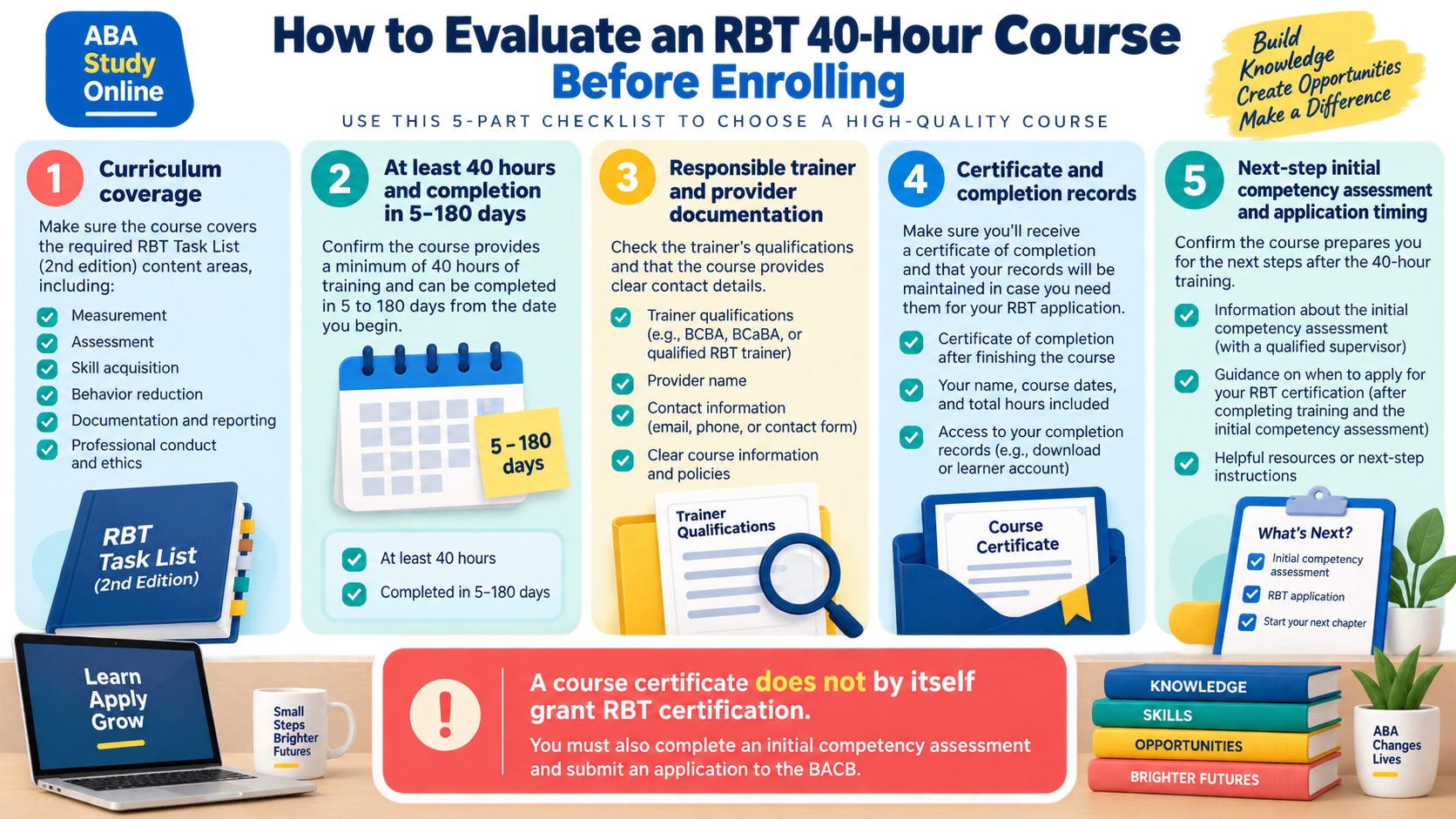
Quick answer: look for a course that clearly identifies the current RBT 2026 curriculum, provides at least 40 hours completed over 5–180 days, explains who is responsible for the training, issues a completion certificate with useful details, and prepares you for the initial competency assessment and application. Do not rely on the phrase “BACB-approved course” without checking the current official requirements. The BACB states that it does not provide 40-hour training, certificates of completion, or training-program recommendations.
Current 2026 requirements at a glance
The RBT 40-hour training is a core eligibility requirement for a new RBT applicant, but it is one part of the application sequence. The current handbook and training outline create several checks that should be visible before you enroll:
- Total time: at least 40 hours of training.
- Completion window: no fewer than 5 days and no more than 180 days, counting the start and end dates.
- Curriculum: the training must cover the current RBT 2026 curriculum outline in the context of behavior-technician service delivery.
- Certificate: save the provider’s completion certificate and the course records that support it.
- Next step: complete the initial competency assessment after the training and no more than 90 days before submitting the RBT certification application.
The timeline matters. A course that can be clicked through in a weekend may not meet the current minimum-day requirement, even if the page advertises “40 hours.” A course that takes longer than 180 days may also create an eligibility problem. Ask for the start-date and end-date rule before you begin, and keep your own record of when the training actually started and finished.
What the course should cover
The official RBT 2026 outline is more useful than a course page that lists only broad topic names. It organizes training around service delivery. The outline includes introductory applied behavior analysis, preparing for service delivery, data collection and graphing, behavior-change interventions, documentation and reporting, professionalism and requirements, and other required content. Each section has a minimum training duration, and the listed section minimums total 38 hours; the complete training still has to total at least 40 hours.
Before enrolling, open the syllabus or curriculum map and check for concrete coverage such as:
- stimuli, responses, the three-term contingency, reinforcement, and common functions of behavior;
- readiness for service delivery, preparing materials and the environment, and building rapport or gaining assent;
- observable definitions, data collection, graphing, and communicating session information;
- skill-acquisition and behavior-change procedures taught in the context of technician service delivery;
- professional conduct, ethics, role boundaries, supervision, and documentation requirements; and
- practice opportunities or checks that help you demonstrate usable performance, not only passive video completion.
Course labels do not have to match the outline word for word, but a provider should be able to show how its modules cover the required content. If the page talks only about general child development, classroom management, or a generic “ABA introduction,” ask for the complete curriculum map before paying.
Trainer, provider, and documentation checks
The BACB does not recommend specific 40-hour programs. A training may be offered by an employer, university, or online program, but you should be able to identify the organization, the responsible trainer, the course dates, the total hours, the curriculum, the completion process, and the record you will receive. A professional-looking sales page is not a substitute for those details.
Ask these questions before enrolling:
- Who is responsible for the training, and what qualifications or experience do they list?
- Does the course explain how it meets the RBT 2026 curriculum outline?
- How are the 40 hours distributed, and how does the platform enforce the 5–180 day window?
- What certificate will be issued, and will it include your name, provider, course dates, total hours, and completion information?
- What learner records can you download or access if you need them for your application?
- Does the course explain the initial competency assessment without pretending to perform that assessment through a quiz?
Be careful with “approved,” “official,” or “guaranteed” language. The BACB’s current materials are the source for requirements; a training provider cannot guarantee that you will pass the exam or become certified. The training certificate is evidence that you completed a course. It is not the RBT credential itself.
What happens after the training?
After you complete the required 40-hour training, you still need to demonstrate competency using the applicable initial competency assessment. The current RBT Handbook states that this occurs after the training and no more than 90 days before you submit an RBT certification application. The assessment is not simply another knowledge quiz. It is intended to document competence in the tasks described by the current assessment requirements.
You should also confirm who can conduct the assessment and what form or packet must be uploaded. Keep the training certificate, assessment documentation, identity or attestation records, and any other required materials together. If a course does not explain what document you will receive at the end, that is a reason to pause and ask questions—not proof that the course is invalid, but a preventable documentation risk.
Training and examination preparation are related but different. The RBT Test Content Outline, 3rd edition, is the exam-content reference identified by the BACB for examinations beginning January 1, 2026. A good 40-hour course teaches the required training curriculum; it should not market itself as the BACB exam or imply that finishing training equals passing the exam.
Can the training be online?
An online format can be practical, especially when it provides a clear course map, progress records, opportunities to practice, and accessible documentation. The format alone does not determine compliance. Check the current curriculum, hour total, dates, completion rules, responsible trainer, certificate, and next-step instructions.
Before paying for an online course, test the learner experience if possible. Can you see the module list? Does the platform show completed hours? Are quizzes or activities tied to the learning objectives? Can you contact the provider? Will you be able to retrieve your certificate later? These questions matter because the application process may happen weeks or months after you finish the training.
Need a study loop alongside your course?
Use the ABA Study Online RBT learning path and RBT practice questions to review terminology, data collection, reinforcement, measurement, and exam-style decisions. This study support does not replace a qualifying 40-hour training, the initial competency assessment, or the BACB application.
Common course-selection mistakes
- Choosing the cheapest course without checking the curriculum: price does not show whether the required sections and duration are covered.
- Finishing in fewer than 5 days: a fast completion can conflict with the current minimum-day rule.
- Ignoring the 180-day limit: a long pause may put the start-to-finish window outside the requirement.
- Confusing a quiz with the competency assessment: the course may prepare you, but the required assessment is a separate step.
- Assuming the certificate is the credential: you still need the assessment, application, and examination process.
- Trusting “BACB approved” marketing: verify the current official requirement documents and do not assume the BACB recommends a provider.
A pre-enrollment checklist
- Save the current RBT Handbook and RBT 2026 40-Hour Training Requirements and Curriculum Outline.
- Compare the course syllabus with the required curriculum sections.
- Confirm at least 40 hours and a completion window of 5–180 days.
- Record the provider, responsible trainer, contact information, start date, and planned end date.
- Ask what the completion certificate contains and how you will retrieve it.
- Plan the initial competency assessment after training and within the application timing window.
- Keep all documents in one application folder and label them with dates.
- Use the current BACB application and examination instructions when you are ready to apply.
FAQ
Is the BACB 40-hour course free?
The BACB does not provide a 40-hour training program. Training may be offered by an employer, university, or online provider. Compare the course against the current BACB requirements instead of assuming that free or paid automatically means qualifying.
Can I finish the RBT 40-hour course in one weekend?
The current 2026 rule requires completion in no fewer than 5 days and no more than 180 days, so a one-weekend completion would not fit the minimum-day boundary. Check the current handbook if the requirements change.
Does a 40-hour certificate make me an RBT?
No. The certificate documents training completion. You still need the initial competency assessment, the required application documents, and the certification examination and application process.
Can I take the RBT 40-hour training online?
An online program may be an available format, but the format does not replace the current requirements. Verify the curriculum, total hours, 5–180 day window, responsible trainer, certificate, records, and post-training assessment steps.
For terminology support, use the ABA glossary. For certification planning, start with the current BACB RBT Handbook and the RBT 2026 training outline. ABA Study Online provides study support, not a certification guarantee.