RBT 3rd Edition Practice Test: What to Check Before You Study
Searching for an RBT 3rd edition practice test usually means you want questions that match the exam content beginning in 2026. You may be comparing free browser quizzes, paid PDFs, apps, or full-length mock exams. Many pages use similar language, but the label alone does not tell you whether the material covers the current outline, explains the answers, or helps you review mistakes.
The current BACB reference point is the RBT Test Content Outline, 3rd edition. Use it to check a practice product’s edition, domain coverage, and terminology. Then judge the practice experience by a second standard: can you turn a missed or uncertain question into a concrete next study action?
Quick answer: what a current practice test should contain
A useful RBT 3rd edition practice test should name the current TCO, represent all six domains, use original questions, explain the answer, and let you review the pattern behind an error. If it claims to simulate the exam, it should also make its question count and timing clear. If it reports a score, the page should explain what that score means—and what it does not mean.
You do not need to reject a resource because it is short or free. A 10-question set can be useful for a warm-up or a single concept. A full-length form is useful for endurance and pacing. The mistake is assigning a small quiz the job of a readiness assessment, or treating a practice percentage as an official BACB result.
The official RBT 3rd-edition snapshot
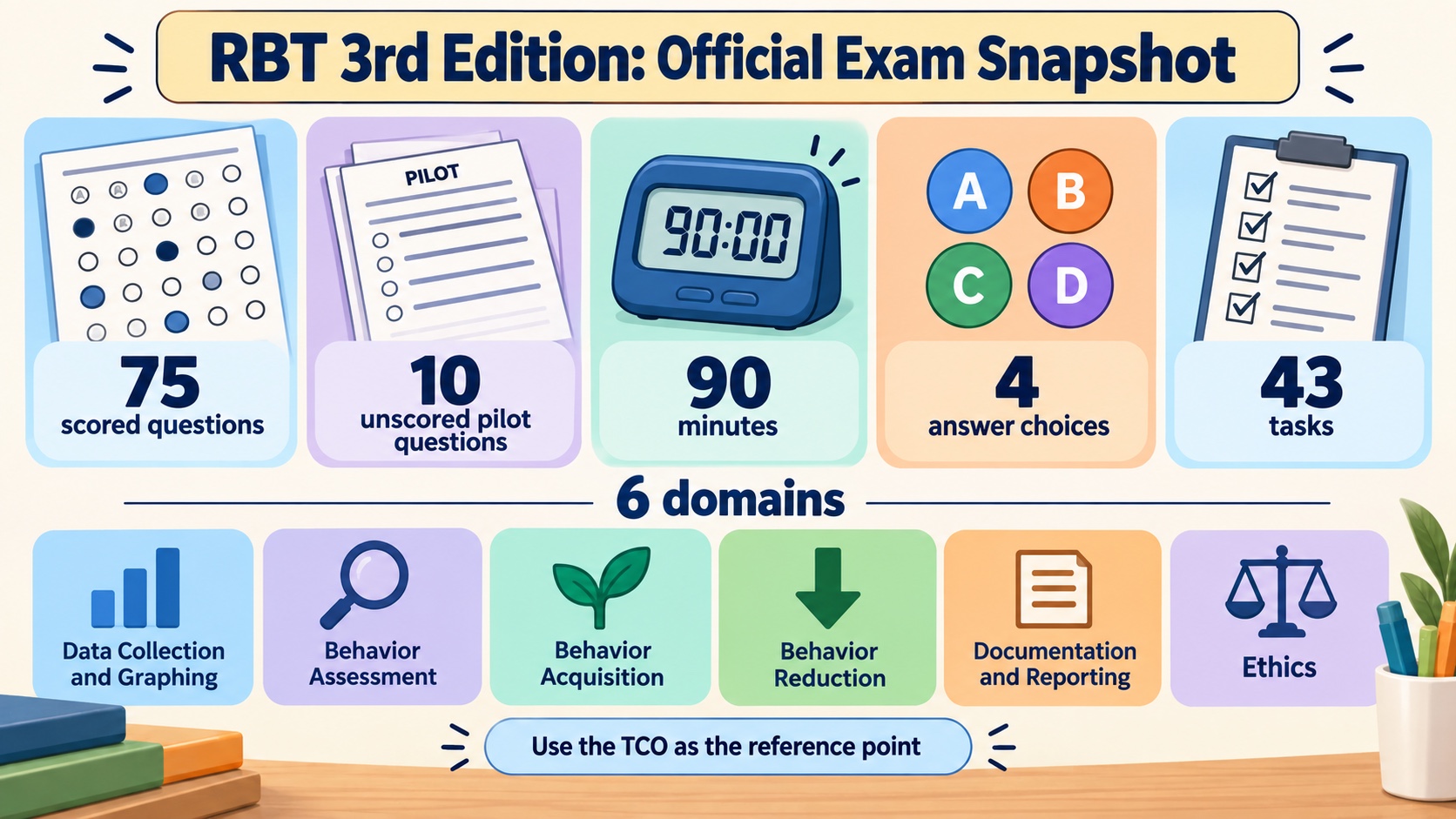
The BACB’s RBT Test Content Outline, 3rd edition, describes 43 tasks organized into six domains. It lists 75 scored questions and 10 unscored pilot questions for the RBT examination. The current RBT Handbook states that candidates have 90 minutes and answer questions with four possible answers and one correct answer.
| Domain | Official TCO question planning count | Share shown in the TCO |
|---|---|---|
| A. Data Collection and Graphing | 13 | 17% |
| B. Behavior Assessment | 8 | 11% |
| C. Behavior Acquisition | 19 | 25% |
| D. Behavior Reduction | 14 | 19% |
| E. Documentation and Reporting | 10 | 13% |
| F. Ethics | 11 | 15% |
The counts are a blueprint for study planning, not a promise about the exact sequence of a live examination. Your practice material does not need to copy the BACB’s secure content. It should use original scenarios and make clear how its categories relate to the current TCO.
What to check before choosing a test
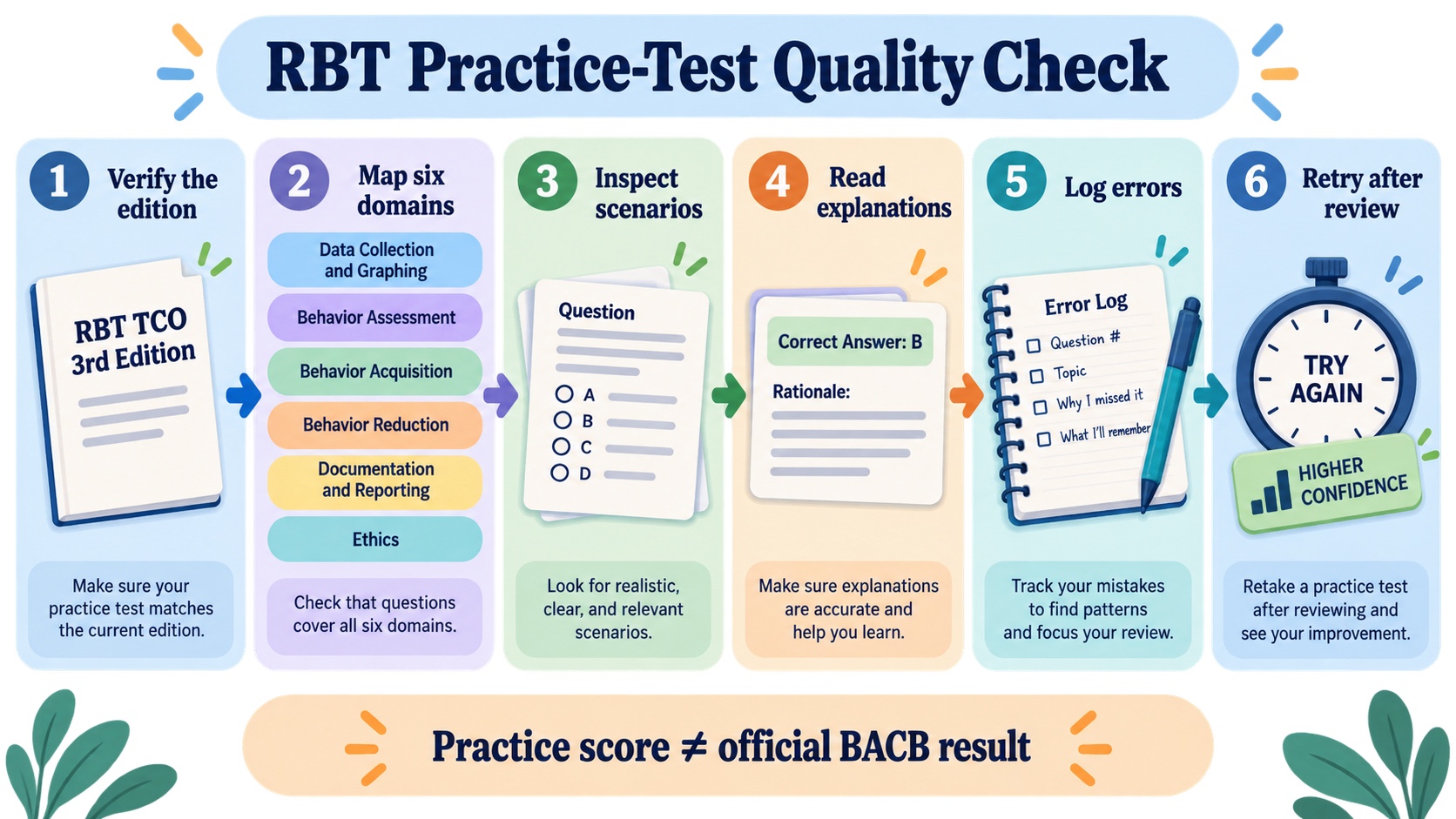
1. The edition is named clearly. Look for “RBT Test Content Outline, 3rd edition” and a meaningful revision date. The previous RBT Task List applied through December 31, 2025; the 3rd-edition TCO began January 1, 2026. A page that only says “RBT task list” without a date needs a closer look.
2. All six domains appear. Check whether the resource covers data collection and graphing, behavior assessment, behavior acquisition, behavior reduction, documentation and reporting, and ethics. A page may use familiar labels such as measurement or skill acquisition, but it should explain how those labels map to the current domain names.
3. The questions require decisions. A vocabulary quiz can support recall, but a useful practice test also includes short scenarios. You should need to distinguish a measurement procedure, choose a next step under a plan, identify an objective note, or recognize a scope and ethics boundary.
4. The answer key teaches. Look for an explanation of why the correct option fits and why the tempting alternatives fail. If you are unsure between two procedures, the rationale should help you see the discriminating feature rather than simply reveal a letter.
5. The format is honest. Does the provider call the resource a quiz, a practice test, a mock, or a study guide? Are question counts, timer settings, attempts, answer review, and access conditions visible? Clear labels help you choose the right job for the tool.
6. The score is bounded. A provider may calculate a percentage, domain result, or progress number. That can guide study. It is not a BACB scaled score, pass decision, or guarantee. The BACB does not endorse specific study guides or other preparation products.
How to use the practice test well
Use a short form first when you are still learning the material. Choose one domain, answer without looking at notes, and mark confidence before you reveal the key. This turns the quiz into a diagnostic: you can separate a concept you do not know from a concept you recognized but could not apply.
For a baseline, choose a longer form and record the conditions. Note whether you used a timer, paused, changed answers, or searched for a term. The number is easier to interpret when you know what happened during the attempt. Do not compare scores across different products as if they were calibrated to one scale.
After the attempt, create a simple error log with five fields: domain, concept or task, selected answer, reason for the error, and next action. Useful error tags include “definition gap,” “misread the scenario,” “confused two procedures,” “data or graph error,” “scope boundary,” and “low-confidence guess.”
Then choose a repair action. Read one explanation, draw a small data example, compare two procedures, write an objective session-note sentence, or answer three new scenarios. Return after a delay. A fresh mixed set tells you more about retention than immediately repeating the same questions.
Free versus paid practice formats
Free practice is valuable when it removes the first barrier. Use it to preview question style, find unfamiliar terms, and build a regular habit. Before you depend on it, check its edition, explanation quality, and whether the page distinguishes practice performance from the official result.
Paid practice may add more forms, detailed rationales, printable files, domain reports, saved history, or a structured review queue. Those features can be worth paying for when they solve your current problem. Do not buy only because a page says “closest to the real exam” or displays a pass-oriented headline. Ask what is actually included, how it is updated, and whether the purchase gives you a way to act on the result.
If a product page uses the old 2nd-edition task-list language while calling itself 3rd-edition practice, treat that as a warning to investigate. It may contain useful general ABA questions, but it should not be your only current-edition study map.
Common practice-test mistakes
One common mistake is taking several tests from the same small question bank and reading the rising percentage as mastery. Familiar wording can make recall feel stronger than it is. Another is studying only the biggest domain, behavior acquisition, and neglecting documentation, assessment, data, behavior reduction, or ethics. Use the TCO’s six-domain map to keep the review balanced.
A third mistake is reviewing only wrong answers. Mark uncertain correct answers too. If you guessed correctly, the concept may still need repair. A fourth is treating a rationale as a replacement for practice. After reading an explanation, close it and create a new example or answer a different scenario. Finally, do not use a practice test to decide whether you meet eligibility requirements. Training, competency assessment, application, examination, and ongoing supervision are separate parts of the certification pathway.
When comparing providers, save a small evidence note: the URL, the edition named, the question count, whether explanations are included, and the date you checked it. That note makes your choice auditable and helps you notice when a resource quietly changes its language. It also keeps a free quiz in its proper role: a useful input to your study plan, not the plan’s authority.
For a first attempt, choose clarity over intensity. You should be able to see the question, answer choices, explanation, and next step without fighting the interface. A calm review experience makes it easier to notice whether the problem is knowledge, discrimination, pacing, or confidence. That makes the second attempt more informative and less dependent on memory alone.
Build your next RBT practice block
ABA Study Online’s RBT learning path can help you review concepts before a practice test. The RBT question route can give you short retrieval practice, while the app can carry flashcards, progress, and repeated review into a daily routine. These are independent study resources, not official BACB materials.
Turn missed questions into your next study action
Use ABA Study Online’s independent RBT practice and app review tools to organize concepts, questions, and follow-up practice. The materials do not issue BACB scores, replace official requirements, or guarantee a passing result.
FAQ
What changed for the RBT 3rd edition?
The RBT examination beginning in 2026 is based on the RBT Test Content Outline, 3rd edition. The TCO organizes 43 tasks into six domains and lists 75 scored plus 10 unscored questions. Use the current BACB TCO and Handbook for the complete boundary.
How many questions should an RBT practice test have?
A full-length practice test may use 85 total questions to mirror the official scored and unscored count, while a shorter quiz can be useful for one topic. Question count alone does not establish quality or current alignment.
Is a practice-test score the RBT passing score?
No. A provider’s percentage is a result on that practice form. The BACB does not publish a practice provider’s score as an official certification decision, and a practice result should be used to choose review work.
Should I study the RBT 2nd edition or 3rd edition?
For the current 2026 exam period, use the RBT 3rd Edition TCO and current Handbook as the primary references. Older materials may provide extra concept practice, but check their labels and do not let them replace the current outline.