
Purdue Global BCaBA: What the Program Says and What to Verify
If you searched for Purdue Global BCaBA, you may be trying to decide whether the university’s applied behavior analysis programs can support a BCaBA certification route. The current Purdue Global catalog describes a Bachelor of Science in Psychology in Applied Behavior Analysis and says its courses have been designed to meet BCaBA Pathway 2 coursework requirements. That is useful information, but it is not the same as a promise that every applicant is automatically eligible to take the examination.
The practical answer is to read the catalog and the BACB rules together. The program version, qualifying courses, supervised learning, application year, state requirements, residency rules, and official records all matter. This guide explains what the current catalog says and gives you a verification checklist before you enroll, transfer, or change plans.
Table of Contents
Short answer: does Purdue Global have a BCaBA route?
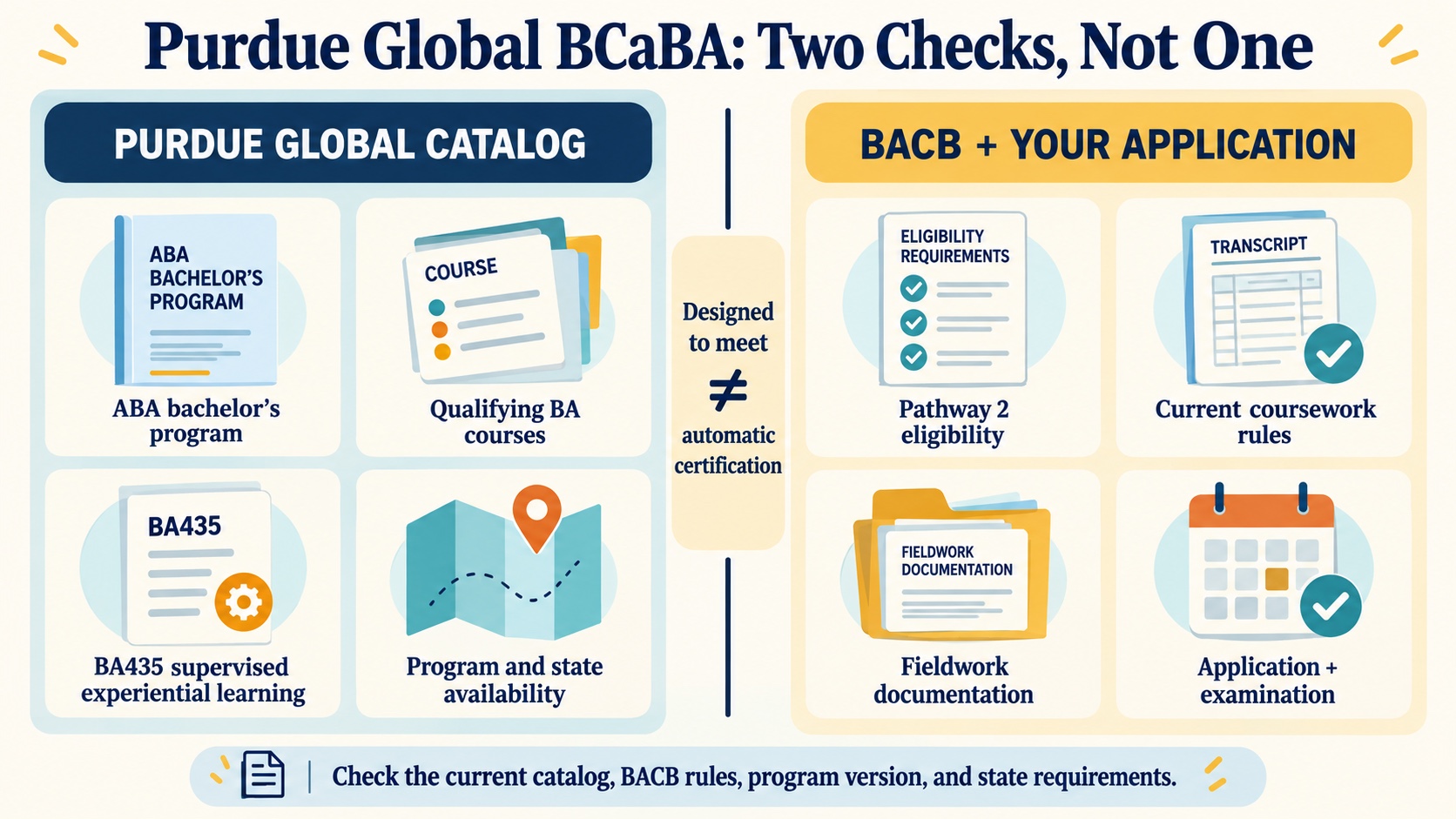
Yes, Purdue Global currently lists an ABA bachelor’s program and states that the courses have been designed to meet BCaBA Pathway 2 coursework requirements. The catalog also lists an Applied Behavior Analysis postbaccalaureate certificate among its offerings. However, the same catalog says applicants must meet additional BACB eligibility requirements and review state-specific information.
That distinction is the most important part of the answer:
- Purdue Global’s statement: its listed program and course design are intended to align with a BCaBA education route.
- The BACB’s decision: the BACB reviews the certification application under the requirements and documents that apply to the applicant.
- The student’s responsibility: confirm the current program version, complete the required route, document fieldwork correctly, and check state or employment rules.
The catalog also says the bachelor’s program is pursuing recognition through the ABAI Tiered Model of Education and clearly notes that pursuit of recognition does not denote recognition status. Do not rewrite that sentence as “ABAI accredited” or “BACB approved.” Those are materially different claims.
What the current Purdue Global catalog says
The live academic catalog describes the Bachelor of Science in Psychology in Applied Behavior Analysis as a minimum 180-quarter-credit program. Its stated outcomes include behavior-analytic principles, research and data interpretation, functional assessment, behavior intervention, and ethical practice. Those outcomes can help a prospective student understand the academic direction of the program, but outcomes are not a substitute for an individual certification review.
The catalog identifies several practical boundaries:
- Program availability can vary. Purdue Global directs prospective and current students to its state availability and licensure information. A program being listed online does not mean every student can enroll from every location on the same terms.
- Residency and BACB rules still apply. The catalog says applicants must meet additional BACB requirements, including evidence of residency in an authorized country.
- State requirements can be separate. The catalog warns that behavior-analyst requirements vary by state and can change. Certification eligibility is not the same as a state license or an employer’s hiring checklist.
- Credit and course history matter. Some listed courses must be completed at Purdue Global, and the catalog warns that returning students may need to retake certain courses completed more than five years earlier.
These details are why a student should save the catalog page, degree plan, and written adviser response that applied when making an enrollment decision. A search snippet or an older PDF may use a previous course code or an older certification framework.
The ABA courses and supervised learning component
The current catalog lists a sequence of qualifying ABA courses including BA200 Conceptual Foundations of Applied Behavior Analysis, BA285 Ethics in Behavior Analysis, BA400 Foundations of Behavior Analysis, BA410 Introduction to Experimental Analysis of Behavior, BA420 Methods of Behavior Analysis, BA430 Behavior Assessment, BA435 Supervised Experiential Learning, BA440 Behavior Intervention, and BA450 Organizational Behavior Management.
Course descriptions add useful detail. BA420 covers behavioral measurement, data display, visual analysis, and single-case designs. BA430 addresses assessment practices and functional assessment methods. BA440 focuses on behavior intervention, including function-based procedures, generalization, and maintenance. BA450 applies behavior analysis to organizational performance and supervision. These descriptions help you inspect the curriculum rather than judging it by the word “ABA” alone.
BA435 is especially important because the catalog describes it as supervised experiential learning at an approved training site under a qualified BCBA supervisor. It also describes a fieldwork schedule and a minimum number of supervised fieldwork hours for that course. The course page is not the same as a complete personal fieldwork determination, so ask how your experience will be documented under the current BACB fieldwork rules and forms.
Purdue Global also states that students seeking BCaBA certification can begin accruing supervision hours only after beginning a qualifying ABA course, and that hours documented before the first qualifying course will not be recognized by the BACB. If you already have experience at a clinic, do not assume that every earlier hour can be moved into your BCaBA record. Ask the program and supervisor where the clock begins and which documents are required.
How the BACB Pathway 2 boundary works
The BACB’s Pathway 2 route is broader than “finish a Purdue Global class list.” Under the published requirements, the applicant needs a bachelor’s degree or higher, qualifying undergraduate behavior-analytic coursework, practical fieldwork, and a passing BCaBA examination. The coursework must be completed at the undergraduate level at a qualifying institution, within the applicable time window, for academic credit, with a passing grade, and in a program with a qualified Pathway 2 Program Contact.
The coursework and fieldwork are separate records. A transcript can show that you completed classes; it does not by itself prove that you completed supervised fieldwork. Likewise, a practicum course can be part of a program’s pathway without making every activity outside the approved arrangement count automatically. Keep syllabi, grade records, fieldwork forms, supervisor details, and application documents in separate folders.
Exam preparation is a third category. The BCaBA Test Content Outline tells you what the examination measures. It does not turn a free practice question, a study note, or a catalog page into academic credit. You can use the ABA Study Online BCaBA learning hub and BCaBA practice questions as study support while keeping eligibility verification with Purdue Global and the BACB.
What changes for BCaBA applicants in 2027
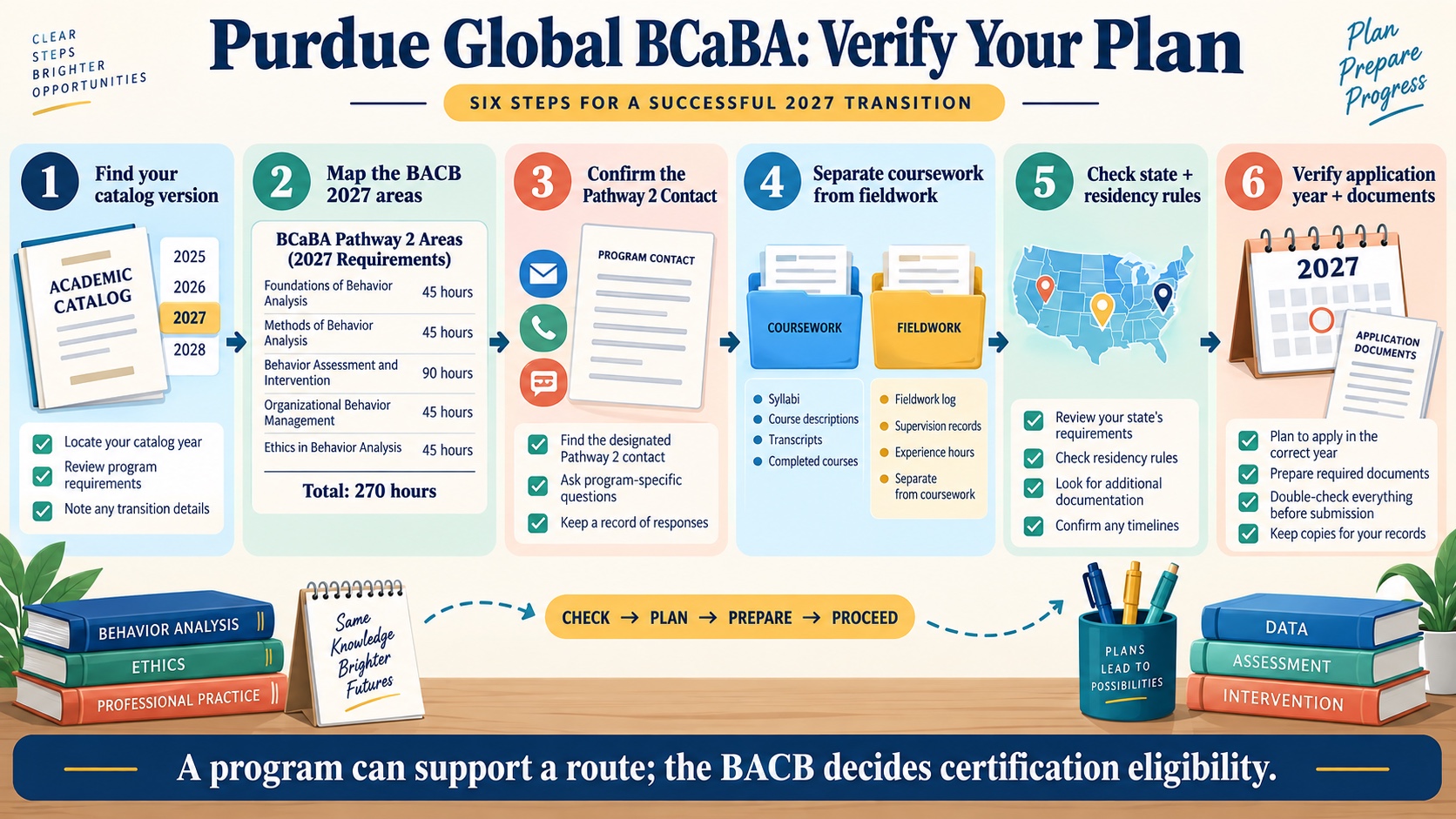
The BACB’s published 2027 BCaBA Requirements take effect January 1, 2027. The document describes two pathways: an accredited degree pathway and a behavior-analytic coursework pathway. For Pathway 2, the published coursework table totals 270 instructional hours across five areas:
| 2027 Pathway 2 area | Instructional hours |
|---|---|
| Foundations of Behavior Analysis | 45 hours |
| Methods of Behavior Analysis | 45 hours |
| Behavior Assessment and Intervention | 90 hours |
| Organizational Behavior Management | 45 hours |
| Ethics in Behavior Analysis | 45 hours, with at least 15 hours in a freestanding course |
| Total | 270 hours |
The current Purdue Global catalog and the BACB 2027 summary answer different questions. Purdue Global describes the courses it currently offers and says they are designed to meet the Pathway 2 coursework requirements. The BACB document describes the certification framework that applies beginning in 2027. If your program plan spans the transition, ask for a written map from your exact course version to the current BACB content and hour requirements. Do not rely on a 2025 PDF, an old VCS label, or a general admissions email.
The BACB also says that a complete application received by December 31, 2026 can be reviewed under the current 2022 requirements, provided all required documents and payment are received. That is a completeness boundary, not a recommendation to submit an unfinished application. If your timing is close, check the current transition guidance and your document status directly.
Questions to ask before enrolling
Use these questions with an admissions adviser, academic adviser, and potential supervisor. Written answers are more useful than a general statement that a program “leads to BCaBA.”
- Which current catalog and degree-plan version will govern my enrollment?
- Which courses in my plan cover each current BCaBA Pathway 2 content area and required hour?
- Who is the Pathway 2 Program Contact, and how does the program verify coursework for my application year?
- How are BA435 practicum hours placed, supervised, and documented?
- When may I begin accruing hours, and what happens to experience completed before the first qualifying ABA course?
- How are transfer credits, advanced-start credits, course substitutions, or older course attempts handled?
- What state, residency, background-check, or employer requirements could apply in the place where I want to work?
- Which documents will I send to the BACB, and who is responsible for each one?
Common mistakes
- Calling the program BACB-approved: the catalog says courses are designed to meet coursework requirements and points applicants to the BACB for full eligibility rules.
- Using an old VCS PDF as the current answer: compare the live catalog, the current BACB rules, and your exact program version.
- Counting every clinic hour: fieldwork must follow the applicable supervision requirements and documentation process.
- Ignoring the application year: January 1, 2027 changes the framework, while December 31, 2026 is the complete-application boundary described by the BACB.
- Confusing certification with licensure: a BACB credential does not answer every state or employer requirement.
- Assuming a degree title guarantees an exam seat: additional BACB eligibility requirements still apply.
Purdue Global BCaBA FAQ
Does Purdue Global offer a BCaBA program?
Purdue Global currently lists a Bachelor of Science in Psychology in Applied Behavior Analysis and an Applied Behavior Analysis postbaccalaureate certificate. Its catalog says the courses are designed to meet BCaBA Pathway 2 coursework requirements, while also stating that applicants must meet additional BACB requirements.
Is Purdue Global ABAI accredited for BCaBA?
Do not use that shorthand. The current catalog says the bachelor’s program is pursuing recognition through ABAI’s Tiered Model and explicitly says that pursuit of recognition does not denote recognition status. Read the current catalog and ABAI or BACB sources for the exact status that applies to your route.
Does Purdue Global include BCaBA fieldwork?
The catalog lists BA435 Supervised Experiential Learning and describes an approved training site and qualified BCBA supervision. Ask the university how the course fits the current BACB fieldwork requirements, how your hours will be verified, and which additional fieldwork or employer steps remain.
Can I use Purdue Global courses after the 2027 change?
That depends on the exact program and course version, your application timing, and the BACB requirements in force. Request a written 2027 course-to-content map and confirm the plan with the university and current BACB materials before assuming that an older sequence carries forward.