Probe in ABA: Definition, Probe Data, and Probe Sessions
If you are learning ABA terminology, the word probe can seem simple at first: present a skill and see what happens. The important detail is what the practitioner is trying to measure and what teaching support is deliberately absent. A probe gives the learner an opportunity to demonstrate a target response under specified conditions so the team can estimate current, independent, maintained, or generalized performance.
That makes a probe different from a teaching trial. In a teaching trial, the arrangement is designed to change performance through instruction, prompting, error correction, and reinforcement. In a probe, those teaching supports are commonly withheld or restricted according to the written protocol. This article explains the distinction without treating every probe procedure as identical.
Quick answer: what is a probe in ABA?
A probe in ABA is a planned opportunity, or a set of opportunities, to measure whether a learner performs a target response under defined conditions, usually without the teaching prompts and programmed teaching consequences used during instruction. The practitioner records what happened, such as an independent correct response, an incorrect response, or no response, along with any other measure named in the protocol.
A probe is not automatically a complete assessment, a mastery decision, or proof that a skill will occur everywhere. Its meaning depends on the purpose and procedure. A probe before instruction may estimate baseline performance. A probe during instruction may show whether responding is emerging with less support. A later probe may check maintenance or generalization. The label tells you that performance is being tested; the phase and conditions tell you what the data mean.
Probe versus teaching, baseline, maintenance, and generalization
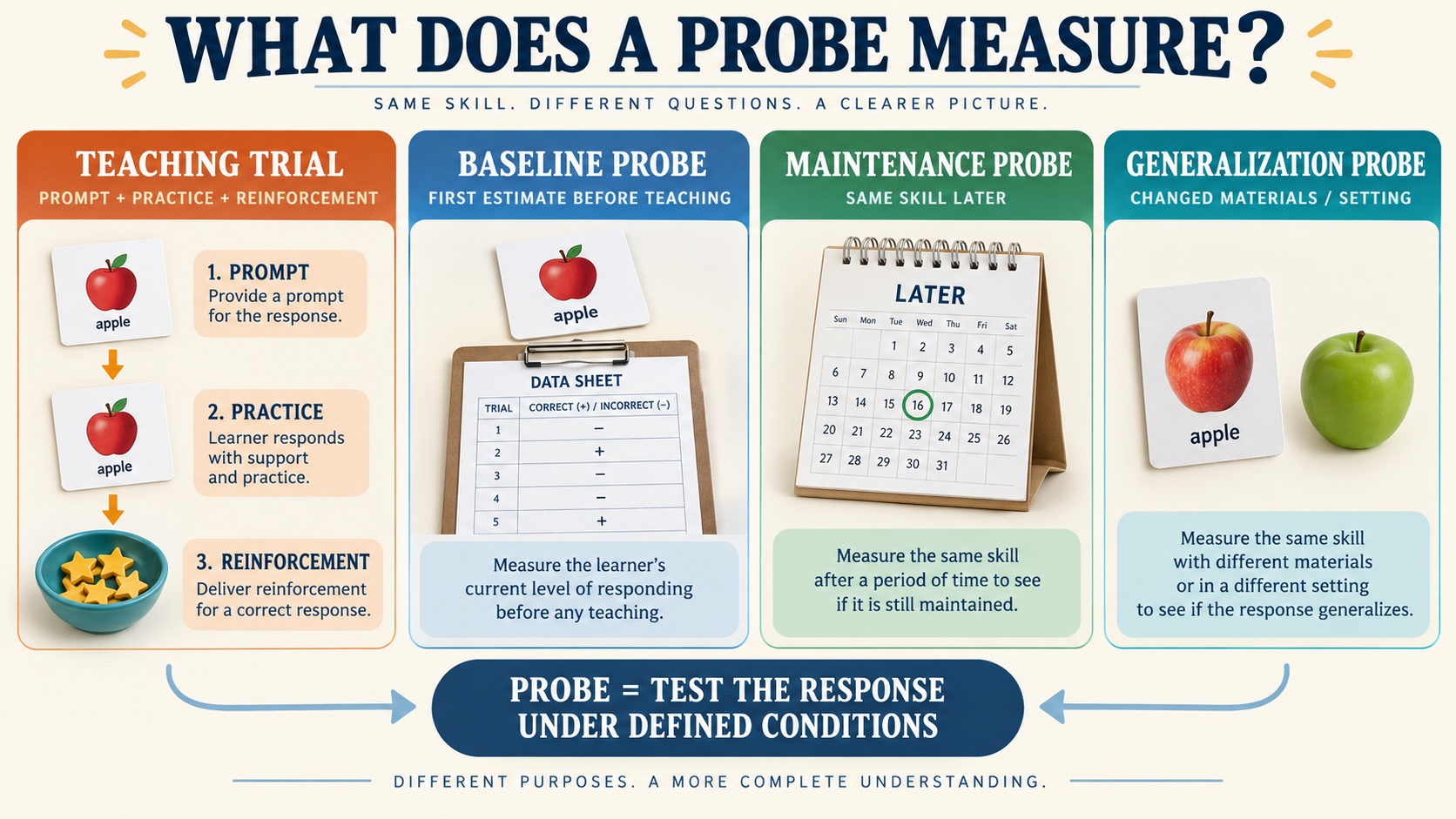
Probe versus teaching trial. A teaching trial is built to support learning. The instructor may present an instruction, add a prompt, use error correction, and deliver reinforcement according to the plan. A probe is built to observe responding with reduced teaching support. If the instructor immediately supplies the answer after every hesitation and reinforces the prompted response, the opportunity is functioning more like teaching than an independent probe.
Baseline probe. A baseline probe is collected before a new teaching procedure to estimate the starting level of the target skill. It can help the team decide whether instruction is needed and provide a comparison for later data. Baseline does not mean that the learner must fail, and it does not mean that every baseline has one trial. The number of opportunities and scoring rule belong in the plan.
Acquisition probe. During acquisition, a probe can be placed before or between teaching blocks to check performance without the full teaching arrangement. It helps the team see whether independent responding is increasing, rather than confusing a prompted success with an unprompted one.
Maintenance probe. A maintenance probe checks whether a skill continues after the learner met the program’s mastery criterion or after direct teaching has been reduced. The team should specify when to check, which materials or cues to use, and what level of performance counts as maintained.
Generalization probe. A generalization probe changes relevant conditions, such as the person, setting, materials, instruction, or response partner, to see whether the skill transfers beyond the teaching arrangement. A learner may respond independently with one instructor at a table but not yet use the skill with a caregiver in a community setting. That difference is useful information, not a reason to label the learner as having or not having the skill in every context.
You may also see cold probe used informally for a probe taken before teaching or before a teaching block. Because local programs can define that term differently, read the actual protocol instead of assuming that “cold” always means one trial or a particular consequence.
How a probe opportunity or session works
A well-defined probe makes the conditions visible. The exact procedure varies, but a learner or student can study the following sequence:
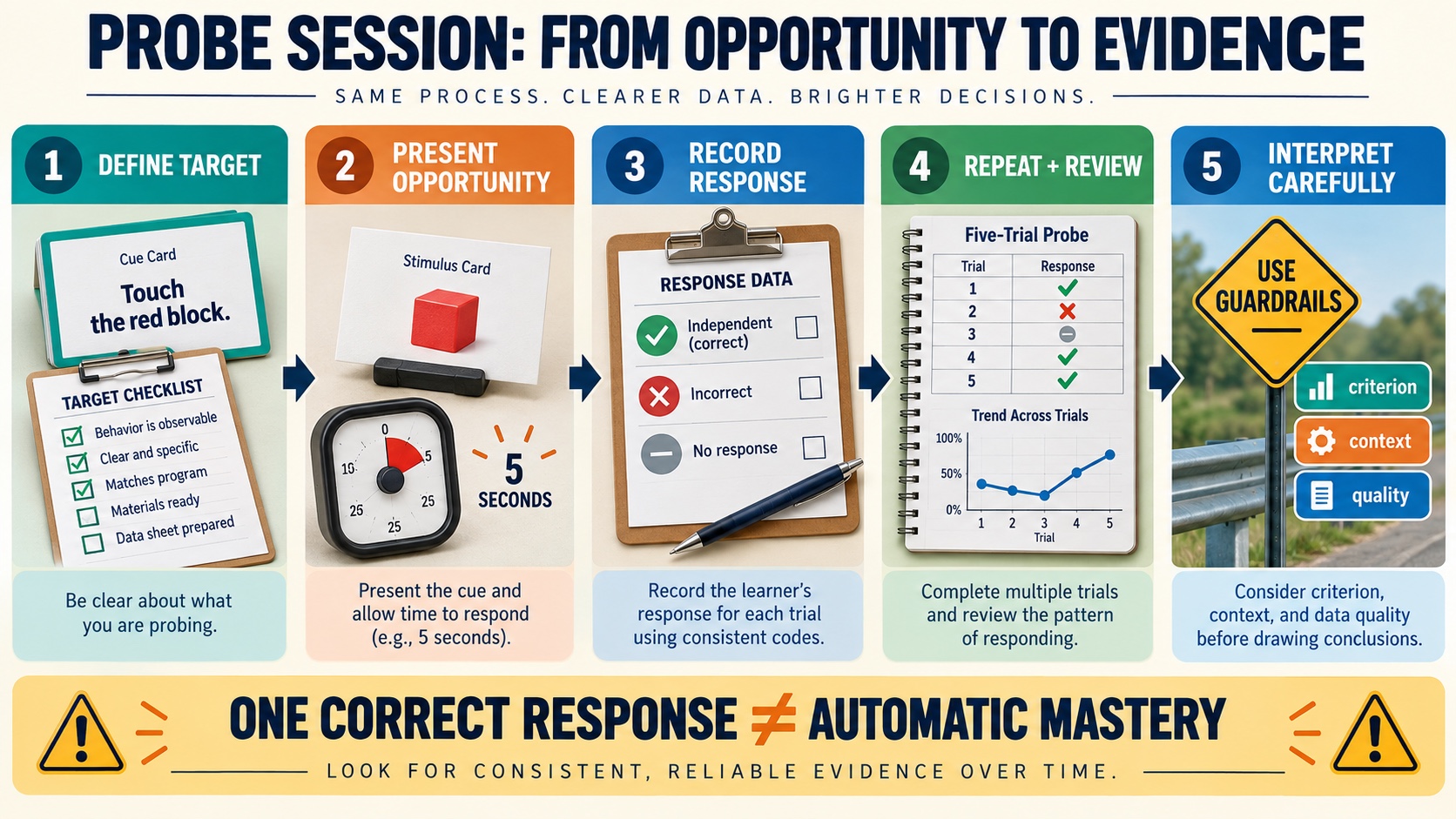
- Define the target. State what counts as the response and what does not. “Requests a break” is less precise than “hands the break card to the instructor or says ‘break’ within 5 seconds of the arranged opportunity.”
- Arrange the opportunity. Present the relevant materials, cue, motivation, or environmental condition. The arrangement should match the purpose of the probe and avoid accidentally adding an unplanned prompt.
- Allow the stated response window. The protocol may allow a fixed number of seconds, a single opportunity, or several opportunities. Do not silently extend the window because the learner is close to responding.
- Record the response. Record the planned measure, such as independent correct, prompted, incorrect, no response, latency, or a task-analysis score. If the probe is meant to measure independent performance, a prompted response should not be scored as independent.
- Follow the consequence rule. Many probe protocols withhold programmed teaching reinforcement and prompts, using neutral feedback or moving to the next opportunity. Other protocols may specify a different safe and ethical consequence. Follow the approved procedure rather than inventing one.
- Repeat and review. Multiple opportunities can reveal a pattern more clearly than one response. The team reviews the data against the stated criterion and decides whether to teach, continue, modify, generalize, maintain, or collect more information.
This sequence also explains why a probe should not be improvised casually in a real service setting. The cue, response definition, response window, scoring rule, and consequence can change the result. In educational study examples, keep the scenario fictional and never include identifying client information.
An original probe-data example
Imagine a fictional program targeting a learner’s request for a break. The written plan defines an opportunity as: the instructor presents a moderately difficult task, places the break card within reach, and waits up to 5 seconds after the learner looks toward the materials. An independent response is handing over the card or saying “break” without a prompt. The probe contains five opportunities, and the instructor uses neutral feedback rather than the programmed teaching reinforcement during the probe.
The learner’s scores are: independent, independent, no response, independent, incorrect. The simple summary is 3 of 5 independent responses, or 60%. That number is useful, but it is not the whole conclusion. A reviewer would also ask whether the five opportunities were comparable, whether the motivation arrangement was consistent, whether the card was visible, whether the response definition was applied consistently, and what mastery rule the program selected in advance.
After the probe, the instructor may begin teaching trials with a prompt and reinforcement if that is the approved plan. The teaching data should be labeled separately. Mixing prompted teaching responses into the probe score would make the learner’s independent performance look stronger than the probe was designed to measure.
How to interpret probe data
Probe data answer a narrow question: what happened under these defined conditions on these opportunities? They can contribute to decisions about skill acquisition, maintenance, and generalization, but they do not answer every question about the learner or the intervention.
Look for level, such as the percentage of independent responses; trend, such as performance increasing across scheduled probes; and condition, such as whether responding changes with a different instructor or material. Also check the integrity of the procedure. If a prompt was accidentally delivered, if the response window changed, or if the opportunity was not arranged as written, mark that limitation instead of treating the point as perfectly comparable.
Do not call mastery from one successful probe unless the program’s written criterion explicitly says that one opportunity is sufficient for that target. Do not call generalization from one new material. Do not call maintenance simply because a skill was correct after a short break. Those conclusions require the relevant repeated data, conditions, and criteria.
For exam questions, the best answer often protects the measurement logic: keep teaching and probe data separate, follow the defined procedure, score independent responding accurately, and use repeated data with the stated mastery or generalization criterion. The current BACB Test Content Outline connects these ideas to measurement selection, data interpretation, prompting and fading, maintenance, and generalization.
Common mistakes and study checklist
- Calling every test a probe: identify whether the opportunity includes teaching, prompting, error correction, or programmed reinforcement.
- Assuming every probe is one trial: check whether the protocol uses single-opportunity or multiple-opportunity scoring.
- Scoring prompted success as independent: record the level of support that occurred.
- Ignoring context: distinguish acquisition, maintenance, and generalization conditions.
- Overreading a small sample: use the planned criterion and repeated data rather than one percentage.
Use these six questions while studying:
- What exact target response is being tested?
- What cue, materials, and response window are specified?
- Are prompts or teaching consequences allowed?
- What is the scoring rule for independent, prompted, incorrect, and no response?
- Is the purpose baseline, acquisition, maintenance, or generalization?
- What conclusion is justified by the amount and quality of data?
For another pass through measurement and ABA terminology, use the ABA Theory Blocks, practice the distinction with free ABA questions, or check related terms in the ABA Definition Search. The ABA Study Online app can support flashcards and section practice, while the current written protocol and qualified supervision remain the source for real-world implementation.
FAQ and sources
Is a probe the same as a baseline? No. A baseline probe is one use of a probe before teaching. Probe describes the test arrangement; baseline describes the timing or purpose.
Do you prompt during a probe? Usually, prompts used to teach the target are withheld when the goal is to measure independent responding. The protocol controls whether any support, neutral feedback, or safety response is allowed.
Can a probe measure generalization? Yes, when the probe intentionally tests the response across a relevant changed condition. A generalization probe should be labeled and interpreted separately from a probe using the exact teaching conditions.
Does one correct probe response prove mastery? Not by itself. Compare the result with the written mastery criterion, repeated probe data, and the conditions in which the skill is expected to occur.
What is probe data? Probe data are the recorded measurements from planned probe opportunities or sessions. They may include independent accuracy, errors, no responses, latency, or other measures specified by the procedure.
Sources
- BACB Task Lists for BACB Certifications
- BACB BCBA Test Content Outline (6th ed.)
- BACB BCaBA Test Content Outline (6th ed.)
- National Professional Development Center: Prompting Steps—Simultaneous Prompting
- Grow and LeBlanc: Evaluating Three Methods of Stimulus Rotation when Teaching Receptive Labels
- Varied Treatment Response in Young Children with Autism
- Evaluating the Cool Versus Not Cool Procedure via Telehealth