Pragmatism ABA Definition: What It Means
In ABA, pragmatism is the idea that the value of a concept, explanation, or plan is connected to what it helps people understand and do in practice. A pragmatic behavior analyst does not stop at an interesting description. They ask whether the analysis helps predict behavior, supports effective action, and improves an outcome that matters to the learner and the people involved.
That does not mean “use whatever seems to work.” Pragmatism still needs clear goals, trustworthy evidence, ethical boundaries, and attention to social significance. It is a philosophical stance that keeps science connected to consequences in the real world. For an exam question, remember the central phrase: usefulness and effective action under relevant conditions.
Quick answer: what is pragmatism in ABA?
Pragmatism in ABA is the philosophical assumption that ideas and analyses should be judged partly by their practical consequences: whether they help us understand behavior, guide effective action, and improve socially meaningful outcomes. The emphasis is not on convenience or on a practitioner’s personal preference. It is on whether the analysis does useful work in the setting and for the people whose lives it is meant to affect.
Pragmatism is taught as one of the philosophical assumptions associated with behavior analysis. The current BACB outline pages identify the BCBA and BCaBA content outlines as 6th editions, while BACB’s public overview describes behavior analysis as a science used to understand behavior, change behavior, and improve lives. Use those official pages for exam scope; use the broader behavior-analytic literature for the philosophical discussion.
A concise exam answer might be: “Pragmatism evaluates a behavioral concept or procedure by whether it leads to effective, useful action and meaningful improvement.” If the scenario contains a question about convenience, ask whether the outcome is meaningful and whether the plan works under the conditions that matter—not merely whether it is easy for the staff member.
What pragmatism means in practice
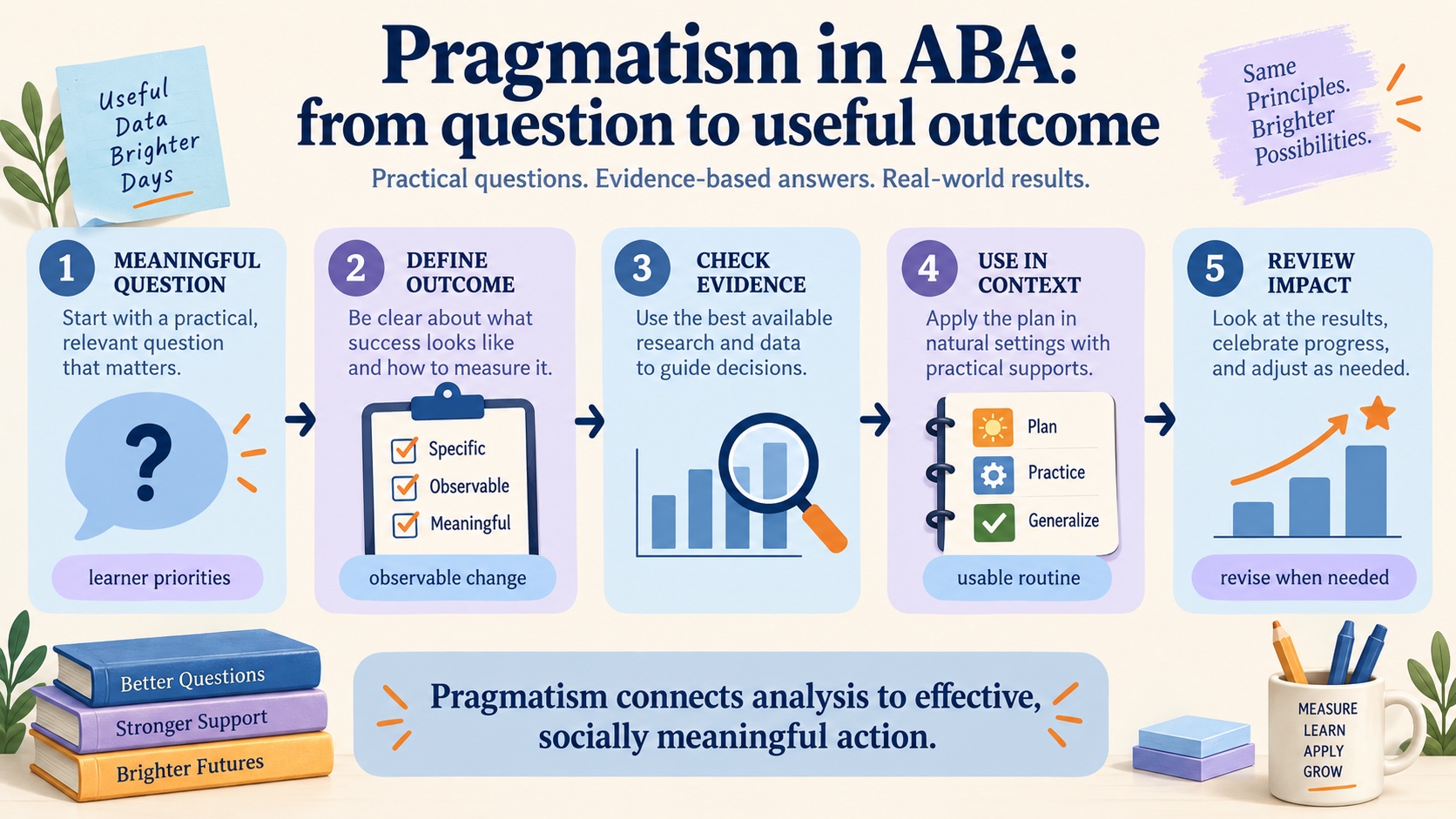
Pragmatic thinking starts with a real problem, not just a technical exercise. A team might ask whether a learner can request a break more independently, whether a parent can use a teaching routine during a busy evening, or whether a student can participate in an important classroom activity. The question is applied because it is connected to the person’s daily life.
The next step is to describe the outcome clearly. “Better communication” is a useful aspiration but not yet a measurement target. A team may define a request as an independent response that occurs within a planned opportunity and then track the number of independent requests, the type of support needed, or the contexts in which the response occurs.
Evidence matters because pragmatism is not a license to trust a pleasing story. Data can show whether the target changed, under which conditions, and with how much variability. A practical plan also needs to be usable. If a procedure produces improvement only when one specialist is present for every interaction, the team may need to consider whether it can be implemented in the settings where the learner actually needs the skill.
Social significance is another part of the practical question. A change can be statistically or visually noticeable and still be unimportant to the learner. A pragmatic review asks whether the goal matters, whether the change improves access or participation, and whether the learner and stakeholders find the outcome acceptable. It also asks whether the plan respects communication, dignity, safety, culture, and choice.
This is why “effective” should be read with a condition attached. Effective for whom, in what setting, for which behavior, and for what purpose? A plan that reduces one observable response but removes a person’s way to communicate may not be a satisfactory practical solution. The behavior analyst needs to look at the broader outcome and identify a useful replacement response when appropriate.
A simple ABA example
Imagine a fictional learner who often waits for an adult to speak for them when choosing an activity. A team introduces a communication support that makes independent requests easier. During therapy sessions, the learner begins requesting more often, and the data show a promising upward pattern.
A pragmatic review does not end with the session graph. The team asks whether the support can travel to the home, classroom, and community settings where independent requesting matters. A family may report that the materials are difficult to carry. The learner may prefer a different response form. Staff may discover that the prompt sequence is too slow during transitions. These details are not distractions from the science; they determine whether the plan produces useful action in the real environment.
The team can respond by measuring the target across relevant settings, asking the learner and stakeholders about acceptability, simplifying the materials when appropriate, and checking whether independence is maintained as prompts are faded. The goal is not to make the intervention look successful in one carefully arranged session. The goal is a meaningful communication improvement that people can use.
One positive anecdote would still be only an initial observation. If a staff member says, “The new card worked today,” that comment can generate a question. It does not by itself establish effectiveness. The pragmatic position is strengthened when the plan produces evidence that supports a useful decision and when the outcome remains meaningful outside the original teaching context.
Pragmatism versus related terms
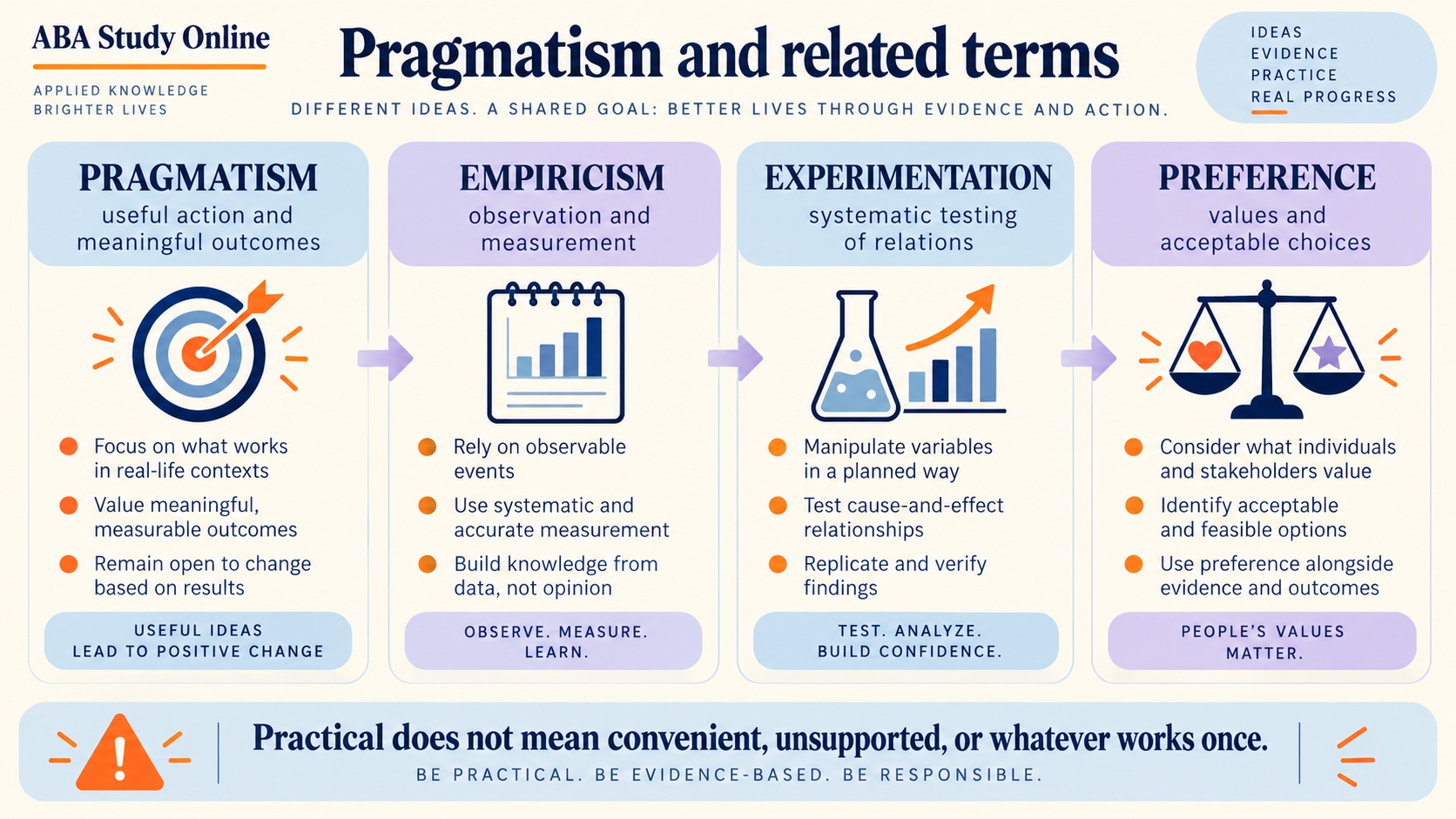
Pragmatism versus empiricism: Empiricism focuses on grounding knowledge claims in observation and measurement. Pragmatism focuses on whether the analysis and resulting action are useful and effective for the purpose at hand. A team needs both: evidence to understand what happened and a meaningful reason to use that knowledge.
Pragmatism versus experimentation: Experimentation systematically arranges conditions to test a relation. Pragmatism asks whether the question, analysis, and outcome help solve a meaningful problem. A pragmatic goal does not remove the need for experimental control, good measurement, or replication when a causal question is being asked.
Pragmatism versus convenience: A convenient plan is not automatically a pragmatic plan. If an intervention is easy for staff but does not improve the learner’s meaningful participation, it has not met the most important practical test. Likewise, a plan that creates unnecessary burden may need revision even if a graph shows a small improvement.
Pragmatism versus preference: Learner and stakeholder preferences help identify acceptable goals, supports, and outcomes. Preference is not the same as evidence that a behavior changed. Pragmatic decision-making respects preferences while still measuring the result and checking whether the plan achieves its purpose.
Pragmatism versus “whatever works”: That shortcut leaves out the questions that make the term useful: works for which target, under what conditions, with what evidence, and with what consequences for the person? A procedure that suppresses communication, is unsafe, or is not socially meaningful should not be treated as a satisfactory outcome merely because one number moved.
Common mistakes and an exam checklist
- Defining pragmatism as convenience: focus on effective action and meaningful outcomes, not only what is easiest to implement.
- Ignoring evidence: a practical decision still needs observation, measurement, and review.
- Confusing usefulness with proof: a plan can appear useful in one situation without establishing a general causal relation.
- Forgetting the person: social significance includes the learner’s and stakeholders’ priorities, acceptability, dignity, and daily context.
- Assuming one outcome tells the whole story: evaluate the target behavior, replacement skills, generalization, maintenance, and side effects when relevant.
- Treating philosophical debate as a single slogan: learn the basic exam definition, but remember that behavior-analytic scholarship contains ongoing discussion about pragmatism and truth.
For an exam scenario, ask:
- What meaningful problem is the team trying to solve?
- What observable outcome would show useful change?
- What evidence supports the decision?
- Will the plan work in the settings and routines that matter?
- Does the outcome respect learner communication, choice, dignity, and stakeholder priorities?
- What should be revised if the plan is not effective or sustainable?
For more ABA foundations, review ABA Theory Blocks, practice evidence distinctions with free ABA questions, or look up related terms in the ABA Definition Search. These are natural study links; this informational page does not make a conversion or exam-performance promise.
FAQ and sources
What is the simplest pragmatism ABA definition? Pragmatism is the idea that behavioral concepts and procedures should be judged partly by whether they lead to effective action and meaningful, useful outcomes.
Does pragmatism mean using anything that works? No. The outcome must be evaluated with evidence and ethical and social-significance boundaries. Convenience alone is not enough.
How is pragmatism different from empiricism? Empiricism asks whether a knowledge claim is grounded in observable evidence. Pragmatism asks whether the knowledge and action are useful for the meaningful problem. They complement each other.
Why is pragmatism important in ABA? ABA is applied to meaningful behavior and real environments. Pragmatism keeps analysis connected to outcomes that improve participation, independence, communication, safety, or another socially important area.