BACB Pathway 2: How to Choose the Right Credential Route
If you search for BACB Pathway 2, you may be looking for coursework, a program contact, an attestation, or a way to qualify for a certification exam. The phrase is useful, but it is incomplete. Pathway 2 is not one universal BACB checklist. The correct requirements depend on whether you are planning for the BCBA or BCaBA credential, which handbook applies to your application, and when you expect to apply.
The most useful first step is therefore not to copy a list of hours from a search result. It is to route yourself to the right credential, then build an evidence folder around that credential’s current rules. This guide explains what the two routes have in common, where they separate, and how to avoid turning a broad search phrase into a wrong application plan.
Quick answer: BACB Pathway 2 generally refers to an eligibility route based on behavior-analytic coursework rather than the accredited or recognized degree route. For a BCBA applicant, that route is connected to a qualifying graduate degree or higher, behavior-analytic coursework, supervised fieldwork, application evidence, and the BCBA examination. For a BCaBA applicant, the degree level and coursework context are different, and the BCaBA Handbook controls the details. In both cases, the institution, current Pathway 2 Program Contact, transcript, fieldwork records, and application date matter.
Choose BCBA or BCaBA before comparing requirements
The phrase “BACB Pathway 2” can appear in university pages and course descriptions for both credentials. That is why a searcher can find two apparently similar checklists with different numbers. The routes share a name and a documentation concept, but they do not create one combined credential.
| Question | BCBA route | BCaBA route |
|---|---|---|
| Who is the page for? | A person planning for the graduate-level BCBA credential. | A person planning for the undergraduate-level BCaBA credential. |
| What does Pathway 2 emphasize? | Qualifying graduate-level behavior-analytic coursework connected to the current BCBA pathway. | Qualifying behavior-analytic coursework connected to the current BCaBA pathway. |
| What must stay separate? | BCBA degree, coursework, fieldwork, application, and examination rules. | BCaBA degree, coursework, fieldwork, application, and examination rules. |
| Where do I verify? | The current BCBA Handbook and BCBA requirements pages. | The current BCaBA Handbook and BCaBA requirements pages. |
This table is a routing aid, not an eligibility determination. If your search began with a university program, ask which credential its coursework is intended to support. If it began with a job goal, ask whether you need the BCBA or BCaBA certification. A program that uses the words “ABA,” “behavior analysis,” or “Pathway 2” in its marketing still needs to be checked against the credential-specific BACB documents.
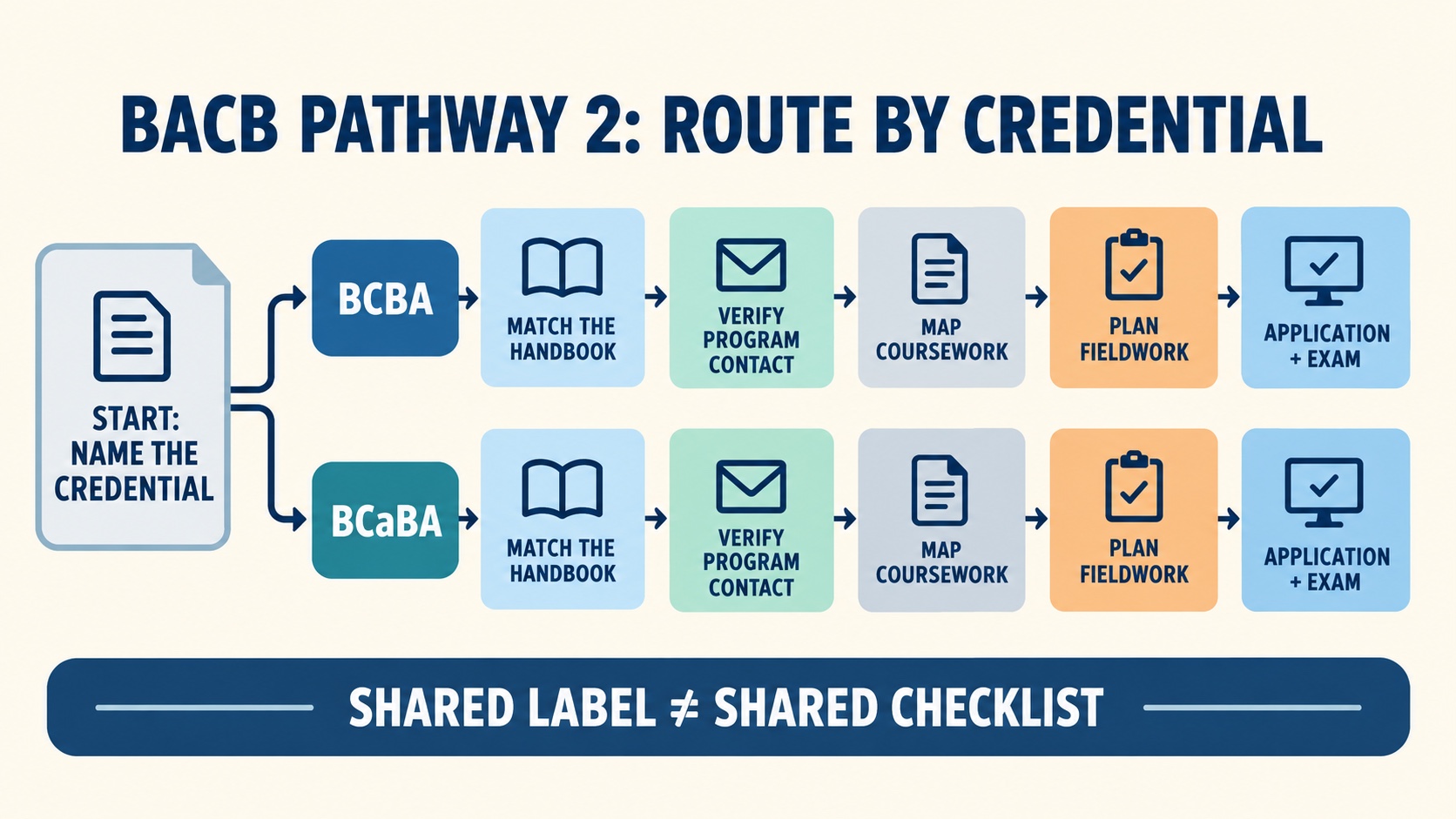
The shared Pathway 2 evidence chain
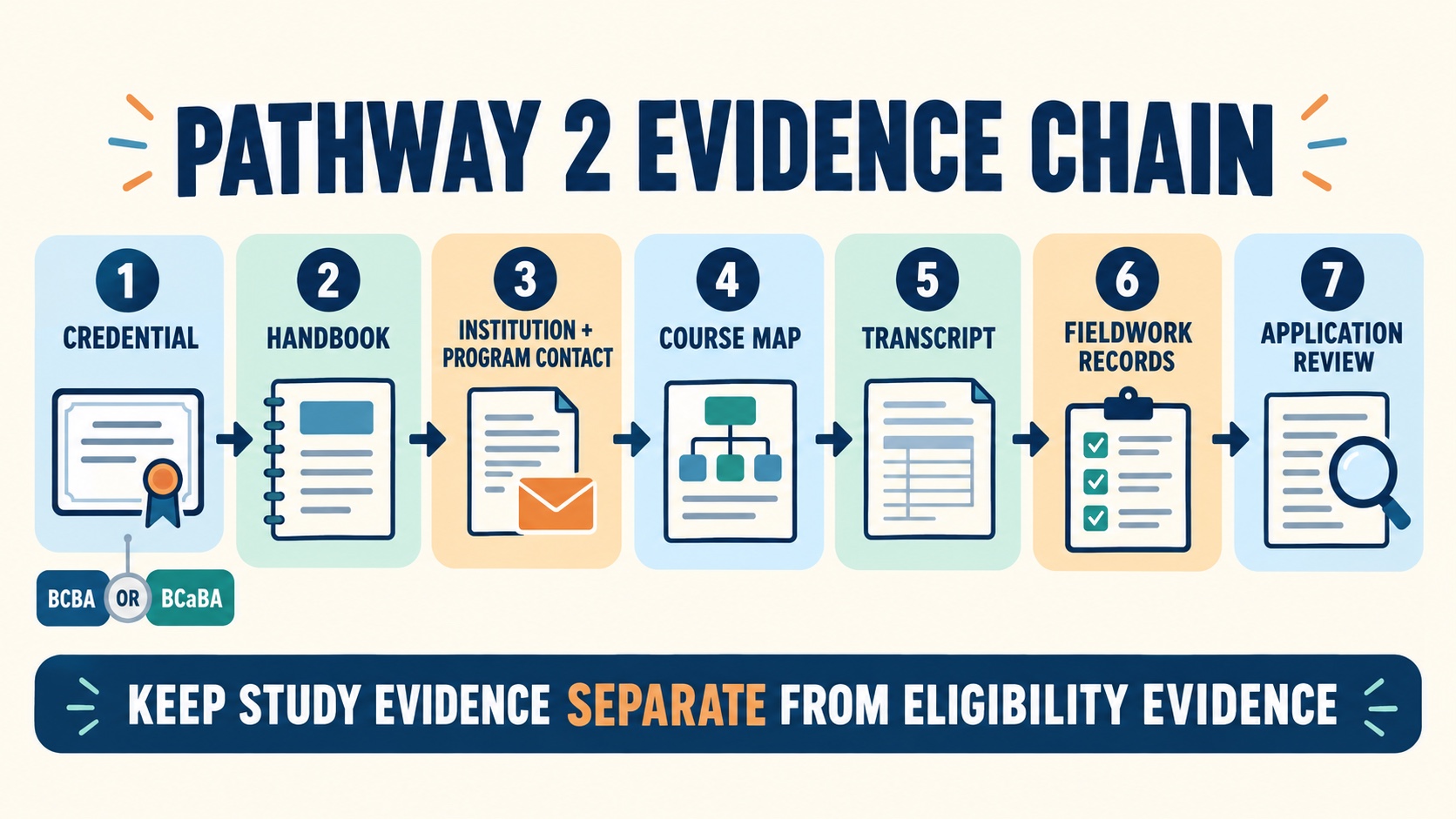
1. Identify the institution and Program Contact
Pathway 2 coursework is not evaluated only by its title. The institution, academic level, course sequence, documentation, and the current Program Contact all matter. The Program Contact is the institutional point of contact who reviews coursework and, when appropriate, submits the applicable coursework attestation to the BACB. The contact does not turn every course into qualifying coursework, and a student cannot replace the institutional process with a self-written declaration.
Before enrolling, ask the school which credential and application period the sequence is designed to support. Ask who the current Program Contact is, how courses will appear on the transcript, whether the institution has a current contact for the relevant credential, and where the program’s written pathway guidance is stored. Save the answers with your planning documents.
2. Map the coursework to the correct handbook
A useful course map includes the course name, institution, academic level, credits or instructional hours, grade, completion date, content area, and any syllabus or catalog evidence. The map should point to the BCBA or BCaBA requirements—not to a blended “BACB Pathway 2” column. If a course seems to fit more than one content area, record the uncertainty and ask the program contact instead of counting it twice.
3. Keep transcript evidence
Official transcripts are part of the evidence chain. A screenshot of a learning platform, a certificate of attendance, or a course advertisement may help you remember what you took, but it is not automatically the document the application process requires. Keep official transcripts and retain syllabi, course descriptions, and institution correspondence in a separate evidence folder.
4. Plan fieldwork as a separate track
Pathway 2 coursework does not replace supervised fieldwork. Fieldwork has its own supervisor relationship, monthly or supervisory-period records, observation and supervision requirements, activity categories, and verification forms. The exact rules depend on the credential and the applicable requirement set. Start the record system before counting hours, and keep signed forms as you go.
5. Separate application evidence from study evidence
Your study notes can help you prepare for an examination, but they do not prove degree, coursework, fieldwork, or application eligibility. Keep two folders: one for certification evidence and one for learning resources. This simple separation prevents a practice score or a course completion badge from being mistaken for a BACB decision.
Current rules, 2027 changes, and exam editions
Application timing is part of the answer. BACB requirements can change by effective date, and BCBA and BCaBA may publish different transition documents. If you are applying close to 2027, write the intended application date at the top of your checklist and keep current and future rules in separate sections. Do not combine a current coursework table with a future fieldwork table simply because both appear in a search result.
The 2027 transition also should not be described casually as a new “7th edition” exam. Eligibility pathways, coursework structures, fieldwork documentation, maintenance rules, and examination content outlines are different research objects. Verify the relevant BCBA or BCaBA Test Content Outline directly, then use the matching handbook and transition page for pathway rules.
If a saved course page mentions a former VCS process, check the date and the current BACB instructions before relying on it. A school’s older PDF may describe a transition arrangement that no longer applies to a new applicant. Label every saved document with its version date, credential, and intended application period.
A practical document checklist
- Name the credential: write BCBA or BCaBA; do not leave “BACB” as the only label.
- Write the application date: identify the current or future requirement set you are planning around.
- Save the matching handbook: use the BCBA or BCaBA document, not a generic summary alone.
- Verify the institution and Program Contact: record the contact’s role and the credential the sequence supports.
- Build the course map: include course, level, credits or hours, grade, date, content area, and source evidence.
- Request official transcripts: keep the institution list and the delivery instructions required by the application.
- Set up fieldwork records: confirm the supervisor, forms, observation, supervision, and activity documentation before counting hours.
- Keep the exam plan separate: study the relevant TCO, but do not treat practice resources as official eligibility evidence.
When one item is unclear, mark it “to verify” rather than “approved.” That small label protects your plan from becoming an accidental promise. The BACB’s formal application review controls an individual outcome, not a blog post, course advertisement, or study app.
Common mistakes
- Using one Pathway 2 checklist for both credentials: the shared label does not erase credential-specific rules.
- Choosing courses by marketing language: topic words do not prove institution, level, hours, grade, or attestation eligibility.
- Confusing a Program Contact with a personal advisor: confirm the institutional role and the current credential-specific process.
- Counting coursework as fieldwork: classroom evidence and supervised practical experience are different records.
- Mixing dates: a future transition rule should not be pasted into a current application checklist without an effective-date review.
- Calling a practice resource official: independent study material can support learning, but it does not come from the BACB merely because it uses exam terminology.
FAQ
Is BACB Pathway 2 the same for BCBA and BCaBA?
No. The documentation idea is similar, but the credential, degree level, coursework map, fieldwork rules, handbook, and examination route must be kept separate.
Can I use online coursework for Pathway 2?
Online delivery by itself does not answer whether coursework qualifies. Check the institution, academic level, course evidence, Program Contact, transcript, and current credential-specific requirements.
Does Pathway 2 mean I am ready to take the exam?
Not automatically. Pathway 2 is an eligibility route. Coursework, fieldwork, application review, authorization, and examination preparation are connected steps with different evidence.
Does the 2027 change create a BACB 7th-edition exam?
Do not infer a new exam edition from an eligibility or maintenance change. Check the current credential-specific TCO and the official transition documents separately.
Which page should I read next?
For the BCBA-specific route, read the BCBA Pathway 2 guide. For the BCaBA-specific route, read the BCaBA Pathway 2 guide. You can also use the BCBA learning path, BCaBA learning path, and ABA glossary for study support. These resources do not determine eligibility or guarantee certification.