
How to Pass the Big ABA Exam: Choose the Right Track and Study Smarter
People often search for how to pass the big ABA exam when they are overwhelmed by acronyms, task lists, practice tests, and a deadline. The phrase sounds like there is one large ABA exam shared by everyone. There is not. The BACB currently lists separate certification examinations for BCBA, BCaBA, and RBT. Each has its own eligibility rules, Handbook, content outline, timing, and level of responsibility.
The most useful first step is not buying another question bank. It is identifying your track, opening the current official sources, and building a study loop that changes when your evidence changes. This guide gives you that map. It does not guarantee a passing result, reproduce secure examination content, or replace the BACB application, Handbook, Test Content Outline, or official testing instructions.
Table of Contents
What “big ABA exam” usually means
In everyday conversation, “the big exam” may refer to the certification test someone in the person’s workplace is preparing for. In BACB terminology, the likely possibilities are:
- BCBA: a graduate-level certification examination for the Board Certified Behavior Analyst pathway.
- BCaBA: an undergraduate-level certification examination for the Board Certified Assistant Behavior Analyst pathway.
- RBT: a paraprofessional certification examination for Registered Behavior Technician certification.
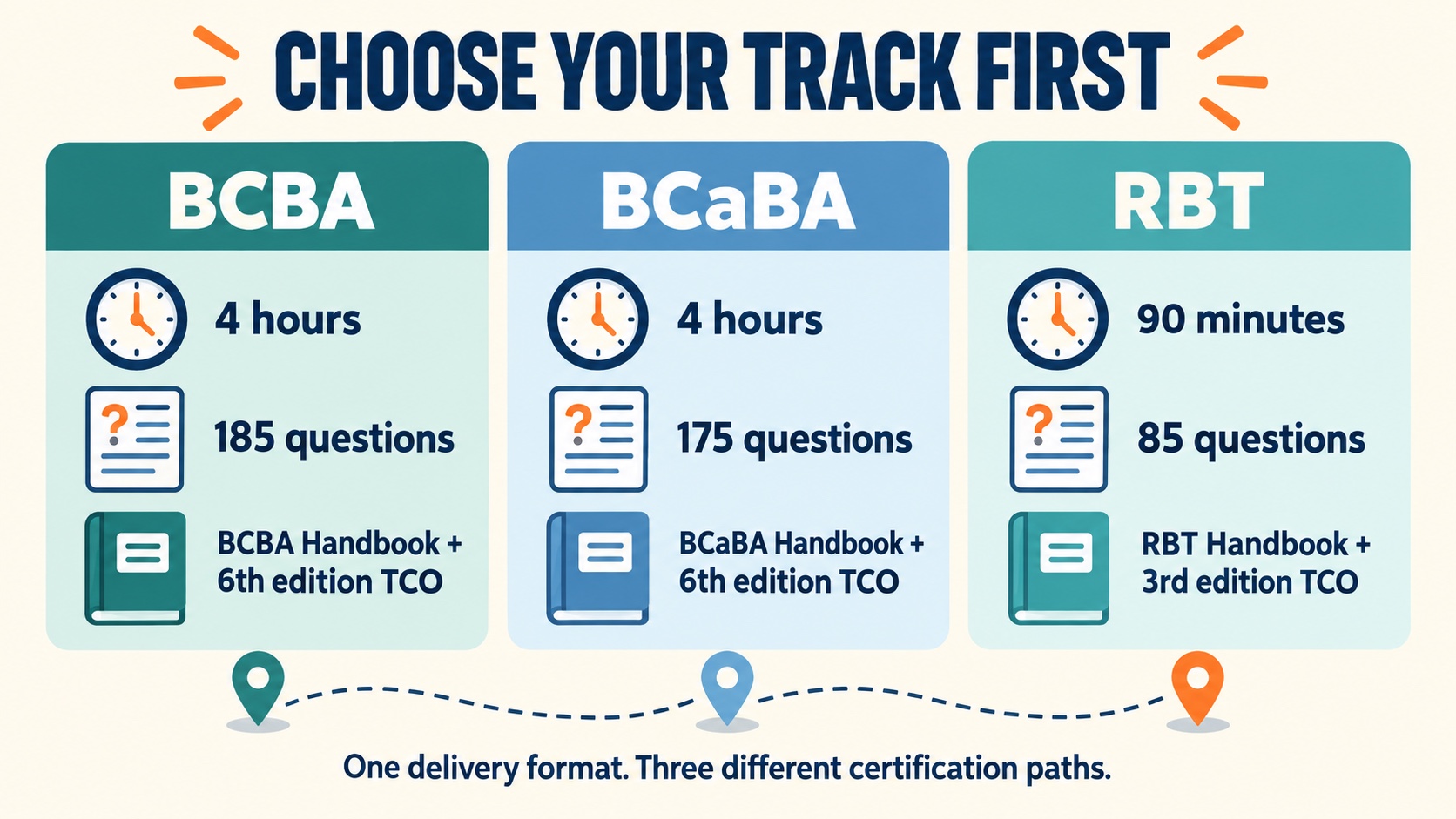
The current BACB Examination Information page lists all three as multiple-choice, computer-based examinations delivered in person at authorized testing locations. Each question has four possible answers and one correct answer. The current operational snapshot is four hours and 185 questions for BCBA, four hours and 175 questions for BCaBA, and 90 minutes and 85 questions for RBT.
That shared delivery format does not make the exams interchangeable. A BCBA candidate should not use an RBT outline as a shortcut, and an RBT candidate does not need to plan around the BCBA blueprint. The correct track determines the content map, study depth, source documents, and practice design.
Choose the correct BACB track first
Before you make a calendar, write one sentence: “I am preparing for the ___ examination.” Fill in BCBA, BCaBA, or RBT. If you cannot fill it in confidently, pause and confirm your application path with the official BACB resources or your supervisor. A general ABA interest is not the same thing as an examination authorization.
Then create a small track card with four fields:
- Certification: the exact track name.
- Current outline: the edition listed for that track on the BACB Test Content Outline page.
- Handbook: the current track-specific handbook, including eligibility, examination rules, and what happens after testing.
- Testing handoff: the official application and Pearson VUE instructions, once you are authorized to schedule.
This card prevents a common kind of confusion: studying an accurate concept from the wrong track. Concepts such as reinforcement, measurement, prompting, and ethics appear across behavior-analysis education, but the task wording, expected depth, and examination emphasis can differ. The track card keeps your study resources aligned.
Build a current source map
Use official sources as the skeleton and learning resources as support. For each study block, keep the source that justifies the topic visible. The BACB’s current Test Content Outline index lists the BCBA and BCaBA 6th editions and the RBT 3rd edition beginning January 1, 2026. That is a source-selection fact, not a reason to assume every article or flashcard online has been updated.
A practical source map has three layers:
- Scope: the current TCO tells you the domains, tasks, and outline structure to organize.
- Rules: the Handbook explains eligibility, examination policies, accommodations, scoring information, and track-specific boundaries.
- Learning: your notes, examples, practice questions, videos, and tools explain the concepts and give you retrieval opportunities.
When the layers disagree, do not resolve the conflict by choosing the answer that appeared most often in a practice app. Check the current official source, record the date you checked it, and update the study note. This habit is especially important during a requirements or content-outline transition.
Your source map should also tell you how deep to go. A definition-only note may be enough for an early orientation session, but exam preparation usually needs distinctions, conditions, examples, and consequences. For instance, do not stop at naming a measurement procedure. Ask when it fits, what its limitations are, how it would look in a short scenario, and what evidence would make another procedure a better choice. The same pattern works for assessment, intervention, ethics, supervision, and research concepts. Depth comes from explaining relationships, not from making every note longer.
Keep version control visible in your notes. Write the source title, edition or update date when one is provided, and the date you reviewed it. If a study card has no source, label it as a learning aid rather than treating it as an official rule. This small habit makes it easier to refresh the right material when the BACB publishes a new handbook, outline, or transition notice.
Use a learn–retrieve–apply–repair study loop
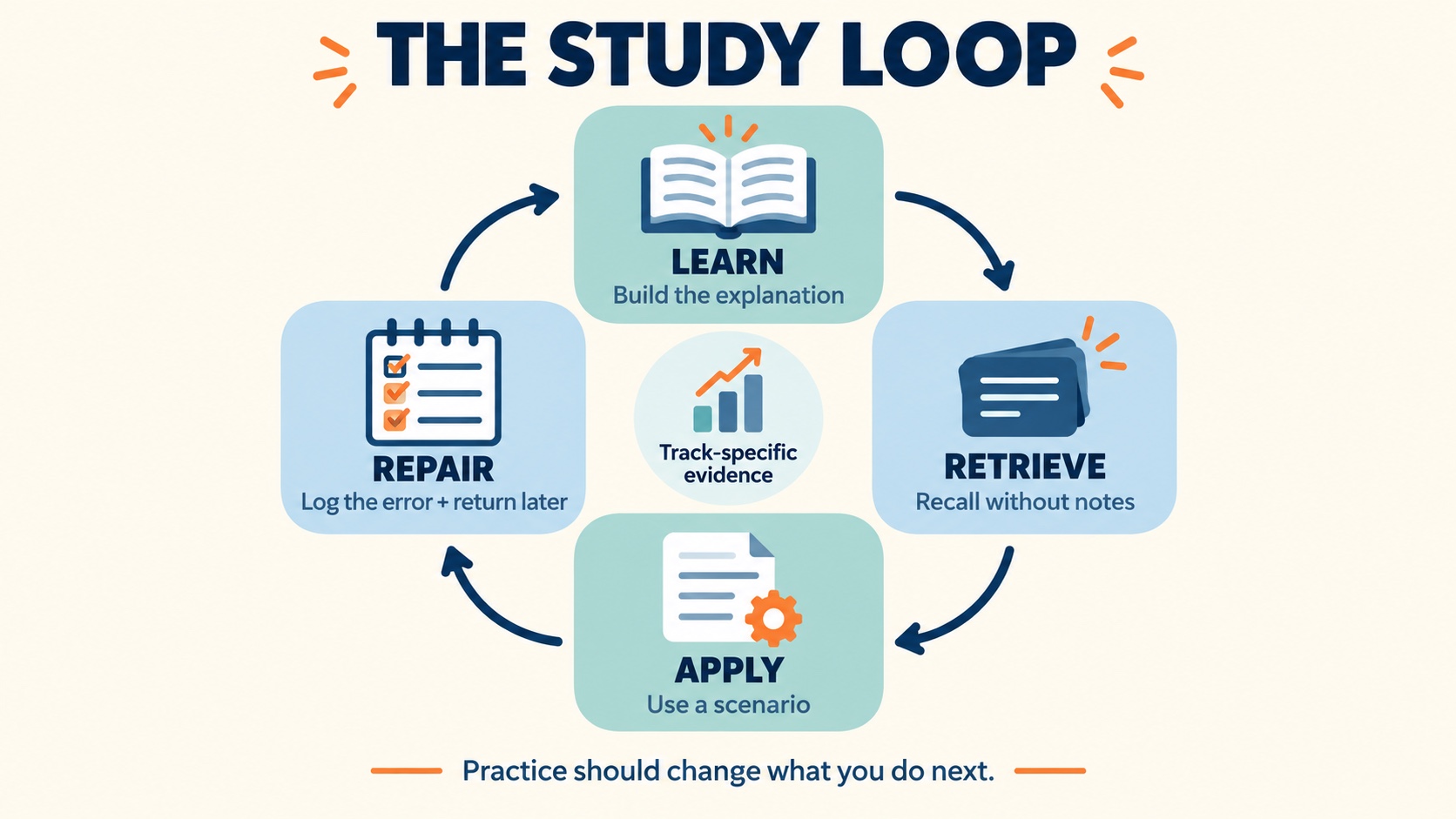
Passing preparation is not the same as reading until the material feels familiar. A stronger loop moves through four different jobs:
- Learn: read a short explanation and identify the terms, relationships, and conditions that matter.
- Retrieve: close the notes and explain the concept from memory. Use a definition, a contrast, and a small example.
- Apply: answer an original scenario that requires you to select or justify a procedure, measurement, ethical response, or interpretation.
- Repair: inspect the error, identify the missing distinction, revise the explanation, and return to the concept later.
The loop becomes more effective when each stage leaves evidence. A learning note should answer what the concept means. A retrieval note should show what you can produce without looking. An application note should explain why the best answer fits the facts. A repair note should identify what you will notice next time.
Make practice tests useful
A practice test is a measurement opportunity, not a verdict. Before starting, decide what you are measuring: first exposure to a topic, mixed retrieval, timed pacing, or full-session stamina. The same percentage means different things in those different conditions.
After each set, review at least four categories:
- Knowledge gap: you did not know the term, rule, or relationship.
- Discrimination gap: you knew the terms but confused two similar concepts.
- Application gap: you recognized the concept but could not select the best action in context.
- Test-taking gap: you misread the stem, rushed, changed a correct answer without evidence, or ran out of time.
Write a short rationale for the correct answer and a short reason the strongest distractor is wrong. Then schedule a delayed return. If you only reread the explanation immediately after missing the item, you may remember the page rather than learn the distinction.
For a weekly rhythm, choose one broad review block, two shorter retrieval sessions, one applied practice set, and one repair session. Keep the workload adjustable: a candidate who is learning a topic for the first time needs more explanation, while a candidate who repeatedly misses one discrimination needs targeted contrasts. The goal is a repeatable loop that tells you what to study next, not a heroic schedule that collapses after a few days.
Keep practice content clearly separate from official BACB content. ABA Study Online’s general ABA learning resources, free questions, mock-exam path, and track-specific hubs can support study, but they are independent educational materials. They do not authorize testing, reveal secure items, determine eligibility, or guarantee a result.
Prepare for exam day without mixing tracks
Once the official application and authorization steps are complete, use the current BACB and Pearson VUE instructions for scheduling, identification, arrival, security, and appointment changes. The testing handoff is operational, while your study plan is educational; keep those jobs separate.
For study purposes, run one final checklist:
- Confirm that your track and current outline match your study materials.
- Review the appointment confirmation and official testing-center instructions.
- Practice reading the question stem before looking at the answer choices.
- Use the computer-based tutorial if the official Pearson VUE page provides one.
- Plan sleep, travel, identification, and arrival time without assuming a third-party app can solve an account issue.
On the final day, reduce novelty. Use the same terminology you have been using in your source map, read the official appointment instructions once more, and stop trying to repair the entire outline in a single evening. A short review of your error log is more useful than an unstructured search for one last “must know” list. If an official rule is unclear, route the question to BACB rather than asking a practice resource to make an account decision.
Common study mistakes
Searching for a universal “ABA exam”
The phrase hides the most important decision. Select BCBA, BCaBA, or RBT before choosing a blueprint or practice bank.
Collecting resources instead of building retrieval
More tabs do not equal more learning. Pick a current source, write an explanation, retrieve it, apply it, and repair the errors.
Studying only the questions you missed
A miss points to a place to investigate; it does not prove that every other area is mastered. Keep a broad review loop while giving extra time to recurring weaknesses.
Turning a practice percentage into a promise
Practice sets vary in content, difficulty, construction, and timing. Use them to make decisions, not to promise yourself or someone else a pass.
Using outdated requirements
Check the current BACB page, Handbook, and TCO when a date or edition matters. A familiar PDF can be out of date even if its definitions still sound correct.
FAQ and official sources
What is the big ABA exam?
That phrase is informal. In BACB certification conversations, it may mean the BCBA, BCaBA, or RBT examination. Ask which track the person means before comparing study plans.
Are BCBA, BCaBA, and RBT exams the same?
No. They share a multiple-choice, in-person computer-based delivery format, but they have different eligibility pathways, Handbooks, content outlines, timing, question counts, and certification roles.
How long is each current BACB exam?
The BACB currently lists four hours and 185 questions for BCBA, four hours and 175 questions for BCaBA, and 90 minutes and 85 questions for RBT. Verify the current official page before scheduling.
Can an app guarantee that I will pass?
No. An independent study app can provide explanations, practice, progress tracking, or review tools, but only the BACB controls certification eligibility, the official examination, scoring, and certification decisions.
Where should I begin?
Start with the current BACB Examination Information page, choose the matching Test Content Outline, and open the track page for BCBA, BCaBA, or RBT. Then create one study loop and let your error log guide the next session.