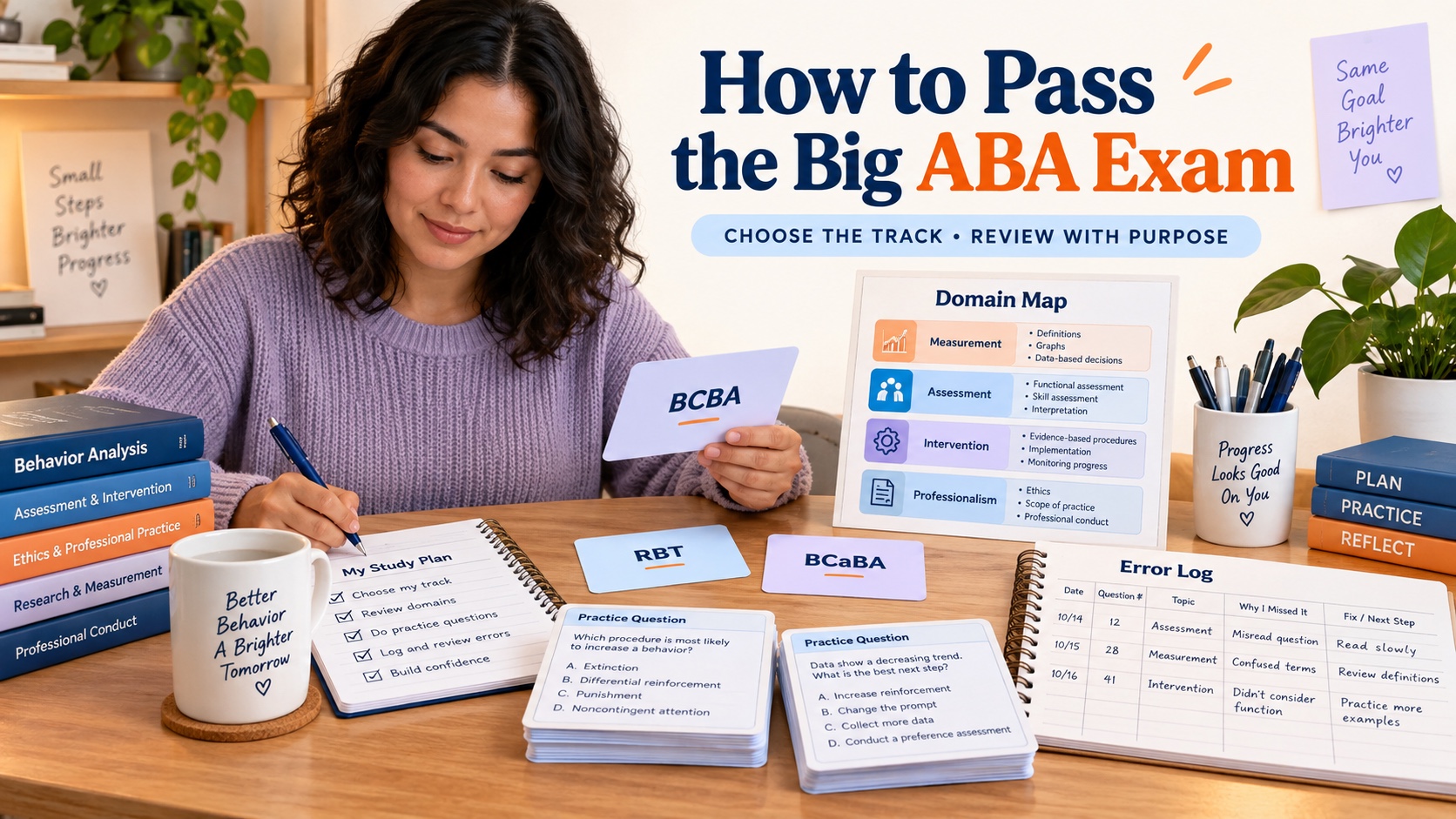
How to Pass the Big ABA Exam: A Track-Specific Study Plan
People often search for ways to “pass the big ABA exam” when they feel overwhelmed by a large amount of terminology, practice questions, and certification information. The first useful clarification is that there is not one universal ABA exam. RBT, BCaBA, and BCBA are separate tracks with different roles, outlines, and study expectations.
That distinction does not make the goal smaller. It makes the next decision clearer. Choose the credential you are actually pursuing, open the current Test Content Outline for that track, and use practice results to decide what to review next. This guide gives you a practical study loop without promising a score or presenting independent materials as official examination content.
Quick answer: Do not begin with a giant mixed question bank. Choose RBT, BCaBA, or BCBA; confirm the current official outline and handbook; take a short baseline; tag each miss by domain and error type; review one small concept or procedure; and answer a similar question later. A passing result cannot be guaranteed by a particular number of questions, study days, or commercial resource.
Study boundary: ABA Study Online provides independent educational materials. This page is not official BACB content, recalled examination content, individualized supervision, certification advice, or a pass guarantee.
Choose the exam track before you study
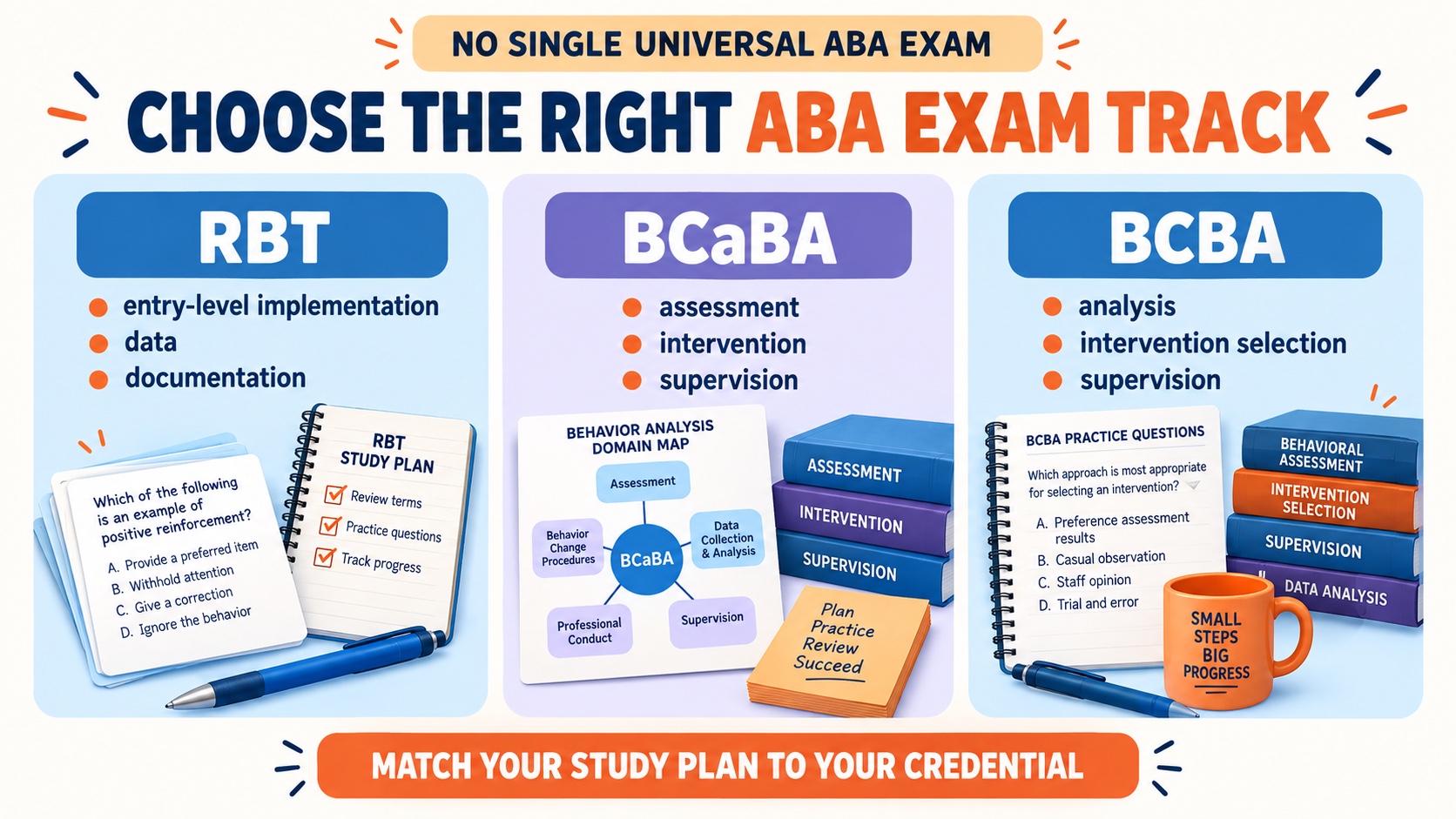
The phrase “big ABA exam” can hide three different study jobs. Use the track that matches your application and role:
RBT study
RBT preparation focuses on entry-level implementation, data collection, behavior assessment participation, skill acquisition, behavior reduction, documentation, reporting, and ethics. The current RBT Test Content Outline (3rd ed.) describes six domains and applies to examination content beginning in 2026. Your study examples should emphasize following written procedures, recording observable information, and bringing questions to the appropriate supervisor.
Use the RBT Theory Blocks and free RBT practice questions when you need entry-level examples. Do not use advanced BCBA reasoning as a shortcut for an RBT role-boundary question.
BCaBA study
BCaBA preparation includes deeper concepts, measurement, assessment, intervention, ethical and professional issues, and supervisory relationships. The current BCaBA Test Content Outline (6th ed.) organizes the examination into nine domains. It is a different study map from the RBT outline, even when a term appears in both.
For BCaBA practice, ask not only “What is the definition?” but also “What does the data support, what procedure fits the goal, and what belongs within the supervision arrangement?” Keep current certification requirements in the handbook rather than assuming the Test Content Outline answers every application question.
BCBA study
BCBA preparation covers philosophical foundations, concepts and principles, measurement, experimental design, ethics, assessment, behavior-change procedures, intervention selection, and personnel supervision and management. The current BCBA Test Content Outline (6th ed.) organizes 104 tasks across nine domains. Practice should include discrimination, data interpretation, assessment logic, intervention selection, ethical reasoning, and supervision decisions.
Use the BCBA Theory Blocks and free BCBA practice questions for independent study. Return to the current BCBA Handbook for eligibility and examination procedures.
Use the current outline as a map
A Test Content Outline is not a complete curriculum. It tells you the content areas and tasks connected to examination preparation; it does not replace a handbook, Ethics Code, supervised training, or current requirements page. Save the title, edition, effective period, and access date in your notes.
Then translate the verbs in the outline into practice actions:
- Identify: recognize the term or feature in a short example.
- Distinguish: compare two related concepts and explain why one fits.
- Explain: describe the relation in plain language and with an applied example.
- Interpret: connect a graph, measurement, or observation to a defensible conclusion.
- Select: choose a procedure or next step that matches the goal, evidence, and role.
- Implement: sequence the procedure and identify the boundary conditions that matter.
This keeps your study active. Reading a definition may help with recognition, but it does not automatically prepare you to distinguish two procedures or interpret a changing data path.
The practice loop that turns misses into progress
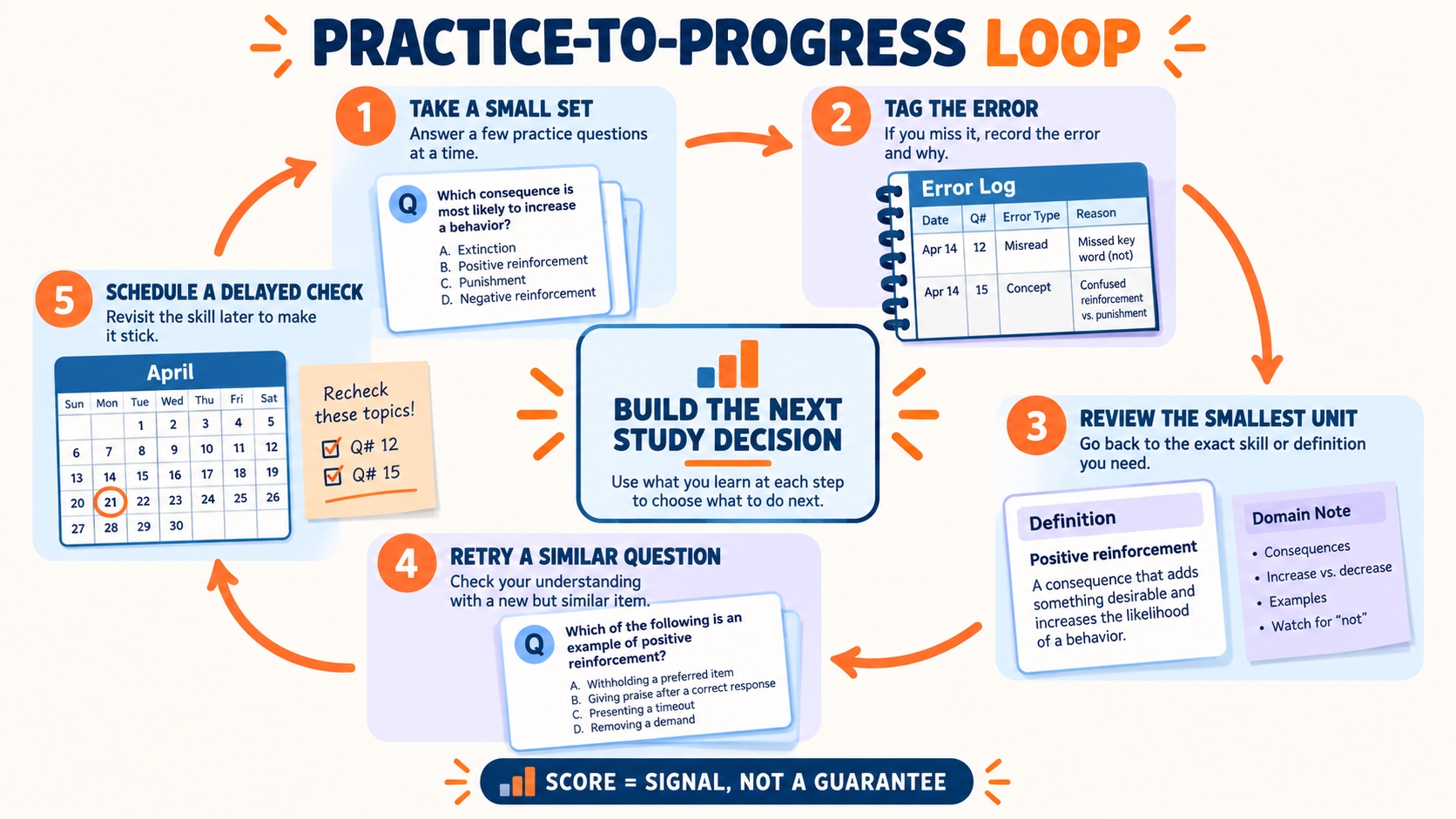
- Take a short baseline. Use 15–25 questions from one track and one or two domains. Stop while you still have time to review.
- Tag each result. Choose a small label such as vocabulary, discrimination, measurement, scenario reading, procedure, ethics, or careless reading.
- Find the smallest useful review unit. Move from the missed item to the definition, task, graph feature, or decision rule that explains it.
- Explain the correct and incorrect choices. If you cannot explain why the distractors are weaker, the concept may not be stable.
- Retry a similar question. A rationale is a starting point, not proof that the skill transferred.
- Schedule a delayed check. Revisit the concept in a later mixed set so you can see whether it holds outside the original wording.
When a question feels difficult, slow down before increasing the question count. Write the observable facts, underline the task verb, identify the relevant domain, and remove answers that exceed the role or evidence. This habit is useful across all three tracks, even though the answer boundaries differ.
A practical 14-day study rhythm
This schedule is a flexible template, not an official BACB recommendation. Adjust the domain mix to your baseline and application timeline.
- Day 1: Confirm the credential track, current outline, handbook, and baseline error tags.
- Days 2–3: Review the weakest foundational concepts and make comparison notes.
- Days 4–5: Practice measurement, data displays, or documentation appropriate to the track.
- Days 6–7: Practice assessment and behavior-change scenarios; write the next responsible action.
- Day 8: Review ethics, role boundaries, privacy, supervision, or reporting responsibilities.
- Days 9–10: Work a new set that mixes the domains you previously missed.
- Days 11–12: Focus on the error type that remains most stable across different question wording.
- Day 13: Complete a longer mixed practice session and review every uncertain answer.
- Day 14: Build the next study plan from your error log rather than from a single score.
Keep sessions consistent enough to observe change. Sleep, breaks, accessible materials, and an appropriate accommodation process matter more than turning every day into an endurance test.
Common study wrong turns
- Searching for one universal exam: choose the RBT, BCaBA, or BCBA track first.
- Mixing editions: check the current outline and effective period before you copy a domain list.
- Chasing question volume: review quality matters more than an impressive count.
- Memorizing without discrimination: compare the concepts that a scenario could plausibly confuse.
- Ignoring role boundaries: the most advanced-sounding answer is not automatically the best answer.
- Treating independent practice as official: use the BACB source for current examination and certification information.
A readiness check before a longer practice set
Before you schedule a longer mixed session, check whether you can do more than recognize familiar words. Choose one task from your outline and explain it without looking at your notes. Give a short example, name the evidence you would need, and state what would make a nearby answer less appropriate. Then complete a small set under ordinary study conditions and compare the error tags with your baseline. If the same mistake keeps returning, narrow the review again. A readiness check should tell you what to practice next; it should not be used as a guarantee about the official examination.
When a question depends on a current date, edition, application rule, or accommodation process, pause the study session and open the relevant BACB page. Version checking is part of responsible preparation, especially when older “task list” language and newer Test Content Outline terminology appear together.
Big ABA exam FAQ
What is the big ABA exam?
“Big ABA exam” is an informal search phrase, not the name of one universal BACB examination. Identify whether you are preparing for RBT, BCaBA, or BCBA, then use that track’s current official outline and handbook.
Can I study all three tracks at the same time?
You can learn shared ABA concepts, but keep separate track maps and practice sets. Mixing domains, roles, or effective periods can make a familiar term lead to the wrong answer.
How many practice questions do I need to pass?
There is no reliable question-count guarantee. Use a number small enough to review carefully, track the reason for each miss, and check whether you can transfer the concept to a new scenario.
Is ABA Study Online official exam content?
No. ABA Study Online provides independent explanations and practice materials. The BACB’s current handbooks, Test Content Outlines, examination pages, and ethics resources remain the authoritative sources.