Pass the Big ABA Exam Book: How to Evaluate the 6th-Edition Manual
If you search for the Pass the Big ABA Exam book, you are usually looking for the PTB ABA Exam Study Manual, a third-party BCBA/BCaBA preparation resource. The provider’s current product page identifies the manual as the 6th Edition V2 and describes it as organized around the BCBA 6th-edition Test Content Outline (TCO). That tells you what the product is; it does not answer whether it is the right fit for your study needs or make it an official BACB resource.
The useful way to evaluate a named exam book is to compare its edition, explanations, practice design, and update discipline with the official sources. The book can be an organizing layer. It should not replace the current TCO, the BCBA Handbook, the Ethics Code for Behavior Analysts, or the materials from your qualifying training. It also cannot reveal live exam questions or guarantee a pass.
Table of Contents
What the Pass the Big ABA Exam book is
Pass the Big ABA Exam is a commercial exam-preparation provider with manuals, workshops, mock exams, lectures, and study aids. Its product page currently calls the book the PTB ABA Exam Study Manual — 6th Edition V2. It describes the manual as a quick-reference companion that organizes the TCO, source literature, examples, visual explanations, ethics notes, hints, and review questions.
That description is important because it sets a reasonable expectation: this is a study manual, not the BACB’s Handbook and not a copy of the certification examination. The provider also states on its product page that its preparation course is not sponsored by or affiliated with BACB. Keep that disclosure visible when you compare the manual with official sources.
The provider page lists product features such as more than 500 pages, domain and task labels, full-color visuals, mnemonics, exam tips, review questions, and updated references. Those are descriptions made by the seller. They can help you decide whether the format suits your learning style, but they are not independent evidence that the book improves pass rates. Testimonials can describe a person’s experience; they cannot establish that a particular book caused the outcome.
The official BCBA boundary to check first
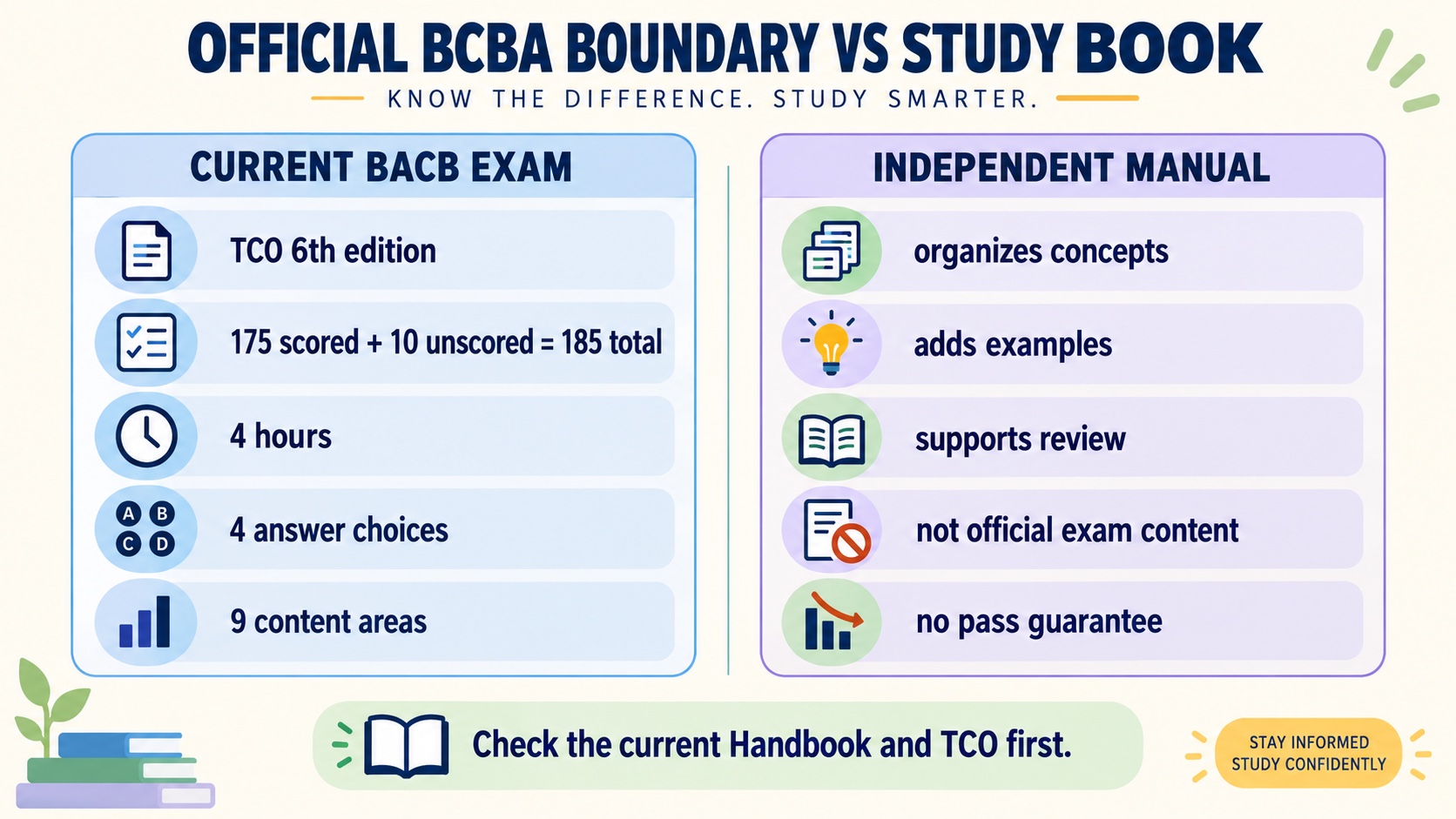
Before using any named book, anchor your notes to the current BACB documents. The current BCBA Handbook states that the examination is based on the BCBA TCO 6th edition. It describes:
| Exam feature | Current study boundary |
|---|---|
| Content outline | 104 tasks organized into 9 content areas in the BCBA TCO 6th edition |
| Question count | 175 scored questions plus 10 unscored questions, 185 questions total |
| Format | Four answer choices with one correct answer |
| Time | Four hours, including the examination process and review time described by the Handbook |
| Scoring | Questions are equally weighted; the result is based on overall performance, not separate content-area pass marks |
The current nine content areas include behaviorism and philosophical foundations; concepts and principles; measurement, data display, and interpretation; experimental design; ethical and professional issues; behavior assessment; behavior-change procedures; selecting and implementing interventions; and personnel supervision and management. A manual that looks polished but uses an old outline should be treated as a historical reference until its edition is verified.
What the provider says the manual includes
Based on the current product page, the manual is designed to make a large outline easier to navigate. The provider says it connects TCO items to source literature, uses examples and visuals, highlights ethics considerations, and includes review questions with answer keys. It also describes reference features such as an index, formulas, acronyms, mnemonics, and room for notes.
Those features can be useful for different reasons:
- Domain and task labels can help you locate a weak area instead of rereading the entire book.
- Examples and visuals can help turn a definition into a discrimination or application task.
- Review questions can expose whether you can recognize evidence, compare distractors, and explain a decision.
- Ethics notes can remind you to check confidentiality, competence, consent, and supervision boundaries while studying.
- Indexing and cross-references can make the manual easier to use beside the official TCO and your training notes.
Do not assume that a long manual is automatically complete. The better question is whether the resource helps you retrieve, apply, explain, and correct. A book can be a strong reference and still need to be paired with data interpretation, scenario practice, ethics review, and the official documents.
What a third-party manual can and cannot do
A third-party manual can organize the vocabulary and task areas, give you a consistent place to take notes, offer examples, and create a repeatable review routine. It may be especially helpful when your course materials are spread across lectures, textbooks, articles, and class notes.
It cannot make several decisions for you:
- It cannot determine whether you meet current BCBA eligibility requirements.
- It cannot replace the current Handbook, TCO, Ethics Code, or qualifying training.
- It cannot identify official unscored questions or provide live, recalled, leaked, or reconstructed exam items.
- It cannot promise that you will pass or convert a practice score into an official prediction.
- It cannot settle state licensure, employer, payer, or scope-of-practice questions.
The BACB explicitly says it cannot endorse specific study guides or other preparation materials and that buying study materials does not guarantee a pass. That statement applies to every commercial book, including a well-known one. It is a reason to use the manual deliberately, not a reason to dismiss it automatically.
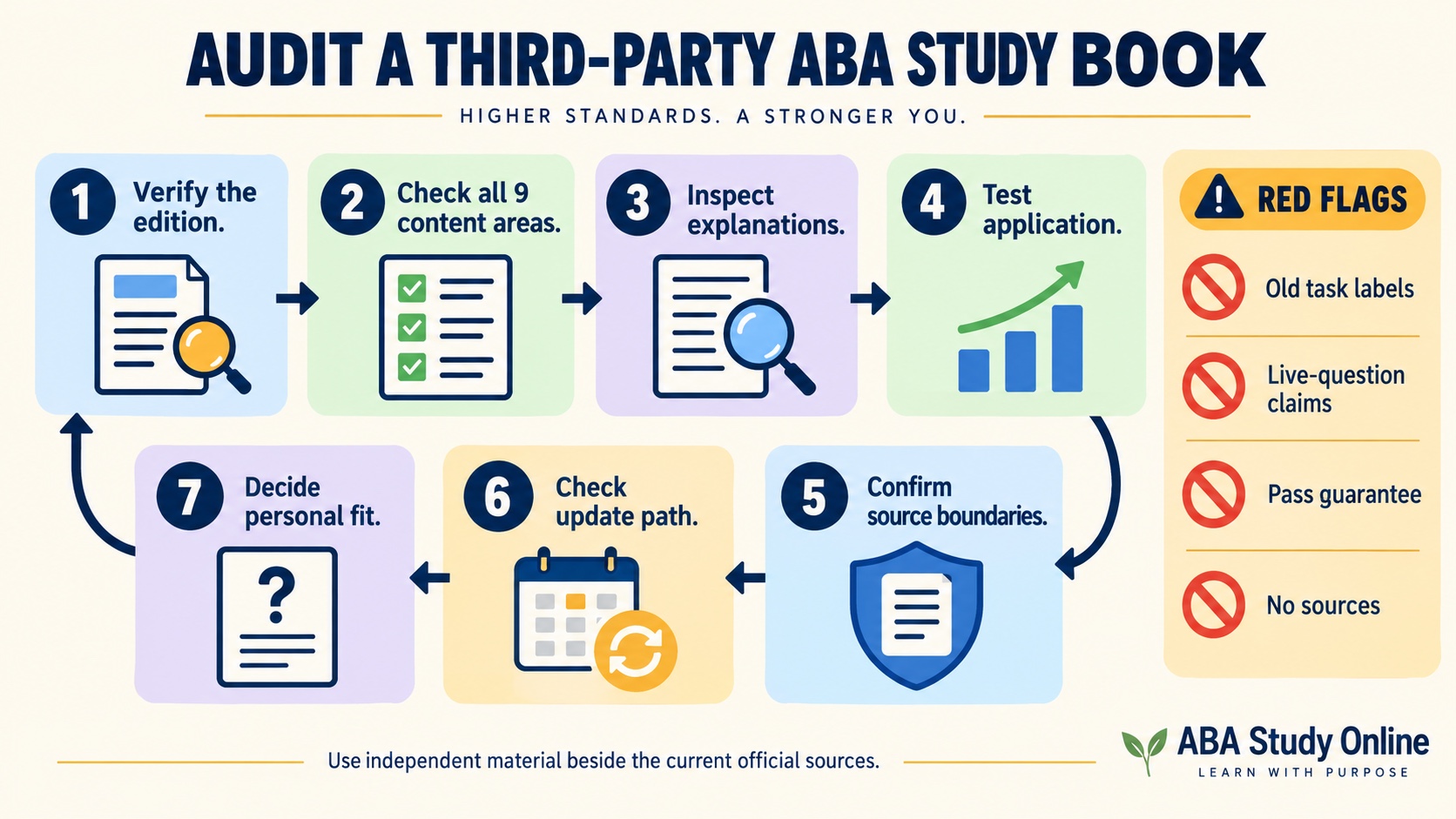
A neutral book-audit checklist
Use these questions before making the book your main reference:
- Edition: Does the book clearly identify the current TCO edition, and do its task labels match the official outline?
- Coverage: Can you find all nine content areas, including ethics, assessment, data, intervention, and supervision?
- Explanation quality: Do the examples explain why an answer fits and why the alternatives fail?
- Application: Are there scenarios, graphs, or procedure decisions—not only vocabulary lists?
- Source boundary: Does the resource distinguish provider-created material from official BACB content?
- Update path: Is there a visible way to check corrections or edition changes before you rely on an old page?
- Personal fit: Can you read, annotate, retrieve, and review from the format without letting the book become passive highlighting?
What to do when the edition does not match
If a manual uses an older TCO, do not throw away every useful explanation. Mark the outdated task labels, compare the old scope with the current official outline, and move any current-rule questions back to the Handbook. Foundational concepts may still be useful, but the resource should be labeled as supplemental rather than current.
If the book and the official source disagree about an exam count, policy, ethics requirement, or testing rule, the official BACB document controls. Record the date of your check and avoid copying the disputed statement into your notes until the source is resolved. This small habit protects your study plan from silently carrying forward an old edition.
How to use the book with other study layers
One practical sequence is to keep the official TCO open while you use the manual. Choose one task or content area, read the explanation, close the page, and write the concept in your own words. Then answer an original scenario or inspect a small data display. When you miss, record whether the problem was a definition, measurement choice, interpretation, intervention procedure, ethics boundary, or distractor-reading error.
Use the manual for organization and explanation, the official TCO for scope, your training materials for foundational context, and independent practice for retrieval and application. Then return to the Handbook when a question involves current exam rules, eligibility, testing conditions, or security. This division of labor keeps one book from carrying claims it was never designed to carry.
For additional independent study, the BCBA learning path can organize theory blocks, the free BCBA questions can provide scenario practice, the ABA glossary can support quick definitions, and the ABA Study Online app can support repeatable review. These are study layers, not BACB-endorsed materials or eligibility decisions.
FAQ and official sources
What is the Pass the Big ABA Exam book?
The phrase usually refers to the PTB ABA Exam Study Manual. The provider currently lists a 6th Edition V2 manual for BCBA/BCaBA exam preparation. It is an independent commercial resource, not an official BACB publication.
Is the book the official BCBA exam guide?
No. The official boundary comes from the current BACB Handbook, TCO, Ethics Code, and training materials. The provider also discloses that its preparation course is not sponsored by or affiliated with BACB.
Can the book replace Cooper or the BCBA Handbook?
It should not be treated as a universal replacement. Use it as an organizing and review layer, then verify scope and current rules against the official TCO, Handbook, and your training materials.
Does buying a study manual guarantee a pass?
No. The BACB says it cannot endorse specific study guides and that purchasing study materials does not guarantee a pass. A practice resource can support preparation, but it cannot determine the result.