How to Pass the BCBA Exam: A Source-Aligned Study Plan
Searching for how to pass the BCBA exam usually means you want more than another list of study tips. You want to know what to study, how to tell whether your practice is working, and how to stop spending time on material you already understand. A reliable plan begins with the current BACB examination information and Test Content Outline (TCO), then turns every missed question into a specific learning decision.
No study guide, practice score, or preparation course can guarantee a passing result. The BACB controls the examination and explains that forms are built and equated through a criterion-referenced process. Your goal is therefore not to chase an unofficial raw-score cutoff. Your goal is to build accurate, flexible reasoning across the current blueprint and show that reasoning consistently under time pressure.
Table of Contents
Short answer: what helps you pass?
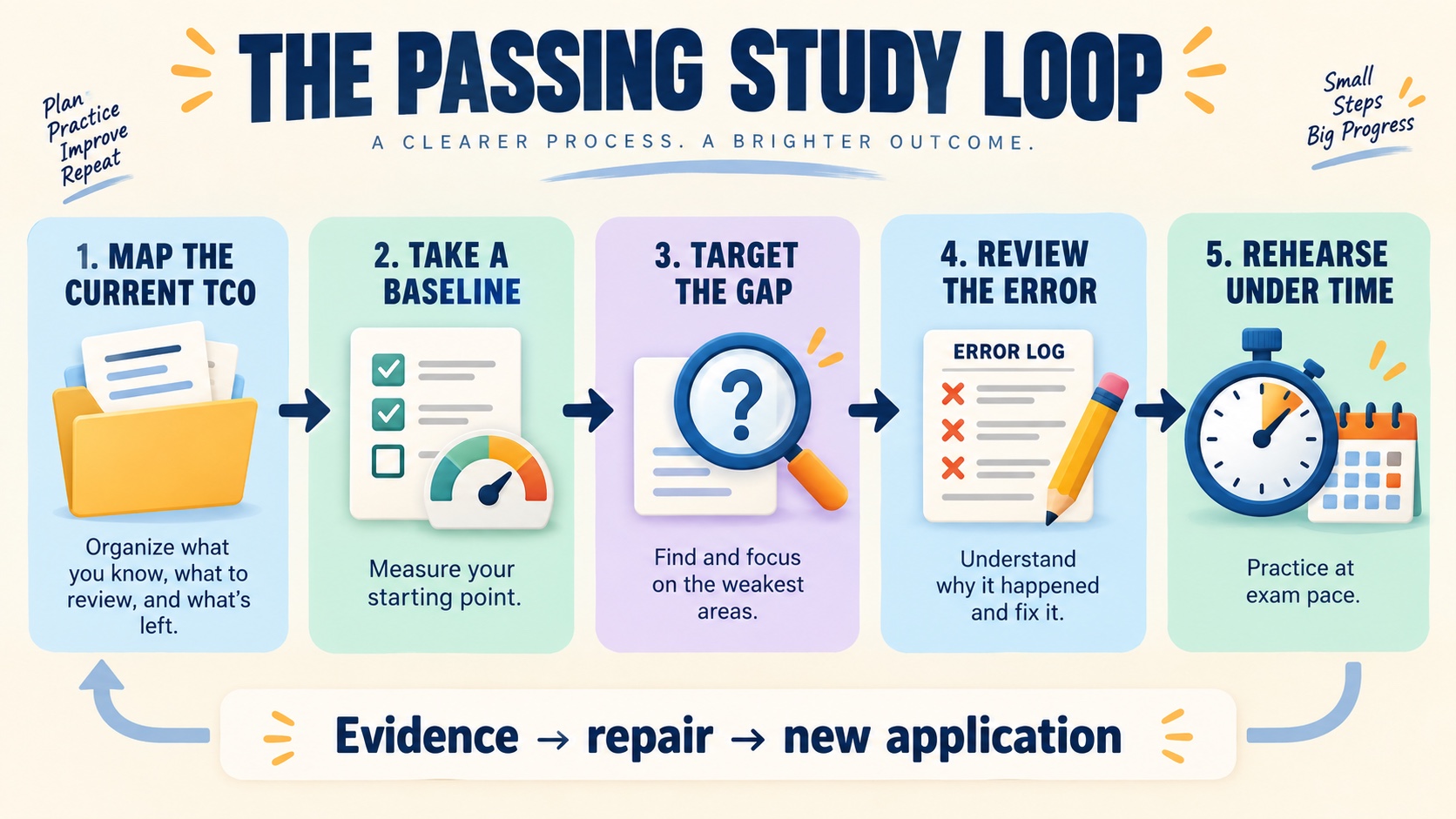
The strongest general approach is a repeating loop:
- Map: use the current BCBA TCO to define the content and decision areas you must cover.
- Measure: take a diagnostic set that shows where your reasoning breaks, not just whether you remember a definition.
- Repair: study the smallest missing concept, distinction, or application rule connected to the error.
- Rehearse: return to mixed and timed questions so you can apply the decision when the context changes.
This loop is more useful than rereading an entire textbook every time you miss a question. It also gives you evidence of progress: fewer repeated error types, clearer explanations, better discrimination between similar answer choices, and steadier pacing.
Start with the current exam target
The BACB Examination Information page currently lists the BCBA examination as 185 multiple-choice questions completed in four hours, delivered in person. The current Test Content Outlines page identifies the BCBA TCO as the 6th edition. These facts are not just trivia. They tell you which blueprint to use and why an old task list or an undated question bank may not be enough.
Download or open the current TCO and turn it into a working map. For each content area, record four things:
- the terms and principles you can define accurately;
- the procedures or decisions you can explain in sequence;
- the scenario cues that tell you which concept applies;
- the ethical, measurement, assessment, intervention, or supervision boundary that could change the answer.
A definition-only study plan can feel comfortable while leaving applied reasoning weak. For every important term, ask, “What would I observe, measure, select, or change in a real case?” Then ask, “What evidence would make a different answer more appropriate?” That second question is where many scenario items become easier to discriminate.
The four-phase study plan
Phase 1: build the blueprint
List the current TCO areas in a spreadsheet or notebook. Add a confidence rating based on evidence, not mood: can you explain the concept, identify it in a scenario, and rule out a plausible distractor? Mark the items that are both important and uncertain. Those become your first study targets.
Phase 2: take a baseline diagnostic
Use a manageable mixed set before you spend a week rereading. For each answer, record whether you were correct for the right reason, correct by elimination, unsure, or wrong. A correct answer that came from a faulty rule is not stable mastery. A wrong answer caused by misreading a measurement detail needs a different repair from a wrong answer caused by confusing a motivating operation with a discriminative stimulus.
Do not turn the diagnostic into a public prediction of your exam result. It is a private map of your current decisions under a particular set of questions. Different practice sources vary in wording, difficulty, and quality.
Phase 3: repair the smallest useful gap
Group misses by error type rather than by the page where you found them. Useful codes include definition confusion, procedure sequence, measurement choice, functional-relation reasoning, stimulus control, intervention fit, ethics or scope, supervision, and careless reading. Then choose one small repair action: compare two terms, draw an antecedent-behavior-consequence chain, work through a data example, or explain why each distractor fails.
After the repair, answer a short new set on the same decision. If you only reread the explanation, you have evidence of familiarity, not yet evidence that you can apply the idea.
Phase 4: rehearse mixed and timed decisions
Move from focused sets to mixed sets as your review improves. The purpose is to practice switching between measurement, assessment, intervention, ethics, and supervision contexts without losing the evidence in the stem. Add timing gradually. A full rehearsal should test pacing, concentration, and review behavior, but a long mock should not replace targeted repair.
How to review missed questions
The review is often more valuable than the score. For every missed or uncertain item, write one sentence for each of these prompts:
- What was the decisive cue? Identify the data, function, measurement, ethical boundary, or procedural detail that mattered.
- What rule did I use? Write the rule you actually applied, not the rule you wish you had applied.
- Why did the best alternative fail? Explain why the distractor was less supported by the evidence.
- What would change the answer? Add one new fact that would make another option appropriate.
- What will I practice next? Name a small task, comparison, or scenario rather than “study more.”
This method trains flexible discrimination. It also makes your notes useful later: instead of a pile of highlighted pages, you have a record of the decisions that repeatedly need attention.
How to use practice questions well
Practice questions are most useful when they are connected to a current content map and followed by explanations. Look for questions that require you to interpret a scenario, choose a measurement, evaluate a functional relation, select an intervention, or recognize an ethics boundary. Avoid relying on any resource that claims to reproduce secure BACB questions or guarantees a passing score.
Use three practice modes:
- Focused practice: one decision type at a time while you are repairing a weak area.
- Mixed practice: several content areas together so you practice identifying what the question is really asking.
- Timed rehearsal: a longer set used to check pacing and concentration after targeted work.
The ABA Study Online BCBA learning hub can organize concepts, while the BCBA practice-question route can support the map–practice–review loop. These are study resources, not BACB materials, exam authorization, or a pass guarantee.
A readiness check before test day
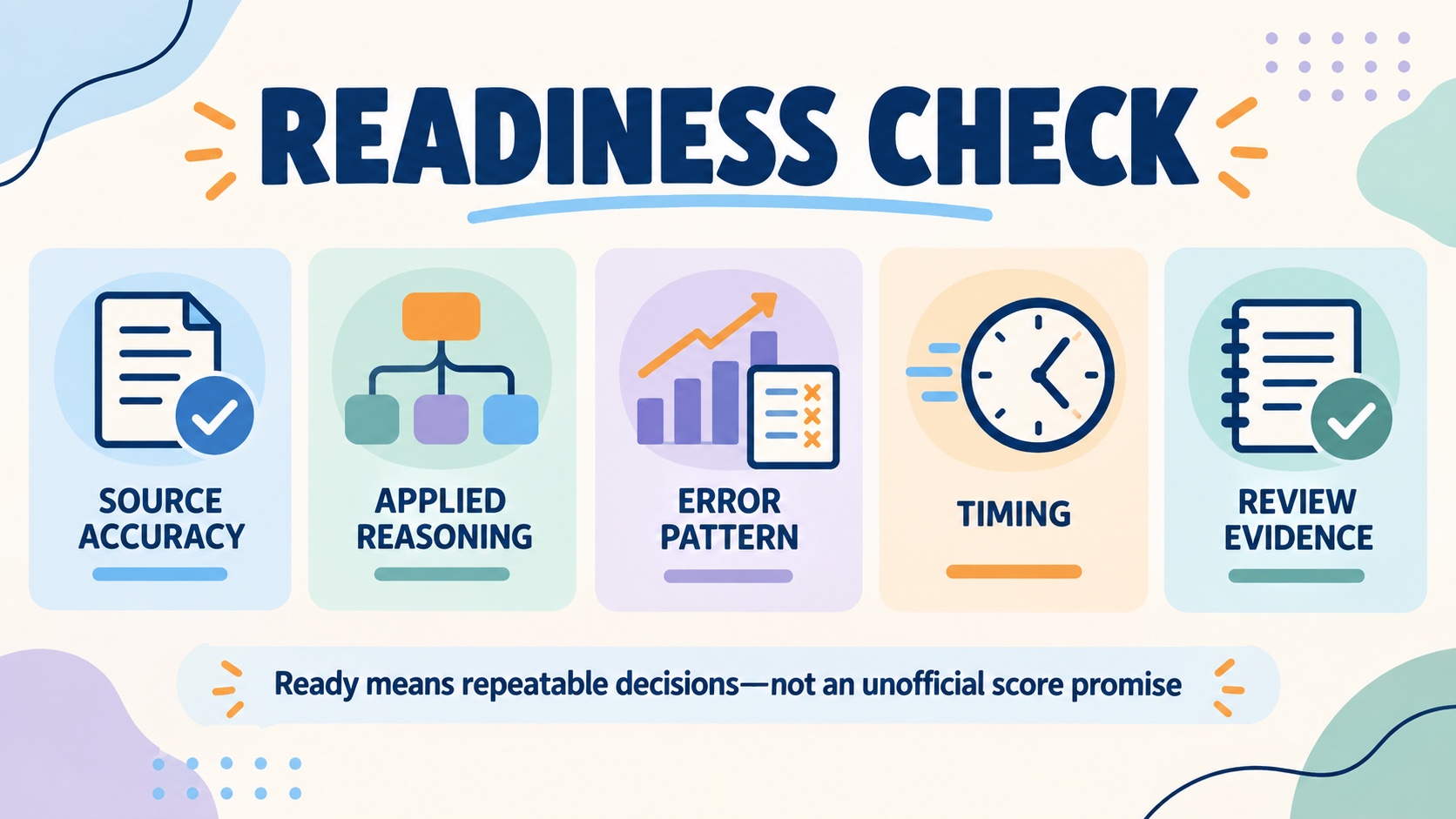
Readiness is broader than one high practice percentage. Before you schedule or sit for the exam, look for evidence in five areas:
- Source accuracy: your notes and study map use the current TCO and current BACB examination information.
- Applied reasoning: you can explain why an answer fits the evidence and why a plausible distractor does not.
- Error pattern: repeated misses are becoming specific and less frequent rather than remaining random.
- Timing: you can maintain a sustainable pace and still read the full stem and options carefully.
- Review behavior: you know how to capture an uncertainty and return to it without changing an answer impulsively.
Common BCBA study mistakes
- Using an old blueprint: start with the current BCBA TCO and exam information.
- Chasing a raw-score cutoff: the BACB explains equated forms and criterion-referenced scoring; an unofficial number cannot determine your result.
- Reading without retrieving: close the book and explain the decision, then test it with a new scenario.
- Counting every correct answer as mastery: review lucky guesses and correct answers based on faulty reasoning.
- Doing only full mocks: use focused repair before repeating long mixed sets.
- Memorizing distractors: learn the evidence rule so a new wording does not undo the decision.
- Adding a last-minute resource pile: choose a small set of current, understandable resources and keep the review loop stable.
How to pass the BCBA exam FAQ
How many hours should I study?
There is no universal number that predicts a pass. Use your diagnostic and error log to decide how much time you need. A candidate with broad content gaps needs a different plan from a candidate who knows the concepts but loses points on applied discrimination or pacing.
What score do I need to pass the BCBA exam?
Do not rely on a fixed unofficial raw-score threshold. The BACB explains that passing standards are criterion referenced and that different forms are equated. Use practice results to identify study needs, not to claim a guaranteed exam result.
Are BCBA practice exams helpful?
They can be helpful when they use current content boundaries, require applied reasoning, and provide explanations that lead to targeted repair. A practice score without review is much less useful, and practice questions are not secure BACB examination items.
What should I study first?
Start with the current TCO, then use a diagnostic to find the overlap between importance and uncertainty. Study the decisions that are both central to the blueprint and repeatedly difficult for you rather than choosing a topic only because it feels familiar.
Sources and verification notes
- BACB Examination Information — current BCBA length, question count, delivery, and scoring explanation.
- BACB Test Content Outlines — current BCBA Test Content Outline (6th ed.).
- BACB BCBA resources — current certification and preparation resource route.
- ABA Study Online BCBA learning hub, BCBA practice questions, free resources, and app study support