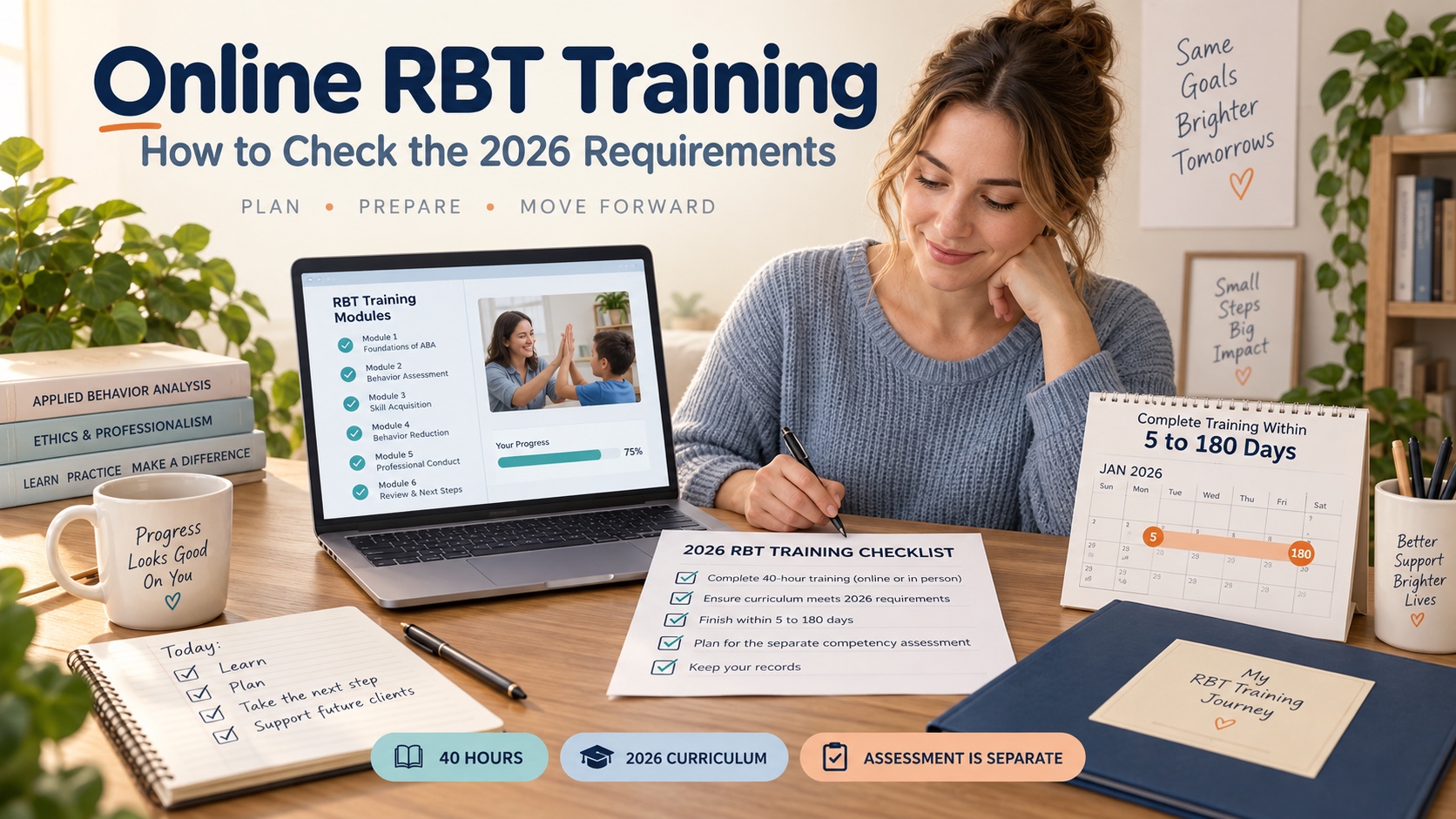
Online RBT Training: How to Check the 2026 Requirements
If you are searching for online RBT training, you may be trying to find a flexible way to complete the required training before moving on to competency assessment and certification steps. Online delivery can work, but “online” describes the format, not whether a course satisfies the current requirements. The important questions are what the course teaches, how long you take to complete it, what the certificate documents, and what remains after training.
This guide gives you a practical way to evaluate an online program under the 2026 rules. It does not rank providers or turn a training course into a promise of certification. Always compare the course and certificate with the current BACB RBT Handbook and official training outline before enrolling.
Table of Contents
Short answer: can RBT training be online?
Yes. The BACB RBT Handbook says the required 40-hour training may be offered by an employer, a university, or an online training program. The word “online” is therefore not the problem. The issue is whether the program meets the current 2026 training requirements and gives you documentation that can support the application process.
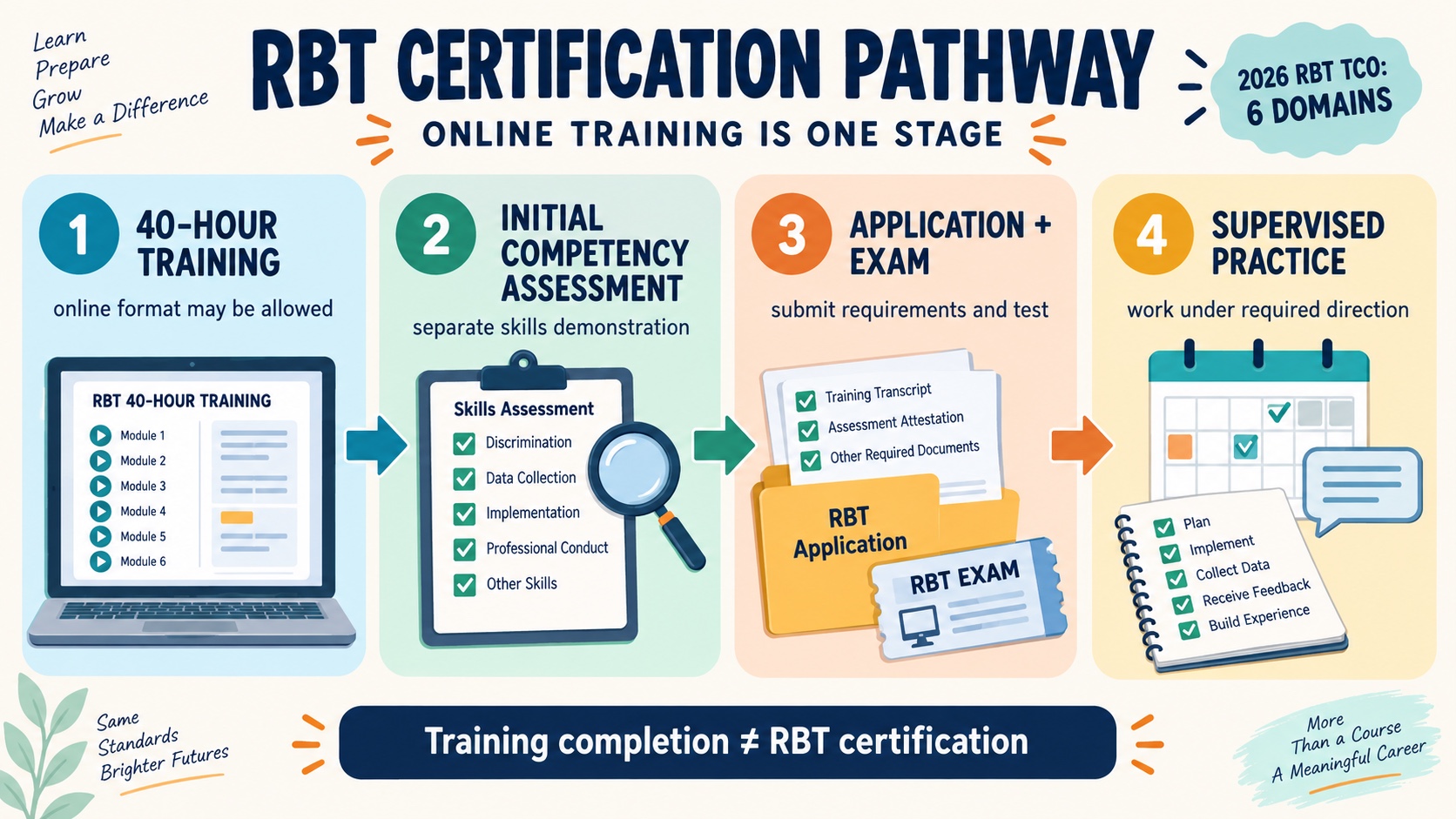
Online training is one stage of the route, not the entire route. After the qualifying training, an applicant still needs the applicable Initial Competency Assessment, application materials, and examination steps. Once certified, RBT practice also takes place under the direction and close supervision of an RBT Supervisor and/or RBT Requirements Coordinator. Finishing videos or quizzes does not by itself make someone an RBT.
That distinction prevents two common mistakes: rejecting every online course because it is online, or assuming that a completion screen means the certification process is finished.
What the current 2026 rule actually asks for
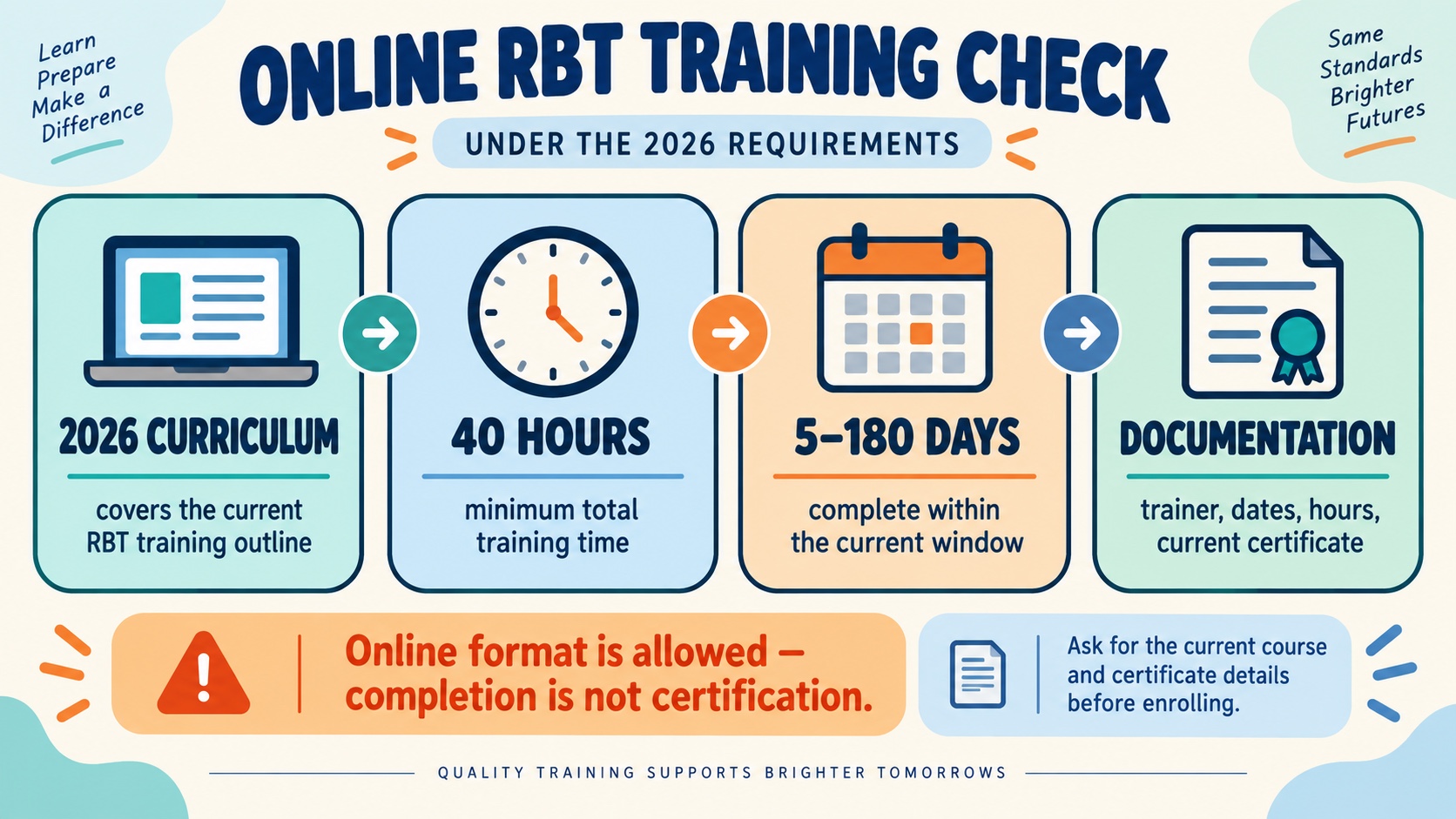
For applicants using the current pathway, the training must meet the RBT 2026 40-Hour Training Requirements and Curriculum Outline. The outline says the training must cover the required content in the context of behavior technician service delivery. The sections may be taught in different orders, but the program should be able to show where the required material is taught.
| Check | What to verify |
|---|---|
| Total time | At least 40 hours of training, completed over no fewer than 5 days and no more than 180 days. |
| Curriculum | The course addresses the 2026 curriculum outline rather than relying on an unlabeled older course. |
| Trainer | The provider can identify the responsible trainer and explain the documentation issued at completion. |
| Certificate | The certificate records the information required for the application and uses the current training statement when applicable. |
| Next step | The provider explains that competency assessment and certification application are separate steps. |
The official curriculum contains eight broad sections: Introduction to Applied Behavior Analysis; Preparing for Service Delivery; Data Collection and Graphing; Assisting with Behavior Assessments; Behavior-Change Interventions; Behavior Reduction Procedures; Documentation and Reporting; and Ethics. Minimum section durations total 38 hours, with two additional hours allocated by the trainer to reach the 40-hour requirement. A provider may organize the lessons differently, but it should not quietly omit a required area.
How to check an online training program
1. Find the edition and requirement language
A trustworthy course page should tell you which current BACB requirement it follows. In 2026, the RBT examination moved to the RBT Test Content Outline (3rd ed.), and the training requirements also changed. Do not accept a vague “BACB-approved” badge as your only check. The BACB does not provide 40-hour training, certificates of completion, or training-program recommendations.
Look for a direct explanation of the 2026 training curriculum and ask the provider for a sample certificate if the page is unclear. A course that only names an old task list, never identifies its version, or cannot explain how its content maps to the current outline deserves a pause before payment.
2. Check the completion window
The current requirement is not simply “watch 40 hours whenever you want.” The training must be completed in no fewer than 5 days and no more than 180 days, counting the start and end dates. A self-paced platform can still work within that window, but you should record when you begin and finish. If a provider encourages you to complete the entire course in a way that conflicts with the minimum-day rule, ask how the certificate will document compliance.
3. Inspect the learning design
Video length is not the same thing as learning quality. A useful online course should give you a clear sequence, concrete examples, accessible explanations, and opportunities to retrieve or apply what you learned. For example, a lesson on measurement should help you distinguish observable definitions, continuous and discontinuous measurement, basic calculations, data entry, graphs, and reporting—not only repeat vocabulary.
For behavior acquisition and reduction, look for demonstrations or scenarios that make the RBT role clear. A course should show how an RBT follows a written plan, records what happened, communicates with the supervisor, and protects the learner’s dignity. It should not teach an entry-level technician to independently redesign an intervention or make decisions reserved for a qualified supervisor.
4. Verify records before you finish
Save the course name, provider contact information, trainer details, start and end dates, and certificate as you go. Read the certificate before you need it. If your name, dates, total hours, trainer information, or required statement is missing or unclear, contact the provider while the course record is easy to retrieve.
What good online learning should help you do
The best fit is not necessarily the longest or most expensive course. It is the program that helps you connect the curriculum to entry-level service delivery. By the end of a lesson, you should be able to explain what a procedure is for, identify what you would observe, follow the written steps, record the relevant data, and know when to ask your supervisor for direction.
- Describe behavior clearly: use observable and measurable language instead of labels such as “noncompliant” without an operational definition.
- Collect and summarize data: recognize common measurement procedures, enter data accurately, inspect a graph, and report a meaningful change.
- Support assessment: understand the RBT’s role in preference, skill-based, and functional assessment activities without presenting the RBT as the independent assessor.
- Implement teaching procedures: follow prompting, fading, shaping, chaining, discrimination-training, and generalization procedures as written.
- Protect ethics and documentation: respect privacy, assent, professional boundaries, accurate records, and supervisor communication.
These capabilities also prepare you for the current RBT examination. The BACB’s RBT TCO 3rd ed. describes 43 tasks across six domains: data collection and graphing, behavior assessment, behavior acquisition, behavior reduction, documentation and reporting, and ethics. The exam has 75 scored questions and 10 unscored questions, four answer choices with one correct answer, and 90 minutes. Use those facts to organize review, not to infer that a training provider can guarantee your result.
What online training does not complete
Training and certification are connected but not interchangeable. After you complete the qualifying 40-hour course, review the current RBT Handbook for the next requirements that apply to you. The Initial Competency Assessment is a separate demonstration of skills and must be completed within the applicable timing window before the application. The application, background and registry checks, examination authorization, and testing appointment are also separate parts of the process.
Some parts of studying may be done online, including lessons, flashcards, practice questions, and review of graphs. That does not mean an online course can replace the person who must assess your competency or the examination process. If a provider sells “online RBT certification” as though one course finishes every requirement, read the claim carefully and compare it with the official handbook.
Red flags before you enroll
Pause and ask questions when a course uses any of these patterns:
- It says “official BACB course” or “BACB-certified training” without a precise, verifiable explanation.
- It does not name the current curriculum, responsible trainer, completion dates, or certificate contents.
- It promises that finishing the course makes you certified or guarantees that you will pass the exam.
- It has no clear route to the Initial Competency Assessment or treats a quiz as the competency assessment.
- It encourages rushing through 40 hours outside the current 5-to-180-day completion window.
- It uses outdated exam language and cannot explain whether the materials reflect the 2026 RBT TCO.
A red flag is not proof that a provider is fraudulent, but it is a reason to verify before spending time or money. The BACB’s current pages and handbook should control when a marketing page conflicts with an official requirement.
A simple way to use the course as study
Set up a small study record before you begin. Make one section for each of the six RBT exam domains and another section for questions about the training process. After each module, write one plain-language definition, one observable example, one data or procedure decision, and one question you would ask a supervisor. This takes less time than copying every slide and gives you material to retrieve later.
When you miss a practice question, classify the error. Was the issue measurement, assessment, acquisition, reduction, documentation, ethics, or reading the scenario too quickly? Then return to the course lesson and the current TCO. This approach lets the online course support both the certificate requirement and genuine skill-building without confusing study progress with certification status.
You can use the RBT learning path for structured review, free RBT questions for application practice, the ABA glossary for quick definitions, and the ABA Study Online app for repeatable review. These are learning resources, not BACB endorsements or substitutes for the official application process.
FAQ and official sources
Can I complete RBT training online?
Yes, the BACB Handbook says the 40-hour training may be offered through an online training program. The program still needs to meet the current 2026 requirements and provide appropriate documentation.
Does online RBT training make me certified?
No. Training is one requirement. The applicable competency assessment, application, examination, and other current requirements remain separate.
How long do I have to complete the online course?
The 2026 requirement is at least 40 hours completed over no fewer than 5 days and no more than 180 days. Confirm the dates and certificate details with the provider.
What should an online RBT course cover?
It should follow the current 2026 curriculum outline and address ABA foundations, service-delivery preparation, data, assessment assistance, acquisition, reduction, documentation/reporting, and ethics in the RBT role.
Does the BACB recommend a specific online provider?
The BACB provides requirements and resources, but it does not provide 40-hour training or recommend a training provider. Compare the provider’s current documentation with the official handbook and curriculum outline.