
NET ABA Examples: Natural Environment Teaching in Everyday Routines
When people search for NET ABA examples, they are usually looking for a picture of what Natural Environment Teaching looks like beyond a table or worksheet. The central idea is simple: a practitioner embeds a defined teaching target in an ongoing, meaningful activity and uses the learner’s interests, motivation, and natural routines to create useful opportunities to respond.
NET is not just “playing instead of teaching.” It is not automatically NET because an activity happens at home, outside, or in a clinic play area. Effective natural environment teaching still has a target, a plan, prompting and fading when needed, a relevant consequence, and data. The examples below are educational illustrations—not an individualized treatment plan—so the learner’s program and supervising professional remain the authority.
Table of Contents
What NET means in ABA
Natural Environment Teaching is a way of arranging instruction so that learning happens in the context where the skill matters. The “natural environment” might be a living room, classroom, playground, kitchen, community setting, or therapy room arranged to resemble a meaningful routine. The location alone does not define the procedure. The teaching relationship does.
A NET opportunity often begins with something the learner is already doing or wants to do. The practitioner notices a relevant moment, arranges access or materials when appropriate, presents an opportunity for the target response, and provides a consequence connected to the activity. For example, if bubbles are the activity and requesting is the target, access to bubbles may be more relevant than an unrelated token delivered across the room.
Naturalistic teaching approaches overlap with related terms such as incidental teaching and naturalistic intervention, but the labels are not always used identically across programs or research papers. For study purposes, focus on the observable arrangement: what target is being taught, what occasioned the response, what prompt was used, and what consequence followed.
The ingredients of a useful NET opportunity
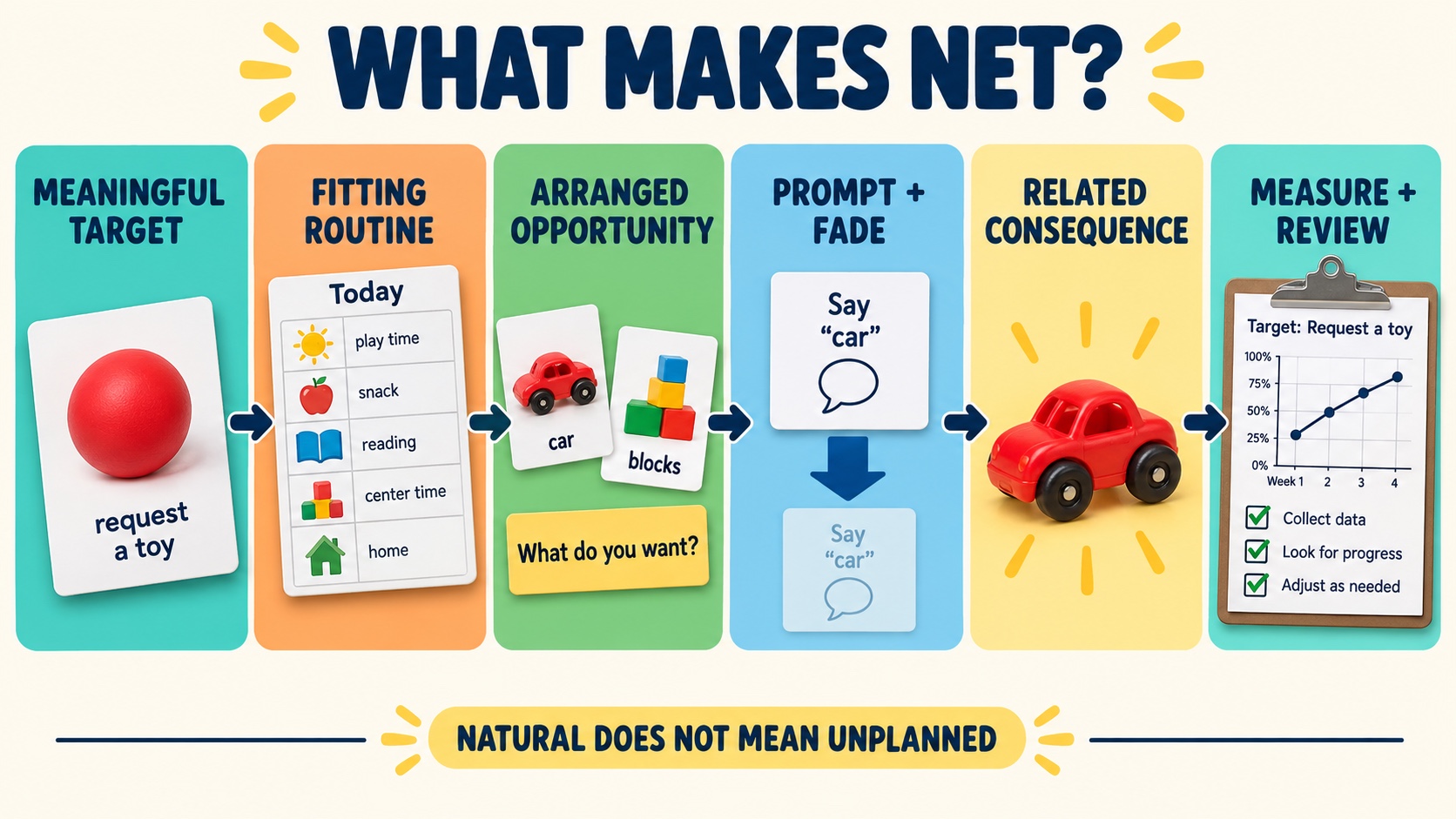
Before calling an activity NET, look for these components:
- A meaningful target. The target might be requesting, labeling, following a direction, turn taking, self-management, or a daily-living step. It should be defined well enough to observe.
- An activity or routine that fits the target. Choose a context in which the response would actually be useful, rather than inserting a random question into play.
- An arranged opportunity. The practitioner may place an item in view, pause a routine, offer a choice, or create a reason to communicate. Natural does not mean accidental or unplanned.
- A response and a prompt plan. Give the learner a chance to respond, then use the least intrusive prompt and fading sequence specified by the program when needed.
- A relevant consequence. When possible, the learner contacts the activity or outcome related to the response—for example, access to the requested toy, continuation of a routine, or a turn in the game.
- Measurement and review. Record the response using the program’s measurement system, then review whether the opportunity, prompt, and consequence are helping the learner use the skill.
NET ABA examples in everyday routines
1. Requesting during bubbles or a preferred toy
A learner reaches toward a closed container of bubbles or a favorite toy. If functional communication is the target, the practitioner can arrange an opportunity for the learner to request, wait for the response, and use the prompt level in the program if the response does not occur. After the defined request, the learner receives access to the bubbles or toy. The item is not merely a prize added after an unrelated drill; it is part of the activity the learner was trying to access.
2. Labels and language during block or pretend play
During block play, a practitioner may target labels such as “bridge,” “tall,” or “red,” or spatial words such as “on,” “under,” or “next to.” The adult follows the learner’s current construction, creates a relevant opportunity, and responds to the learner’s answer by continuing the play. If the target is describing an action, the practitioner might model and prompt “crash” as a tower falls, then help the learner use the word during the next play moment.
3. Following directions while preparing a snack
A snack routine can create opportunities to follow a direction, identify materials, request help, or complete a small self-management step. For example, the learner may follow “put the cup on the table” while preparing a drink, then continue the routine. The direction, prompt, and safety requirements should be individualized. NET does not mean allowing unsafe access to food, appliances, utensils, or restricted items.
4. Turn taking during a game or playground routine
During a ball game, swing routine, or board game, the target might be requesting a turn, waiting for a brief interval, responding to a peer, or handing over an item. The natural consequence can be the learner’s turn or continuation of the shared activity. A practitioner may still arrange the order of turns, use a visual cue, and measure the target response. The structure supports the natural routine rather than replacing it with an unrelated worksheet.
5. Daily-living steps during dressing or cleanup
Routines such as putting on a coat, packing a bag, or cleaning up materials can support targets for sequencing, requesting assistance, labeling clothing, or completing an independent step. The activity is not NET merely because it is a daily routine; the teaching target and response-consequence relationship should be clear. A learner may practice fastening a coat, request help with a zipper, and then move on to the next routine step.
6. Communication and choice in a community routine
When the program includes community instruction, a planned visit might create opportunities to request an item, identify a sign, follow a safety direction, or choose between two available activities. The practitioner must plan for consent, safety, privacy, access, and the learner’s support needs. A community outing is not a reason to improvise a new intervention without supervision.
Across all six examples, the same question matters: what response is being taught, why does it belong in this activity, what prompt and consequence are planned, and how will the team know whether the learner is using the skill?
NET vs. DTT: different arrangements, not competing labels
Discrete Trial Training (DTT) and NET organize teaching opportunities differently. DTT commonly uses more tightly arranged antecedents, responses, prompts, and consequences, often with repeated trials and clear boundaries around the teaching interaction. NET embeds the opportunity in an ongoing activity and often uses the learner’s current motivation and a naturally related outcome.
That contrast does not mean DTT is always artificial or NET is always better. A learner may need both arrangements across a program. A practitioner might teach a discrimination in a structured format, then arrange opportunities to use the skill during play, snack, classroom routines, or community activities. The correct choice depends on the target, learner, context, data, and supervisor’s plan.
Also avoid the reverse mistake: a casual play interaction is not automatically NET. If there is no defined target, no planned opportunity, no response measurement, and no review, it may simply be play or rapport-building. Those activities can be valuable, but the label should match what actually happened.
How to plan and review a NET activity
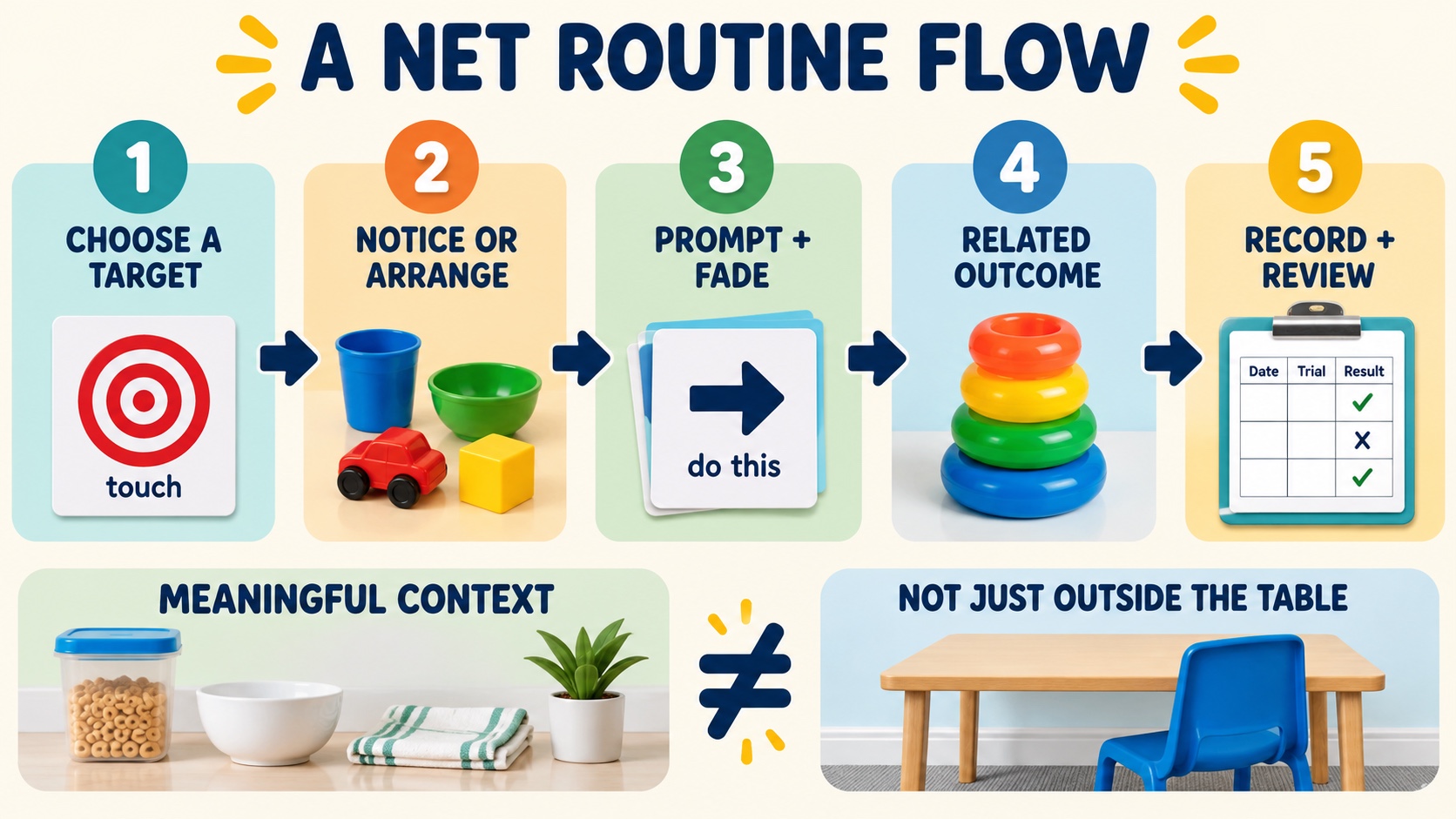
Use this six-question planning sequence when studying an example or discussing an activity with a supervisor:
- What skill is the learner practicing? Write an observable response rather than “work on communication.”
- Where would that skill naturally matter? Match the activity to the learner’s routines, preferences, culture, and goals.
- What opportunity will be arranged? Decide what materials, pause, choice, or environmental change will make the response likely without removing meaningful control.
- What will happen if the learner needs help? Follow the approved prompt, error-correction, and fading plan.
- What consequence is related to the response? Identify what the learner receives, continues, or accesses after the target response.
- What will be measured and reviewed? Track the agreed data and decide whether the skill is becoming more independent, flexible, and useful across people or settings.
Common mistakes when describing NET
“NET means no structure.” Naturalistic teaching can be carefully planned. The routine may look relaxed while the target, prompt, reinforcement, and measurement are intentional.
“Anything outside the table is NET.” The setting is only one part of the description. A natural context without a teaching arrangement does not tell you what procedure was used.
“The learner must initiate every opportunity.” Some naturalistic procedures place more emphasis on learner initiation, while others arrange opportunities or follow the learner’s focus. Name the procedure and the actual response rather than applying one rule to every program.
“Natural reinforcement makes data unnecessary.” A relevant consequence can make instruction meaningful, but the team still needs data to evaluate progress and make responsible changes.
“NET replaces all structured teaching.” NET and DTT can serve different teaching purposes. Use the arrangement that fits the learner’s goals, context, and evidence-based plan.
FAQ and sources
What does NET stand for in ABA? NET commonly stands for Natural Environment Teaching. It describes teaching embedded in meaningful routines, activities, and contexts rather than a single physical location.
Is NET only used at home? No. NET may occur in a home, classroom, clinic, playground, or community setting when the context is meaningful and the teaching arrangement fits the target. A location alone does not make an activity NET.
Is NET the same as incidental teaching? The terms overlap in everyday ABA writing, but research and programs may use them differently. Incidental teaching is one naturalistic procedure with specific features; use the program’s operational description instead of assuming every NET example follows the same steps.
Is NET better than DTT? Neither label is automatically better for every learner or target. NET and DTT use different arrangements and may be combined when the individualized program and data support the choice.
Where can I study the related ABA concepts? Use the ABA learning blocks, free practice questions, ABA glossary, and free materials for definitions and practice. These resources do not replace individualized assessment, supervision, or a treatment plan.
The best NET example is not the most playful activity. It is the example in which a meaningful routine, a clearly defined skill, a planned opportunity, a relevant consequence, and careful measurement work together.