
Multiple Exemplar Training in ABA: Examples, Benefits, and Limits
Multiple exemplar training (MET) in ABA means teaching the same target across a planned range of relevant examples. The target might be identifying a concept, communicating a need, responding to a social cue, or completing a daily-living skill. The materials or situations change, but the response the learner is meant to acquire remains clear.
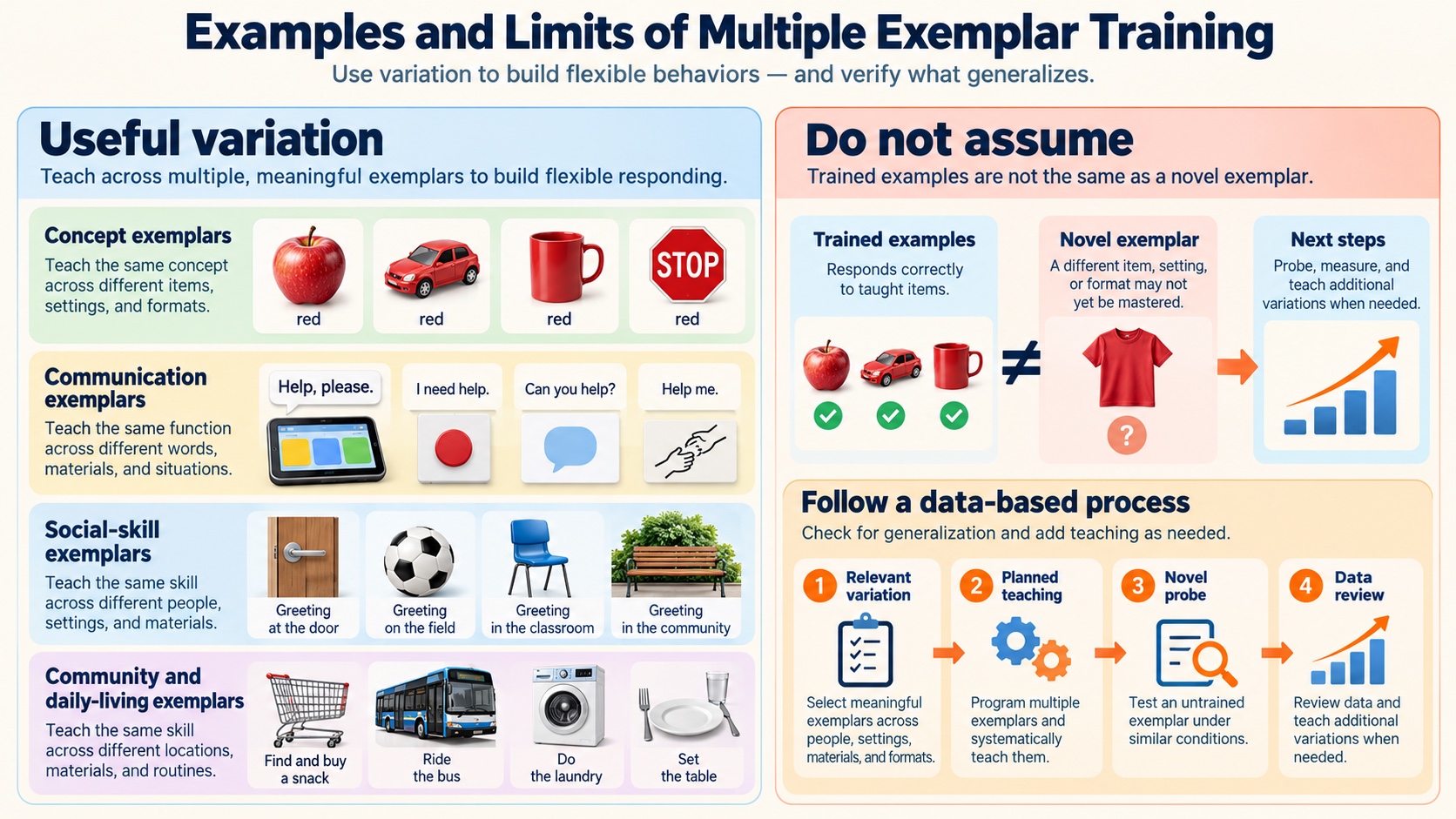
The reason for using more than one exemplar is practical: accurate responding to one item does not automatically show that the learner will respond to a new item, person, setting, or format. MET can make variation part of instruction rather than waiting to discover a generalization problem later. It still requires a probe and data review. A learner may master the trained examples and need additional teaching for a novel one.
What multiple exemplar training means
An exemplar is one example of the stimulus, response, person, setting, material, or situation involved in a teaching target. In an MET arrangement, the instructor selects several exemplars that differ in ways that matter while preserving the target relation. The selection is not random decoration. It should represent the kinds of variation the learner is expected to meet in everyday life.
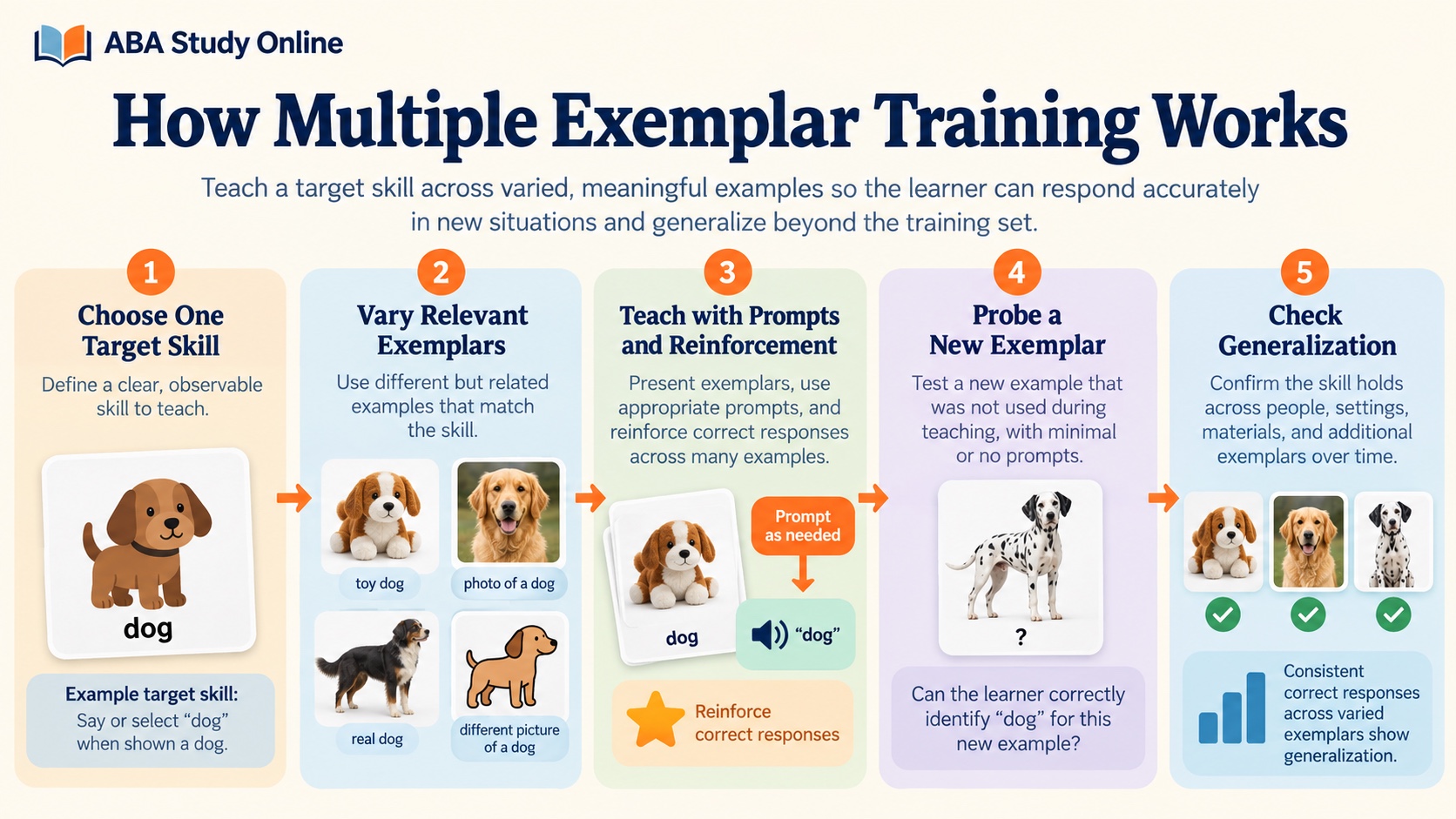
For example, if the target is saying or selecting “dog” when shown a dog, the teaching set might include a toy dog, a photograph, different breeds, a drawing, and a real dog at an appropriate distance. The learner is not being taught five unrelated labels. The instructional question is whether the response “dog” comes under the relevant dog features across varied examples.
Holth’s review describes MET as a way to train across a range of stimulus or response topographies. The approach has been discussed in relation to abstraction, relational responding, rule following, questions, and other skills. That breadth does not mean every skill needs the same number or type of exemplars. The clinician must decide which dimensions of variation are relevant to the learner and the goal.
Example: teaching a concept
Suppose the target is selecting “red.” If instruction uses one red card repeatedly, the learner may learn to select that card without showing a flexible color concept. A multiple-exemplar arrangement could rotate a red apple, red car, red cup, red stop sign, and red shirt. The items can vary in shape, texture, size, and context while the relevant color remains the same.
The goal is not to make every trial maximally different. Early teaching may begin with manageable variation and clear prompts. As responding becomes more accurate, the instructor can introduce additional exemplars and probe a new red item. If the learner selects the new item incorrectly, that is useful information: the teaching set did not yet produce the intended generalization for that exemplar. The next step may be another teaching opportunity, a clearer prompt, or a review of whether “red” was the actual controlling feature.
This example also shows why MET is different from simply presenting many materials. The materials should be selected because they represent a meaningful dimension of the concept. If a new item also changes the instruction, position, prompt, and consequence at the same time, it may be difficult to know what helped or interfered with responding.
Communication and social examples
For communication, the target may be requesting help rather than repeating one exact phrase. Instruction could arrange several functional forms: “help,” “help please,” a speech-generating-device button, a sign, or handing over a help card. The response forms are not interchangeable in every program, so the team should define what counts as correct and what communication function is being taught. Varying materials and partners can help the learner contact the same communicative outcome in more than one routine.
Social skills can also involve multiple exemplars. A greeting skill might be practiced at a doorway, in a classroom, on a playground, and in a community setting, with planned variation in the person and the opening cue. The target response might be a defined greeting sequence, not an expectation that the learner will perform an unlimited social script. Teaching should respect the learner’s communication mode and the context.
Research on multiple exemplar arrangements has examined skills such as empathy-related responding and sharing. Those studies are useful examples of why variation matters, but they also warn against overclaiming. In the sharing study, generalization occurred within categories for participants, while transfer across categories was not uniform. A trained response therefore needs to be probed in the situations that matter, rather than assumed to have generalized because the training set was large.
How to plan multiple exemplar training
- Define one observable target. Specify what the learner will do, under what conditions, and what counts as correct. “Generalize the skill” is not a measurable target by itself.
- List the relevant dimensions of variation. Consider materials, people, settings, instructions, response forms, task examples, or natural routines. Choose dimensions connected to the expected use of the skill.
- Choose a teaching set. Select enough examples to represent the target without creating unnecessary difficulty. A teaching set can expand as the learner’s performance becomes stable.
- Teach systematically. Use the planned prompting, error-correction, reinforcement, and data procedures. Variation should not replace good instruction.
- Probe a novel exemplar. Present an example that was not used during teaching, with the agreed level of support. Record the learner’s response instead of treating it as a casual observation.
- Review the data. Compare performance across trained and novel exemplars. If the target does not transfer, add teaching or adjust the program based on the pattern.
One practical planning question is, “What will this learner actually encounter?” A communication program may need variation in partners and routines. A concept program may need variation in objects and pictures. A daily-living skill may need variation in materials, locations, and natural time demands. The best exemplar set is tied to the learner’s environment and meaningful outcomes.
What MET does not guarantee
MET is not a promise that generalization will occur automatically. It is not the same as maintenance, because a skill can remain after teaching without transferring to a new exemplar. It is not the same as stimulus equivalence, and it does not mean that every possible variation must be trained. It is also not a reason to add random difficulty without a clinical purpose.
A learner may respond correctly to all trained dog cards but not to a dog in a busy park. A learner may request help from a parent but not from a teacher. A learner may greet at the classroom door but not in a community setting. These outcomes do not make the teaching effort useless. They identify the boundary of the current training set and show where a new exemplar or additional teaching may be needed.
There is also a balance between variation and instructional clarity. If every component changes at once, the learner may face an unnecessarily difficult task and the team may lose the ability to interpret errors. Good planning selects meaningful variation, introduces it in a teachable sequence, and uses data to decide what to do next.
A practical checklist
- Is the target response or relation observable and measurable?
- Which variations are relevant to the learner’s real routines?
- Are the teaching exemplars intentionally selected rather than randomly changed?
- Are prompts, reinforcement, error correction, and data collection defined?
- Has at least one meaningful novel exemplar been probed?
- Does the data show transfer, or is additional teaching needed?
- Have the team’s conclusions stayed within the conditions actually tested?
FAQ
What is a simple multiple exemplar training example in ABA?
Teaching a learner to identify “dog” using a toy dog, photos of different dogs, drawings, and a real dog is a simple example. The target response stays the same while relevant examples vary.
Why use multiple exemplars?
They can help instruction represent the variation a learner is likely to encounter. They also make it easier to test whether a response transfers beyond one memorized item or routine.
Does multiple exemplar training guarantee generalization?
No. It may support generalization, but a novel exemplar should be probed and measured. Research shows that transfer can be uneven across categories or contexts.
How many exemplars should be used?
There is no single number that fits every target. Choose a teaching set based on the relevant dimensions of variation, the learner’s performance, the setting, and the data. Add examples when the probe shows a meaningful gap.
Academic sources
- Holth (2017), Multiple Exemplar Training: Some Strengths and Limitations
- Sivaraman et al. (2017), Multiple Exemplar Training to Teach Empathy Skills
- Marzullo-Kerth et al. (2011), Generalized Sharing in Children With Autism
- BACB: About Behavior Analysis
- ABA Study Online generalization learning resource
- ABA Study Online free resources