
Motivating Operations ABA Definition: A Clear Guide
The phrase motivating operation is easy to confuse with everyday “motivation.” In ABA, it has a specific functional meaning. A motivating operation is an antecedent event or condition that temporarily changes how effective a consequence is and changes the current frequency of behavior related to that consequence.
The best way to remember the concept is to name the consequence and the behavior. What became more or less valuable? What response changed because of that value change? This approach keeps the analysis tied to observable relations instead of treating motivation as a permanent trait inside a person.
Quick answer: motivating operations ABA definition
A motivating operation is an antecedent variable that momentarily changes the effectiveness of a consequence as reinforcement or punishment and changes the frequency of behavior that has produced that consequence in the past. An answer that names only “increasing motivation” is incomplete because an MO can increase or decrease consequence effectiveness.
For example, if a person has not had access to a preferred activity for some time, access may become more effective as reinforcement and responses that have produced access may occur more often. After extensive access, the activity may be less effective and those responses may occur less often. The classification depends on the consequence, the relevant behavior history, and the observed effects in the current context.
The current BACB test-content-outline page is useful for locating behavior-analysis concepts in exam scope. Technical definitions should also be studied through behavior-analytic literature, because a short exam label still needs a functional explanation.
The two effects that define an MO
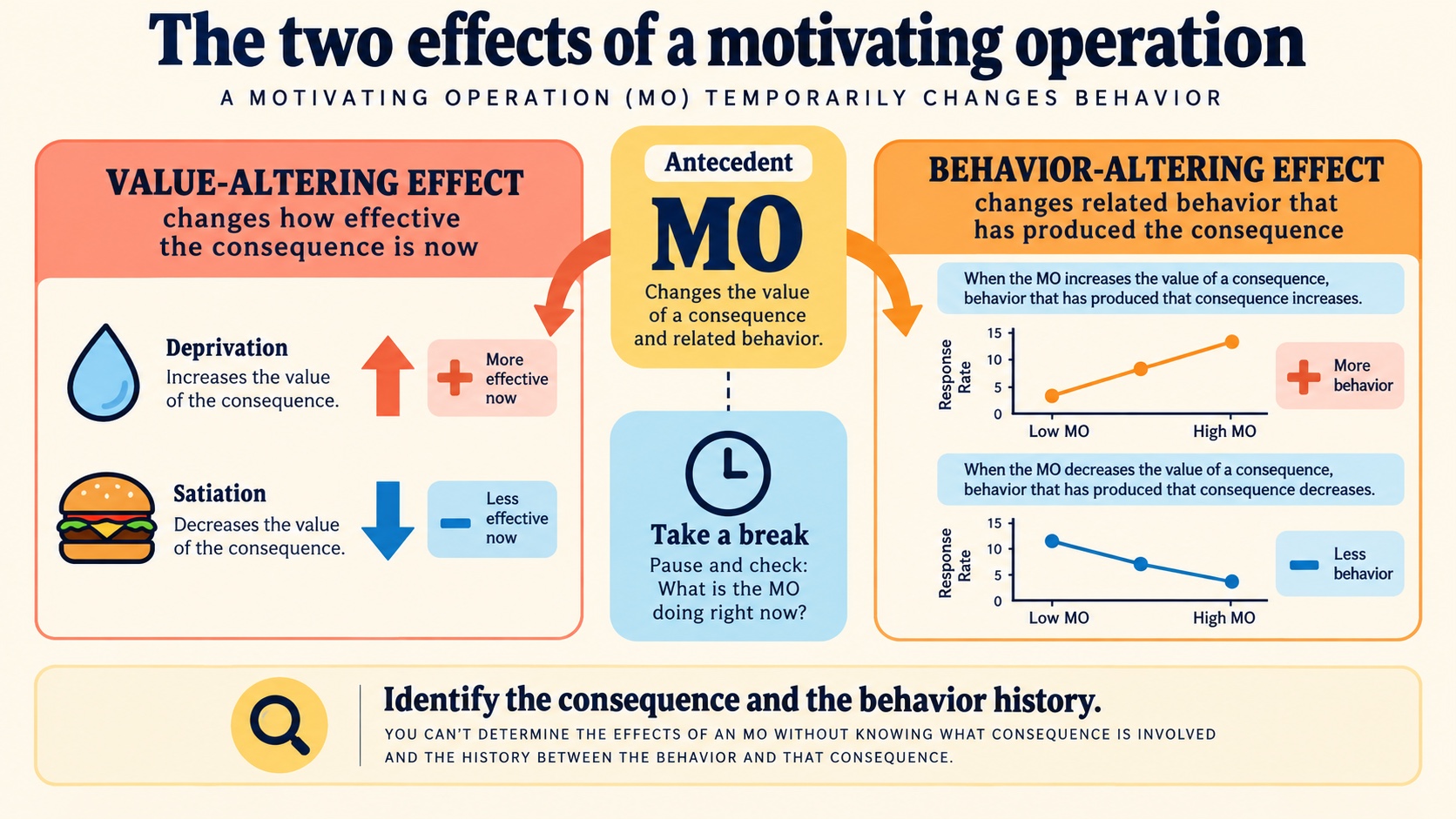
An MO has two related effects:
- Value-altering effect: the current effectiveness of a particular consequence changes. The consequence may become more or less reinforcing or punishing under the present conditions.
- Behavior-altering effect: behavior that has historically produced that consequence changes in frequency. When the consequence becomes more effective, related behavior may be evoked; when it becomes less effective, related behavior may be abated.
These effects help distinguish a technical MO from a general statement such as “the learner wanted something.” If the consequence is not identified, or if there is no behavior history connecting the response to that consequence, the explanation is not yet complete.
Remember that “momentarily” describes the current, changing influence of the antecedent. It does not mean that every effect disappears instantly. It means that the analyst is describing a condition that alters the current value of a consequence rather than assigning a permanent quality to the learner, object, or setting.
A simple break-request example
Imagine a fictional learner who has learned to hand an adult a break card when a difficult task is paused. In the past, the card exchange has produced a short, appropriate break. On one afternoon, the learner has worked through several tasks without a break, and the next task is longer than usual.
If the current conditions make the break more effective as reinforcement, the learner may use the break card more often. The relevant MO analysis is not “the learner was tired” as a complete explanation. It is more precise to describe the current condition, the break as the consequence, the history of card exchanges, and the increase in the related request response.
Now imagine that the learner has just received a break and is offered a short, easy task. The break may be less effective at that moment, and the card exchange may occur less often. The card can still be available, and the learner can still know how to use it. A change in consequence value can help explain why the same response is more or less likely across opportunities.
This is a fictional learning example, not a rule that a difficult task always functions as an MO. A team would need clear definitions, safe and ethical arrangements, measurement, and attention to communication and context before making a functional conclusion.
A practical review can record the condition that occurred before the response, the consequence that was available, the defined response, and what happened after it. The team can compare similar opportunities rather than relying on a single memorable session. If requests increase when the break has greater current value and decrease after a break, that pattern may support further analysis. If the pattern is inconsistent, the team should reconsider the assumed consequence, the response definition, the availability signal, or the relevant history.
This does not mean creating unnecessary deprivation, distress, or difficult situations. The purpose of identifying an MO is to understand behavior and improve access to appropriate reinforcement and communication. Ethical planning includes safe choices, assent and stakeholder input where applicable, dignity, and a plan to teach useful alternatives rather than merely arranging conditions to make a response more likely.
It is also useful to ask whether the proposed MO is specific to one consequence. A long wait may increase the value of a break without increasing the value of every available item. A recent snack may reduce the value of food while leaving a social activity effective. Functional analysis therefore stays specific: identify the consequence, the relevant response, and the conditions that changed their relation.
MO versus SD, EO, and AO
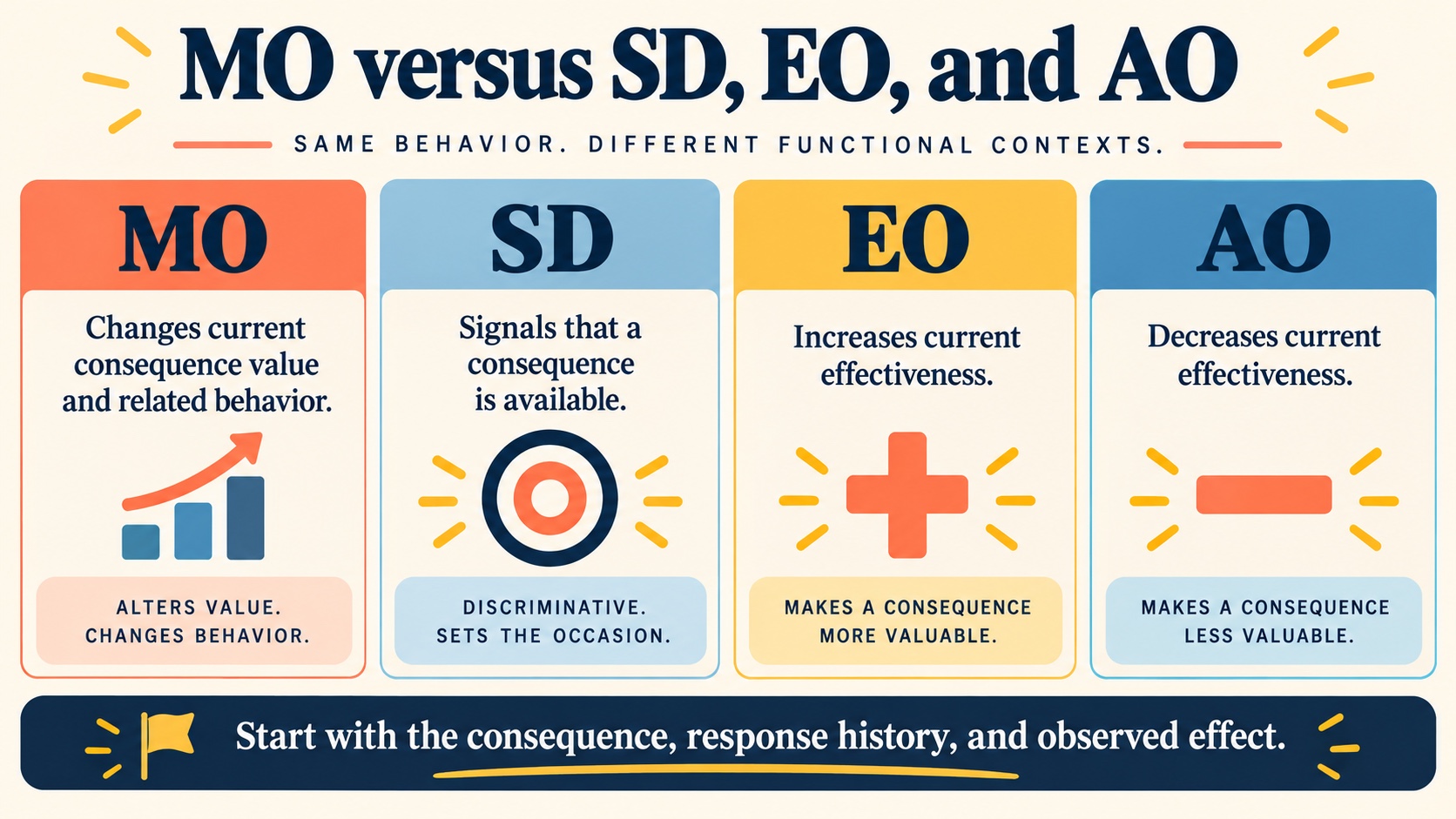
MO versus SD: A motivating operation changes the current effectiveness of a consequence and related behavior. A discriminative stimulus, or SD, signals that a consequence is available for a response because that response has been reinforced in its presence. They can work together. A break may be valuable while a break card or adult signal indicates how it can be requested.
MO versus EO: An establishing operation, or EO, is an MO effect that increases the current effectiveness of a consequence and may evoke behavior that has produced it. The word establishing describes direction, not a completely separate concept from MO.
MO versus AO: An abolishing operation, or AO, decreases the current effectiveness of a consequence and may abate behavior that has produced it. EO and AO are useful direction labels inside the broader MO framework.
MO versus a reinforcer: An MO is an antecedent variable; a reinforcer is a consequence that increases future behavior when it follows a response. A condition can make a break valuable, but the break itself is the consequence being evaluated.
MO versus a preferred item: Preference alone does not establish an MO. The analyst must identify what consequence is currently more or less effective and what related behavior changes. The same item can have different functions under different conditions and learning histories.
Common mistakes and an exam sentence
- Defining an MO as “wanting” something: name the consequence and the two functional effects.
- Calling every antecedent an MO: an MO must alter consequence effectiveness and related behavior.
- Confusing MO with SD: ask whether the event changes value or signals availability.
- Assuming the effect is permanent: MOs describe current conditions, not fixed traits.
- Ignoring the learner’s communication: do not use MO language to replace respectful assessment of the environment and response options.
A useful exam sentence is: “An MO changes the current value of a consequence and changes behavior that has produced that consequence.” If the question asks for an example, add the consequence, the relevant response history, and the direction of change. If the scenario only shows that a stimulus came before behavior, consider whether it is an SD rather than an MO.
For more concept review, visit ABA Theory Blocks, practice distinctions with free ABA questions, or search related terms in the ABA Definition Search. These are natural study links; this informational page does not promise certification or exam performance.
FAQ and sources
What is the simplest definition of an MO in ABA? It is a current antecedent condition that changes how effective a consequence is and changes behavior related to that consequence.
What are the two effects of a motivating operation? The value-altering effect changes consequence effectiveness. The behavior-altering effect changes the frequency of related behavior.
Is an MO the same as motivation? No. MO is a technical functional concept, not a permanent internal trait or a general description of wanting something.
Are EO and AO types of MO? They describe the direction of an MO effect: establishing increases current effectiveness, and abolishing decreases it.
Sources
- BACB Test Content Outlines for BACB Certifications
- McGill: A Tutorial on the Concept of the Motivating Operation and its Importance to Application
- Motivating Operations and Discriminative Stimuli: Distinguishable but Interactive Variables
- On the Distinction Between the Motivating Operation and Setting Event Concepts