
Motivating Operation in ABA: Definition, Examples, and MO vs. SD
A motivating operation, or MO, is an antecedent event or condition that temporarily changes the effectiveness of a consequence and changes the current frequency of behavior related to that consequence. It helps explain why the same reinforcer may work differently at different times, or why a response that usually occurs becomes less likely in a changed context.
The term does not mean that a learner has a permanent level of “motivation.” In ABA, the useful question is functional: What consequence became more or less effective, and what behavior changed because of that value change? Once that question is clear, it becomes easier to separate an MO from an SD, a reinforcer, a consequence, or a vague personal-trait explanation.
Quick answer: what is a motivating operation?
A motivating operation is an antecedent variable that momentarily changes the value of a consequence as reinforcement or punishment and changes the frequency of behavior that has produced that consequence in the past. A complete answer names both effects: the change in consequence value and the related change in behavior.
For example, going several hours without water may make drinking more valuable and may increase behavior that has previously produced access to water. After drinking a large amount, the value of another drink may decrease and drink-seeking behavior may decrease. These are only illustrations; an MO is identified by its functional effects in the relevant situation, not by a shortcut such as “thirst always equals an MO.”
MOs can affect reinforcers or punishers, and their effects can increase or decrease. An establishing operation increases the current effectiveness of a consequence. An abolishing operation decreases it. Both are directions of motivating operation effects, not separate explanations that replace the broader MO concept.
The two effects of an MO
- Value-altering effect: the antecedent temporarily changes how effective a particular consequence is. A consequence may become more reinforcing, less reinforcing, more punishing, or less punishing under the current conditions.
- Behavior-altering effect: the antecedent changes the current frequency of behavior that has historically produced that consequence. If the consequence becomes more effective, related behavior may be evoked. If its effectiveness decreases, related behavior may be abated.
Consider a fictional learner who has a history of requesting a break from difficult work. As the task becomes longer and a break has not been available for some time, the break may become more effective as a reinforcer. The learner may request more often. The description is stronger if it identifies the consequence, the response history, and the current condition than if it says only, “The learner was motivated to escape.”
An MO does not automatically tell us that a behavior is appropriate, harmful, or caused by one internal state. It is one functional variable among the conditions that influence behavior. A practitioner still needs a clear target definition, suitable measurement, and attention to what happens before and after the response.
Where the MO fits in the four-term contingency
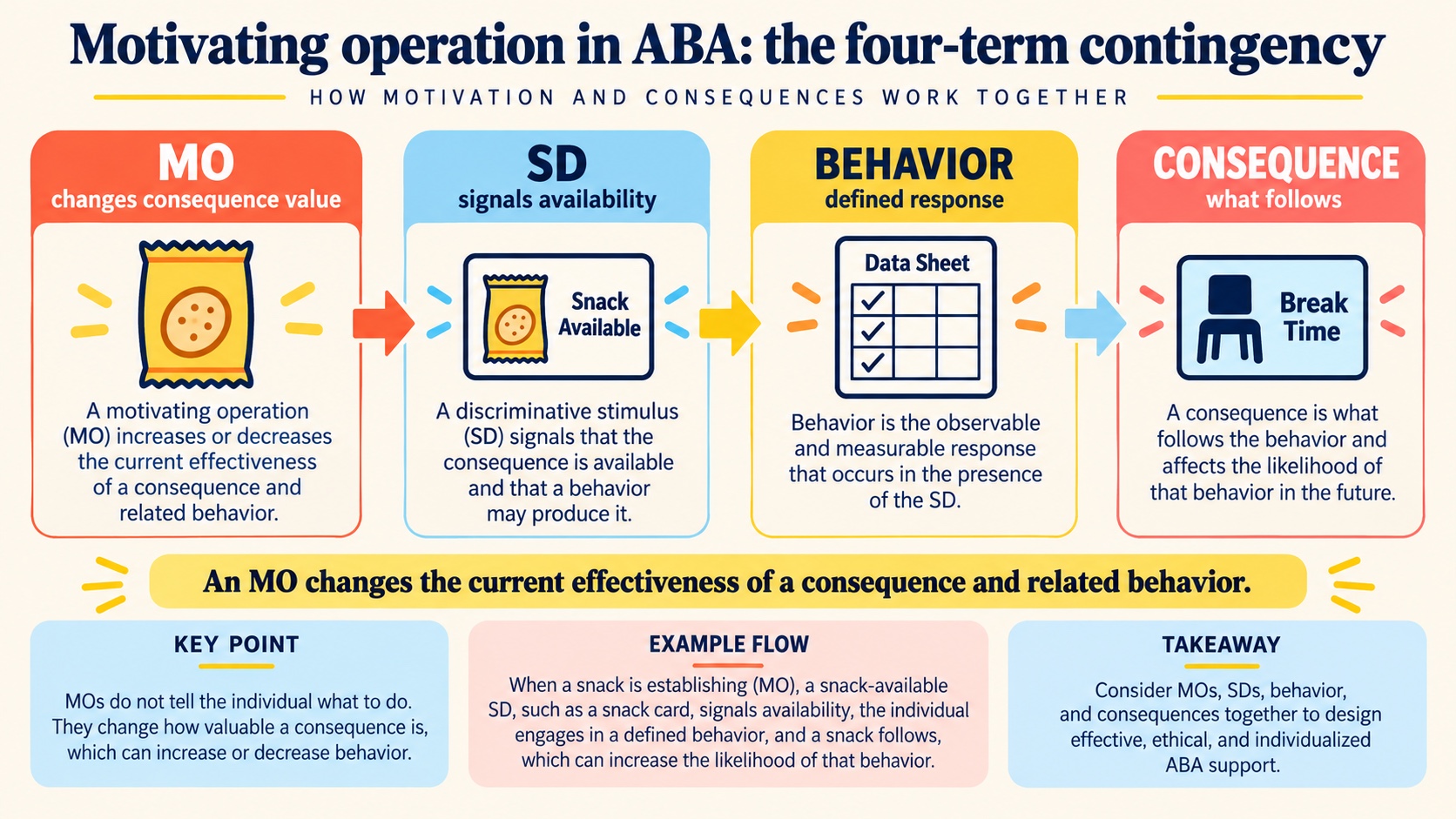
A four-term contingency places the motivating operation before the discriminative stimulus, behavior, and consequence:
- MO: changes the current value of a consequence and related behavior.
- SD: signals that the consequence is available for a response.
- Behavior: the defined response of interest.
- Consequence: the event that follows the response and may change future behavior.
Imagine that a learner has learned to request a snack by using a picture card. The current condition may make the snack especially valuable. The picture-card exchange may signal that the snack is available when the response occurs. The learner exchanges the card, and access to the snack follows. The MO and SD are not the same part of the contingency, but both can influence the response in the same episode.
Now change the condition: the learner has just eaten and the snack is no longer valuable. The same card may still signal availability, but the request may occur less often because the consequence has less current value. This is why an SD does not guarantee that behavior will occur. The signal can be present while the MO changes the effectiveness of the consequence.
Context also matters when a team evaluates an MO. A difficult task may make a break more valuable for one learner, while a predictable choice routine may make independent responding more valuable for another. A quiet room, a crowded transition, a long wait, or a change in communication access can alter the conditions around the consequence. These observations do not justify guessing at a private state; they help the team identify which environmental events should be described and measured.
When an MO is suspected, the practical response is not to manipulate a person’s deprivation or distress casually. A responsible plan considers safe, ethical, and socially valid ways to arrange opportunities, offer communication, and observe behavior. The goal is to understand the contingency and improve access to appropriate reinforcement—not to create unnecessary discomfort so that a response will occur.
Data can help test the hypothesis without turning it into a label. Record the relevant condition, the target response, the consequence available, and the response pattern across comparable opportunities. If requests increase only when a particular condition is present, the pattern may support further analysis. If the response does not change, the team should reconsider the proposed consequence, the definition, the signal, or the learning history. A graph cannot identify an MO by itself, but it can show when the proposed relation deserves closer examination.
MO versus SD, reinforcer, EO, and AO
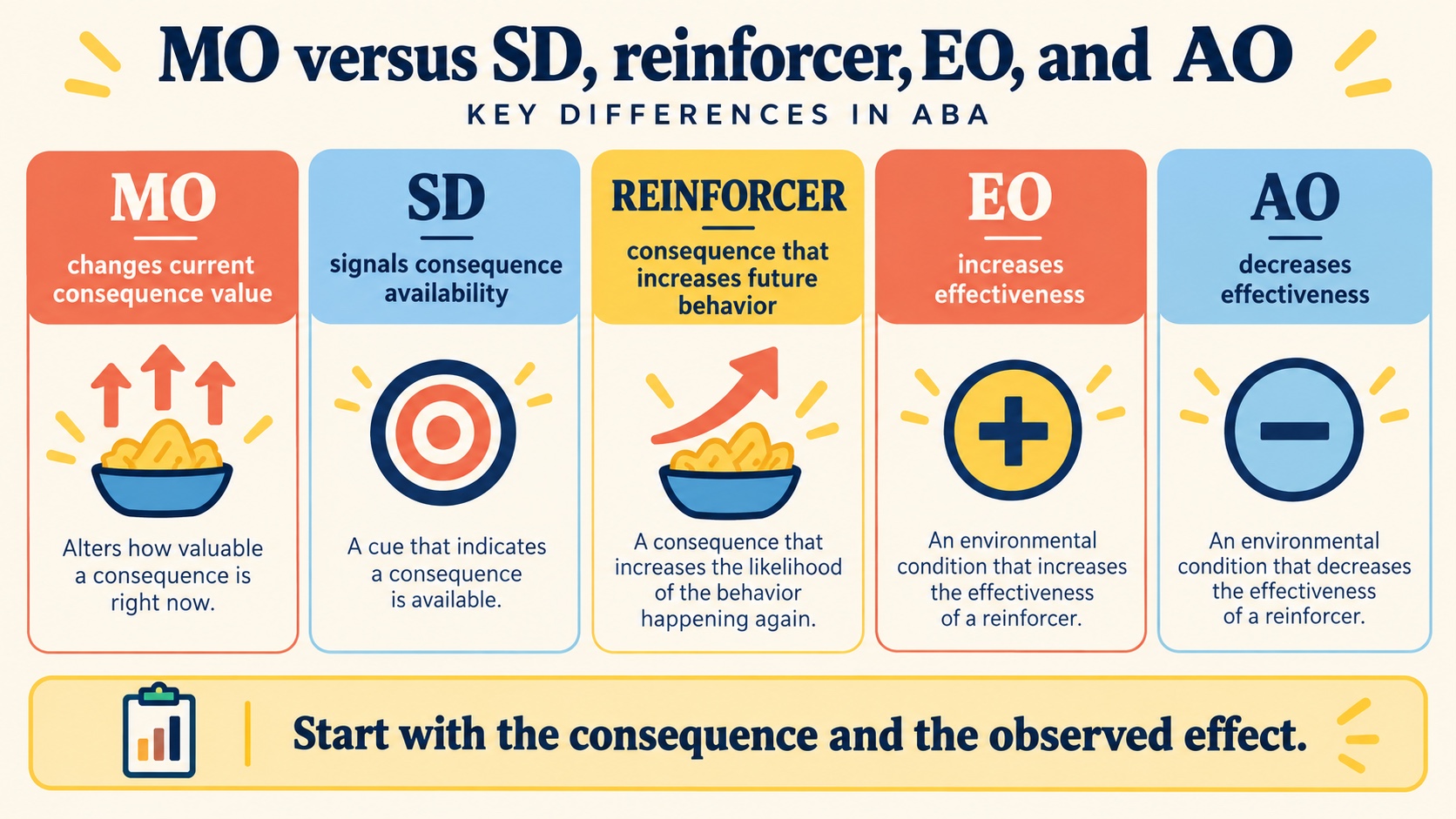
MO versus SD: An MO changes the current value of a consequence and behavior related to it. An SD signals that a consequence is available for a response because that response has been reinforced in its presence. In a communication routine, the current value of a break and the availability of a way to request it can both matter.
MO versus reinforcer: An MO is an antecedent variable. A reinforcer is a consequence that increases future behavior when it follows a response. A condition that makes a drink valuable is not itself the drink; it changes the current effectiveness of the drink as a consequence.
MO versus EO and AO: EO and AO describe direction. An EO establishes or increases the current effectiveness of a consequence, while an AO abolishes or decreases it. The broader term MO includes both directions. Do not use EO and AO as though they refer to different kinds of learning history.
MO versus conditioned and unconditioned: Some motivating effects depend on learning history and are conditioned. Others do not depend on the same type of individual learning history and are unconditioned. The specific conditioned types—CMO-S, CMO-R, and CMO-T—need their own functional analysis and are covered in the related CMO study page.
MO versus a preferred item: A preferred item may function as a reinforcer under particular conditions, but preference alone does not tell us whether the item, its absence, a signal, or another event is functioning as an MO. Identify the value-altering effect and the related behavior.
Common mistakes and an exam checklist
- Using “motivation” as a trait: describe the current antecedent, consequence, and behavior effect instead.
- Giving only one effect: an MO involves both a value-altering effect and a behavior-altering effect.
- Calling every antecedent an MO: identify the consequence whose effectiveness changed.
- Confusing an MO with an SD: ask whether the event changes value or signals availability.
- Assuming the same MO works for everyone: current conditions, history, and consequences matter.
- Ignoring communication and context: do not use MO language to replace a meaningful assessment of the person’s environment and response options.
For an exam scenario, ask:
- What consequence is being discussed?
- Did its current effectiveness increase or decrease?
- What behavior that has produced the consequence changed in frequency?
- Is another stimulus signaling that the consequence is available?
- Does the example describe an EO, AO, conditioned MO, or unconditioned MO?
- What observation or measurement would help test the proposed relation?
For more ABA concept review, visit ABA Theory Blocks, practice distinctions with free ABA questions, or search related terms in the ABA Definition Search. These are natural study links; this informational page does not promise certification, exam success, or a specific clinical result.
FAQ and sources
What is a motivating operation in ABA in simple terms? It is a current condition that changes how valuable a consequence is and changes behavior related to getting or avoiding that consequence.
What are the two effects of an MO? The value-altering effect changes the effectiveness of a consequence. The behavior-altering effect changes the frequency of behavior that has produced that consequence.
Is an MO the same as an SD? No. An MO changes current consequence value; an SD signals that a consequence is available for a response. They can work together.
Are establishing and abolishing operations types of MOs? They describe the direction of an MO’s effect: establishing increases consequence effectiveness, while abolishing decreases it.
Sources
- BACB Test Content Outlines for BACB Certifications
- McGill: A Tutorial on the Concept of the Motivating Operation and its Importance to Application
- Motivating Operations and Discriminative Stimuli: Distinguishable but Interactive Variables
- On the Distinction Between the Motivating Operation and Setting Event Concepts
- A Clinical Tutorial on Methods to Capture and Contrive Establishing Operations to Teach Mands