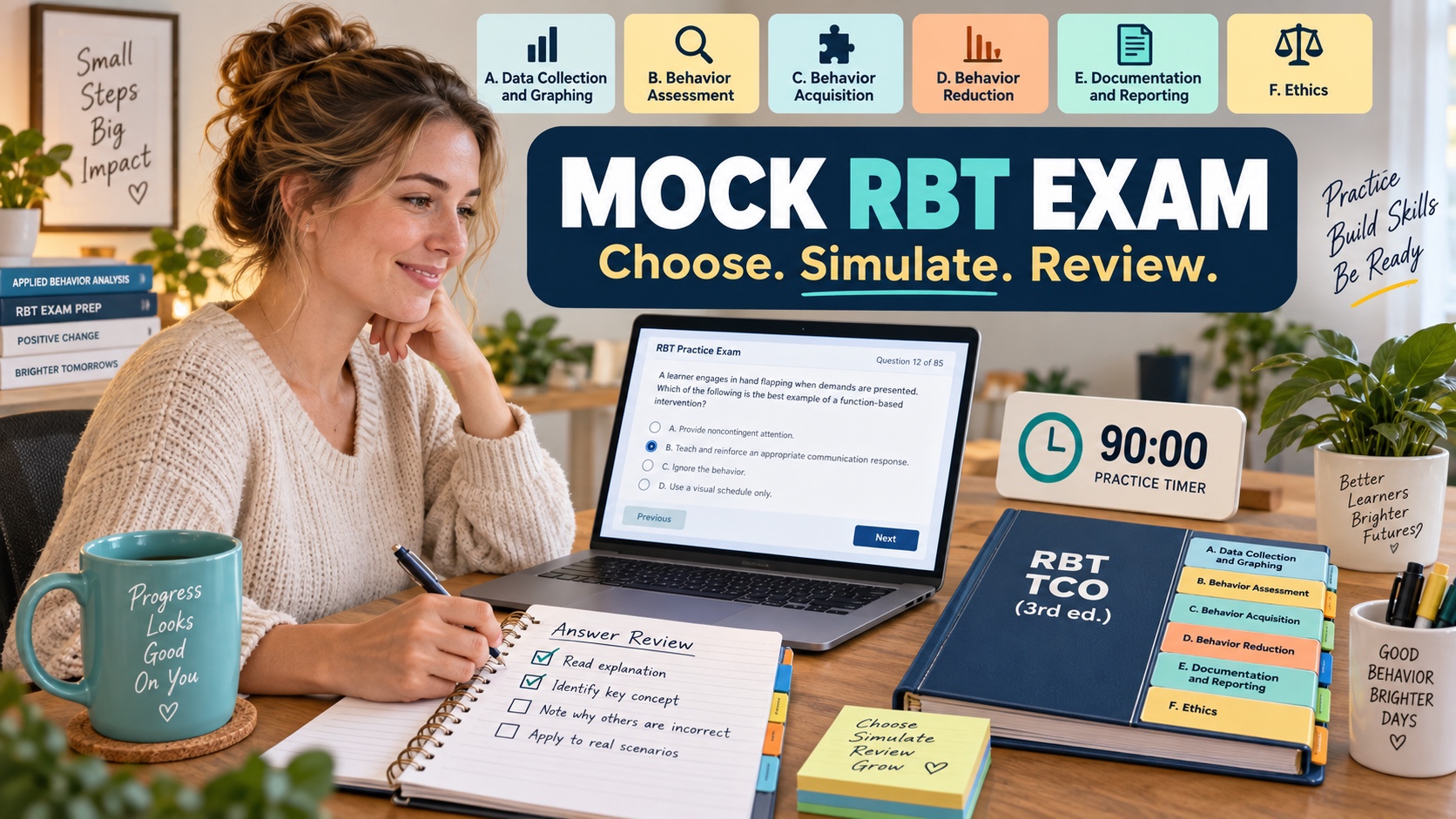
Mock RBT Exam: How to Choose and Use a Full Practice Simulation
Searching for a mock RBT exam usually means you are ready to practice under more realistic conditions than a short vocabulary quiz. You may want to know whether you can keep your attention across a longer set, switch between content domains, read close answer choices, and review mistakes without immediately looking at the explanation. A good mock can help with that. It is still an independent study resource, not the official BACB examination and not a promise about your result.
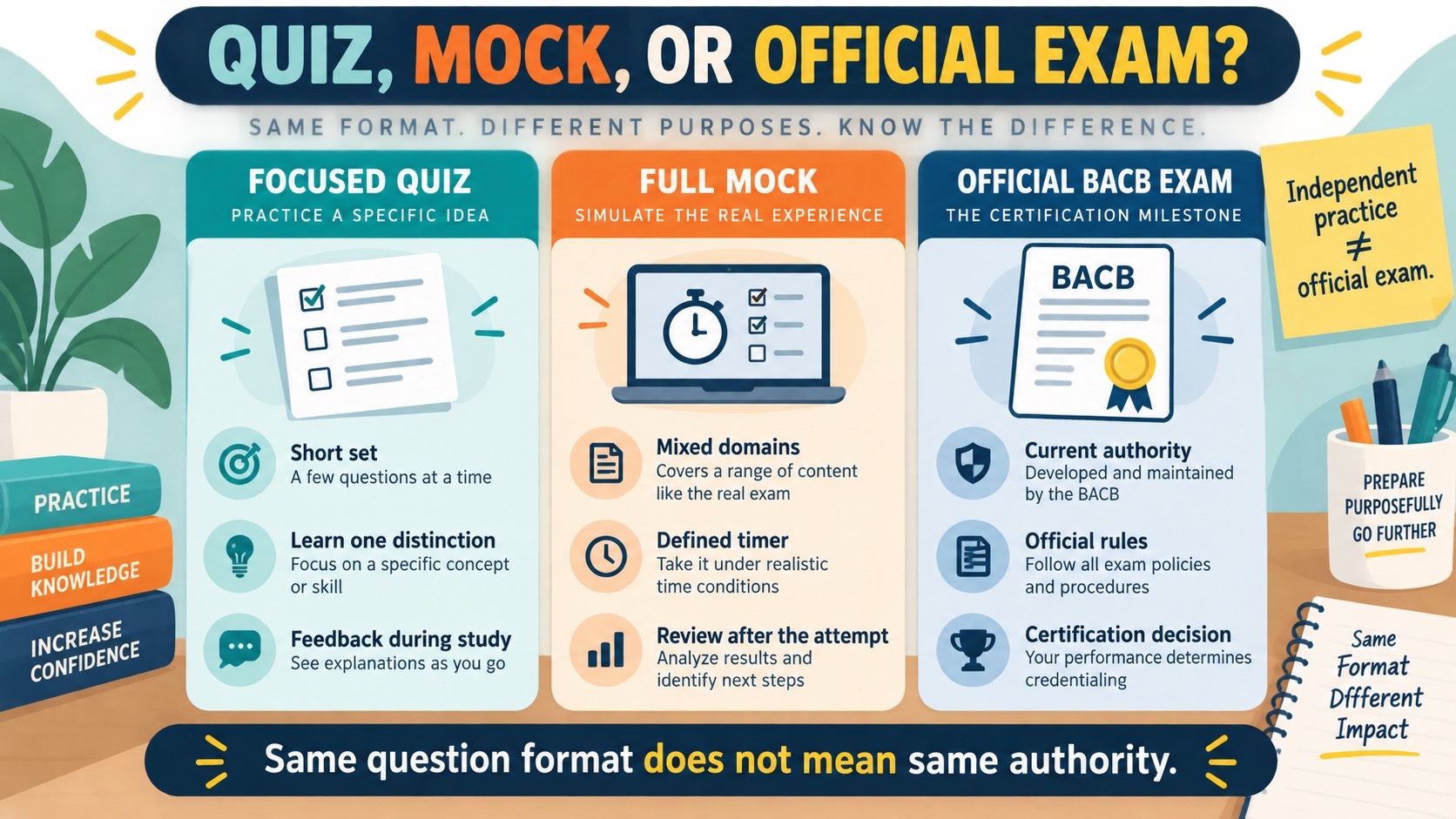
The best choice depends on your current study job. A short quiz is useful while learning one distinction. A full mock is useful after you have studied the content and want to rehearse pacing, mixed-domain decisions, and an end-to-end review routine. This guide explains the current RBT exam context, what makes a simulation useful, and how to turn one attempt into a more focused plan.
Table of Contents
Quick answer: what a mock RBT exam is for
A mock RBT exam is a practice simulation designed to help you rehearse exam-style decisions. It can combine questions from the current content areas, limit the time available, delay answer feedback until the attempt is finished, and provide explanations or a domain breakdown afterward. Those features make the practice experience more informative than a random set of terms, but they do not make the questions official.
Use a mock when you can already explain the basic vocabulary and want to test application under mixed conditions. If you are still learning the difference between frequency and duration, or between a prompt and a reinforcer, start with a focused lesson and short practice set. A low mock score is not a verdict. It is information about content, test-taking behavior, timing, or some combination of the three.
The current RBT exam context
The BACB RBT Test Content Outline (3rd ed.) describes examination content beginning January 1, 2026. It organizes 43 tasks into six domains: Data Collection and Graphing, Behavior Assessment, Behavior Acquisition, Behavior Reduction, Documentation and Reporting, and Ethics. The outline describes 75 scored questions and 10 unscored pilot questions.
The current RBT Handbook describes an 85-question multiple-choice examination, with four possible answers for each question and 90 minutes to complete it. That is why a full simulation may use 85 questions and a 90-minute timer. The official outline and handbook are the authority for current exam facts; an independent mock site should not imply that its items, scoring, interface, or explanations are issued by the BACB or Pearson VUE.
Content weighting is useful for planning, not for predicting a personal result. Behavior Acquisition and Behavior Reduction carry substantial space in the outline, while documentation, reporting, and ethics still matter. A balanced simulation should make it possible to practice across all six domains instead of allowing one familiar topic to create a misleadingly high score.
What makes a mock exam useful?
“Realistic” should describe a practice condition, not a claim of access to secure questions. Before you start, look for five qualities.
- Current content alignment. The resource identifies the RBT TCO (3rd ed.) or clearly explains the effective exam context. It does not mix old task-list labels with current requirements without explanation.
- Balanced coverage. Questions are distributed across data collection and graphing, assessment, acquisition, reduction, documentation and reporting, and ethics. A practice set focused only on reinforcement is not a full simulation.
- Scenario-based decisions. Items give enough context to decide what the RBT should measure, implement, document, report, or ask a supervisor about. They should test application, not only whether you can recognize a definition.
- Protected answer review. You can commit to an answer before reading the rationale, then see why the best option fits and why close alternatives do not. Immediate feedback is useful for learning, but a separate timed mode is useful for simulation.
- Transparent boundaries. The provider says that its questions are original and unofficial, avoids pass guarantees, and does not encourage sharing live or recalled examination content.
A timer by itself does not create quality. A set can have 85 questions and still be poorly written, repetitive, out of date, or missing important domains. Read the explanations. If the rationale merely repeats the answer letter, it will not help you repair the reasoning that produced the error.
Choose the right practice format
Use the shortest format that answers your current question. If you are asking, “Do I understand this one concept?” choose a short topic set. If you are asking, “Can I identify the relevant domain when the topic changes?” choose a mixed set. If you are asking, “Can I sustain a ninety-minute study condition and review my decisions afterward?” choose a full mock.
- Focused quiz: best for learning one task, comparing two close terms, or checking a lesson immediately.
- Mixed practice: best for switching between measurement, assessment, teaching, reduction, documentation, and ethics.
- Full mock: best for pacing, attention, decision consistency, and practicing a complete review routine.
- Official preparation: always begins with current BACB requirements, the TCO, the Handbook, and any instructions from the relevant certification authority.
Do not compare scores across formats as if they were the same measurement. A high score on ten familiar questions and a lower score on a new mixed simulation may be telling you different things. Record the number of questions, the timing, whether feedback was visible, the domains represented, and how confident you felt before checking the answer.
A before, during, and after workflow
Make the mock a small experiment rather than a one-time judgment.
- Before: choose a defined session, remove answer notes from view, prepare paper for an error log, and decide whether the first attempt is timed or diagnostic. If you have not studied the current outline, do that first.
- During: read the whole scenario, identify the task being tested, eliminate answers that exceed the RBT role, and flag uncertainty instead of changing answers repeatedly. Follow the timer you chose, but record technical interruptions or unusual conditions.
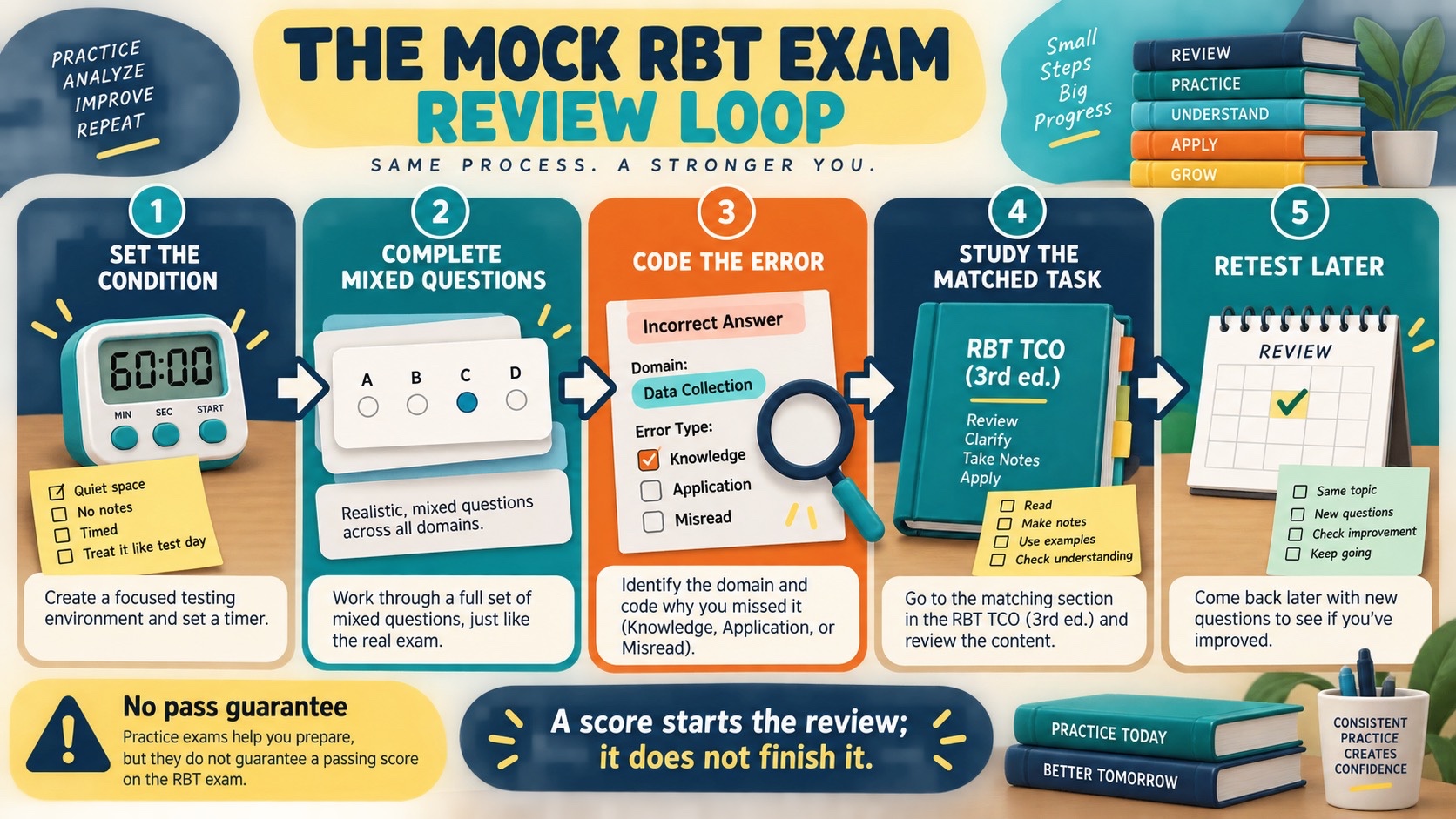
- After: review every missed answer and every correct answer that felt uncertain. Write the domain, the exact decision point, the reason your choice seemed attractive, and the source or lesson that should guide the next attempt.
- Later: practice the weak distinction with new examples after a delay. Then use another mixed set to check whether the reasoning transfers when the wording and context change.
This structure matches a basic learning principle: retrieving information and receiving useful feedback can support later retention better than simply rereading. That evidence supports using practice tests as learning tools, but it does not turn an unofficial score into a certification prediction. The quality of the question, the explanation, your prior study, and the timing all affect what the result means.
How to read your result
Start with the pattern, not the percentage. A cluster of errors in Data Collection and Graphing may point to measurement definitions, graph interpretation, or choosing a recording method from a scenario. Errors in Behavior Acquisition may involve prompting, fading, reinforcement, chaining, generalization, or following the written teaching plan. A documentation or ethics error may reveal a scope-of-practice or reporting boundary that deserves careful attention even if it represents only one item.
Also code the type of error:
- Knowledge gap: you did not know the concept or could not recall it.
- Discrimination error: you knew both terms but missed the fact that separated them in the scenario.
- Procedure error: you knew the idea but selected a step that did not follow the assigned plan or sequence.
- Reading error: you missed a qualifier such as “first,” “most appropriate,” “independent,” or “under supervision.”
- Timing or endurance error: your reasoning changed as attention or pacing deteriorated.
Choose the next study action from the code. A knowledge gap calls for a clear explanation and a new example. A discrimination error calls for a side-by-side comparison. A procedure error calls for returning to the authorized steps and supervisor direction. A reading error calls for slower scenario annotation. A timing pattern calls for shorter timed sets before another full simulation.
Common mock-exam mistakes
- Taking a full mock before learning the blueprint: begin with the current TCO and know what each domain represents.
- Treating the score as a pass prediction: an unofficial result is evidence from one practice condition.
- Choosing only familiar topics: balanced mixed practice reveals whether you can identify the task when the surface details change.
- Reading explanations before committing: protect the retrieval attempt when the goal is simulation.
- Repeating the same questions: memory for the answer letter is not the same as flexible understanding.
- Ignoring role boundaries: an RBT practice answer should not teach independent treatment-plan changes or unsupervised clinical decisions.
- Using outdated or supposedly live items: verify the edition and use original, ethical preparation material.
FAQ and sources
How many questions should a mock RBT exam have?
A full simulation may mirror the current 85-question testing experience and 90-minute time limit described in the RBT Handbook. Shorter sets can still be valuable for focused learning. The number alone does not establish quality or official status.
Is a mock RBT exam the official RBT exam?
No. An independent mock is a study tool. Use the BACB TCO and Handbook for official requirements and exam facts, and do not treat a mock score as a BACB score report or guarantee.
Should I take a mock RBT exam timed?
Use an untimed or lightly timed set while learning a new distinction. Use a full timed simulation when your goal is pacing, attention, and practice under a defined condition. Record which condition you used so you can interpret the result honestly.
What should I do after a low mock-exam score?
Review the pattern of errors, tag each item by domain and error type, study the matched task, and retest later with new questions. Do not simply repeat the same test until the percentage rises.
Where can I verify the current RBT exam format?
Start with the RBT Test Content Outline (3rd ed.) and the RBT Handbook. The BACB’s RBT resource page and Examination Information page provide additional official context.