Mock BCBA Exams: How to Use Multiple Practice Tests
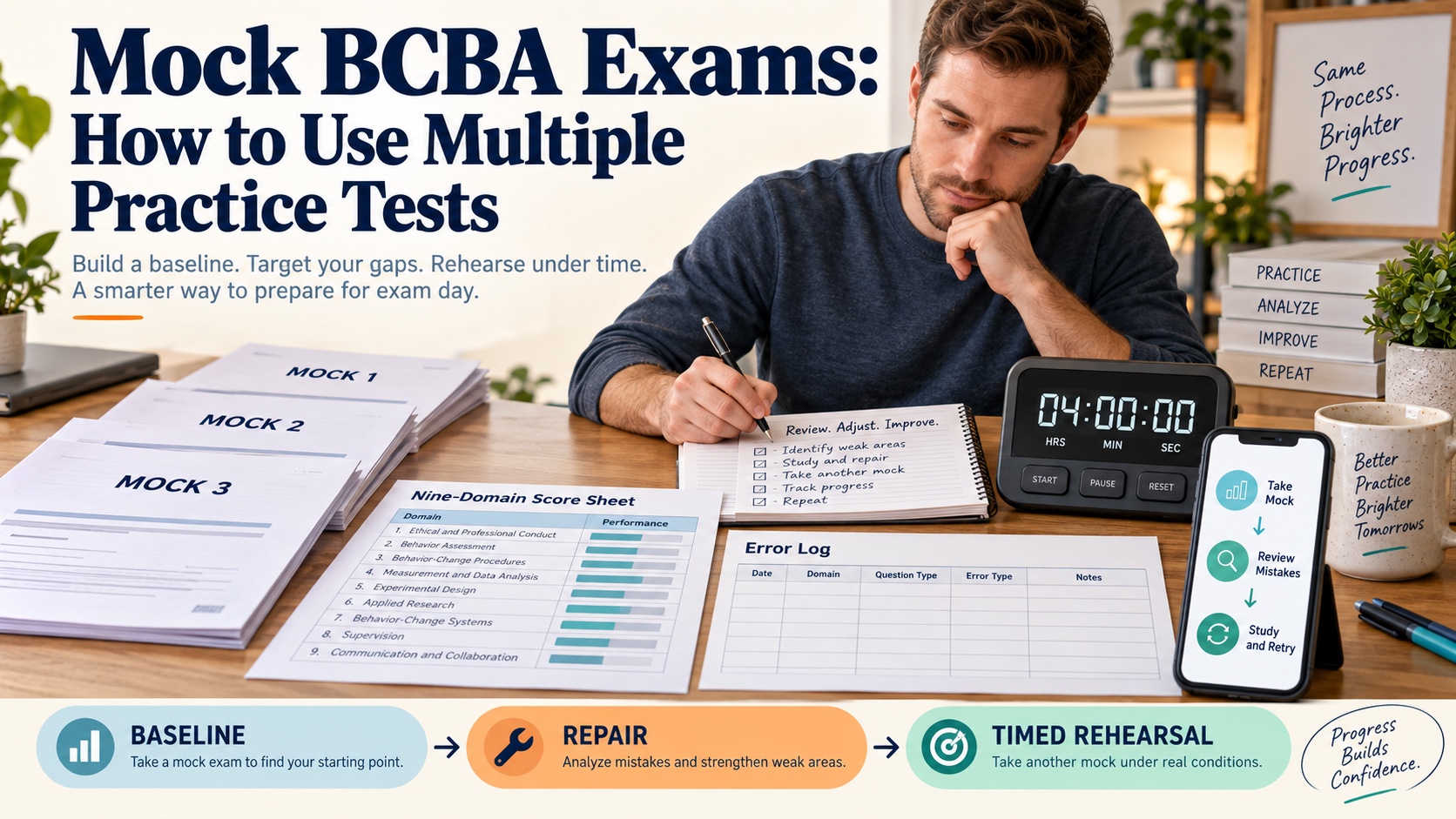
Searching for mock BCBA exams usually means you are deciding between several practice forms, not asking for one more random quiz. One mock can give you a baseline. A second can show whether focused review transferred to new scenarios. A later timed form can rehearse pacing and stamina. Taking several tests without changing the purpose of each attempt, however, can produce a pile of percentages and very little guidance about what to study next.
This guide explains a practical sequence for choosing and using multiple original practice exams. It uses the current official BCBA exam structure as a boundary, not as a promise that any third-party mock reproduces the exam. ABA Study Online’s longer mock-exam experience belongs on the website; the app can carry the shorter flashcards, section practice, audio review, progress, and error-repair loop afterward.
Table of Contents
Short answer: why use more than one mock?
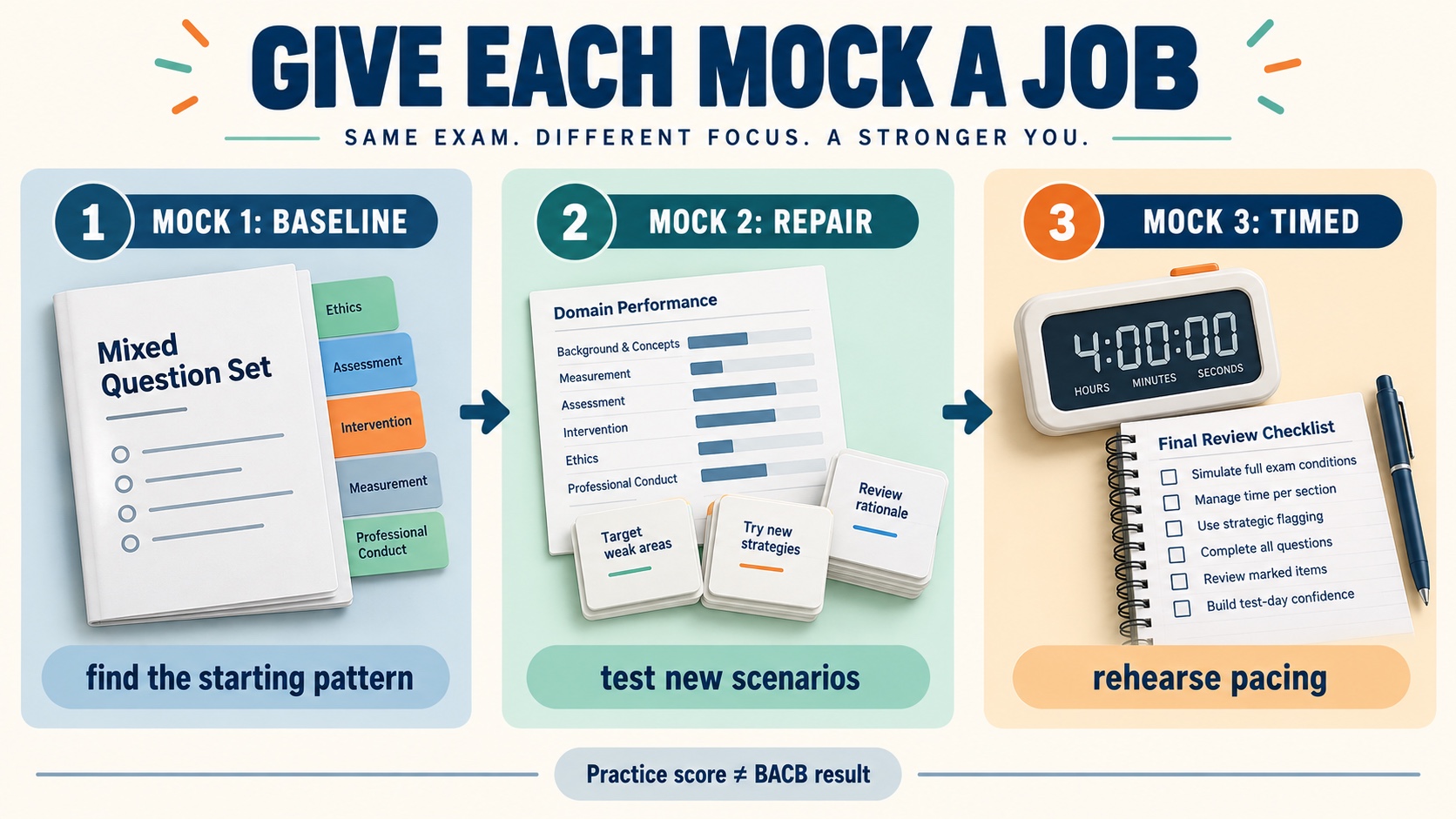
Use multiple mock exams when each one answers a different study question. The first asks, “Where am I starting?” The next asks, “Did my targeted repair transfer to new items?” The final timed rehearsal asks, “Can I sustain careful reasoning under the planned conditions?” A mock score is evidence about that practice form, not an official BACB result or a pass guarantee.
A useful sequence also protects you from a common testing habit: repeating the same form until you remember its wording. Familiarity can look like improvement even when the underlying discrimination has not changed. Different original forms, delayed retesting, and review of the reasoning behind each answer give you better information than taking the same questions back to back.
The current BCBA format a mock should disclose
The BACB Examination Information page currently lists the BCBA examination as 185 questions with four hours of testing time. BACB materials also describe four possible answers with one correct answer and computer-based delivery through Pearson VUE. The current BCBA Test Content Outline is the 6th edition and organizes the content into nine domains.
Those facts are useful for evaluating a practice product, but they do not mean a third-party mock is official. A responsible page should tell you which edition it uses, how many questions are in a full-length form, whether the timer is optional or enforced, how content areas are represented, and whether explanations are included. It should also say plainly that its questions are original and unofficial.
Do not use a mock to reproduce, recall, or reconstruct secure BACB items. The practice value comes from building your own applied reasoning: identify the relevant evidence, discriminate close concepts, choose the most defensible response, and explain why the alternatives do not fit the scenario.
A three-form sequence that gives each mock a job
Form one: establish a baseline
Take the first form before you have polished every weak area. Choose a broad, mixed set that shows how you handle different domains, scenario length, and answer-choice discrimination. If your goal is to measure pacing, use a clear timer. If your goal is to learn how you currently reason, a controlled untimed baseline can be useful, but record that condition so you do not compare it with a later timed result as if they were equivalent.
Record more than the percentage. Note the domain, confidence, time used, and error type for each missed or guessed item. For example, “low confidence but correct” points to shaky retrieval; “high confidence but wrong” points to a discrimination or reasoning problem that deserves closer attention.
Form two: test targeted repair
After the baseline, choose two or three small repair targets. A target might be a measurement distinction, a functional-assessment decision, an experimental-design pattern, an ethics application, or a behavior-change procedure. Review the concept, answer shorter original questions, explain the rationale aloud, and wait long enough that you are not relying on immediate memory.
Use the second mock to test transfer. It should contain new scenarios and a mixed order rather than simply repeating the same domain worksheet. Compare the kind of errors you make, not just the headline score. A small score change with fewer high-confidence errors may represent real progress; a large change on an easier or familiar form may not.
Form three: rehearse the testing demand
Use the final form for a deliberate rehearsal. Match the planned time condition, remove avoidable interruptions, prepare the same practical materials you will use on test day, and practise making a decision without turning every item into an open-ended research project. The purpose is to observe pacing, attention, fatigue, and review habits across a long session.
Do not schedule the rehearsal so close to the exam that you have no time to act on what it shows. If the result exposes a recurring error pattern, select a smaller repair block. If it exposes pacing trouble, practise shorter timed sets and a calmer flag-and-return routine instead of simply taking another full form the next day.
What to compare before choosing a mock-exam product
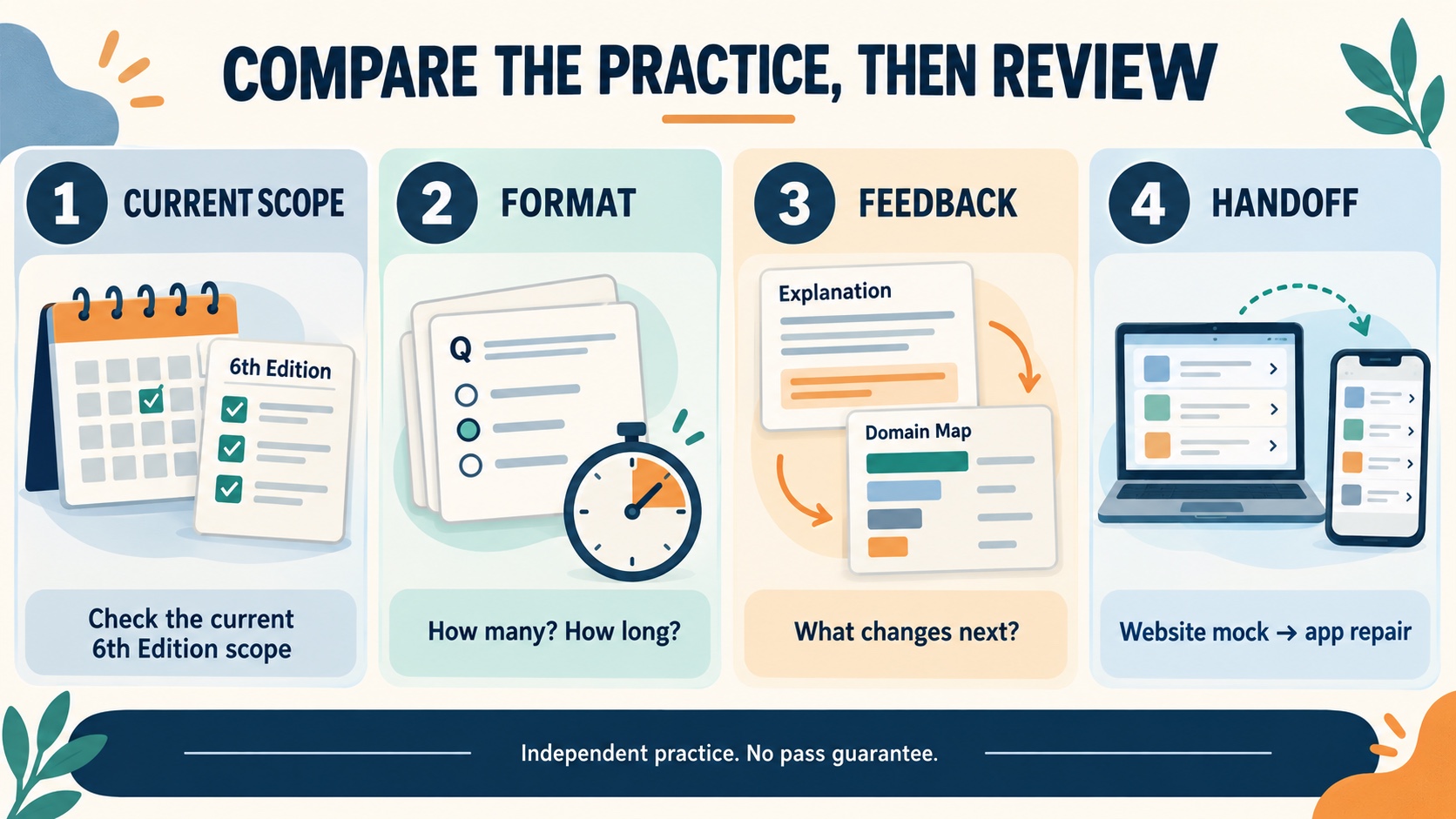
“More questions” is not enough information to choose between mock BCBA exams. Compare the product on the dimensions that will change your next study decision:
- Currentness: Does the page identify the BCBA 6th-edition basis and show when the scope was checked?
- Format: Does it state the question count, timing, answer-choice structure, and whether the session is full-length, mini, domain-based, or mixed?
- Coverage: Can you see how the questions map to the nine domains without being promised an exact copy of the official exam?
- Explanations: Does each answer explain the evidence and the distractors, or does it only reveal a letter?
- Review controls: Can you flag uncertain items, record confidence, revisit rationales, or export an error list?
- Access and privacy: Is the access window clear, and do you understand what account or device data the product stores?
- Independence: Does the provider clearly say it is not BACB-endorsed and does not guarantee a passing result?
These checks are useful whether you are comparing a free sample, a paid set of full-length forms, a printable product, or a website practice experience. The best choice is the one whose feedback changes what you do next—not necessarily the one with the largest question count or the loudest “pass” language.
Turn the result into the next study block
A mock is most useful when the review begins before you open another test. Sort the result into four buckets:
- Knowledge gap: you did not know the relevant definition, procedure, or rule.
- Discrimination gap: you knew both concepts but selected the wrong one for the evidence in the stem.
- Application gap: you recognized the concept but missed how it changes in the scenario.
- Testing-process gap: you rushed, overthought, changed a correct answer without evidence, or lost time on a difficult item.
Then choose one small action for the next session. Read one explanation and write your own contrast. Complete a short domain set. Rehearse one chart or scenario type. Or do a timed block with a planned flag-and-return rule. The ABA Study Online app can carry these shorter review actions through flashcards, section practice, audio review, progress, and saved mistakes. Keep the full mock on the website, where the longer practice session can be treated as a distinct event.
Common mistakes with multiple mocks
- Taking forms too close together. Immediate repetition can measure memory for the form instead of transfer to new scenarios.
- Comparing unlike conditions. A calm untimed set and a four-hour rehearsal answer different questions.
- Chasing a score cutoff. Third-party scores are not official scaled results, and there is no responsible universal mock-score guarantee.
- Ignoring high-confidence errors. A confident wrong answer often reveals a concept discrimination that needs an explanation, not just more volume.
- Using leaked or recalled content. Original practice is safer and more educational than attempting to reproduce secure items.
- Putting every practice mode in the app. Use the website for the full mock destination and the app for shorter, repeatable review when that matches the product boundary.
Mock BCBA exam FAQ
How many mock BCBA exams should I take?
There is no official number that fits every candidate. A useful minimum sequence is one baseline, one new-form transfer check after targeted repair, and one timed rehearsal if you need to observe pacing. Stop adding full forms when the result is no longer changing your study decision.
Should every mock BCBA exam be full length?
No. Full-length forms are useful for stamina and broad diagnosis. Short domain or mixed sets are more efficient for repairing one pattern. Label the mode clearly so you do not treat a short practice percentage as equivalent to a full rehearsal.
Can a mock score predict whether I will pass the BCBA exam?
No practice provider can responsibly turn one third-party score into an official prediction. Use the score as evidence about that form, then inspect domain, confidence, error type, and pacing patterns. The BACB remains the source for official examination rules and results.
Are ABA Study Online mock BCBA exams official?
No. ABA Study Online practice is independent and original. It can help you rehearse concepts and review mistakes, but it is not BACB examination content, a BACB score report, an endorsement, or a pass guarantee.
Choose your next practice mode
If you have not taken a broad baseline, start with one. If you already have a result, do not automatically buy or open another full form: identify the smallest repair target first. When you are ready for a longer website session, choose a mock that states its current scope, format, explanations, and independent status. Then use the result to select the next short review block.
Use the website for the full mock
Explore the ABA Study Online BCBA mock-exam destination for an independent practice session, then use the app for shorter review and error repair. These resources are not BACB-endorsed and do not guarantee a certification result.
Official sources and study links
Use the BACB Examination Information page, the BCBA Handbook, the BCBA Test Content Outline, and the BACB Terms of Use for current boundaries. For independent study, use BCBA practice questions, the BCBA learning path, the ABA glossary, and the ABA Study Online app to turn a mock result into a repeatable review plan.