
Is the RBT Exam Hard? A Realistic Difficulty Guide
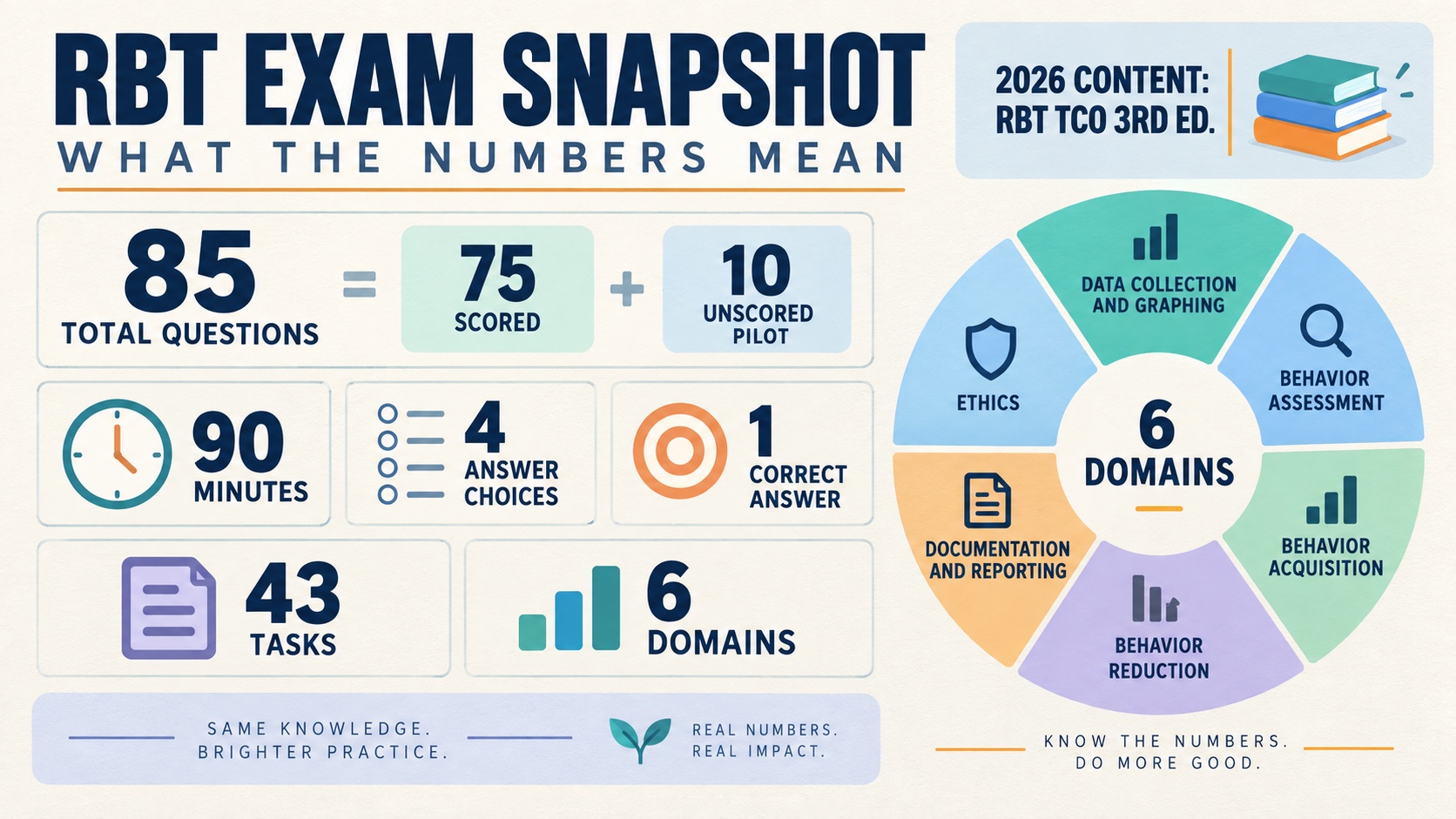
If you are asking is the RBT exam hard, the most useful answer is: it is a serious entry-level certification examination, but its difficulty is easier to plan when you break it into specific demands. The current RBT examination has 85 multiple-choice questions, 75 scored questions and 10 unscored pilot questions, four answer choices with one correct answer, and 90 minutes to complete the test. That is enough breadth and time pressure to make casual studying risky, but it is not a reason to treat the exam as mysterious or impossible.
The better question is not whether the exam feels hard to everyone. Ask which part is hard for you: remembering the current content map, applying a procedure to a new scenario, moving at a workable pace, or reviewing mistakes without repeating them. This guide uses current BACB sources for exam facts and pass-rate context. It does not predict an individual result, publish a magic passing percentage, or replace the current RBT Handbook.
Table of Contents
Short answer: what makes the RBT exam feel hard
The exam feels difficult when a learner has memorized terms but has not practiced choosing the best response in a short behavior-analytic scenario. RBT candidates may need to distinguish a measurement procedure, identify what an assessment result does and does not show, implement a teaching or behavior-reduction procedure as written, document an event objectively, and recognize an ethics or scope-of-practice boundary. Those decisions can look familiar in notes and still feel different when the answer choices are close.
Another source of difficulty is switching between domains. The current RBT Test Content Outline, 3rd edition, organizes 43 tasks across six domains: Data Collection and Graphing, Behavior Assessment, Behavior Acquisition, Behavior Reduction, Documentation and Reporting, and Ethics. The largest planning areas are Behavior Acquisition and Behavior Reduction, but a study plan cannot safely ignore the smaller domains. A missed documentation or ethics distinction can still matter on a real question.
What the current exam format demands
The BACB’s current RBT materials describe an examination with 85 questions delivered in a multiple-choice format. Seventy-five questions are scored and 10 are unscored pilot questions. You cannot identify the pilot questions during the exam, so every item deserves the same careful attention. Each question has four possible answers and one correct answer, and candidates have 90 minutes.
The 2026 content boundary is also important. The BACB says the RBT examination content beginning in 2026 is based on the RBT TCO, 3rd edition. Older notes may use the previous task-list language or different domain distributions. That does not mean every older concept is irrelevant; it means you should use the current official outline as the organizing map before deciding what to review.
Four kinds of difficulty to prepare for
- Content breadth. The RBT outline moves from measurement and assessment to acquisition, reduction, documentation, and ethics. You do not need to memorize every page of a training course equally. You do need a current map that tells you where a concept belongs and what the RBT is expected to implement, record, communicate, or escalate.
- Scenario discrimination. Many practice questions become harder when two choices are both related to ABA but only one matches the evidence in the stem. Slow down and ask what happened, what is directly observed, what procedure is authorized, and what action stays within the RBT role. A definition is useful only when it helps you discriminate between alternatives.
- Pacing and stamina. Ninety minutes for 85 questions creates a real clock. You may spend more time on a long scenario and less on a direct definition, but repeatedly getting stuck early can make later decisions rushed. Timed practice should include a move-on rule and a return strategy, not only a stopwatch.
- Feedback and confidence. A low practice score can reflect a content gap, a reading mistake, an unlearned calculation, fatigue, or a test-taking habit. A high score can also contain lucky guesses. The useful question is not “Did I pass this one set?” but “What pattern did this set reveal, and what repair will I test next?”
How to interpret RBT pass-rate data
The BACB’s 2025 annual data report shows a 75% first-time pass rate for RBT candidates and a 38% pass rate for retakes. Those figures are important context: most first-time candidates in that reported group passed, and preparation should be taken seriously. They are not a personal probability. Candidates differ in training quality, time available, experience, language, testing conditions, and whether they used a current outline.
Do not turn the 75% figure into a promise, and do not conclude that a retake is automatically harder because the retake percentage is lower. Retake groups can differ from first-time groups in preparation and circumstances. Use the data to justify a deliberate plan, not to label yourself before you have evidence from current, track-appropriate practice.
Be cautious with claims such as “you need exactly 70%” or “you must answer a fixed number correctly.” The BACB explains that examination forms are equated and that the passing standard can vary by form. The raw number of correct answers and a universal overall percentage are not reported as a simple public cutoff. If a candidate fails, the report can identify RBT tasks connected to incorrect responses, which is more useful for planning than an invented magic number.
How to check readiness without guessing
Create a small readiness record rather than relying on how familiar your notes look. For each practice set, record the date, the source and outline version, whether the set was timed, the score, the questions you guessed on, and the reason for each miss. Use labels such as content, scenario discrimination, measurement, ethics/scope, reading, pacing, or fatigue.
Look for the same pattern across at least two or three sets. One poor result may reflect a bad day or an unfamiliar interface. Repeated errors in Behavior Acquisition, Behavior Reduction, or Data Collection deserve targeted practice. Repeated guessed answers deserve review even when they are technically correct. Readiness is stronger when you can explain why the best answer fits and why the alternatives do not.
A practical study and repair loop
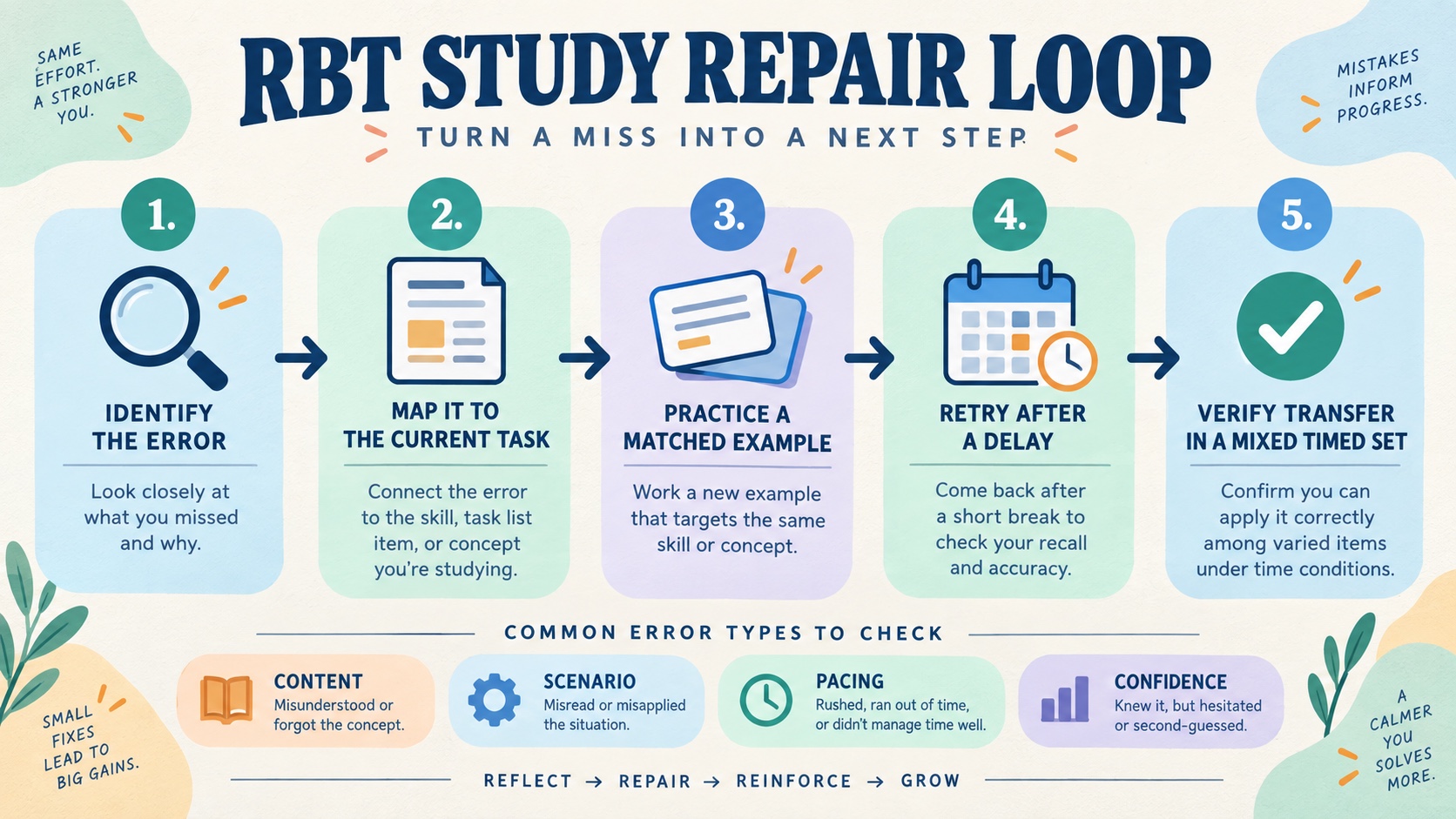
- Map the source. Start with the current RBT TCO, then connect each study note to a domain and task. Keep eligibility, training, competency assessment, and examination notes separate so one document does not replace another.
- Build a contrast. For a difficult concept, write the plain-language rule, one example, one non-example, and the feature that separates the closest competing answer.
- Practice in layers. Begin with untimed explanation, move to short timed sets, and then use mixed sets that require switching domains. Practice should include scenario items, not only flashcard recognition.
- Repair the error. Choose the repair that matches the label: revisit a task statement for a content gap, calculate a measurement example for a data gap, or practice a move-on rule for a pacing gap.
- Retry later. Do not immediately repeat the same question until it feels familiar. Use a delayed, parallel question and then a mixed timed set to see whether the skill transfers.
Common preparation mistakes
- Using an outdated map: check whether a resource clearly addresses the current RBT TCO, 3rd edition, for 2026 examination content.
- Studying only the largest domain: weight your time thoughtfully, but keep all six domains in rotation.
- Confusing certification steps: the 40-hour training, Initial Competency Assessment, application, and examination are related steps, not interchangeable documents.
- Chasing a magic score: an independent practice score is feedback, not an official BACB result or a guarantee.
- Ignoring guessed answers: uncertainty is a review signal even when the selected option happens to be correct.
- Taking only full-length tests: long sessions test stamina, while short targeted sets often repair a particular task more efficiently.
Is the RBT exam hard FAQ
Is the RBT exam harder than the training?
The training and examination have different purposes. Training introduces the required content and responsibilities; the examination asks you to recognize and apply that content under a clock. Completing training is necessary in the certification pathway, but it does not by itself predict an examination result.
How long should I study for the RBT exam?
There is no single official number of study days that fits every candidate. Use the current outline, your error record, and repeated timed practice to decide. A shorter plan with specific repair actions is usually more informative than an arbitrary promise to study for a fixed number of weeks.
What is the hardest part of the RBT exam?
Many candidates find scenario discrimination and pacing harder than simple definition recall. Your own error record should decide where to spend more time. If you miss questions across multiple domains, return to the full map rather than studying only one familiar topic.
Can a practice test tell me whether I will pass?
No. A current, well-designed practice set can reveal knowledge, application, and pacing patterns, but it is independent study material. It is not secure BACB content, an official score report, or a pass guarantee.