Is the BCBA Exam Harder Than the Bar Exam?
If you are asking whether the BCBA exam is harder than the bar, you are probably trying to estimate the size of the challenge before you commit to a study plan. The honest answer is that there is no official, universal difficulty ranking between the two. A bar exam can mean different exams in different jurisdictions, and the BCBA exam is built around a specific behavior-analysis content outline and certification process.
One person may find the BCBA exam harder because the scenarios require precise behavior-analytic discrimination. Another may find a bar exam harder because of its breadth, jurisdiction-specific law, writing tasks, or preparation schedule. The useful comparison is not “which credential is more impressive?” It is “which demands will this candidate need to manage, and what evidence will show that the plan is working?”
Table of Contents
The short answer
Neither the BACB nor a bar-administration body publishes a single scale that lets you say the BCBA exam is harder than every bar exam. The BCBA Test Content Outline (6th ed.) describes the content and task-level objectives for the BCBA examination. Bar examinations are administered under jurisdiction-specific rules and may combine multiple-choice, written, performance-test, or other components.
That means a comparison needs a qualifier. You can compare the breadth of the content, the type of reasoning, the pace, the amount of writing, the eligibility path, and the time available to prepare. You should not turn one candidate’s experience or one jurisdiction’s bar format into a universal fact.
What makes an exam feel harder?
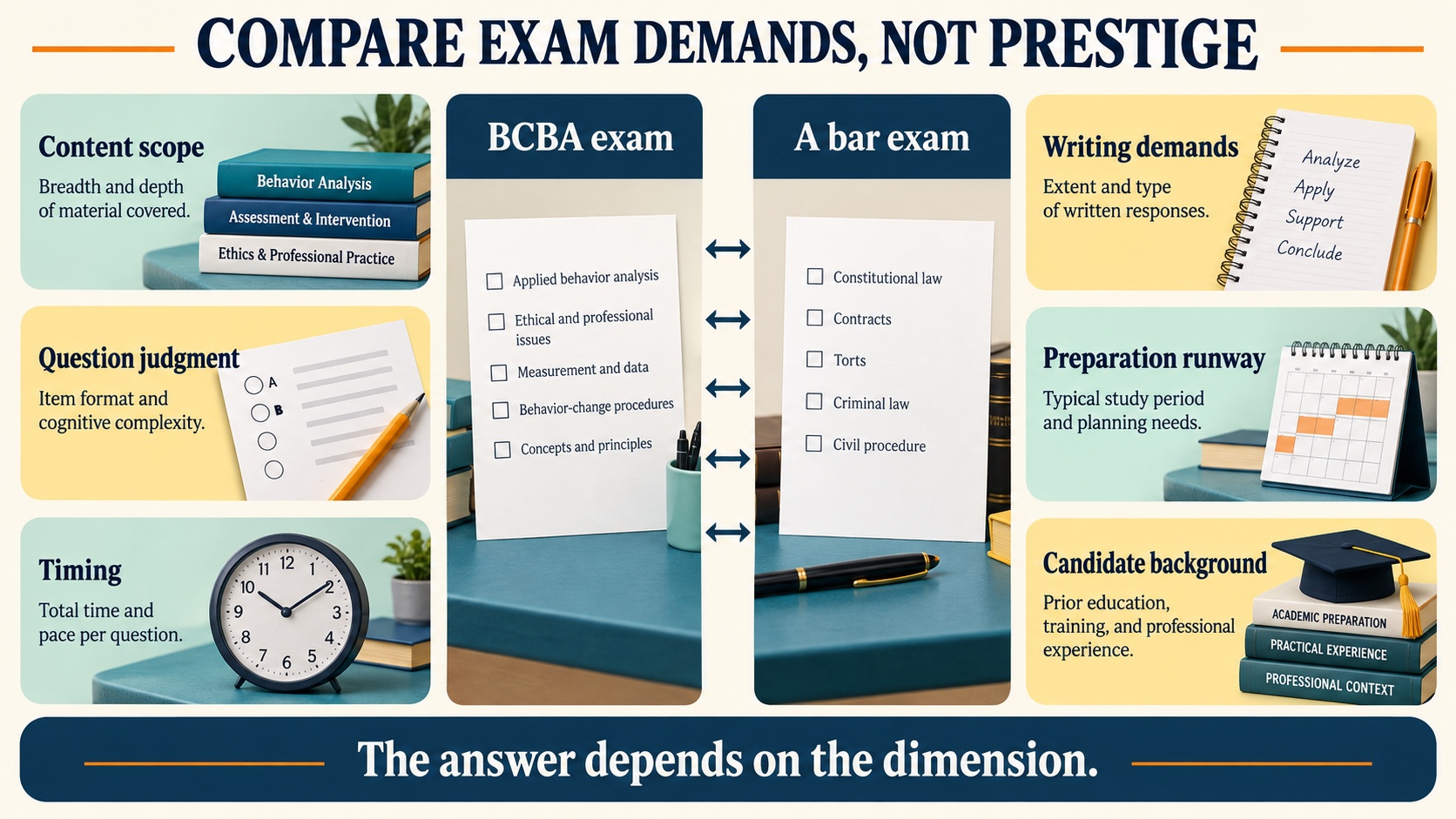
An exam can feel difficult for at least six different reasons:
- Scope: How many concepts must you organize, and how closely related are the answer choices?
- Transfer: Must you apply a rule to a new scenario rather than recognize a definition?
- Pacing: Can you make a defensible decision within the available time?
- Writing: Do you need to construct written answers in addition to selecting responses?
- Preparation runway: How much coursework, supervised experience, and prior knowledge do you bring?
- Personal stakes: How much does the result affect your next professional step?
Content and scope
The BCBA examination is organized around the current BACB Test Content Outline. That outline gives candidates a structured map of behavior-analytic domains, tasks, and knowledge expectations. Preparation therefore involves more than memorizing isolated definitions: candidates need to discriminate concepts, interpret data, reason about design and intervention, and apply ethical and professional boundaries to scenarios.
A bar exam’s scope depends on the jurisdiction and examination format. It may include foundational legal subjects, jurisdiction-specific rules, procedure, writing, and performance tasks. Comparing a BCBA outline with one bar outline can be informative, but it cannot establish a universal difficulty result. The two exams are designed for different professions and different decisions.
Question format and judgment
BCBA candidates often describe difficulty in terms of the “best answer” problem: several options may sound related to the scenario, but one fits the controlling fact, principle, or ethical boundary better than the others. That makes explanation and application practice important. A high flashcard score alone cannot show that a candidate can identify the relevant variable in a new case.
Bar examinations may add substantial writing or performance components depending on jurisdiction. If a candidate is stronger at timed multiple-choice discrimination than at organized legal writing, the bar may feel harder even when the BCBA content is unfamiliar. The reverse can also be true for a behavior analyst who is comfortable with scenario reasoning but has not built the legal vocabulary or writing stamina required by a particular bar format.
Preparation demands
For BCBA preparation, start with the official TCO and examination information. Turn each domain into a study map, then combine concept review with original questions, explanations, mixed scenarios, and timed practice. Track the distinction you missed rather than only the percentage you earned.
Do not copy a bar-preparation schedule into a BCBA plan without checking the actual content and eligibility path. The number of study hours is not a reliable difficulty score. A shorter plan can be demanding if the learner has a strong foundation and little available time; a longer plan can still fail if it consists only of passive rereading.
Why personal background matters
Difficulty is partly relational. A lawyer moving into behavior analysis may find the BCBA terminology and scientific reasoning unfamiliar. A behavior analyst may have the opposite experience when facing legal writing, jurisdictional rules, or a different style of timed performance. Work schedule, fieldwork, test anxiety, language, disability accommodations, and access to feedback also change the preparation demand.
Instead of asking which exam is “objectively harder,” identify your current gap. Can you explain the concepts without notes? Can you apply them to a changed scenario? Can you finish a mixed set without losing accuracy? Can you review an error and name the next action? These questions produce a more useful plan than a comparison headline.
How to plan BCBA preparation
- Map the current official outline: use the BACB TCO and examination information as the source of truth.
- Baseline your knowledge: use a mixed diagnostic set and record confidence, not just correct answers.
- Repair concepts: write plain-language definitions, examples, nonexamples, and decision rules.
- Practice transfer: answer original scenarios that change the setting, variables, and distractors.
- Rehearse pacing: add timed blocks and later a full simulation under realistic conditions.
- Review errors: schedule delayed retrieval for the exact distinction you missed.
ABA Study Online’s BCBA resources, free questions, app review tools, and mock-exam resources can support those layers. They are independent study resources; the current BACB outline and examination information remain the official boundaries.
Comparison mistakes to avoid
- Using one bar format as “the bar exam”: jurisdiction and component differences matter.
- Comparing pass rates without context: cohorts, eligibility, repeat attempts, and definitions may differ.
- Confusing prestige with difficulty: professional status does not measure your preparation task.
- Assuming long study hours prove hardness: method and feedback matter more than a headline number.
- Practicing only definitions: BCBA candidates need scenario application and explanation.
- Ignoring the current TCO: older task lists and forum advice can misdirect a study plan.
FAQ and sources
Is the BCBA exam harder than the bar exam?
There is no universal official ranking. The answer depends on which bar examination, which difficulty dimension, and the candidate’s preparation and background. Compare scope, question style, writing, timing, and personal gaps instead.
Does a hard exam require more study hours?
Not necessarily. Study time depends on prior knowledge, schedule, feedback, learning method, and the current exam requirements. Use performance evidence to adjust your plan.
What should BCBA candidates use as the source of truth?
Use the current BACB Test Content Outline, BCBA Handbook, examination information, and official BCBA resources. Independent guides can organize practice but cannot change the official requirements.