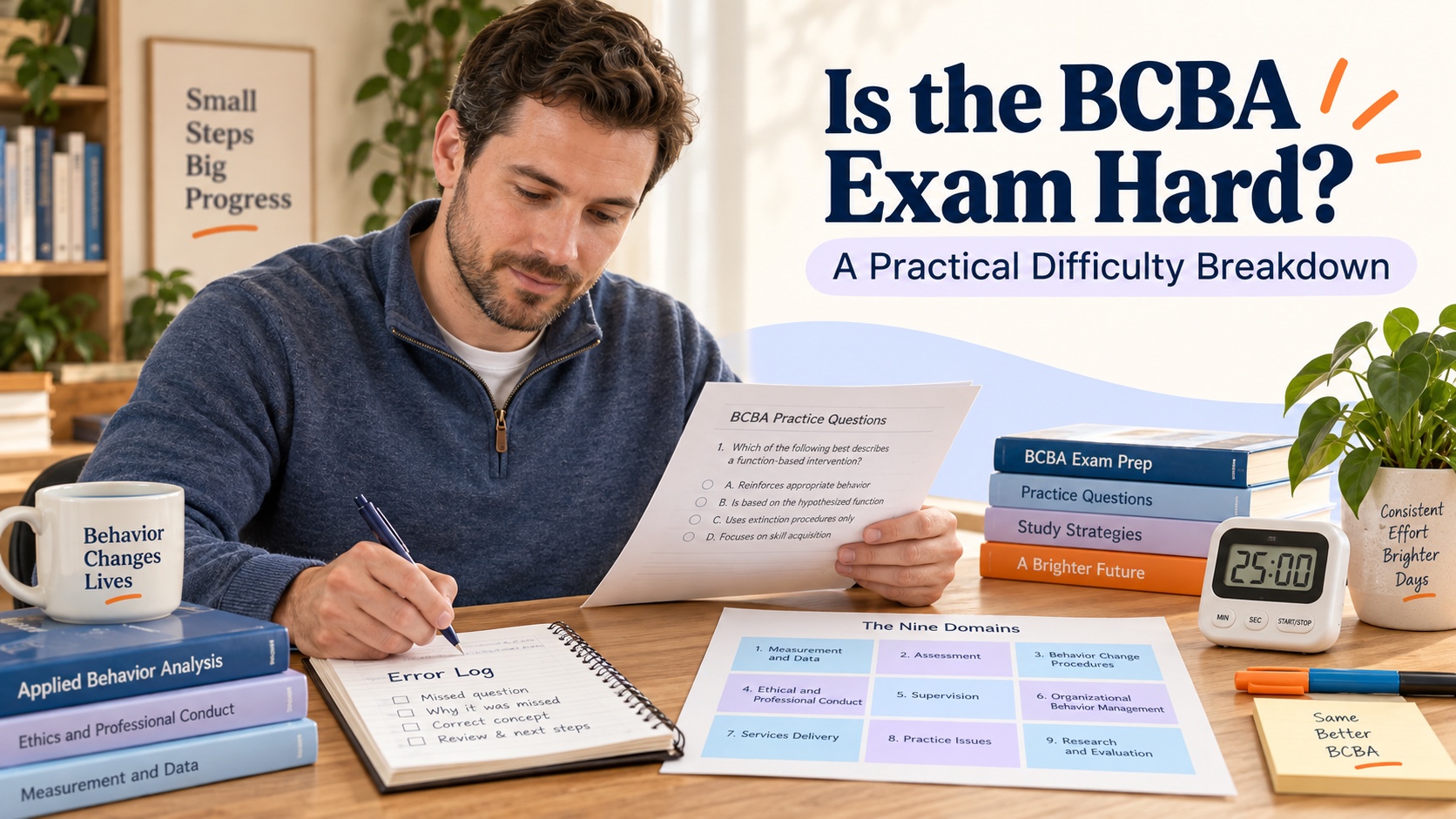
Is the BCBA Exam Hard? A Practical Difficulty Breakdown
If you are asking is the BCBA exam hard, you probably do not need another vague “believe in yourself” answer. You need to know what makes the exam demanding and whether your current study routine is repairing the right problem. The honest answer is that the exam is challenging, but its difficulty is not mysterious. It comes from breadth, application, decision-making under time pressure, and the need to transfer behavior-analytic knowledge to unfamiliar scenarios.
That does not mean a pass rate can predict your result or that one unofficial mock score can label you ready or unready. The useful question is more specific: which part of the work is breaking down for you, and what evidence would show improvement? This guide uses the current BACB format and published group-level results to build that diagnosis.
Table of Contents
Short answer: is the BCBA exam hard?
Yes, the BCBA exam can be hard, especially when a candidate studies definitions without practicing discrimination and application. But “hard” is not the same as impossible, and it is not a stable personal trait. Candidates often experience difficulty in different places:
- One person knows the terms but cannot select the best procedure in a dense scenario.
- Another understands the concepts but loses accuracy after sustained testing.
- A third can answer isolated questions but cannot connect measurement, assessment, ethics, and intervention decisions.
- Someone else has a content gap in one or two heavily represented areas and keeps reviewing what already feels comfortable.
Those are different problems. They need different repairs. A useful preparation plan treats the exam as a set of observable decisions rather than as one giant feeling of anxiety.
What the current exam asks you to manage
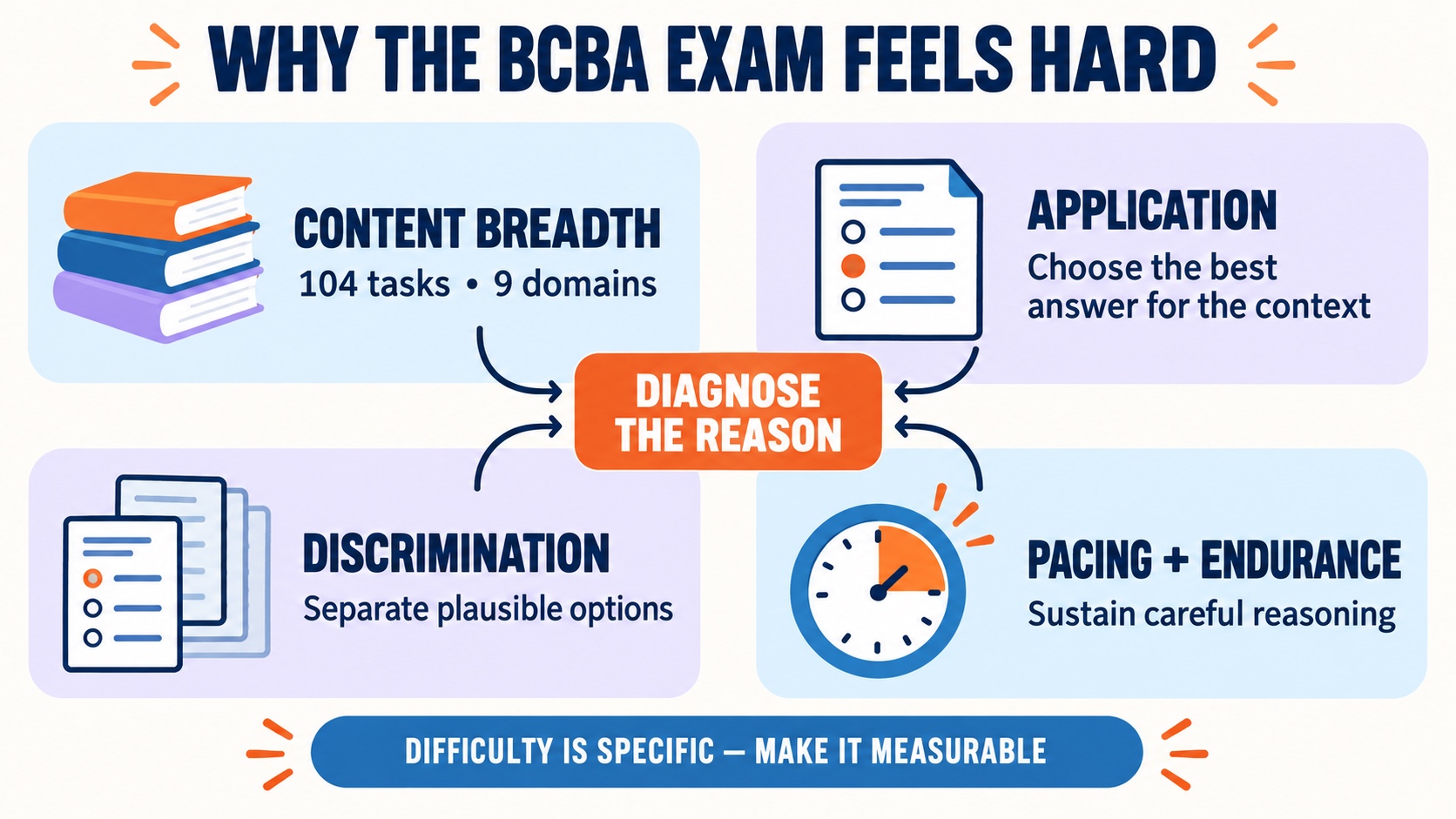
The BACB’s BCBA Test Content Outline, 6th edition, describes 104 tasks across 9 domains. The examination includes 175 scored questions and 10 unscored pilot questions. That format creates two immediate demands: you need broad coverage, and you need to make many decisions across a sustained testing session. Memorizing a short list of favorite concepts is not enough if your knowledge is uneven across the outline.
The outline is also a map of decisions, not simply a reading list. It includes philosophical foundations, concepts and principles, measurement and data interpretation, experimental design, ethical and professional issues, behavior assessment, behavior-change procedures, and other domains represented in the current outline. A candidate must move between precise terms, data-based reasoning, ethical boundaries, and applied choices without treating each domain as an isolated flashcard deck.
Questions may feel difficult when several options sound professionally reasonable. The task is often not to recognize a familiar word; it is to identify which answer best fits the stated data, sequence, scope, or ethical constraint. That is why a candidate can score well on simple definition quizzes and still struggle with applied practice items.
The current outline and the official BCBA examination information should control your format assumptions. Older study guides may describe a different task-list edition or question structure. Use the current official source to build the content map, then use practice to test whether you can apply it.
What official pass rates can and cannot tell you
The BACB examination-information page reports group-level results. For 2025, it lists a 51% pass rate for first-time BCBA candidates and a 23% pass rate for retakes. Those figures show that the exam deserves serious preparation. They do not tell you the probability that a particular person will pass, because candidates differ in coursework, fieldwork, timing, preparation quality, testing conditions, and many other factors.
Do not turn the published percentage into a personal cutoff. It is not a rule that half of every room will fail, and it is not a target score for an unofficial question bank. The BACB also explains that examination forms are equated for differences in difficulty and that the raw number correct is not reported as a universal passing requirement. A practice score can be useful feedback, but it is not the official pass standard.
Use pass-rate data for one narrow purpose: to reject casual preparation. Then shift quickly to your own evidence. Which domains are below your target? Which errors came from missing knowledge, misreading the stem, confusing two procedures, ignoring a scope boundary, or running out of time? That information is more useful for your next study session than a national percentage.
Four reasons the exam feels difficult
1. The content is broad
A broad outline makes selective studying risky. You may enjoy concepts and principles but avoid experimental design, ethics, data interpretation, or assessment. The avoided area then becomes both a knowledge gap and a confidence trigger. Use the official domain map to give every area a place in your schedule, while assigning more time to verified weaknesses.
2. The best answer depends on context
Applied items often include enough context to change the answer: the function is uncertain, the measurement is weak, the client has a communication need, a professional boundary is present, or a previous intervention has not been evaluated. The answer that sounds generally helpful may not be the best answer for the evidence in front of you. Practice stating the decision rule before looking at the options.
3. Several plausible options compete
Distractors are most useful when they are not absurd. You may need to distinguish a prerequisite from a later step, a preference assessment from a functional assessment, a measurement problem from an intervention problem, or an ethical obligation from a convenient habit. After each item, explain why the correct option wins and why each distractor loses.
4. Endurance changes reasoning
Even a prepared candidate can make avoidable errors when reading slows, attention narrows, or every uncertain item feels urgent. Endurance is not solved only by taking one giant mock exam at the end of preparation. Build it gradually: timed blocks, deliberate breaks when permitted, review of flagged items, and a record of when accuracy begins to fall.
A diagnostic study and repair loop
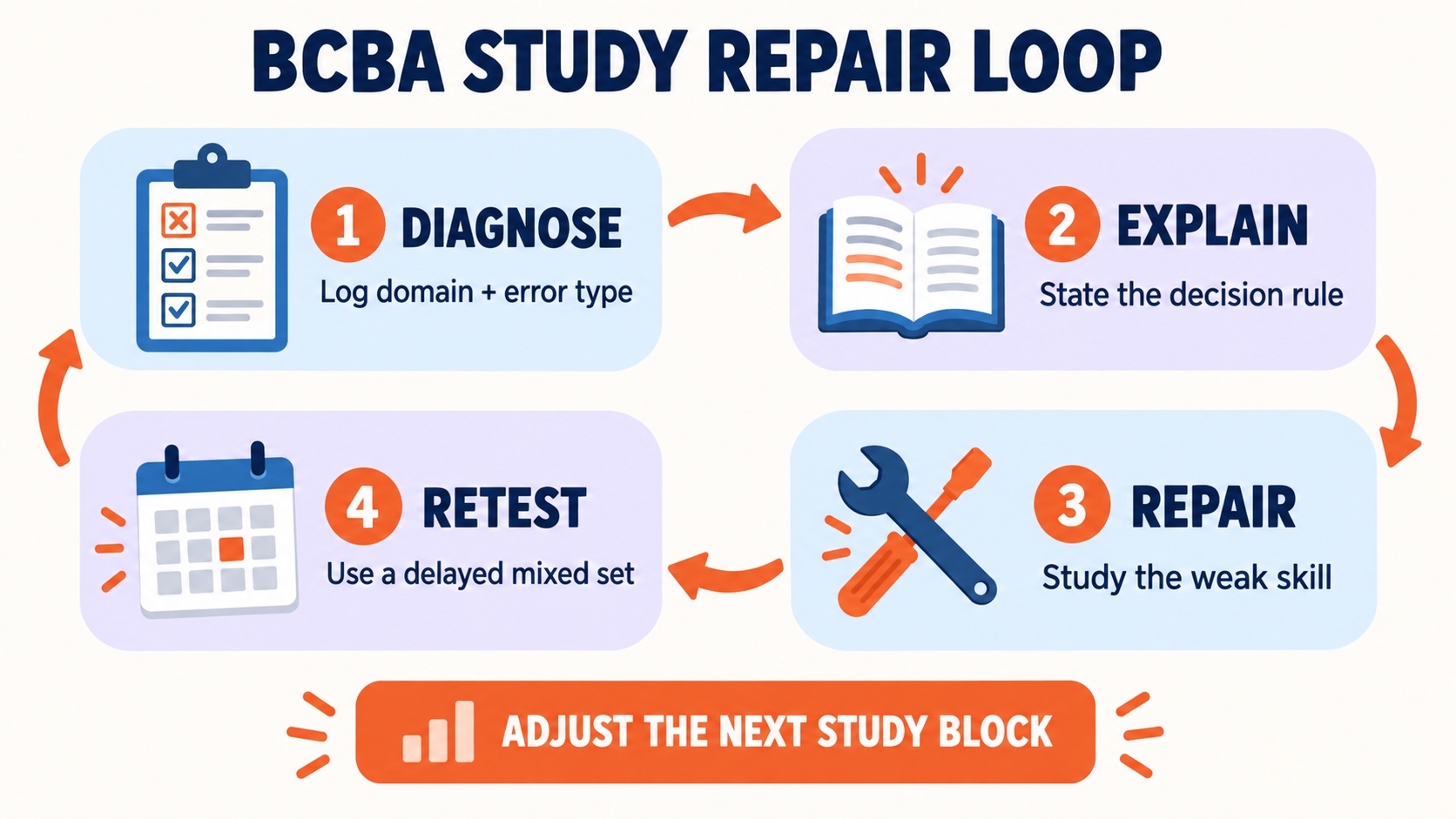
Use a repeatable loop instead of collecting more and more resources:
- Diagnose. Complete a mixed set or domain set under defined conditions. Record the domain, task, confidence, time, and error type for every missed or guessed item.
- Explain. Write the decision rule in your own words. If you cannot explain why the correct answer fits the evidence, the problem is not fixed just because you saw the explanation.
- Repair. Return to the official outline, course notes, source material, or a focused concept block. Work a small number of new examples that change the surface details.
- Retest after a delay. Revisit the task later with mixed items. Delayed transfer is stronger evidence than immediate recognition of the same question.
- Adjust the schedule. Keep strong areas warm, but give the next block to the error pattern that is still repeating.
For example, if you repeatedly choose an intervention before confirming the function of behavior, label the error as a sequencing/application problem. Your repair should include functional reasoning and new scenarios, not just another list of intervention definitions. If you understand the sequence but lose accuracy after long blocks, shorten the content review and train pacing.
Readiness signals to track
Readiness is stronger when several signals agree. Look for stable performance across mixed domains, not only a high score on a familiar topic. You should be able to explain why an answer is correct, identify the evidence that rules out distractors, and transfer the same principle to a new scenario.
Track at least four measures:
- Accuracy by domain: separate first-attempt answers from guesses and corrected answers.
- Error type: label knowledge, discrimination, application, ethics/scope, reading, or pacing errors.
- Explanation quality: write the rule and the evidence, not only the option letter.
- Endurance: note when speed or accuracy changes during timed work.
No unofficial readiness signal guarantees a result. The point is to make your preparation more honest and more efficient. If your scores rise only when the topic is predictable, add mixed practice. If you are accurate but slow, use timed blocks. If you are fast but explain poorly, slow down and repair reasoning before chasing more volume.
Common preparation mistakes
- Using fear as a study plan: “hard” is not a schedule. Name the error pattern.
- Chasing a magic percentage: unofficial question-bank scores are feedback, not BACB passing standards.
- Studying only favorite domains: broad exams punish invisible gaps.
- Reviewing only incorrect answers: a correct guess can reveal a weak explanation.
- Memorizing distractors: learn the decision rule so you can handle a new surface form.
- Taking a final mock too late: use diagnosis early enough for the results to change your schedule.
- Treating old format claims as current: confirm the edition and structure with BACB sources.
BCBA exam difficulty FAQ
Is the BCBA exam hard for everyone?
No single difficulty experience applies to everyone. Candidates enter with different coursework, fieldwork, study habits, and testing strengths. The exam is demanding, but a useful plan identifies the specific source of difficulty instead of turning it into a fixed judgment about ability.
Is the BCBA exam harder than the practice tests?
Practice tests vary in blueprint coverage, wording, depth, and quality, so no universal comparison is valid. Use a practice set to train reasoning and identify gaps. Do not assume that a particular provider’s score reproduces the official examination or predicts a pass.
What is the hardest BCBA exam domain?
There is no official universal “hardest domain” ranking for individual candidates. The most difficult area is often the one where your knowledge, discrimination, or application evidence is weakest. Use the current TCO and your error log rather than someone else’s ranking.
Can a high mock-exam score guarantee that I will pass?
No. A high score can be encouraging evidence, but it depends on the quality and coverage of the questions, the conditions, and whether you can explain and transfer the reasoning. The BACB does not authorize practice providers to guarantee a result.
How should I start if I feel overwhelmed?
Choose one mixed diagnostic set, record the error type for every missed or guessed item, and repair the most repeated pattern first. Then retest after a delay. A small evidence-based loop is more useful than opening ten new study resources at once.