Is the ABAT Exam Hard? A Current QABA Difficulty Guide
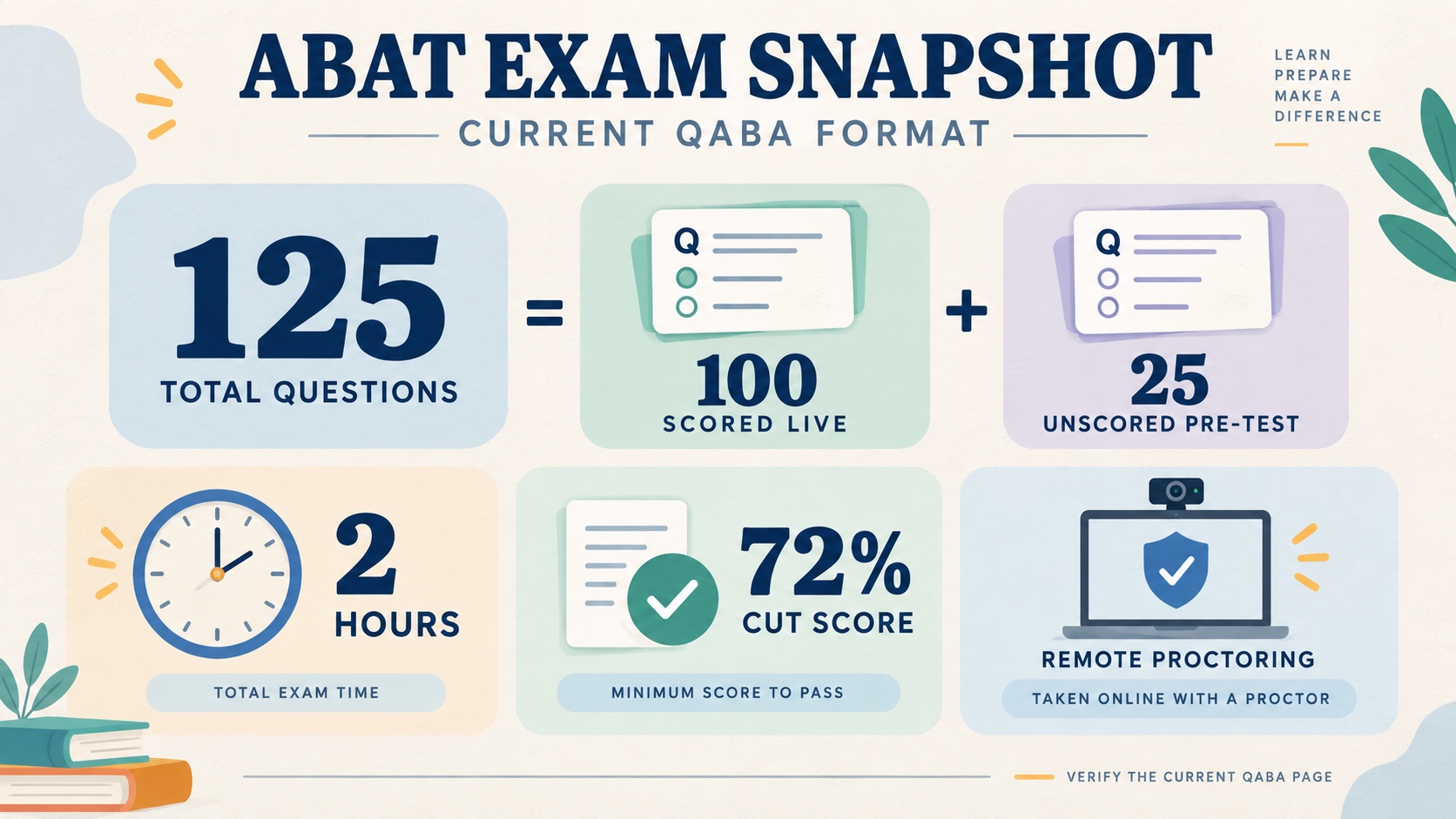
If you are asking is the ABAT exam hard, the honest answer is that it is a focused technician-level credentialing exam with real breadth, a firm clock, and an important document-version issue. The current QABA ABAT requirements page describes a two-hour examination with 125 questions: 100 scored live questions and 25 unscored pre-test questions. It also lists a 72% cut score. That combination does not make the exam impossible, but it does make casual definition review an incomplete preparation strategy.
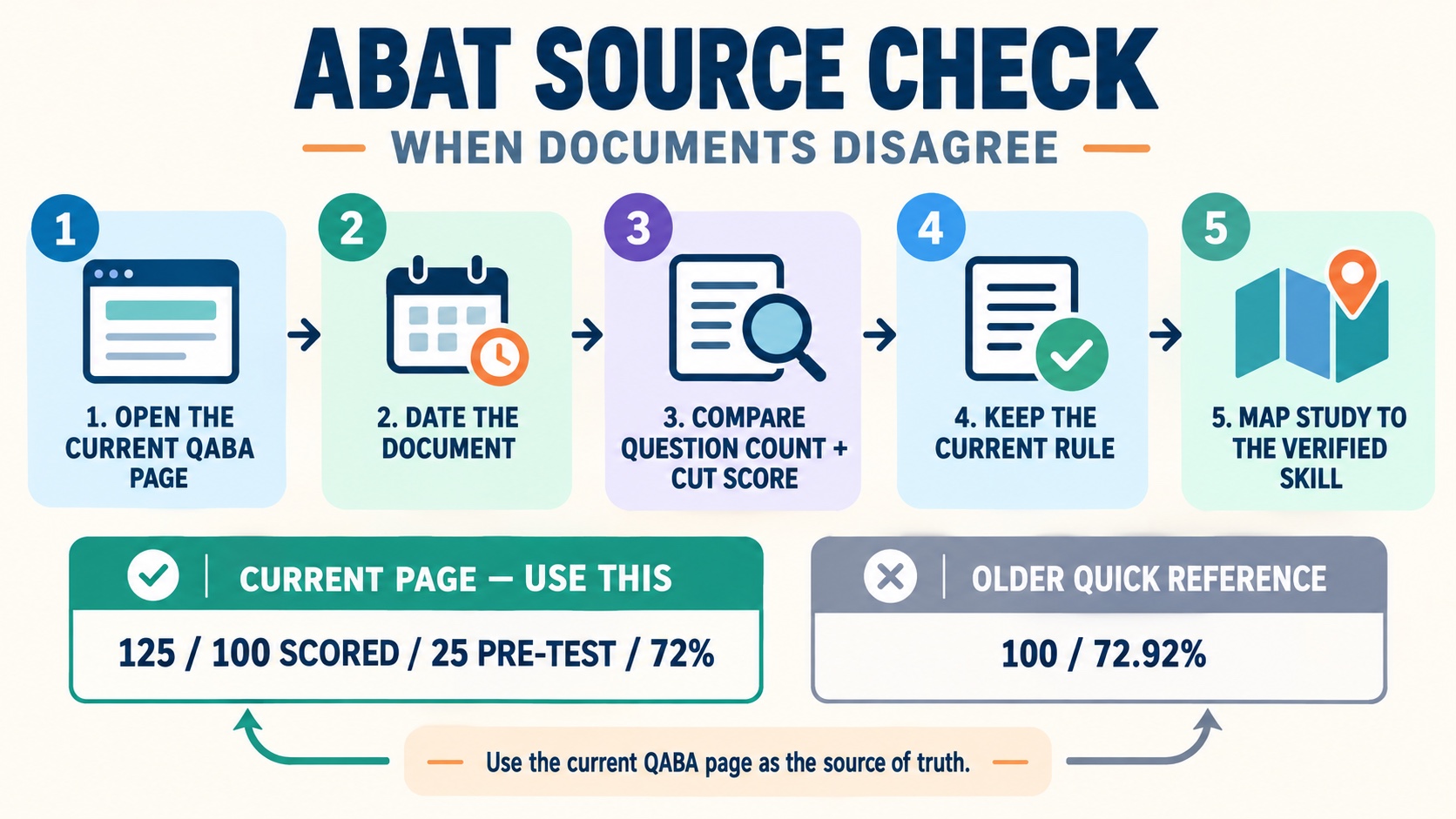
The first step is to identify which source is current. QABA’s separate Quick Reference Guide still displays an older 100-item and 72.92% description. This guide labels that conflict instead of blending the numbers. For current eligibility and exam rules, use the current QABA requirements page and the candidate materials linked from QABA. Then prepare for the actual learning demands: applied decisions, autism-related support, measurement, behavior change, ethics, and pacing.
Table of Contents
Short answer: why the ABAT exam can feel hard
The ABAT exam is challenging for four connected reasons. First, the content is broader than a list of ABA vocabulary. QABA’s current requirements page describes expectations around data collection, graphs, behavior support, skill acquisition, autism-related principles, transitions, visual supports, reinforcement, documentation, and professional conduct. Second, a candidate must recognize how a principle applies to a person-centered or behavior-support situation rather than simply recite a definition.
Third, the two-hour window creates pacing pressure. One hundred twenty-five questions across two hours allows less than one minute per item on average, before you account for reading, reasoning, and any review. Fourth, the exam is part of a credential process that includes coursework, supervised fieldwork, recommendation, background documentation, and proctoring. A candidate can know the concepts and still lose time or confidence if the administrative and technology conditions were never rehearsed.
What the current QABA format says
As currently stated on QABA’s ABAT requirements page, the examination has:
- 125 questions total;
- 100 scored live questions;
- 25 unscored pre-test questions;
- two hours to complete the examination;
- a 72% cut score; and
- remote proctoring through Premier Proctoring as part of the current eligibility and exam process.
QABA says the unscored pre-test questions are not marked, so the candidate cannot identify them during the session. Treat every question as worth your full attention. Also keep the cut score in context: it is the credentialing board’s current published pass point, not a claim that any practice provider can convert a mock score into a guaranteed result.
Four demands behind exam difficulty
- Applied measurement. You may need to recognize continuous and discontinuous data procedures, understand duration or episodic severity, and see how graphs support a behavior-support decision. Practice should include brief scenarios and small data displays, not just word-definition cards.
- Implementation under a plan. The ABAT role involves implementing skill-acquisition and behavior-support plans under supervision. A question may test whether you can follow a procedure, use reinforcement appropriately, support communication, or identify when a decision belongs with the supervisor rather than improvising.
- Autism and person-centered support. QABA’s current requirements page includes sensory information, transitions, visual supports, anxiety-related events, advocacy, and respectful support. The best answer should be connected to the described person and plan, not a generic “make the behavior stop” response.
- Pacing and remote testing. Two hours is enough to work carefully only if you have practiced moving through the test. Remote proctoring adds a separate rehearsal task: confirm the current equipment, room, identity, and technology instructions from QABA and its proctoring partner before the appointment.
How to handle conflicting ABAT documents
When two QABA documents show different numbers, do not average them or choose the number that appears most often in a search result. Record the title, URL, version or update information, and the date you checked it. Then prioritize the current credential requirements page, the current candidate handbook, and the instructions connected to your approved application.
For example, the QABA Quick Reference Guide available as a PDF describes a 100-item examination, a 72.92% cut score, and Examity. The current ABAT requirements page describes 125 total questions, 100 scored plus 25 unscored pre-test questions, a 72% cut score, and Premier Proctoring. These are not details to combine into one hybrid exam. They are a signal to verify the current source and effective process before you build a study calendar or schedule technology checks.
This source-check habit is part of exam preparation. It prevents a learner from spending weeks memorizing the wrong question count, planning around an old cut score, or arriving with an outdated proctoring assumption. It also gives the article a responsible boundary: ABA Study Online can explain how to compare sources, but QABA controls the credentialing rules.
How to check readiness
Build a readiness record with four columns: current source coverage, application accuracy, timed performance, and technology or test-day preparation. For each practice set, record the source date, how many items you answered, how many you guessed on, and the reason for every miss. Useful labels include measurement, implementation, autism support, ethics, reading, pacing, and confidence.
Do not make a decision from one score. A repeated pattern across two or three current practice sets is more informative. If you miss measurement items, practice matching a data procedure to the behavior dimension. If you miss implementation items, return to the written plan and identify what the technician does versus what the supervisor decides. If you run out of time, rehearse a move-on rule rather than simply taking the same untimed quiz again. Keep the record dated so a later source update is visible.
A practical preparation loop
- Verify the source. Save the current QABA requirements page and candidate materials. Mark any older quick-reference facts that conflict.
- Map the content. Organize notes around measurement, behavior support, skill acquisition, autism-related support, documentation, ethics, and the tasks shown in the current official materials.
- Explain before timing. For each weak concept, write the rule in plain language, an example, a non-example, and the supervision boundary.
- Use short timed sets. Practice making a sound decision without spending several minutes on one uncertain question. Then add a longer mixed set that resembles the two-hour demand.
- Rehearse remote conditions. Follow the current proctoring instructions for equipment, room, identity, connection, and permitted materials. Do not rely on an old guide’s vendor name or technology checklist.
- Retry after a delay. Use a new but parallel scenario later. The goal is transfer, not recognition of an answer you just memorized.
Common mistakes
- Calling ABAT an RBT exam: ABAT is a QABA credential with its own eligibility, supervision, exam, and renewal rules.
- Using the old question count: mark the Quick Reference Guide conflict and verify the current QABA requirements page.
- Studying only ABA vocabulary: add measurement, implementation, autism support, documentation, ethics, and scenario discrimination.
- Ignoring the supervisor boundary: a technician implements within the approved plan and seeks direction when a decision exceeds the role.
- Practicing only untimed: two hours for 125 questions needs a pacing rehearsal.
- Treating the cut score as a promise: the published 72% is the current QABA pass point, not a guaranteed result from any practice source.
Is the ABAT exam hard FAQ
How many questions are on the ABAT exam?
The current QABA ABAT requirements page describes 125 questions: 100 scored live questions and 25 unscored pre-test questions. Because a separate older Quick Reference Guide shows a different count, verify the current page and candidate materials for your application.
How long is the ABAT exam?
The current QABA requirements page gives candidates two hours. That creates a meaningful pacing demand across 125 questions, so include timed practice instead of studying only with untimed flashcards.
What score do I need to pass the ABAT exam?
The current QABA requirements page states a 72% cut score. A separate older quick-reference PDF shows 72.92%, which is why the live current QABA source should control your preparation notes.
Is ABAT the same as RBT?
No. ABAT is a QABA credential and RBT is a BACB credential. They may involve overlapping behavior-technician skills, but their eligibility rules, official documents, supervision requirements, examination processes, and renewal rules are separate.
Can a practice score guarantee that I will pass?
No. Practice questions can reveal content and pacing patterns, but they are independent study material. They are not a QABA score report, secure exam content, or a certification guarantee.
Official sources
- QABA: ABAT Certification Requirements and Procedures
- QABA: How the Exams Work
- QABA: ABAT Quick Reference Guide — retained in the article only as an explicitly dated/conflicting reference
- ABA Study Online general ABA learning resources and ABA glossary