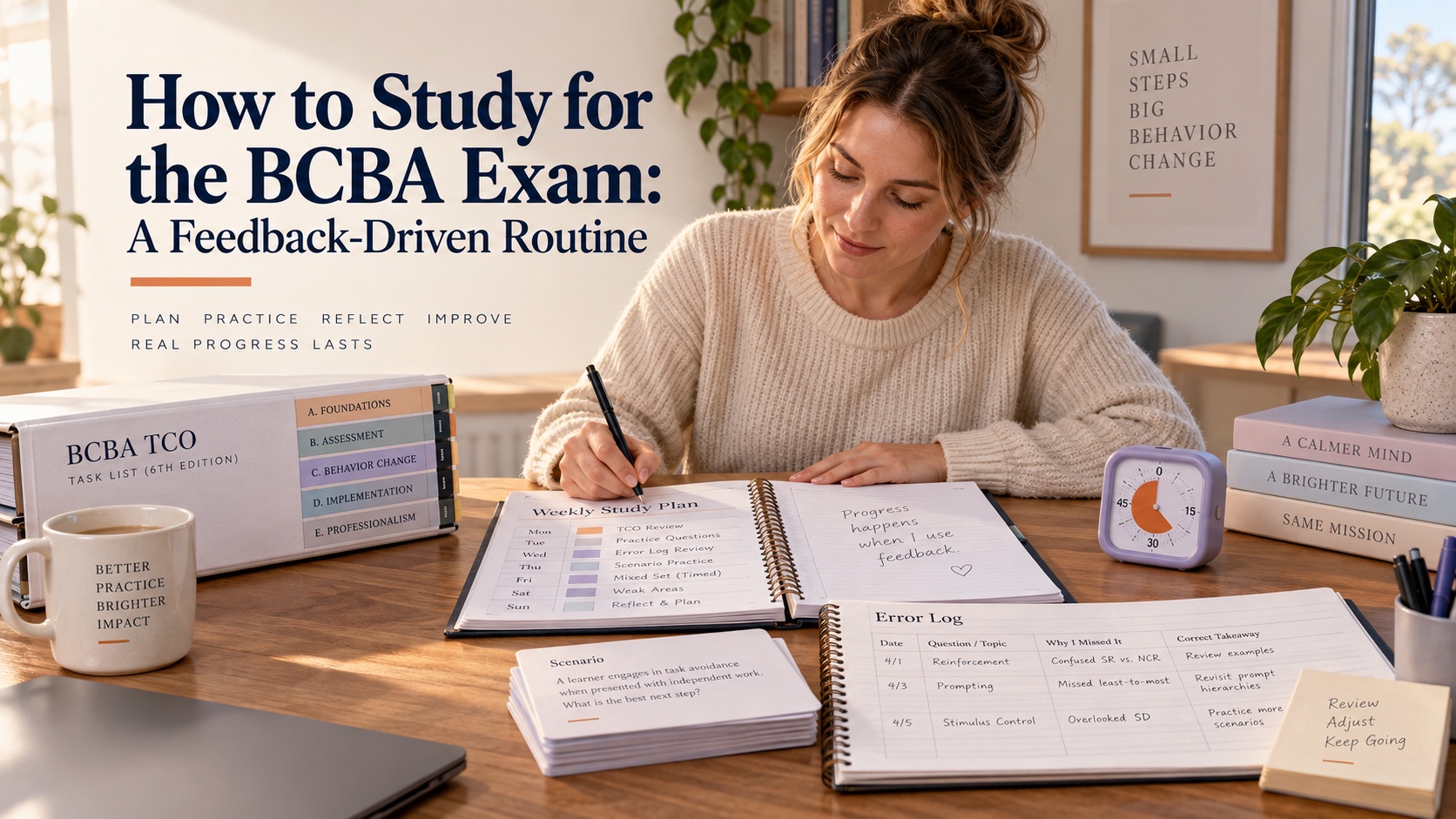
How to Study for the BCBA Exam: A Feedback-Driven Routine
If you are wondering how to study for the BCBA exam, start with a routine that tells you what to do after you miss a question. Reading more pages is not always the answer. Sometimes the problem is a confused distinction, a missed condition in the scenario, weak graph interpretation, or an ethical boundary you have not yet applied.
The current BACB materials give you the content boundary. Your study system must turn that boundary into retrieval, application, feedback, and transfer. That is the difference between collecting notes and building exam-ready judgment.
The quick answer
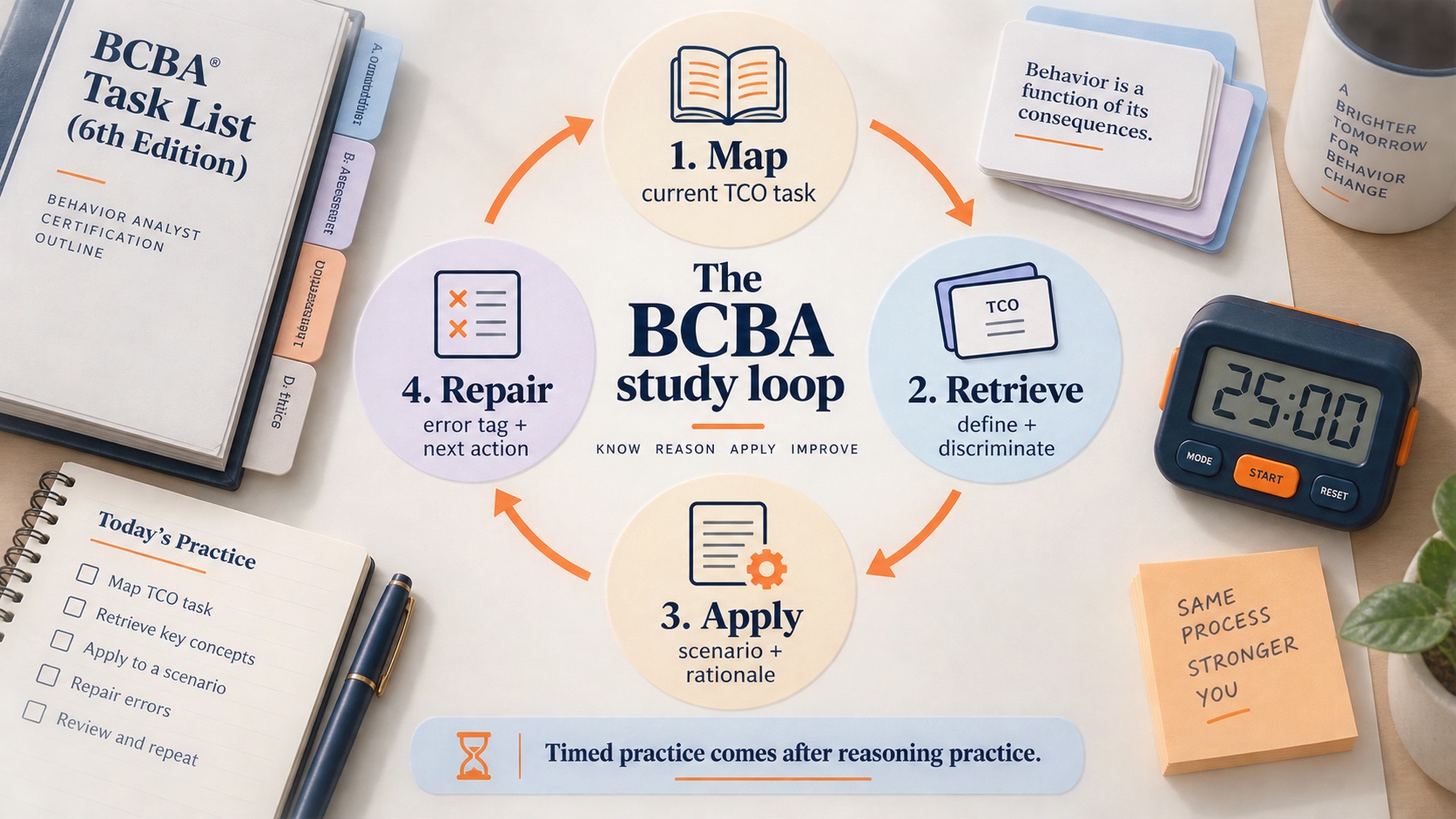
Study for the BCBA exam in a repeated five-part cycle:
- Map: choose a current TCO task or connected group of tasks.
- Retrieve: define the concept and discriminate it from its closest alternatives.
- Apply: solve a new scenario and explain why the best answer fits.
- Repair: tag the reason for a miss and select one concrete next action.
- Transfer: return later with mixed and eventually timed practice.
You do not need every study session to contain every step. A short weekday session might retrieve definitions and compare examples. A longer weekend session might use mixed scenarios and review the error log. The important part is that practice results guide the next session.
Set the source boundary first
The current BCBA examination is based on the BCBA Test Content Outline (6th ed.). The outline organizes 104 tasks across nine content areas. The examination includes 175 scored questions and 10 unscored pilot questions, and candidates have four hours to complete it. The BACB recommends reviewing the current TCO, the Ethics Code for Behavior Analysts, and the materials gathered from your training.
Use the TCO as a map, not as a replacement for instruction. Write down the domains and tasks, then mark each one as explain, apply, or repair. “Explain” means you can state the concept. “Apply” means you can choose or interpret it in a new scenario. “Repair” means recent evidence shows that the distinction still breaks down under pressure.
Keep the edition boundary visible. A saved study guide may use older labels, examples, or formatting. That does not make every sentence useless, but it means you should compare its coverage with the current BACB source before making it the center of your plan.
Build a useful baseline
Begin with a modest mixed set rather than an exhausting full simulation. Mark every answer as confident, uncertain, or guessed before checking the explanation. A correct guess is feedback: it tells you that the answer may not be stable enough for a high-stakes scenario.
For each miss or guess, record four things:
- Content: which domain, task, or concept was involved?
- Reason: knowledge gap, close-term confusion, reading error, calculation, ethics boundary, or overthinking?
- Evidence: which phrase, condition, graph feature, or rule should have changed your answer?
- Repair: what will you do next—rewrite a contrast, solve two examples, reread a source section, or retry later?
This is more useful than writing “review reinforcement” beside every wrong answer. The next action should be small enough to complete and specific enough to test. If you confused negative reinforcement with punishment, write a two-column contrast and create a new example for each. If you missed a measurement question because you did not notice the behavior dimension, practice identifying the dimension before choosing the measure.
Run the weekly study loop
Session 1: map and retrieve
Choose one current task or a small group that belongs together. Close your notes and write what you know. Then check the source and fill the gaps. Include a nonexample or contrast, because many BCBA questions are difficult precisely because two alternatives sound reasonable.
Session 2: apply to scenarios
Use original or carefully reviewed practice questions. Before looking at the options, identify the behavior, context, goal, measurement, or ethical decision the stem is asking about. Then compare each option with the evidence in the scenario. Write one sentence explaining why the best answer fits and why the closest distractor does not.
Session 3: repair errors
Review your error log, not only your newest score. Group errors by reason and choose the smallest repair that could change the next result. A short contrast table, a graph interpretation exercise, or a delayed retry may be more valuable than another hour of passive reading.
Session 4: mix and transfer
Mix domains after focused work. Transfer asks whether you can recognize the same principle when the vocabulary, client context, or presentation changes. Keep the rationale review active; a score without an explanation does not show stable understanding.
Repeat the loop each week, adjusting the ratio of learning, practice, and repair according to your evidence. A learner with a large knowledge gap may need more source review at first. A learner who knows definitions but misses scenarios may need more discrimination and application instead.
Add timed practice at the right time
Timing matters, but it should come after you have a reasoning process. Start with untimed items so you can observe how you read the stem, identify the task, compare options, and use the relevant source. Then add short timed sets. Gradually increase length as you learn what slows you down.
When a timed session goes poorly, diagnose the cause. Did you read too slowly, calculate repeatedly, change answers without evidence, or spend too long on one unfamiliar concept? Each cause calls for a different repair. A practice score is not an official BACB result and does not guarantee a future outcome; it is useful when it changes your next study decision.
Common study mistakes
- Studying by hours alone: time spent is not the same as tasks retrieved and applied.
- Reading without retrieval: familiarity can disappear when the notes are closed.
- Doing only one domain: focused practice is helpful early, but the exam requires mixed discrimination.
- Ignoring uncertain correct answers: guesses reveal fragile learning.
- Adding resources instead of repairing errors: a larger library does not automatically solve a reasoning gap.
- Using outdated materials without checking: compare every high-stakes rule and outline claim with current BACB sources.
Study checklist
- Confirm the current BCBA TCO and keep it beside your plan.
- Choose a small weekly target tied to one or more tasks.
- Retrieve definitions and contrasts with notes closed.
- Practice new scenarios and write rationales.
- Tag misses and guesses by reason.
- Complete the repair action, then retry after a delay.
- Add mixed and timed practice only after your reasoning routine is usable.
For organized concept review, visit the ABA Study Online BCBA learning route. For additional retrieval practice, use the BCBA question library. The app review loop can support spaced return to weak concepts; none of these resources replaces the current BACB materials.
FAQ
How many hours should I study for the BCBA exam?
There is no single useful number for every candidate. Use your baseline, error types, available time, and exam date to set a sustainable routine. Measure progress by what you can explain and apply, not only by hours logged.
Should I study one BCBA domain at a time?
Focused domain work helps build a foundation. Add mixed practice later so you learn to identify the relevant concept when the question does not announce its domain.
When should I take a full mock exam?
After you have a working reasoning and review loop. A mock is most useful when you can interpret the result and turn it into targeted repair, not when it is used only as a confidence label.