
How to Get BCBA Certified: A Clear Path from Coursework to Certification
If you are searching for how to get a board certified behavior analyst certification, the short answer is: identify the BACB pathway that applies to your application date, complete the required degree and behavior-analytic content, document supervised fieldwork, submit the certification application, receive an approved determination, pass the BCBA examination, and maintain the credential afterward. The order matters because the exam is not the first step.
This guide explains the path in plain language. It is a planning map, not an individual eligibility decision. The current BCBA Handbook, official forms, and BACB portal instructions control your case. If your application timing crosses January 1, 2027, read the official transition guidance before assuming that a checklist from another year still applies.
Table of Contents
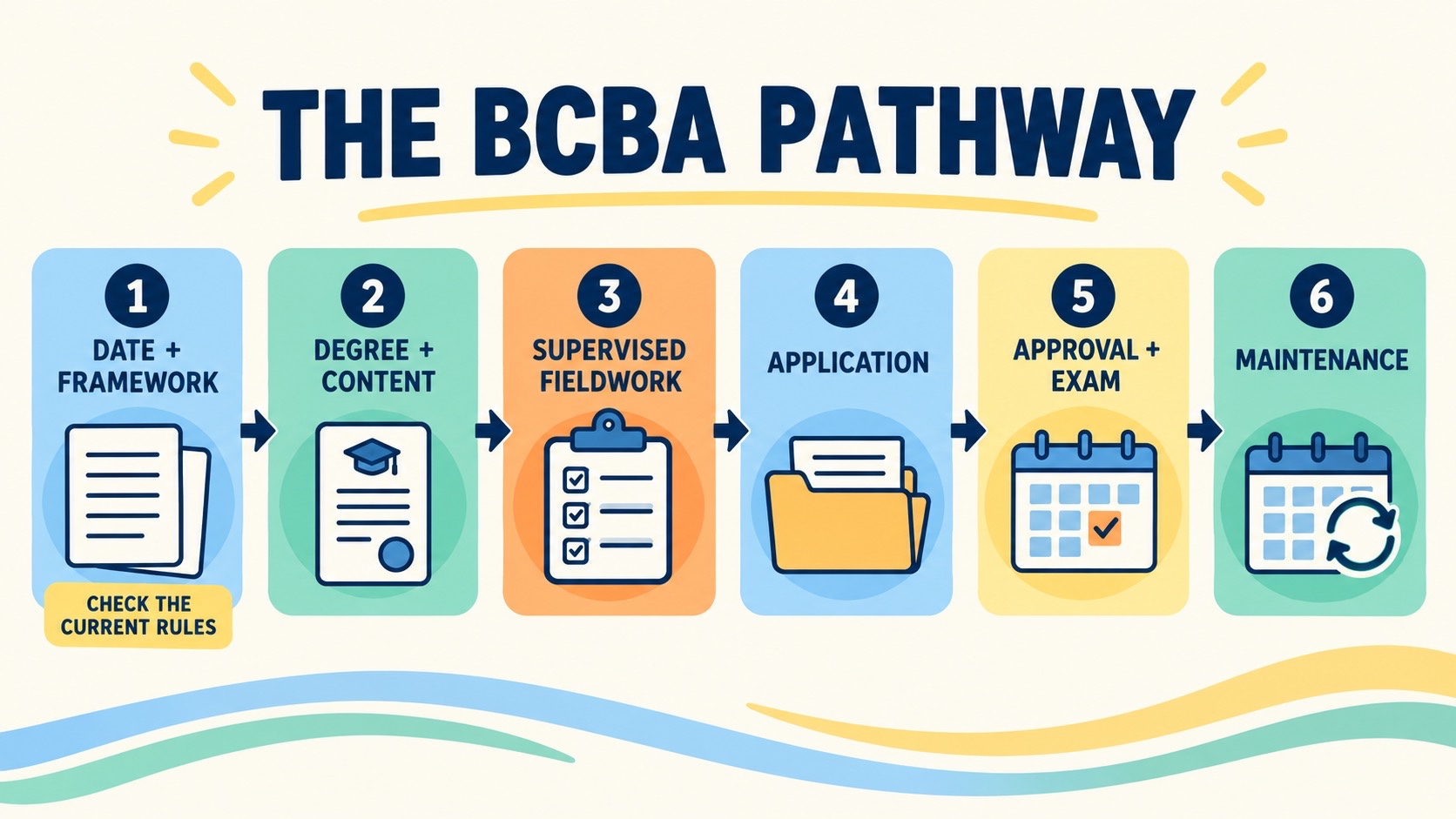
The BCBA certification sequence
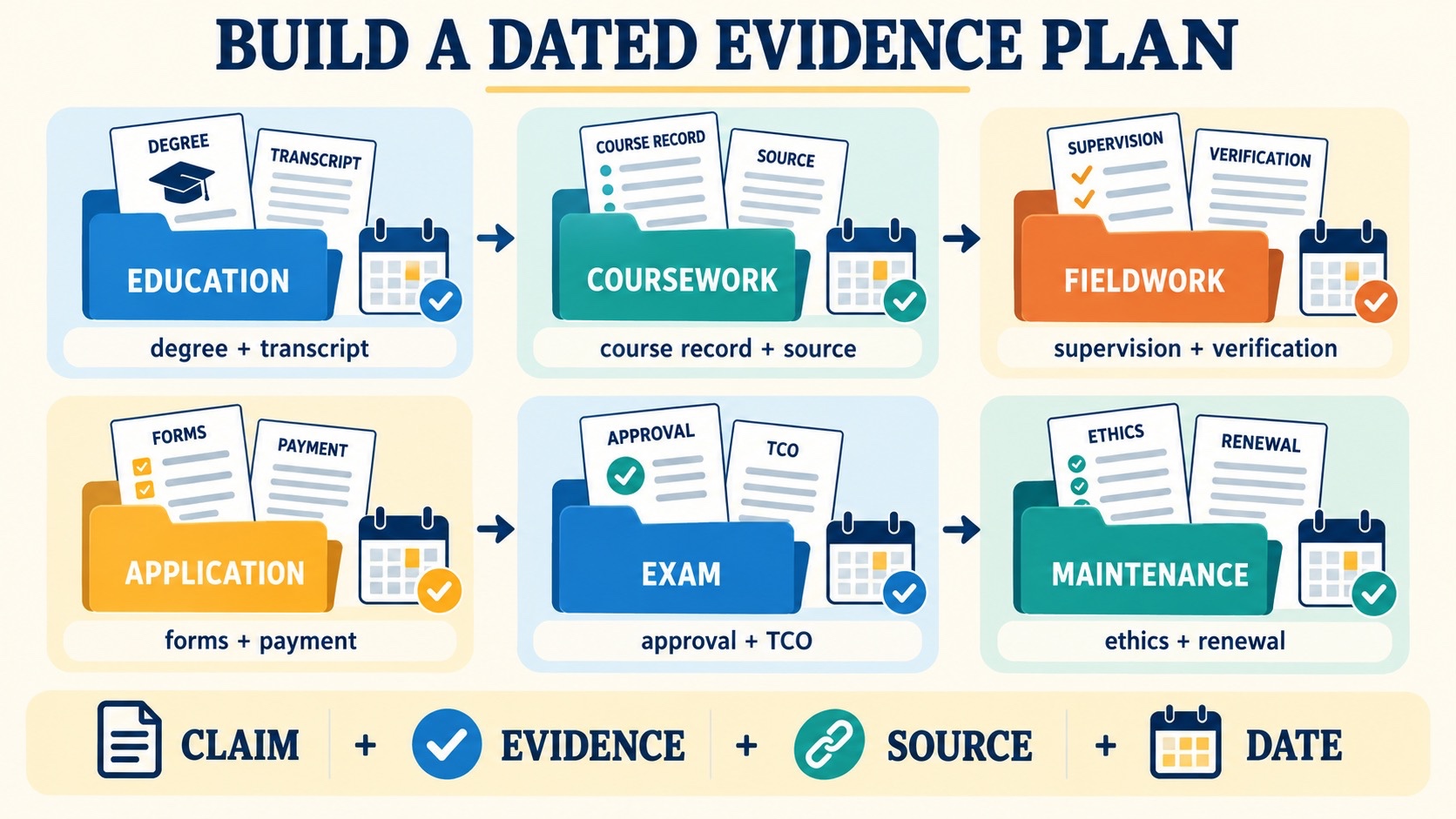
A useful way to picture the process is as a chain of evidence:
- Choose the application timeline and the BACB requirements that govern it.
- Meet the degree and behavior-analytic content requirements through an applicable pathway.
- Complete qualifying supervised fieldwork and retain the required verification records.
- Submit a complete certification application and wait for the eligibility determination.
- After approval, schedule and pass the BCBA certification examination.
- Keep meeting ethics, continuing-education, supervision, renewal, and other maintenance requirements.
A master’s degree alone is not the whole process. A behavior-analysis course alone is not the whole process. Passing a practice exam is not an application approval. Each checkpoint answers a different question, so keep the documents separate instead of putting every achievement into one folder labeled “BCBA ready.”
Step 1: choose the application-date framework
Start with timing, because BACB requirements are not timeless. The BACB’s transition announcement says significant BCBA eligibility and maintenance changes take effect January 1, 2027. To be reviewed under the current 2022 requirements, a complete application—including payment and required documents—must be received by December 31, 2026, under the official transition rules. If you are aiming for a 2027 application, read the 2027 requirements and transition guide before choosing courses or counting fieldwork.
For a personal planning file, write down three dates: when you began collecting evidence, when you expect to submit the application, and the publication or update date of each official source. Do not silently combine a 2026 coursework checklist with a 2027 fieldwork rule. If the dates are uncertain, plan conservatively and ask the BACB, your program contact, or qualified supervisor which framework applies.
The public BACB materials do not describe this as a new “7th edition” of the exam outline. The BCBA Test Content Outline and the eligibility-requirements transition are related to the same credential but are different documents. Keep those labels separate in your study notes.
Step 2: complete the degree and behavior-analytic content
The current BCBA Handbook lists eligibility pathways. In broad terms, every current pathway requires a graduate-level degree, behavior-analytic content, supervised fieldwork, and a passing examination. The exact evidence depends on the pathway: an accredited or recognized program route, behavior-analytic coursework, faculty teaching and research, or postdoctoral experience may be relevant under the current framework. The handbook—not a university marketing page—determines which pathway evidence is accepted.
If you are using a coursework pathway, verify the current process with the institution and the BACB instructions. The university-training guidance explains that Pathway 2 coursework attestations are managed through designated program contacts for applications in the current period. A transcript entry and a course title can be useful evidence, but they do not automatically prove that every content or timing requirement is met.
Make a simple education audit with the degree name, institution, conferral date, transcript source, course list, syllabi or official descriptions, pathway, and unresolved questions. Mark uncertain items “to verify.” That label is more useful than assuming a course counts because it contains the word ABA.
For the 2027 framework, read the official requirements before enrolling or finishing a sequence. The transition guidance describes two future pathways and changes to degree, coursework, fieldwork, continuing education, and ongoing supervision rules. The future framework may affect what a later applicant needs even when the person has already started studying.
Step 3: arrange and document supervised fieldwork
Supervised fieldwork is the practical part of the pathway. It is not simply time spent working at an ABA-related employer. The activities, supervisor qualifications, contacts, observations, supervision records, and verification forms must fit the rules that apply to your pathway and application date.
Before beginning, identify the supervisor relationship, the expected documentation, how supervision contacts will be recorded, and how questions will be escalated. Keep dates, activities, supervision notes, observations, forms, and source versions as you go. Reconstructing a fieldwork record from memory at the end creates avoidable risk.
Do not treat a signature as proof that every hour or activity qualifies. A supervisor can verify a record, but the applicant still needs to understand the current requirements and retain accurate evidence. The BACB’s fieldwork resources and handbook control the details; a workplace job description does not replace them.
Step 4: submit the application before scheduling the exam
Once the education, content, and fieldwork evidence are ready, follow the current BCBA application instructions. Check that names match across the portal, transcript, identity documents, attestations, and fieldwork forms. Use the required forms and submit the payment and documents within the relevant application window.
The sequence is important: you do not schedule the BCBA examination merely because you completed a degree or finished supervised fieldwork. The BACB examination page says that applicants first meet the applicable eligibility requirements, submit a certification application, and receive an approved determination. Only then do they schedule and take the certification examination through the official testing process.
Keep a submission log with the application date, documents sent, confirmation messages, action items, and the official source used for each decision. If the BACB asks for clarification, answer the action item rather than opening a second application and hoping the records merge.
Step 5: prepare for and pass the BCBA exam
After the application is approved, study from the current BCBA Test Content Outline and examination information. The current public examination information lists the BCBA exam as a four-hour, multiple-choice examination with four answer choices per question. Use the live BACB page and handbook for current question counts, delivery, scheduling, identification, and policy details; these operational details can change.
Good practice is more than memorizing definitions. Work through short scenarios, explain why one answer fits the facts, separate observation from interpretation, and check whether an example belongs to measurement, assessment, skill acquisition, behavior reduction, documentation, or ethics. ABA Study Online’s BCBA learning blocks, free BCBA practice questions, and ABA glossary can support that study loop. They are learning resources, not secure BACB items and not a score guarantee.
Step 6: maintain the certification
Certification is not finished forever on the day you see a passing result. The current handbook and BACB resources describe ongoing obligations such as ethics, continuing education, supervision, renewal, and status changes. The exact maintenance framework depends on the certification year and the rules in force, so save the current handbook and calendar the next review rather than relying on an old social-media checklist.
Also keep certification separate from state licensure, employer requirements, payer rules, and scope of competence. BCBA certification is a BACB credential; it does not automatically answer every jurisdiction’s licensing or practice question. If you plan to work in a particular state or country, check the applicable authority and employer requirements as a separate research task.
Common mistakes and a practical checklist
Choosing a program by its headline alone. “ABA,” “behavioral science,” or “BCBA preparation” in a program name is not a formal BACB determination. Check the pathway and evidence.
Using an old pathway or task list. A saved checklist may describe a previous requirement framework. Check the handbook update and application date before counting coursework or fieldwork.
Scheduling the exam too early. Eligibility, application, approval, scheduling, and examination are separate stages.
Confusing practice with certification. Practice questions can build reasoning; they do not reproduce secure exam content, approve an application, or guarantee a result.
Before you call your plan ready, confirm that you can answer “yes” to these questions:
- Have I identified the application date and the requirements framework that will govern it?
- Can I explain which education/content pathway I am using and what evidence it requires?
- Are my fieldwork records current, complete, and tied to the applicable rules?
- Do I know which application documents and payment instructions are current?
- Will I wait for the official approval before scheduling the examination?
- Have I planned for maintenance and any separate jurisdictional requirements?
FAQ and official sources
Can I become a BCBA with any master’s degree? Not automatically. The degree, behavior-analytic content, pathway, fieldwork, timing, and documentation all matter. Read the current handbook for the pathway that applies to your application.
Do I take the BCBA exam before I apply? The general sequence is eligibility evidence, certification application, approved determination, then examination. Follow the current BACB instructions for your case.
Is the 2027 update the seventh edition of the BCBA exam? Do not use that shorthand. The 2027 material is an eligibility and maintenance requirements transition; the exam content outline is a separate document with its own edition label.
Where should I verify the final rules? Start with the BACB BCBA page, the current BCBA Handbook, the examination information page, and the official 2027 transition guidance. If one of your documents is unusual, ask the BACB or the qualified program/supervisor contact rather than relying on a general article.
The best answer to “how do I get BCBA certified?” is therefore a dated evidence plan: choose the correct framework, complete the education and fieldwork pathway, apply, wait for approval, pass the exam, and keep the credential current. Treat every checklist as a navigation aid and the live BACB sources as the authority for the decision.