
How to Get BCaBA Supervision Hours: A Monthly Setup Guide
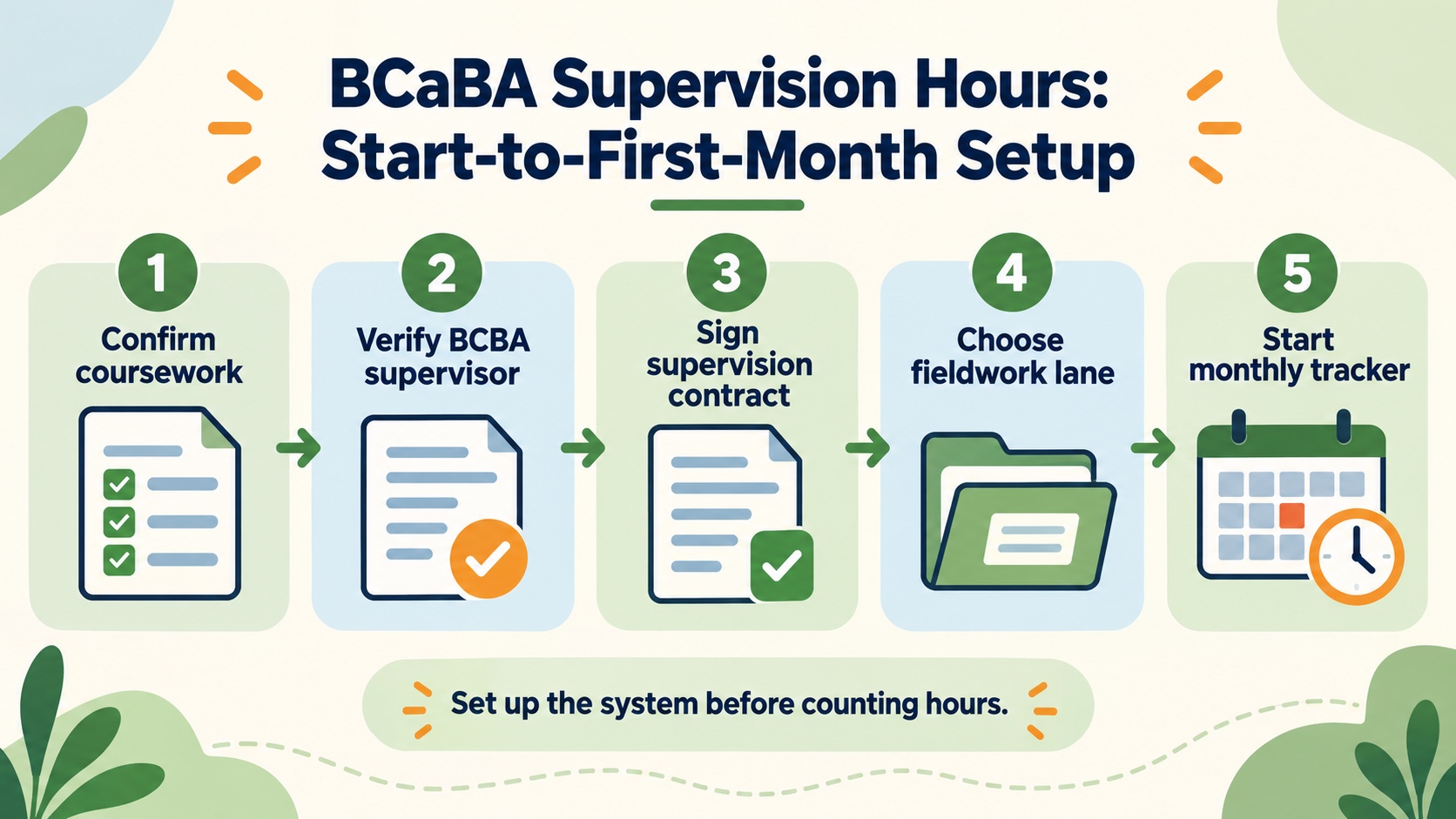
If you are searching for how to get BCaBA supervision hours, the safest starting point is to build the supervision system before you count the first hour. You need qualifying behavior-analytic coursework in progress, a qualified supervisor, a clear contract, a fieldwork plan, and records that show what happened each month.
The current BCaBA Handbook has separate rules for Supervised Fieldwork and Concentrated Supervised Fieldwork. The official 2027 requirements also change several details, so your application date matters. This guide focuses on the practical setup: how to choose the supervision arrangement, plan a month, protect the evidence, and keep current and 2027 requirements in separate lanes.
Quick answer: to start BCaBA supervision hours, begin the qualifying coursework required by your pathway, identify a supervisor who meets the current BACB requirements, complete the supervision contract before fieldwork begins, choose the applicable fieldwork type, and agree on a monthly documentation routine. Then track actual eligible hours, supervision, contacts, observation, individual/group balance, unrestricted activities, and signatures. The current BCaBA Handbook and your supervisor—not a generic online calculator—determine whether a particular activity qualifies.
Set up the foundation before counting hours
“I work at an ABA clinic” is not the same as “I have started qualifying BCaBA fieldwork.” Before the first hour goes into your fieldwork tracker, confirm four foundations:
- Your education pathway: know whether you are using an ABAI-accredited degree route or the qualifying behavior-analytic coursework route. The coursework situation must be established before fieldwork begins.
- A qualified supervisor: confirm the supervisor’s active BCBA status, lack of current disciplinary sanctions, certification history, and any consulting-supervisor requirement that applies to a newer BCBA.
- A signed supervision contract: document the scope, responsibilities, meeting structure, setting, records, and conditions for reviewing or signing forms.
- A record system: decide where the contract, activity log, monthly verification forms, notes, observation evidence, and corrections will be stored.
The BACB’s handbook says applicants must meet the requirements in effect when they apply. That makes version control part of the plan. Save the handbook and form version you used, note the date you began, and ask your supervisor what will happen if your application crosses the 2027 transition.
Choose and screen a qualified supervisor
A good supervisor search is more than finding a BCBA willing to sign a form. The current BCaBA Handbook recommends checking the supervisor’s status in the BACB Certificant Registry and considering whether the supervisor has the qualifications, time, documentation habits, and experience to oversee fieldwork. A supervisor should also be able to explain how the work will be observed, how feedback will happen, and how disagreements about an activity will be handled.
Before agreeing, ask practical questions:
- Which fieldwork type will be used in each month?
- How will the contract define roles, meetings, observation, and communication?
- How will individual and group supervision be separated?
- How will the supervisor decide whether an activity is restricted, unrestricted, client-related, or outside the fieldwork definition?
- Where will monthly forms and supporting notes be stored, and who keeps copies?
- What happens if the supervisor changes employers, becomes unavailable, or cannot verify a record?
The supervisor must still exercise professional judgment. A checklist helps you ask better questions, but it cannot approve a person or an activity. If the arrangement is unclear, resolve the question before hours accumulate rather than hoping the issue can be repaired at application time.
Plan one fieldwork month
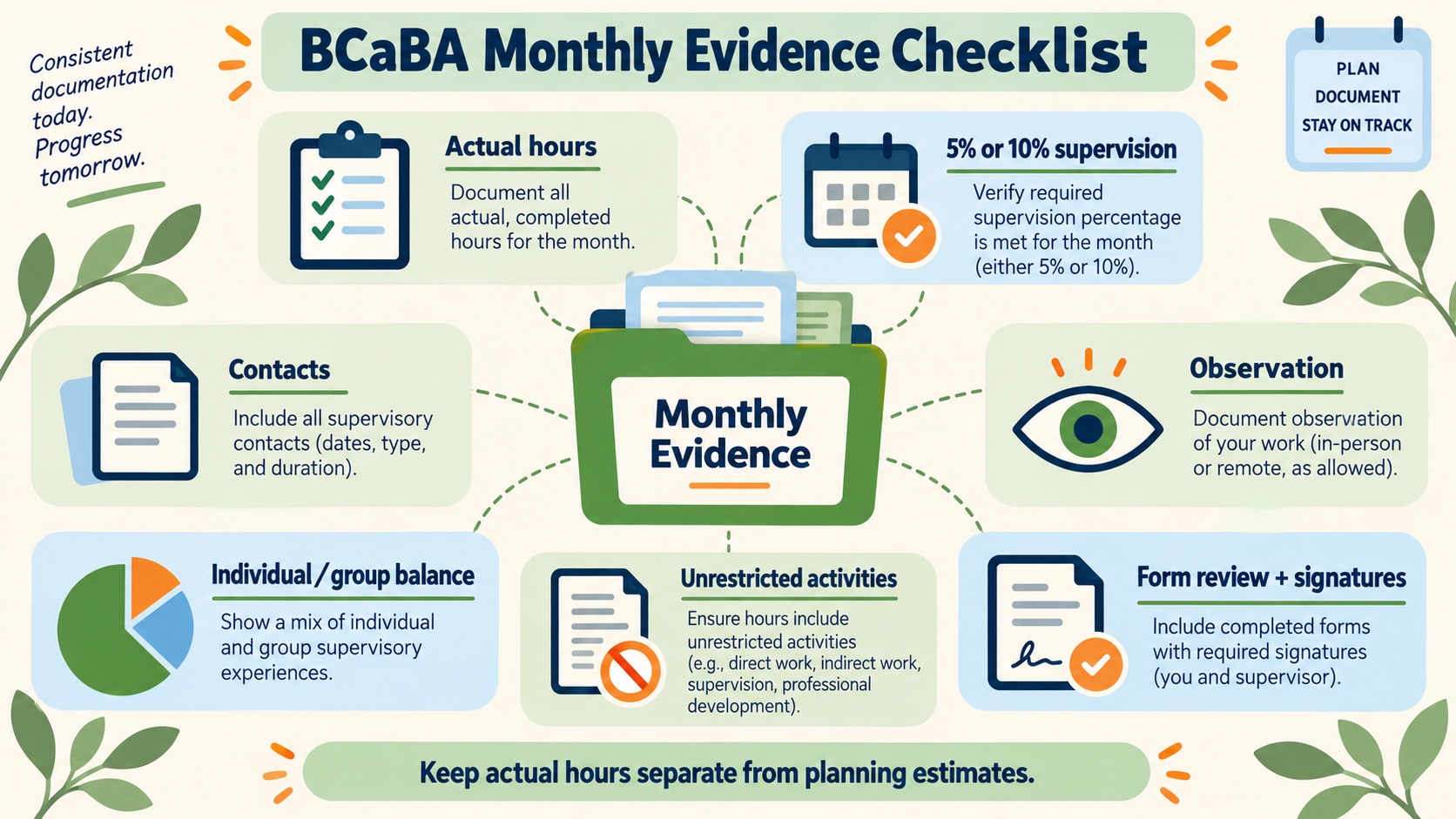
Under the current June 2026 handbook, both fieldwork types use a one-calendar-month supervisory period and a 20–130-hour monthly range. Supervised Fieldwork requires 5% supervision; Concentrated Supervised Fieldwork requires 10%. The current overview also uses four supervisor contacts for standard fieldwork and six for concentrated fieldwork, with an observation in each period. At least 50% of supervised hours must be individual, and at least 40% of overall supervised fieldwork hours must be unrestricted.
Use this sequence at the beginning of every month:
- Write the lane. Label the month Supervised Fieldwork or Concentrated Supervised Fieldwork. Do not assume the percentage from the previous month carries over.
- Set a realistic range. Estimate eligible hours and check the current monthly minimum and maximum before the month closes.
- Schedule contacts and observation. Put supervision meetings and the client observation on the calendar early enough to recover from cancellations.
- Plan the activity mix. Identify the work that will provide practical experience and keep a separate unrestricted-activity running total.
- Leave time for review. The supervisor needs time to examine notes, observe performance, give feedback, and resolve questionable classifications.
- Close the month deliberately. Compare the tracker with the form, correct discrepancies while memories and records are fresh, and obtain signatures under the current instructions.
For example, if you plan 60 eligible hours in a current standard month, the supervision target is calculated using 5% of those hours. If the month is concentrated, the target uses 10%. The arithmetic is only the first check: the supervisor still needs to verify contacts, observation, individual/group balance, activity quality, and the supporting record.
Record the evidence and protect the forms
Keep actual hours separate from planning estimates. A useful monthly tracker has fields for date, setting, activity, client relationship, restricted or unrestricted classification, hours, supervisor contact, observation, individual or group supervision, feedback, and document location. Add a note when an activity was excluded and why. Exclusions are often more informative than a clean total because they show that someone reviewed the boundary.
The Monthly Fieldwork Verification Form is not just a final signature page. Before asking for a signature, compare the form with your daily or weekly notes. Check names, dates, fieldwork type, actual hours, supervision percentage, contacts, observation, individual/group balance, unrestricted percentage, and any required attestations. Keep the signed form and supporting evidence together.
BACB documentation guidance says monthly fieldwork forms should be signed by the last day of the calendar month following the month of supervision, and the trainee and supervisor should retain copies for at least seven years. If a form is late, missing, or inaccurate, do not silently recreate it. Stop, identify what can be verified, and follow the current BACB guidance and supervisor process for corrections.
Multiple supervisors and settings require extra care. Each relationship should have the appropriate contract and evidence. One master tracker can help you see the overall total, but it should link back to the correct setting, supervisor, form, and observation record. A combined total must not hide a gap in one fieldwork relationship.
Handle mixed fieldwork and the 2027 transition
The current handbook permits a combination of fieldwork types. If you mix them, keep actual hours in separate columns and use the handbook’s permitted planning calculation only for the combined eligibility total. Do not copy a planning-equivalent number into a verification form or application as though it were hours actually worked.
The 2027 BCaBA Requirements create a different planning lane. They list 1,300 Supervised Fieldwork hours and 800 Concentrated Supervised Fieldwork hours, a 20–160-hour supervisory-period range, 5% or 10% supervision, and 60 or 90 cumulative observation minutes for the two fieldwork types. They also identify the 2027 Monthly and Final Fieldwork Verification Forms for applicants after January 1, 2027.
Do not mix current and 2027 numbers in one unlabeled checklist. Write “current 2026 handbook” or “2027 application framework” at the top of the month’s plan, and confirm which requirements govern your application. If you are near the transition, ask the supervisor to review the form version and application date with you before you change the tracking system.
Common mistakes
- Counting before the contract: a job start date does not automatically equal a fieldwork start date.
- Choosing a supervisor by title alone: verify current status, qualifications, documentation, and the supervision arrangement.
- Using one percentage for every month: 5% and 10% depend on the fieldwork type.
- Calling every ABA task unrestricted: the activity must fit the current fieldwork definition and be reviewed in context.
- Repairing records from memory: missing or conflicting evidence should be addressed transparently and promptly.
- Mixing current and 2027 forms: label the governing rule set and use the correct application-era documents.
- Combining BCaBA fieldwork with ongoing supervision: post-certification supervision and fieldwork hours are different records.
FAQ
When can I start BCaBA supervision hours?
Start only after the qualifying coursework situation, qualified supervisor, supervision contract, and fieldwork record system are in place. Confirm the exact current requirements with the supervisor and BCaBA Handbook.
How many hours do I need each month?
Under the current overview, each monthly fieldwork period is 20–130 hours. Supervision is 5% for Supervised Fieldwork and 10% for Concentrated Supervised Fieldwork. The 2027 framework changes the period range to 20–160, so the governing application date matters.
Can I get BCaBA supervision hours online?
Some supervision activities and observations may use the formats permitted by the current handbook and forms, but “online” does not automatically make an activity eligible. Confirm the current delivery, observation, documentation, and jurisdiction requirements with the supervisor.
Does ABA Study Online approve my supervision hours?
No. ABA Study Online can support theory review, practice questions, and study planning, but it cannot approve individual fieldwork, sign forms, replace a qualified supervisor, or determine BACB eligibility.
For study support, use the BCaBA learning path, BCaBA practice questions, or the ABA glossary. These are learning resources, not fieldwork authorization.