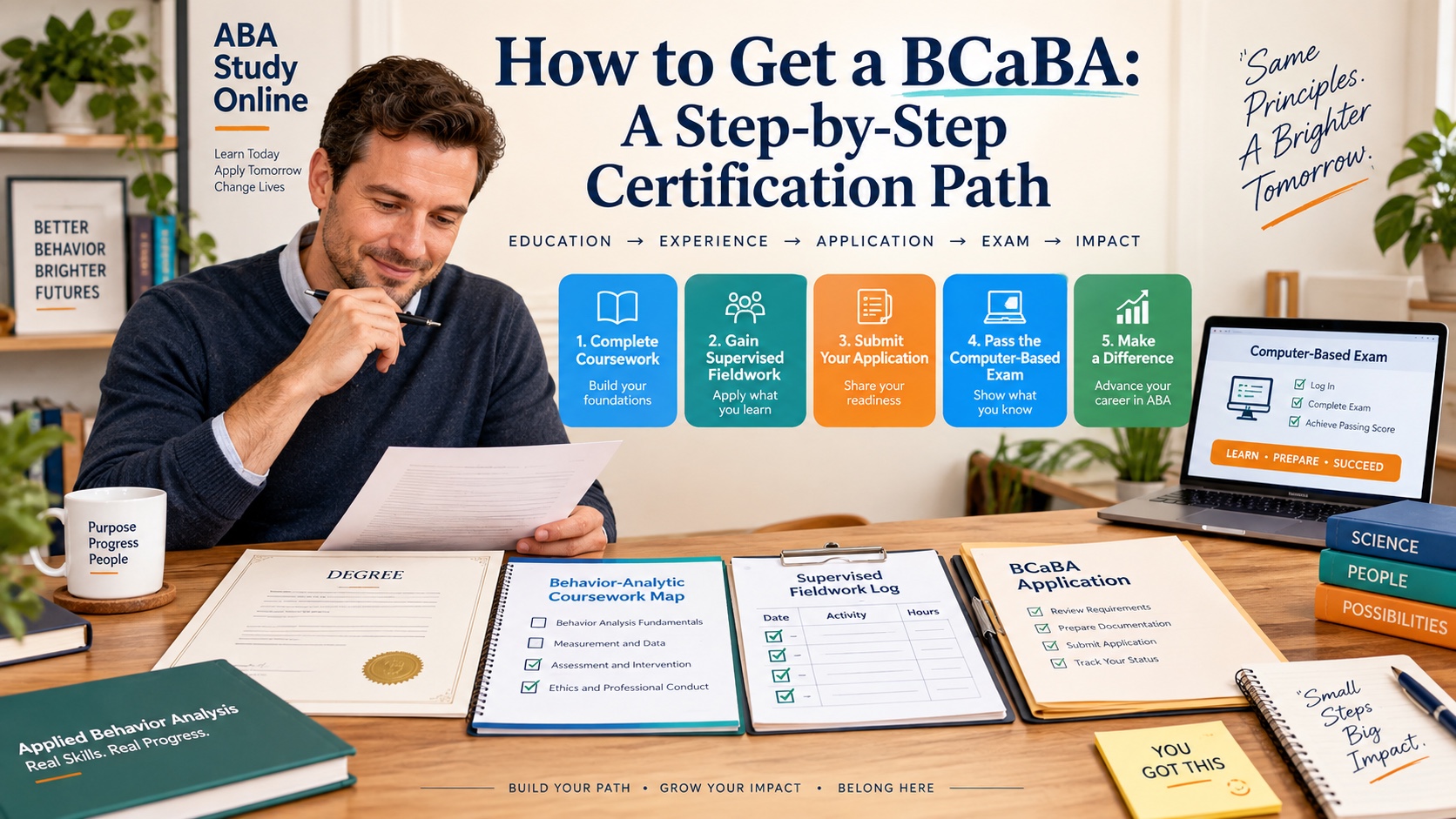
How to Get a BCaBA: A Step-by-Step Certification Path
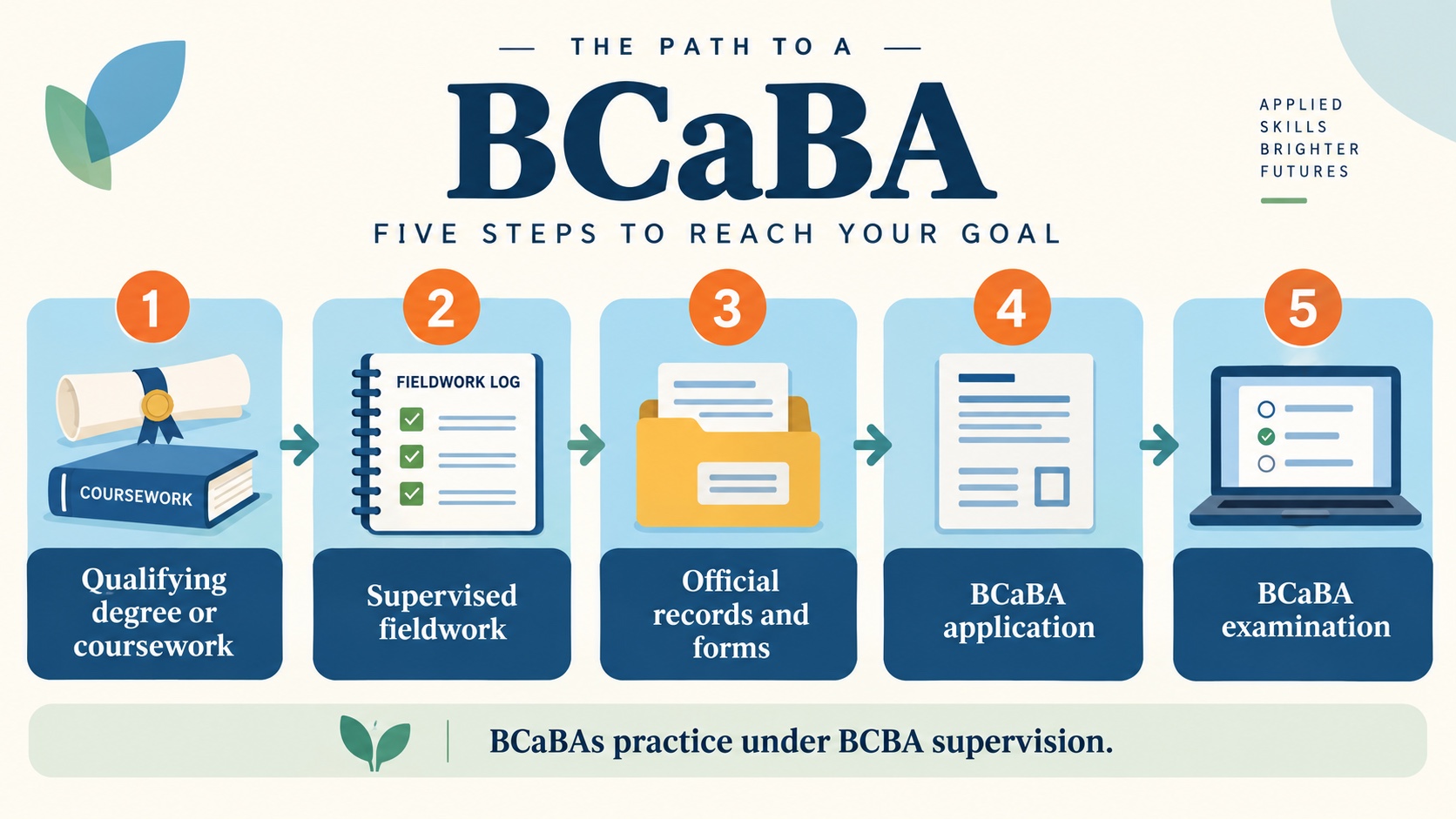
If you are searching for how to get a BCaBA, the most useful starting point is to think in four connected parts: education, behavior-analytic content, supervised fieldwork, and the BCaBA examination. A single ABA class or an online certificate does not automatically create BCaBA eligibility. The BACB reviews the pathway evidence and official documents that apply to your situation.
This guide explains the current route, the difference between the two eligibility pathways, the fieldwork and application records to plan for, and the published 2027 changes. It also keeps the BCaBA role separate from BCBA-level practice: BCaBAs provide behavior-analytic services under BCBA supervision.
Quick answer: to become a BCaBA, you need a qualifying degree, behavior-analytic content through the pathway you use, supervised fieldwork, a complete application with official evidence, and a passing BCaBA certification examination. The current BCaBA Handbook describes Pathway 1 through an ABAI-accredited program and Pathway 2 through an undergraduate degree plus qualifying behavior-analytic coursework.
Choose the right BCaBA pathway
The current BACB Handbook says each BCaBA eligibility pathway includes a degree, behavior-analytic content, supervised fieldwork, and the examination. The first decision is which education route matches your record:
| Pathway | Education direction | Shared next steps |
|---|---|---|
| Pathway 1 | Bachelor’s degree or higher from an ABAI-accredited program | Supervised fieldwork and BCaBA examination |
| Pathway 2 | Undergraduate degree plus qualifying behavior-analytic coursework | Supervised fieldwork and BCaBA examination |
Pathway 1 is tied to the accreditation status of the program when the qualifying degree was earned. Pathway 2 requires more than a general interest in ABA: the coursework must meet the current BACB descriptions, hours, institution, grade, and documentation conditions. Read the current handbook before assuming that a familiar course title is enough.
Complete the degree and behavior-analytic content
Under Pathway 1, the degree program supplies the behavior-analytic content through the accredited program route. Under Pathway 2, you need an undergraduate degree and a qualifying set of behavior-analytic courses. The current handbook is the source for the exact course-content and transcript rules. BACB relies on official transcripts to verify the degree and coursework, so keep your transcript and program documentation organized from the beginning.
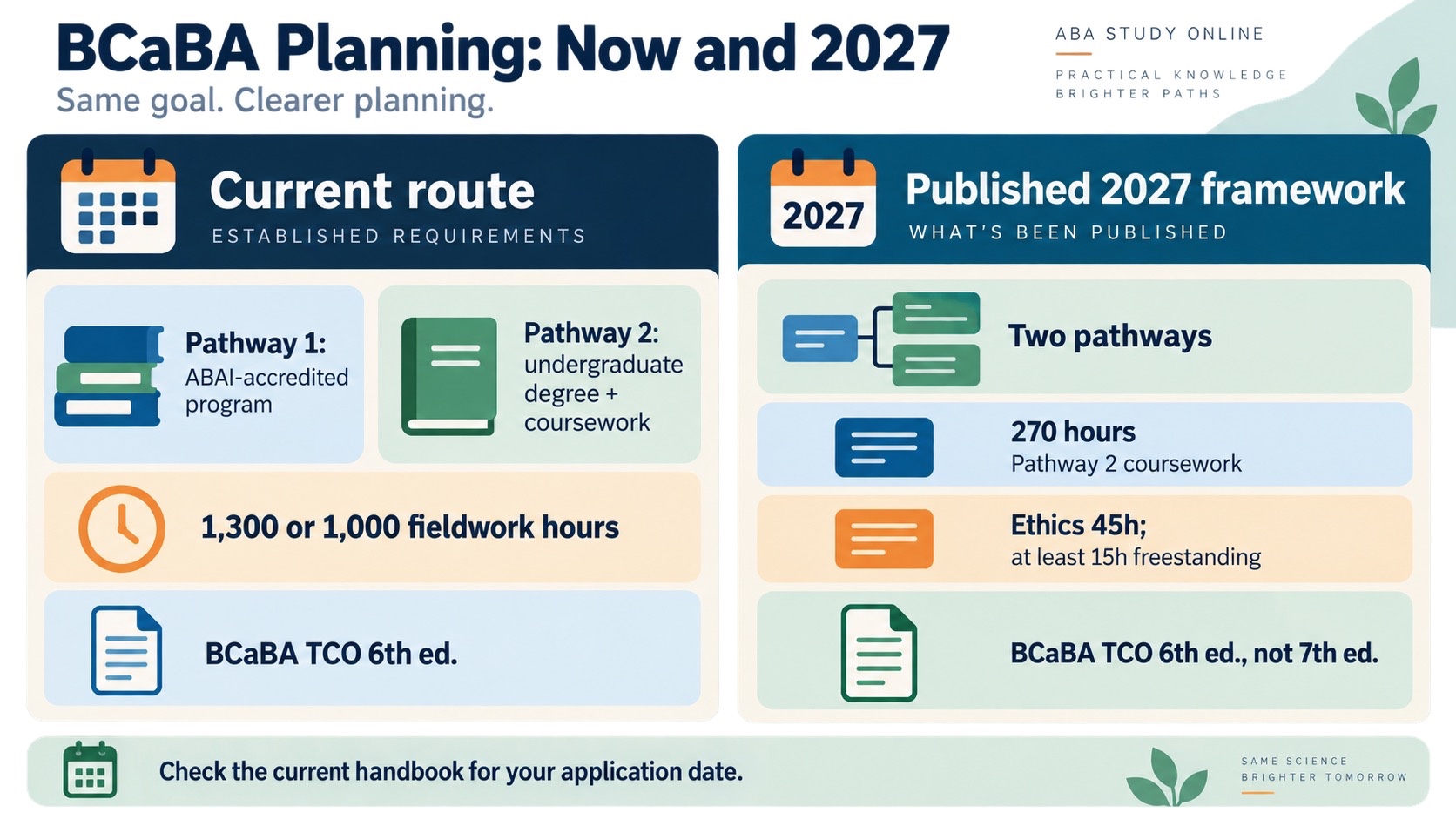
The published 2027 BCaBA Requirements reorganize the future Pathway 2 coursework into five areas totaling 270 instructional hours:
- Foundations of Behavior Analysis: 45 hours in one freestanding course.
- Methods of Behavior Analysis: 45 hours in one freestanding course.
- Behavior Assessment and Intervention: 90 hours within two freestanding courses.
- Organizational Behavior Management: 45 hours in one freestanding course.
- Ethics in Behavior Analysis: 45 hours, with at least 15 hours in a freestanding course.
Those are future requirements, not a reason to relabel every current transcript. If your application crosses the 2027 transition, compare your records with the official BCaBA transition guidance and the current handbook. Do not rely on a third-party course page to decide whether your credits map to a future content area.
Complete and document supervised fieldwork
The current BCaBA Handbook’s high-level fieldwork table lists 1,300 hours for supervised fieldwork or 1,000 hours for concentrated supervised fieldwork. The supervision percentage is 5% for supervised fieldwork and 10% for concentrated fieldwork. A supervisory period contains at least 20 hours and no more than 160 hours of fieldwork, and at least 40% of total supervised fieldwork hours must be unrestricted activities.
These numbers are a planning overview, not the entire fieldwork rule. Your supervisor, supervision contract, monthly forms, final forms, audit log, observations, individual supervision, and activity classifications must follow the current handbook and form instructions. Keep records as you go rather than trying to reconstruct them at application time.
Choose a qualified supervisor and confirm the arrangement before counting hours. Ask which activities are unrestricted, how the supervisory period will be defined, how observations will be recorded, and which fieldwork verification forms will be used. If your route crosses January 1, 2027, check whether the applicable forms and high-level requirements have changed.
Prepare the application and examination
Once your degree or coursework and fieldwork evidence are ready, use the BACB portal and the current BCaBA Handbook to prepare the application. Official transcripts and signed fieldwork verification forms are central documents. The exact application requirements, fees, attestations, background information, and document-upload steps can change, so use the current BACB application instructions rather than an old checklist.
Passing the BCaBA examination is the final certification step after the eligibility requirements are met. The examination is not the same as a course final or a practice test. Study to the current BCaBA Test Content Outline, use official exam information for scheduling, and treat practice questions as preparation only.
Build an evidence folder
A simple evidence folder can prevent avoidable delays. Keep the official transcript that shows the degree and conferral date, the program or coursework documentation used for your pathway, the supervision contract, monthly fieldwork records, final verification form, audit log if required, and copies of any attestation or application documents. Name files with the date and document type so you can find the right version later.
Your folder is a planning tool, not a replacement for BACB review. If a supervisor or program contact changes, record the change and keep the original records. Before submitting, compare every form with the current BACB version and make sure the names, dates, hours, signatures, and pathway information agree. A neat folder cannot make an ineligible course or unverified fieldwork count, but it can make a valid record easier to review and help you answer questions without reconstructing your history.
What changes in 2027?
The published 2027 BCaBA Requirements keep two eligibility pathways and revise the details of the content and fieldwork framework. The 2027 Pathway 2 coursework total is 270 hours, and the future document lists the new content areas described above.
The 2027 document also says the BCaBA examination is based on the BCaBA Test Content Outline, 6th edition, effective January 1, 2025. The 2027 transition is not a seventh-edition exam change. If a study page uses “BCaBA 7th edition,” verify it against the current BACB test-content-outline page before changing your preparation plan.
Maintenance is a separate topic. The published 2027 framework lists 20 CEUs per two-year cycle, including 4 ethics CEUs and 3 supervision CEUs for supervisors. This article is about initial certification, so use the current BCaBA Handbook and maintenance guidance for recertification records.
A practical BCaBA planning checklist
- Identify the pathway. Compare your degree and program status with Pathway 1 or your degree and coursework record with Pathway 2.
- Request official records. Obtain transcripts and keep course descriptions, program contact information, and any required attestation.
- Set up supervision before hours accrue. Agree on activities, supervisory periods, observation, documentation, and forms.
- Track fieldwork continuously. Record hours, supervision percentage, individual supervision, observations, and unrestricted activities.
- Use the current application instructions. Check the portal, fees, forms, and document versions close to submission.
- Study to the current outline. Use the 6th-edition BCaBA TCO unless BACB publishes a later official version.
Common mistakes
- Assuming any ABA degree qualifies: accreditation, coursework, transcripts, and pathway conditions matter.
- Counting hours without a plan: fieldwork must be supervised and documented under the current requirements.
- Confusing BCaBA and BCBA: a BCaBA is an undergraduate-level credential and practices under BCBA supervision.
- Calling 2027 a seventh edition: the published 2027 document points to the 6th-edition BCaBA TCO.
- Using a course certificate as an eligibility decision: official transcripts and BACB application evidence control the review.
- Waiting to read the handbook: forms and documentation rules should shape the plan from the start.
FAQ
What degree do I need to become a BCaBA?
The current route can use a bachelor’s degree or higher from an ABAI-accredited program through Pathway 1, or an undergraduate degree plus qualifying behavior-analytic coursework through Pathway 2. Confirm the current handbook conditions for your application.
Can I become a BCaBA without an ABA degree?
Pathway 2 is designed for an undergraduate degree plus qualifying behavior-analytic coursework, but the coursework, institution, grades, and official transcript still need to meet BACB requirements. A general degree alone is not enough.
Can a BCaBA work independently?
BCaBAs provide behavior-analytic services under BCBA supervision. Do not treat BCaBA certification as interchangeable with BCBA certification or as a general state-licensure determination.
How many fieldwork hours are required?
The current high-level BCaBA table lists 1,300 supervised fieldwork hours or 1,000 concentrated supervised fieldwork hours. Check the current handbook for all supervision, activity, observation, and form conditions.
Where can I study for the BCaBA exam?
Start with the current BACB outline, then use the BCaBA learning path, BCaBA practice questions, and ABA glossary. These resources support study and do not determine eligibility.