
How to Become a BCaBA: Start With These 6 Decisions
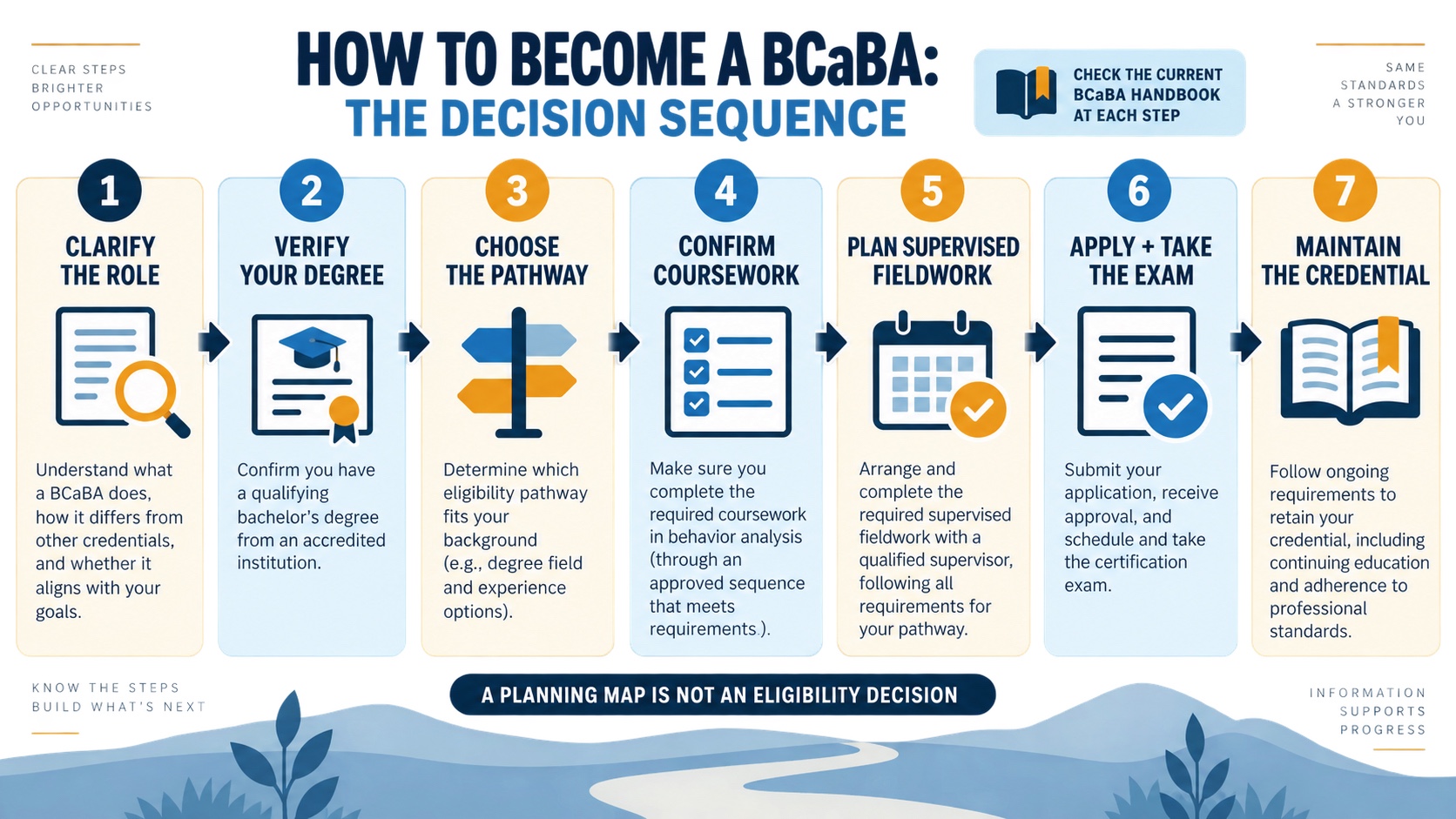
If you are searching for how to become a BCaBA, the first step is not buying an exam course or counting every hour at an ABA job. The safer first step is to identify the current BACB pathway that may fit your education, then verify the coursework, supervised fieldwork, application timing, and examination requirements from the official sources.
This guide gives you a beginner-friendly order of operations. It does not make an individual eligibility decision, replace the current BCaBA Handbook, or promise certification. Your program contact, advisor, qualified supervisor, local authority, and the BACB’s current documents may all matter to your specific situation.
Table of Contents
What becoming a BCaBA means
The Board Certified Assistant Behavior Analyst (BCaBA) is an undergraduate-level behavior-analysis certification operated by the Behavior Analyst Certification Board. The current BACB description says that BCaBAs may provide behavior-analytic services under the supervision of a BCBA. BCaBAs may also supervise RBT work when the applicable requirements are met.
That role boundary is important when you read university pages and job advertisements. A bachelor’s degree in any subject is not automatically the same as BCaBA eligibility. A clinic job title is not automatically qualifying fieldwork. An ABA course or certificate is not automatically an approved certification pathway. The credential is a combination of education, behavior-analytic preparation, supervised experience, application documentation, examination performance, and maintenance.
The six decisions to make first
Before you build a multi-year plan, write down answers to these six questions:
- Is BCaBA the right role? Confirm that the undergraduate-level credential and supervised practice structure match your professional goal. If you are aiming for independent BCBA practice, the BCBA pathway is a different route.
- What degree do you have or plan to earn? Keep the exact institution, degree level, graduation date, and official transcript requirements visible. Do not rely only on the way a program describes itself.
- Which eligibility pathway might fit? The current BCaBA materials describe Pathway 1 through an ABAI-accredited program and Pathway 2 through behavior-analytic coursework. Your program contact or advisor can help you interpret the details.
- When could you submit an application? The application date affects which requirements and forms apply, especially around January 1, 2027.
- How will fieldwork be supervised and documented? Identify a qualified supervisor and a record system before assuming that work hours will count.
- Which source will you recheck? Save the current BCaBA Handbook, TCO, examination information, ethics source, and transition guidance. A saved summary should never outrank a newer official document.
Verify your education pathway
The current BCaBA materials organize eligibility around two pathways. Under Pathway 1, the applicant uses a bachelor’s degree or higher from an ABAI-accredited behavior-analysis program. Under Pathway 2, the applicant uses a bachelor’s degree or higher plus qualifying behavior-analytic coursework through the required institutional and program-contact structure.
Use documents to verify the claim. Ask the program:
- Which current BACB pathway does this program support?
- What will appear on my official transcript?
- If this is Pathway 2, who is the registered Pathway 2 Program Contact?
- Which course descriptions and records will support the application?
- How does the program distinguish its academic coursework from an informal certificate or continuing-education class?
A course title can be a useful starting clue, but it is not a final eligibility answer. Keep your transcript, course descriptions, program correspondence, and any required attestation information together. If a program cannot explain how its records support the current pathway, pause before paying a deposit or planning your fieldwork around its marketing language.
This is where a general “how to become a BCaBA” page should stop short of making a personal ruling. The official handbook controls the requirement, and your institution or program contact may need to confirm facts about your education. If a state, payer, employer, or other authority adds a rule, that rule belongs in a separate local checklist.
Plan supervised fieldwork and documentation
Coursework explains behavior analysis; supervised fieldwork gives you a structured way to apply behavior-analytic activities with oversight. The current BCaBA Handbook describes the fieldwork types, supervisor qualifications, monthly structure, observations, supervision percentage, activity categories, forms, and record-retention expectations. Read that section with your supervisor instead of treating a generic hour total as the whole requirement.
Before fieldwork begins, clarify:
- Who is the supervisor, and how will the supervisor’s current qualification be verified?
- Which fieldwork type or combination will you use?
- What is the supervisory period and what records will be completed each month?
- How will client observation, supervision time, individual or group supervision, and unrestricted activities be documented?
- Where will the signed supervision contract and verification forms be stored?
- What happens if the supervisor changes, the setting changes, or a month does not meet the requirements?
Do not assume that every hour paid by an ABA employer is qualifying fieldwork. The activity must fit the current BACB fieldwork rules, occur within the appropriate supervision structure, and be documented for the relevant application framework. A job can provide valuable experience without every task counting toward certification.
Keep official requirements separate from suggestions. “The handbook requires this form” is different from “my supervisor prefers this spreadsheet.” Both notes can be useful, but only one is the certification rule. Label your records so a convenient local habit does not become a false universal requirement.
Place the examination in the right sequence
The examination is one stage in the pathway, not the first proof that your degree and fieldwork qualify. Once you understand the eligibility route and application process, use the current BCaBA Test Content Outline, Ethics Code for Behavior Analysts, and training materials to plan your study. The current BCaBA examination uses the 6th-edition TCO in the official BACB materials.
The BACB’s examination information identifies the BCaBA examination as a computer-based, in-person test delivered through authorized Pearson VUE locations. The current examination table lists 175 questions and four hours for BCaBA candidates, with four possible answers and one correct answer per question. Use the live BACB examination page and handbook for the rules that apply to your appointment.
Practice questions can help you learn terms, compare answer choices, and build application fluency. They are not official BACB questions, cannot sign an application, and cannot guarantee a passing result. A sensible study loop is: identify the current TCO domain, answer an original scenario, explain why the best option fits, inspect the distractors, record the error, and retrieve the distinction again later.
Check the 2027 transition date
The BACB has announced significant BCaBA eligibility and maintenance changes effective January 1, 2027. The public transition guidance says Pathways 1 and 2 continue, while Pathway 2 coursework structure, content descriptions, total hours, and freestanding-course expectations change. Fieldwork documentation and forms also change under the 2027 framework.
If your complete application is intended to be reviewed under the current requirements, the BACB’s public 2027 transition announcement says that the complete application, payment, and required documents must be received by December 31, 2026. That sentence is a planning boundary, not individualized legal or eligibility advice. If your timeline is uncertain, compare the current handbook, the 2027 requirements, and the transition guidance with your program contact and supervisor.
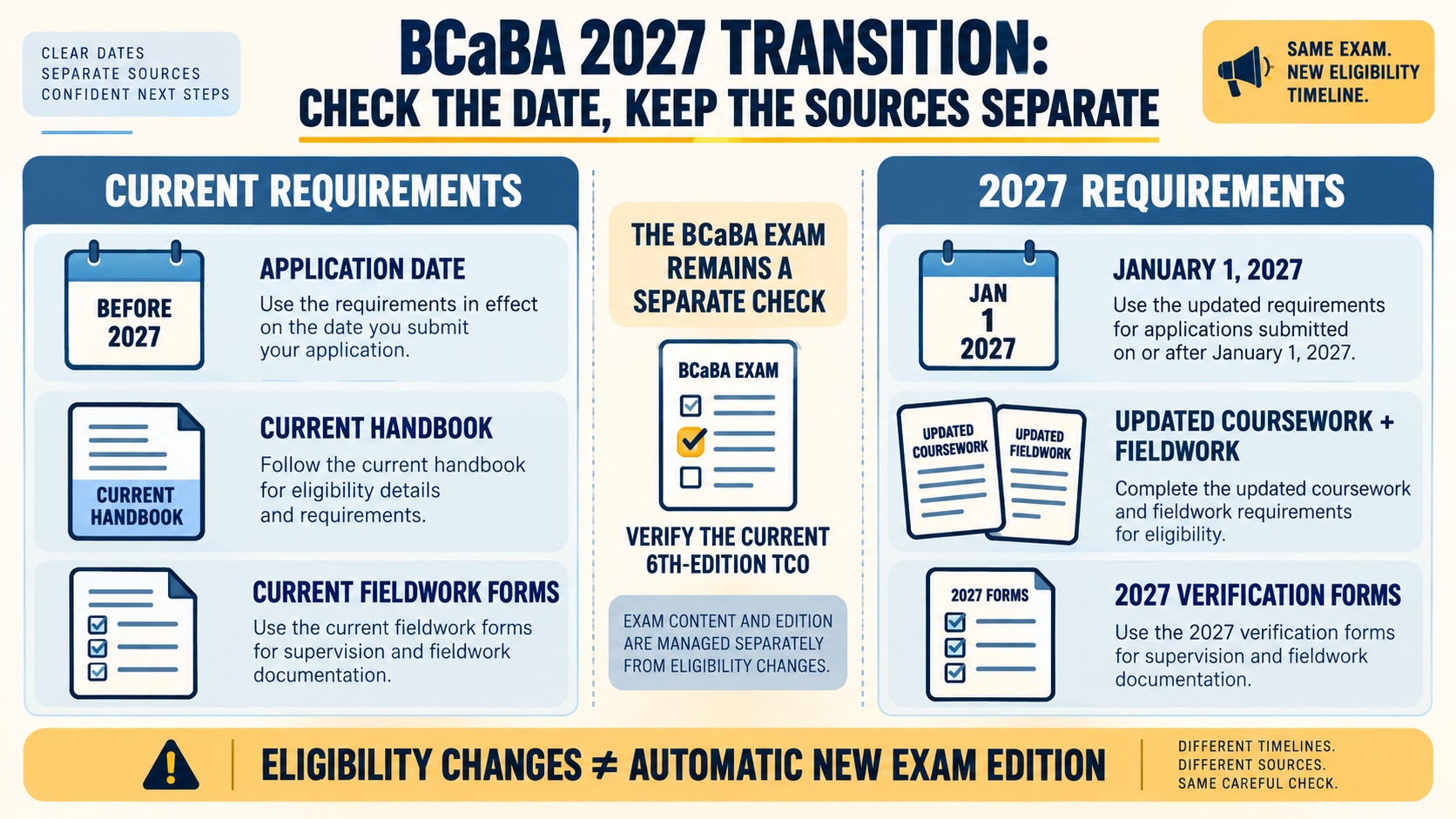
Do not turn the transition into a “7th-edition exam” claim. The official BCaBA transition guidance distinguishes eligibility and maintenance changes from the examination. Check the current TCO and handbook instead of allowing a social-media headline or an old course label to decide the edition for you.
A practical planning example
Imagine Maya, an undergraduate student who has taken several classes labeled ABA and now works in a clinic. She wants to become a BCaBA. Her first draft plan says, “Finish school, count my work hours, and buy a test-prep course.” That plan is too vague to protect her timeline.
Maya revises it into four meetings and four document checks. She asks her academic advisor whether her program is being evaluated through Pathway 1 or Pathway 2. She asks the program contact how coursework will appear on her transcript. She meets a potential supervisor to discuss the contract and monthly fieldwork records. Finally, she writes an application-date range and checks the current and 2027 transition documents side by side.
Only after those questions are clearer does Maya build her examination study plan. Her notes now separate official requirements, program-specific instructions, supervisor decisions, and personal study actions. That separation makes the next step visible without pretending that a generic article can approve her application.
Common mistakes to avoid
- Starting with test prep only: an exam course cannot repair an unverified education or fieldwork pathway.
- Assuming a degree is enough: the credential also involves behavior-analytic preparation, supervised experience, an application, an examination, and maintenance.
- Counting every clinic hour: qualifying fieldwork depends on the current rules, supervisor, activity, timing, and records.
- Following a saved checklist: handbooks and transition guidance change; record the update date of the source you use.
- Calling a requirement change a new exam edition: keep eligibility, fieldwork, maintenance, and examination-outline changes separate.
- Expecting a website to guarantee approval: independent study support cannot make a certification decision or guarantee a pass.
FAQ and official sources
Do I need a bachelor’s degree to become a BCaBA?
The current BACB pathway materials describe a bachelor’s degree or higher for both BCaBA pathways. The exact pathway, coursework, fieldwork, application, and examination requirements still need to be checked in the current handbook.
What is the difference between Pathway 1 and Pathway 2?
Pathway 1 uses a degree from an ABAI-accredited behavior-analysis program. Pathway 2 uses a qualifying degree plus behavior-analytic coursework through the required program-contact structure. Your institution’s official records and the current handbook determine how the pathway applies.
Can any ABA job count as BCaBA fieldwork?
No. Work must fit the current fieldwork rules, supervision structure, activity categories, timing, and documentation. Discuss the specific setting and activity with a qualified supervisor before counting hours.
What should I do if I may apply in 2027?
Save the current BCaBA Handbook, the 2027 BCaBA Requirements, and the official 2027 transition guidance. Compare the application date, coursework, fieldwork records, and forms with your program contact and supervisor. Do not rely on a headline or an old checklist.
Is ABA Study Online an official BCaBA certification provider?
No. ABA Study Online’s theory pages, glossary, practice questions, and app are independent educational resources. They do not replace the BACB handbook, a program contact, a qualified supervisor, local rules, or the BACB application process.
For the current rules, start with the BACB BCaBA overview and the BCaBA Handbook. Then check the 2027 BCaBA Requirements, the 2027 transition guidance, the Examination Information, and the BACB test-content-outline page. For educational support, you can explore the BCaBA Theory Blocks, free ABA questions, and ABA Definition Search; these links are for learning, not certification approval.