How Many Questions Are on the BCBA Exam?
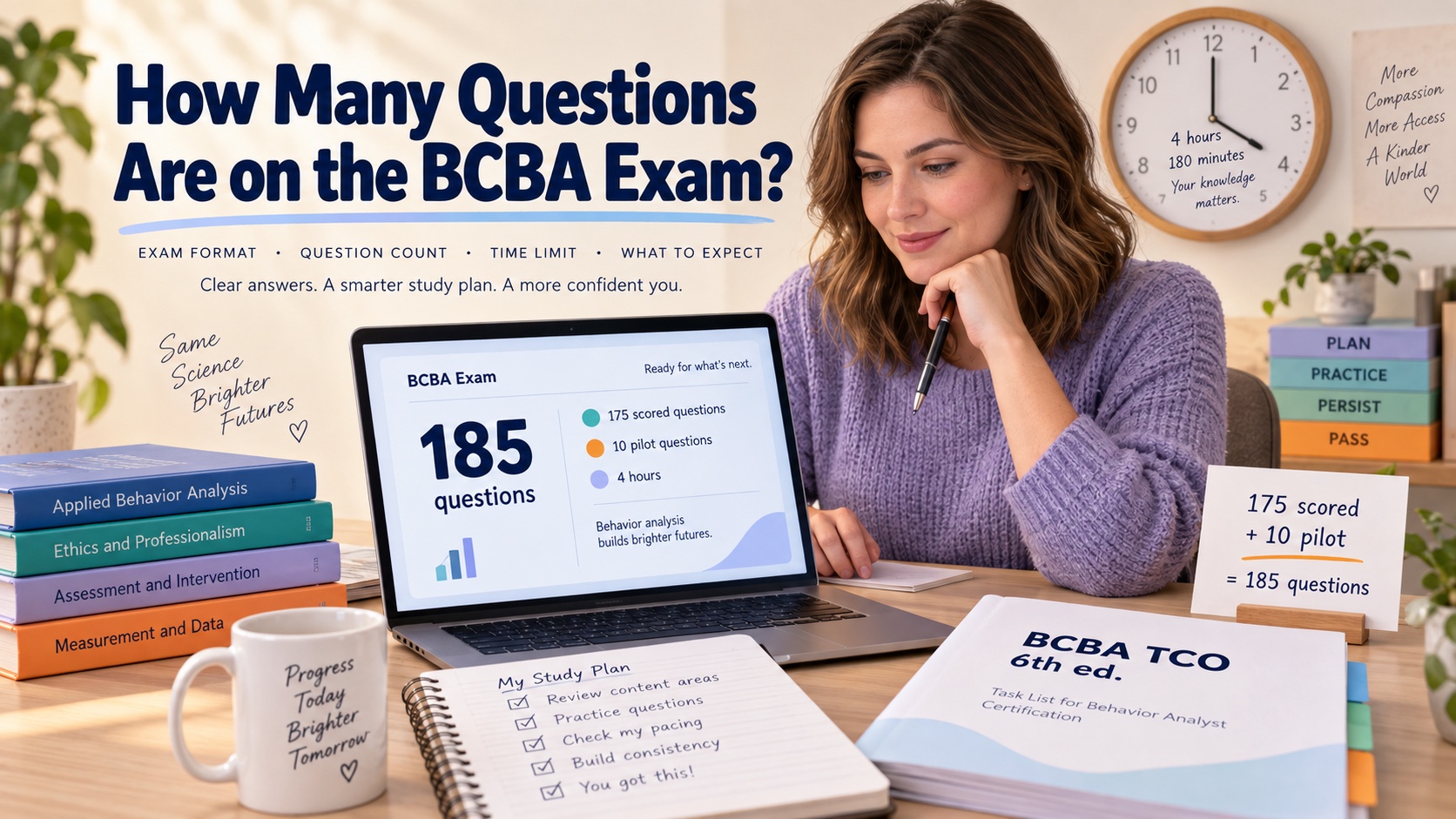
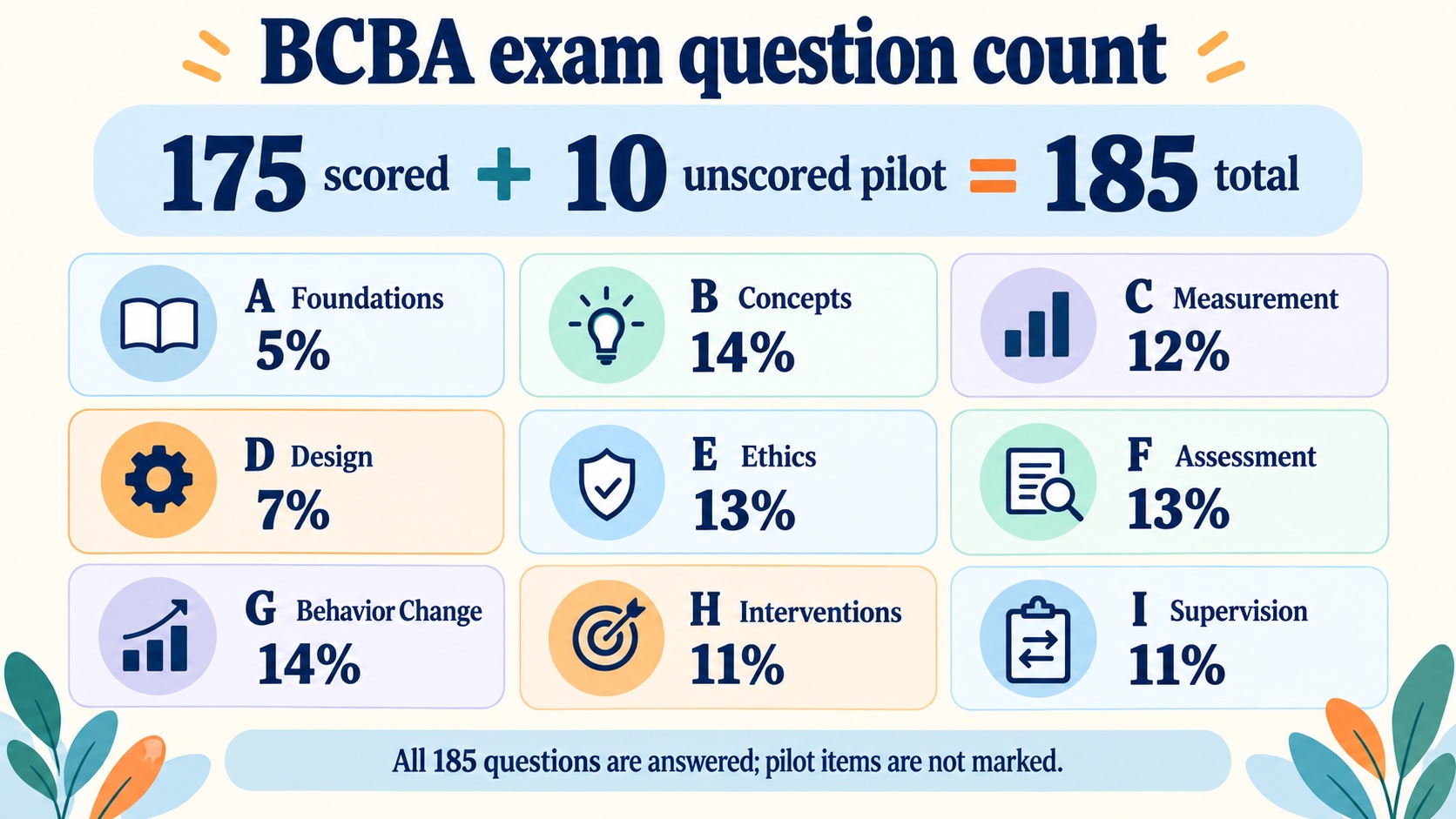
If you are preparing for the BCBA examination, the short answer is 185 questions. The current examination includes 175 scored questions and 10 unscored pilot questions. You answer all 185 questions during a four-hour appointment, and the pilot questions are not marked for you.
The numbers can look confusing because the BACB’s Test Content Outline describes the scored blueprint, while the examination information page and handbook describe the full appointment. Both numbers matter: 175 questions contribute to the scored blueprint, but 185 questions appear on the screen. This guide explains the distinction, the nine content domains, pacing, and what you should not try to calculate from a practice score.
Short answer: the current BCBA examination has 185 multiple-choice questions, 175 scored and 10 unscored pilot questions. You have four hours, each question has four answer choices with one correct answer, and the exam is delivered in person through authorized Pearson VUE sites. The current source of truth is the BACB’s BCBA Handbook and Examination Information page.
175 scored plus 10 pilot questions
The BCBA Test Content Outline (6th ed.) says that the exam includes 175 scored questions and 10 unscored pilot questions. The current BCBA Handbook describes the examination as 185 multiple-choice questions, with 175 scored and 10 unscored. The BACB’s Examination Information page also lists 185 questions for the BCBA exam.
A pilot question is being evaluated for possible future use. It is mixed into the examination, and you cannot identify it by looking at the screen. That means the practical instruction is simple: treat every question as important, read every stem carefully, and choose the best answer even when you are unsure about its role in scoring.
The scored question count is useful for understanding the blueprint. The total count is useful for planning the appointment, stamina, navigation, and pacing. Do not remove ten questions from your attention or assume that a strange item must be unscored. You have no reliable way to make that decision during the exam.
The nine BCBA content domains
The current TCO organizes 104 tasks into nine domains. The percentages below describe the scored-question blueprint:
| Domain | Content area | Scored blueprint |
|---|---|---|
| A | Behaviorism and Philosophical Foundations | 8 questions · 5% |
| B | Concepts and Principles | 24 questions · 14% |
| C | Measurement, Data Display, and Interpretation | 21 questions · 12% |
| D | Experimental Design | 13 questions · 7% |
| E | Ethical and Professional Issues | 22 questions · 13% |
| F | Behavior Assessment | 23 questions · 13% |
| G | Behavior-Change Procedures | 25 questions · 14% |
| H | Selecting and Implementing Interventions | 20 questions · 11% |
| I | Personnel Supervision and Management | 19 questions · 11% |
The percentage is a coverage map, not a list of separate passing standards. The largest scored domains are G, Behavior-Change Procedures, and B, Concepts and Principles, at 14% each. Ethics and Behavior Assessment are also substantial at 13% each. That can help you allocate study time, but a low-percentage domain is not optional. A question about experimental design or philosophical foundations can still be the question that exposes a gap in your reasoning.
Some domains also support one another. Concepts and Principles supplies vocabulary that appears in behavior change and assessment scenarios. Measurement and Experimental Design both require careful attention to what was measured, how it was measured, and what conclusion the design supports. Study connections, not only isolated headings.
How four hours affects pacing
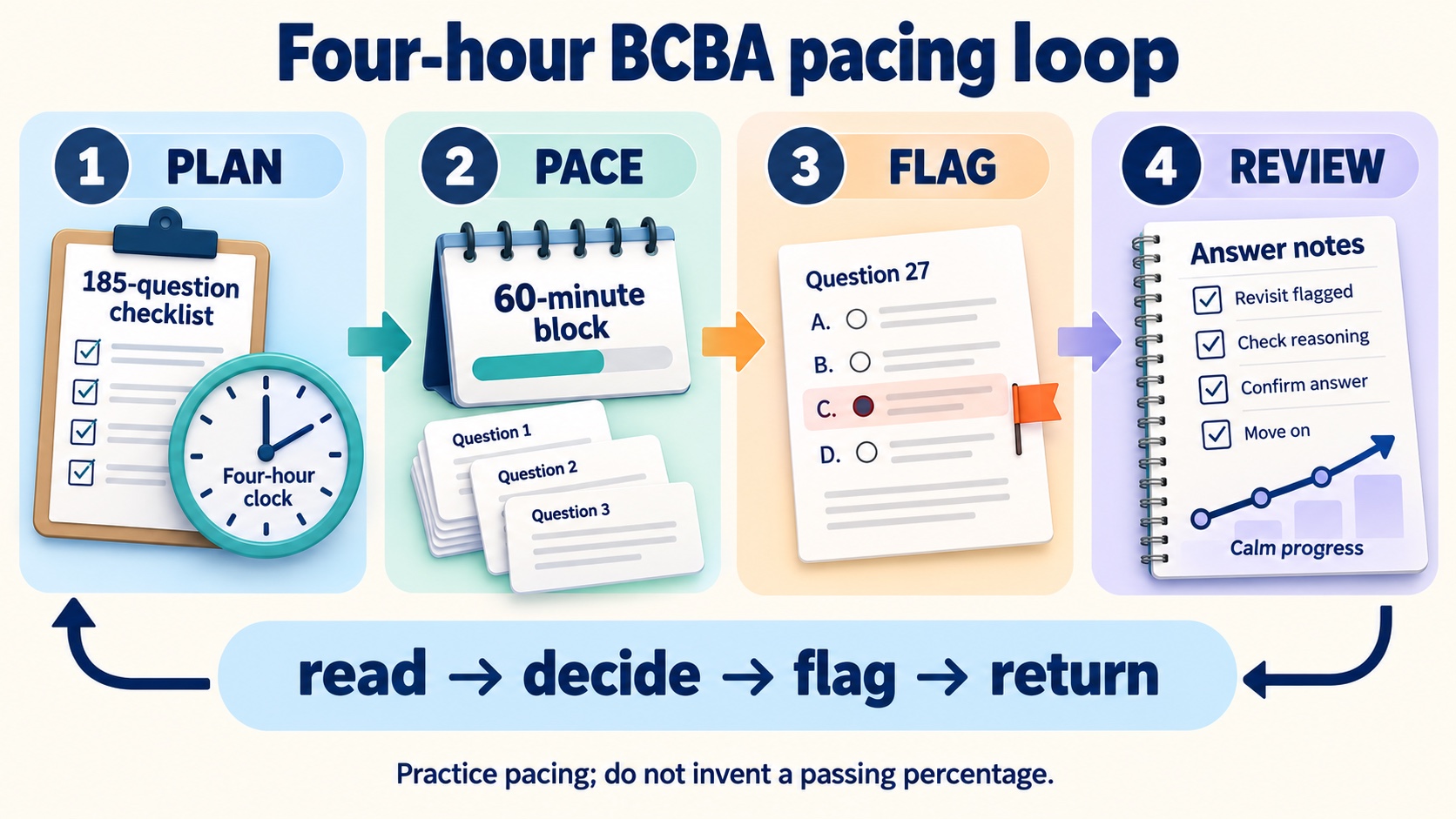
Four hours is 240 minutes. Dividing 240 minutes by 185 questions gives an average of about 78 seconds per question. That is a planning average, not a command to spend exactly 78 seconds on every item. Some questions will be quick; others require careful reading, calculation, graph interpretation, or comparison of close answer choices.
The current BCBA Handbook notes that the time allocation includes the terms and conditions screen, the exam navigation tutorial, loading time, the examination, and any review. A break may also use the available appointment time. Build a small buffer rather than planning to use every second only for reading question stems.
A practical pacing routine is:
- Read for the learning target. Identify what the question is actually asking before you chase every detail.
- Choose the best supported answer. Eliminate options that violate the facts, scope, function, measurement, ethics, or design logic.
- Flag genuine uncertainty. If two choices remain and rereading is not helping, record the question and move forward.
- Return with a reason. When reviewing a flagged item, ask which fact changes the answer instead of changing it because of anxiety.
How to practice with the correct format
Use at least three types of practice. A short set helps you learn a distinction. A domain set shows whether a particular content area needs work. A full-length set rehearses the attention and pacing demands of a long appointment. Record the number of questions, timing mode, content mix, and whether you checked explanations during the attempt.
For a full rehearsal, use 185 original questions if the resource is designed for that format, but do not assume that a mock’s content or difficulty is officially equivalent. A shorter session can still be useful when your goal is learning rather than stamina. The key is to label the purpose and compare like with like.
After a practice set, sort mistakes by reason. Did you forget a concept? Misread a qualifier? Choose a procedure before considering assessment data? Confuse a measurement dimension? Miss an ethical boundary? A score tells you how the session ended; the error log tells you what to do next.
Review correct but uncertain answers too. If you chose an answer by guessing between two options, write the distinction that should decide a new scenario. This is more useful than memorizing a letter or trying to predict which practice questions will appear on the secure examination.
Why you should not invent a passing percentage
The BACB uses a scaled-score system and an examination-form process. The Examination Information page explains that the number of correct responses required can vary with the examination form and its difficulty, so the BACB does not report a simple raw number correct as your result. Candidates receive a pass or fail result, and failing candidates receive performance information to guide further study.
That means you should be skeptical of a practice page that says a particular percentage is the official BCBA passing score. A third-party target can be a study goal if it is clearly labeled as that provider’s recommendation, but it is not a BACB rule. Your practice score also cannot tell you which items were scored or pilot items because independent practice questions are not the secure exam.
Use the official domain blueprint as a coverage map, your practice results as learning evidence, and your error explanations as the bridge between them. Keep studying all domains even when one report shows a small area of weakness. The BACB itself cautions against studying only the areas in which a candidate performed poorly because a small number of items may not predict full understanding.
For a weekly plan, reserve the largest blocks for the high-weight domains while keeping every domain in rotation. For example, you might pair Concepts and Principles with Behavior-Change Procedures, then pair Measurement with Experimental Design, and revisit Ethics, Assessment, Interventions, and Supervision across mixed practice. The exact schedule should reflect your baseline, coursework, fieldwork, and exam date. The point of the blueprint is to prevent a familiar topic from crowding out a necessary one.
Common mistakes
- Answering only 175 questions in practice: the real appointment presents 185, and pilot items are not marked.
- Trying to identify pilot items: candidates cannot reliably distinguish them during the exam.
- Using outdated counts: verify the current BCBA Handbook and Examination Information page before studying.
- Turning blueprint percentages into pass rules: domain weights describe coverage, not separate passing scores.
- Planning 240 minutes only for question reading: the appointment also includes terms, navigation, loading, and review time.
- Chasing a fixed raw cutoff: the BACB reports a scaled result rather than a universal number-correct rule.
- Studying only one weak domain: targeted repair helps, but complete preparation still covers the entire TCO.
For a deeper study path, use the BCBA learning path and BCBA practice-question hub. These are educational resources; they do not provide official BACB questions or guarantee an examination result.
FAQ
How many questions are on the BCBA exam?
The current BCBA exam has 185 total multiple-choice questions: 175 scored questions and 10 unscored pilot questions.
Do the 10 pilot questions count?
They are unscored for the current examination form, but you cannot identify them. Answer all 185 questions as carefully as possible.
How long is the BCBA exam?
The current exam appointment is four hours. The time allocation includes the required screens and tutorial, loading, the questions, and review time.
How much time do I have per question?
Four hours across 185 questions averages about 78 seconds per question, but that is only a planning average. Use flag-and-return practice so one difficult item does not consume the appointment.
What is the BCBA passing score?
Do not rely on a universal raw-percentage claim. The BACB uses a form-based passing process and scaled scoring. Check the current BACB examination information for the official explanation.