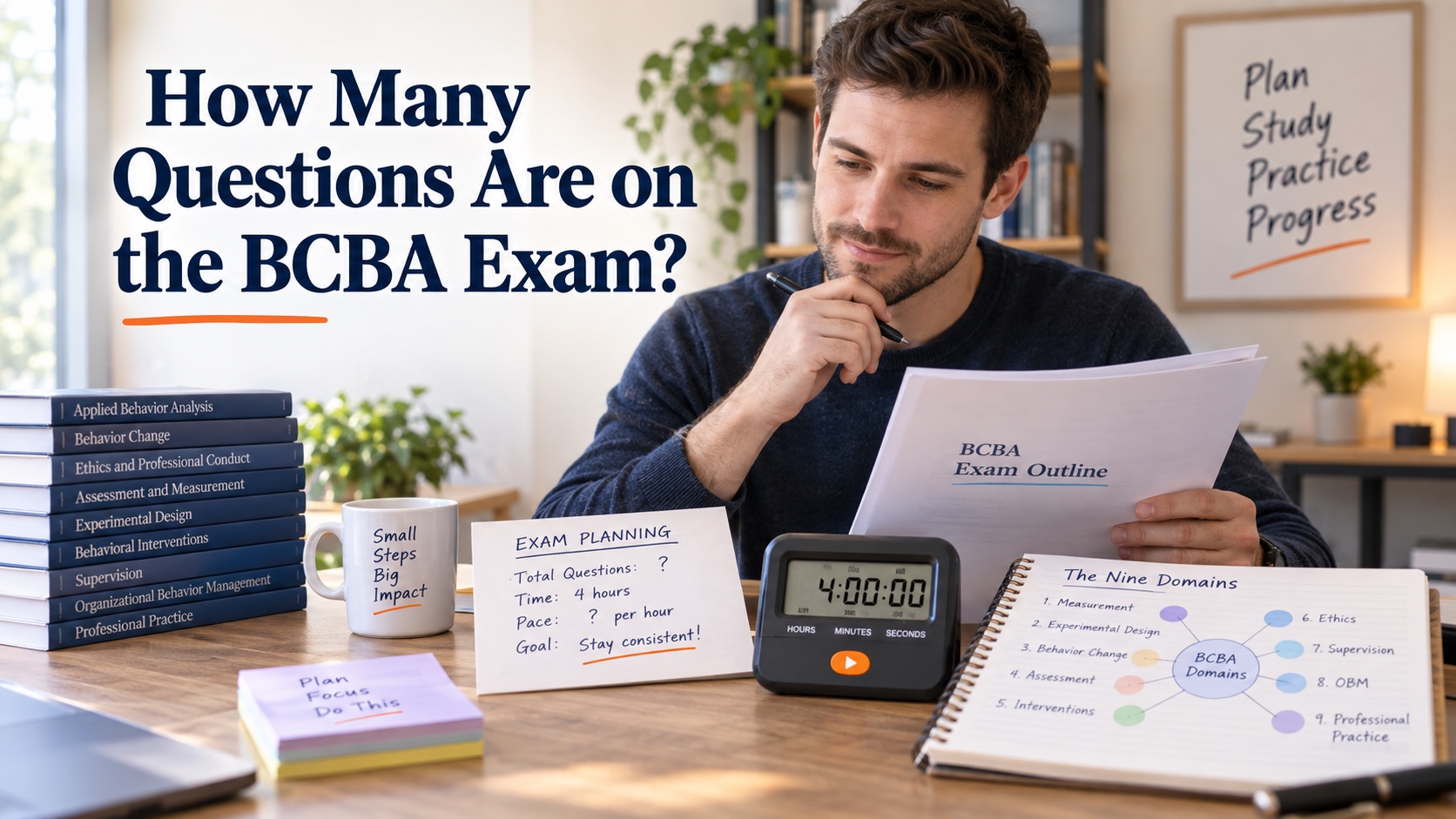
How Many Questions Are on the BCBA Exam?
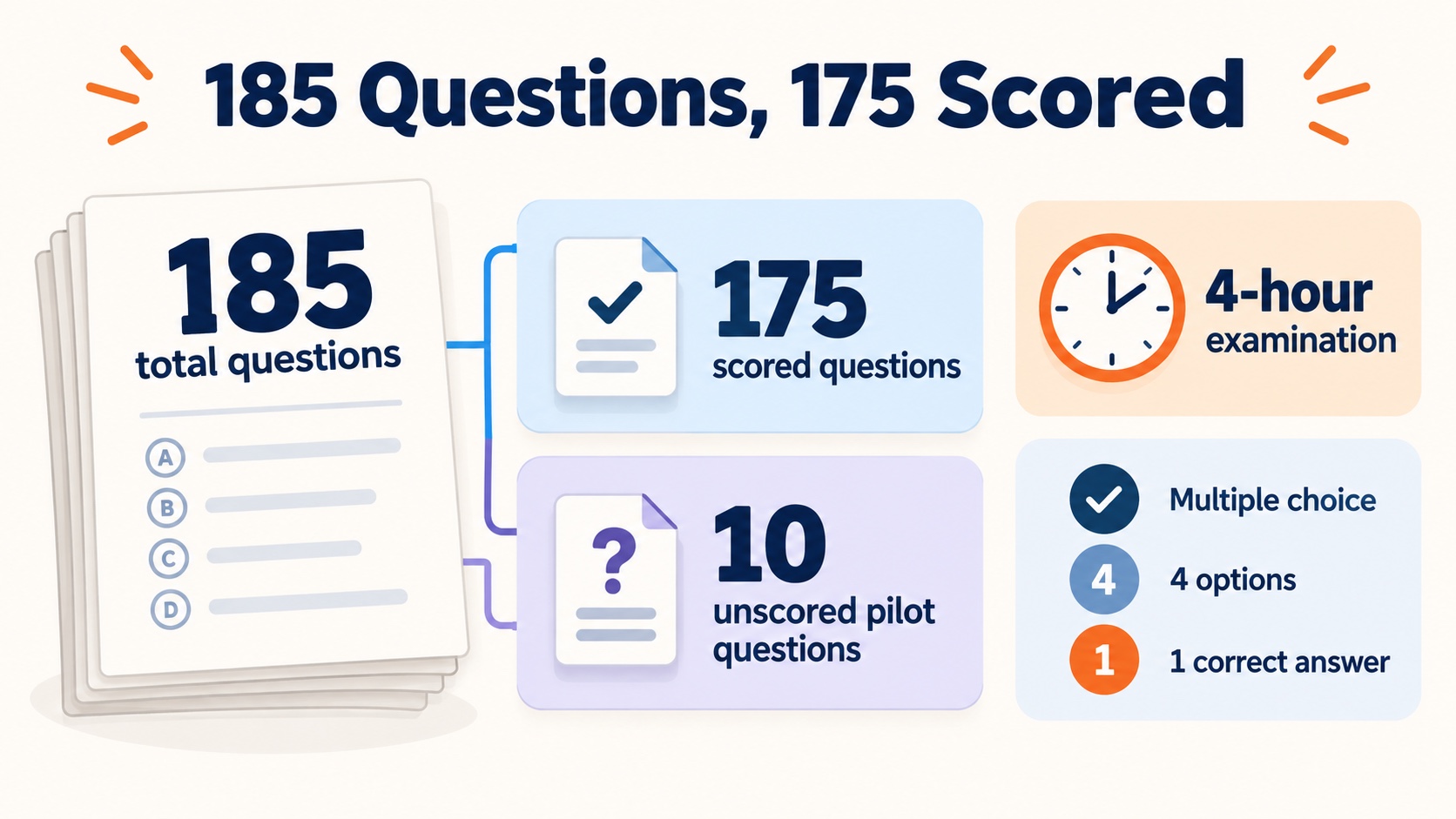
If you are planning for the BCBA exam, the short answer is 185 questions. The current BACB examination information says the BCBA examination lasts 4 hours and contains 185 multiple-choice questions. The current BCBA Test Content Outline (6th ed.) adds an important detail: 175 questions are scored and 10 are unscored pilot questions.
That distinction matters for planning. You will see all 185 questions during the examination, but you should not treat the 10 pilot questions as part of a simple “how many did I get right?” formula. The BACB uses equating and scaled scores, so there is no universal raw number correct that guarantees a pass on every examination form.
Table of Contents
Short answer: 185 questions
The current BACB Examination Information page lists the BCBA examination as:
- 185 total questions
- 4 hours to complete the examination
- Multiple-choice format
- Four answer options for each question, with one correct answer
- Computer-based delivery at an authorized Pearson VUE testing site or another authorized location described by the BACB
The “185” answer is the number to use when you plan stamina and pacing. The “175 scored plus 10 unscored” answer is the number to use when you interpret the Test Content Outline and score information. Both statements describe the same current exam, but they answer different questions.
185 total versus 175 scored
The BCBA Test Content Outline (6th ed.) says the examination includes 175 scored questions and 10 unscored pilot questions. The pilot questions are included in the test experience, but they are not used to calculate the candidate’s scored result. You cannot identify them reliably while testing, so the practical strategy is to treat every question as worth careful attention.
“Unscored” does not mean “optional.” You still need to read the item, evaluate the scenario, select the best answer, and manage the time. A question may be unfamiliar because it is a pilot item, because it targets a less familiar task, or simply because the scenario requires a different application of a familiar principle. Do not spend your exam time trying to guess which category an item belongs to.
The distinction also prevents a common study mistake: dividing 100 percent of your effort across an imagined 185 scored questions and then treating the percentages as a guaranteed passing threshold. The official outline is a content map, not a raw-score promise.
Time, question format, and pacing
Four hours for 185 questions gives an average of about 1 minute and 18 seconds per question. That is a planning average, not a rule that every item should take exactly the same time. A short definition item may take less time, while an applied scenario involving measurement, assessment, ethics, or intervention selection may require more reading.
A practical pacing pattern is to divide the exam into four broad blocks of roughly 46 questions. Use the clock as a check rather than a source of panic. For example, after the first quarter, ask whether you are still moving at a sustainable pace. If a single question becomes a time sink, mark it according to the test-center interface rules and return if the interface permits. Always follow the current BACB and Pearson VUE instructions for navigation, breaks, and review.
Because every question has four options and one correct answer, read the stem before chasing familiar words in the choices. Identify the target dimension: measurement, functional relation, ethical obligation, intervention decision, supervision issue, or another task. Then eliminate choices that change the facts, overreach beyond the evidence, or answer a different question.
Practice should include both accuracy and timing. A learner who can explain a rationale without a clock may still need a separate rehearsal for reading speed, decision discipline, and returning to a difficult item. The goal is not to race; it is to preserve enough time to think through the entire form.
How the 175 scored questions are distributed
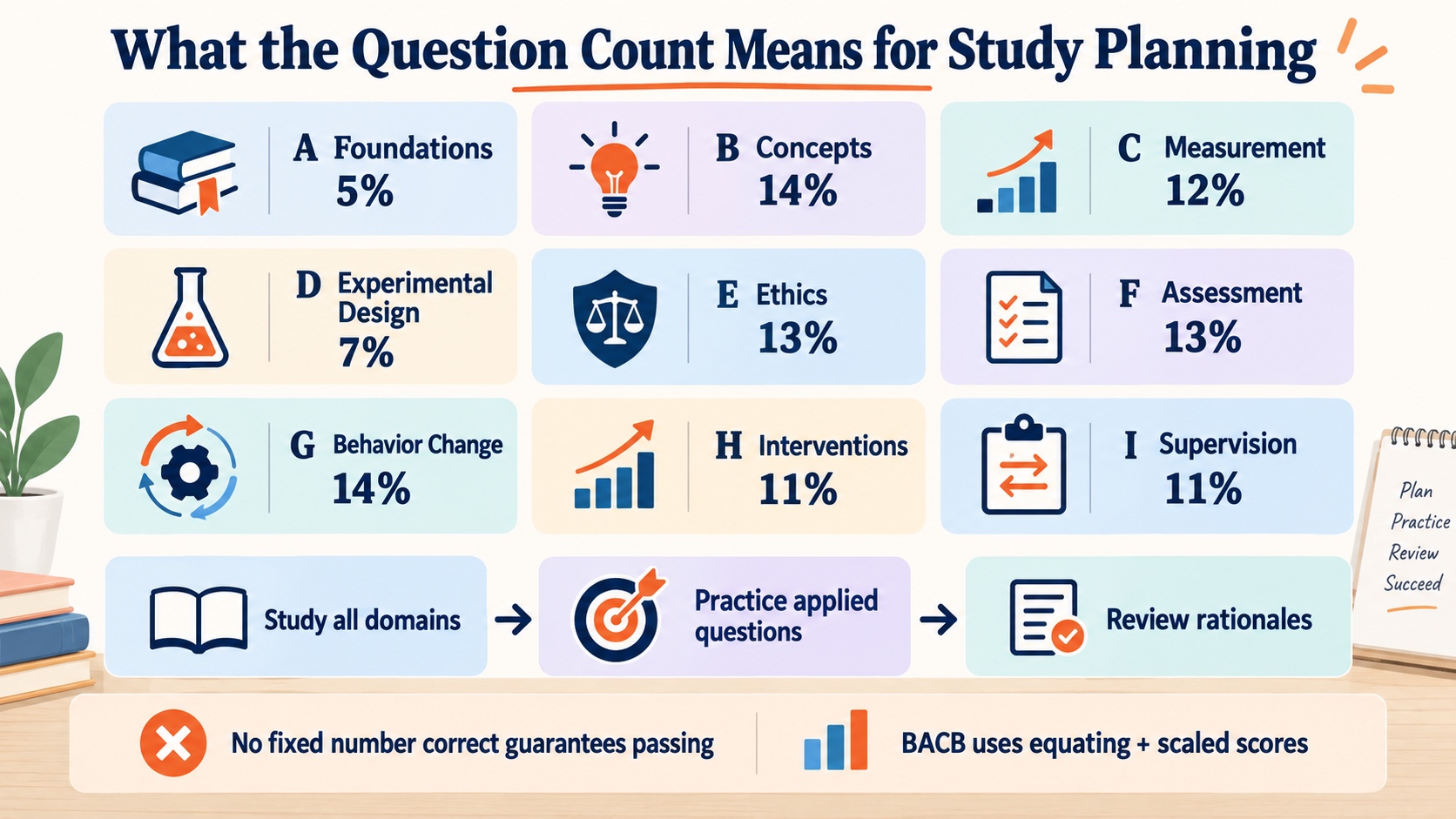
The current BCBA Test Content Outline organizes the scored content across nine domains. The percentages are approximate exam allocations, so use them to prioritize study depth without treating them as a prediction of the exact items on your form:
- A. Behaviorism and Philosophical Foundations: 8 questions, approximately 5%.
- B. Concepts and Principles: 24 questions, approximately 14%.
- C. Measurement, Data Display, and Interpretation: 21 questions, approximately 12%.
- D. Experimental Design: 13 questions, approximately 7%.
- E. Ethical and Professional Issues: 22 questions, approximately 13%.
- F. Behavior Assessment: 23 questions, approximately 13%.
- G. Behavior-Change Procedures: 25 questions, approximately 14%.
- H. Selecting and Implementing Interventions: 20 questions, approximately 11%.
- I. Personnel Supervision and Management: 19 questions, approximately 11%.
The largest approximate allocations in the current outline are Concepts and Principles and Behavior-Change Procedures, each at 14%. That does not mean you can safely ignore Foundations, Experimental Design, or Supervision. A small percentage still represents real scored content, and many applied questions require more than one domain to solve well.
Why question count does not equal a fixed pass number
The BACB explains that examination forms are statistically equated to account for differences in difficulty. The passing score is established through a criterion-referenced process and then transformed to a scaled score for the specific form. As a result, the raw number of questions required to pass may vary across forms, and the BACB does not report a universal “you need X out of 175” rule.
This is why a practice-test percentage should be treated as study evidence, not as an official prediction. A score can help you identify inconsistent reasoning, weak content areas, timing problems, or careless reading. It cannot convert directly into a guaranteed BCBA result. The official BACB Examination Information page remains the source for current examination details and score explanations.
If you receive a failing score report, use the content-area information as a clue rather than studying only one small list of missed tasks. The BACB cautions that the number of items associated with individual tasks is relatively small. A better retake plan reviews the full content outline while giving extra practice to the reasoning patterns that the report or your error log identifies.
How to use the count in a study plan
- Build a 185-question stamina plan. Include timed practice that approximates the length of the real session, while also using shorter sets for targeted repair.
- Map your review to the nine domains. Start with the current TCO, then mark which domains need conceptual review, applied scenarios, data interpretation, or ethics reasoning.
- Practice the scored-content boundary. Study as if every question matters, but do not interpret a mock score as a direct conversion to the official raw pass number.
- Keep an error log. Record whether the miss came from a definition, a measurement choice, an unsupported inference, an ethics boundary, a calculation, or a pacing problem.
- Review rationales. A correct answer that was a guess is a review item. The goal is stable reasoning, not a lucky percentage.
The ABA Study Online BCBA learning path can help organize concepts by domain, and BCBA practice questions can help you rehearse applied decisions. These are independent study resources. They do not provide secure BACB exam items, change the official question count, or guarantee a result.
Common mistakes
- Answering “175” when asked how many questions appear: 175 is the scored count; 185 is the total number you see.
- Assuming the 10 pilot items can be identified: plan to treat all items as real exam work.
- Turning percentages into a pass formula: the TCO allocations guide study; equating and scaled scoring govern the official result.
- Studying only the largest domains: smaller domains still contain scored content and may appear in applied combinations.
- Using practice-test percentages as guarantees: use them to find gaps, timing issues, and unstable rationales.
- Ignoring pacing: content knowledge is harder to use when the final questions are rushed.
BCBA exam question-count FAQ
How many questions are on the BCBA exam?
The current BCBA examination has 185 total multiple-choice questions. The current Test Content Outline identifies 175 scored questions and 10 unscored pilot questions.
How long do you have to take the BCBA exam?
The BACB Examination Information page currently lists 4 hours for the BCBA examination.
Are all 185 questions scored?
No. The current outline separates 175 scored questions from 10 unscored pilot questions. Candidates generally cannot identify the pilot items during the exam, so every item should receive careful attention.
How many questions do you need to get right to pass?
The BACB does not publish one universal raw-number rule for every examination form. Forms are equated, and results use scaled scores. Do not treat a fixed raw count as a guarantee.
What is the current BCBA exam outline?
The current BCBA Test Content Outline is the 6th edition. It organizes the scored content across nine domains and provides approximate question allocations for study planning.