How Long Is the RBT Exam? Time, Questions, and What the 90 Minutes Includes
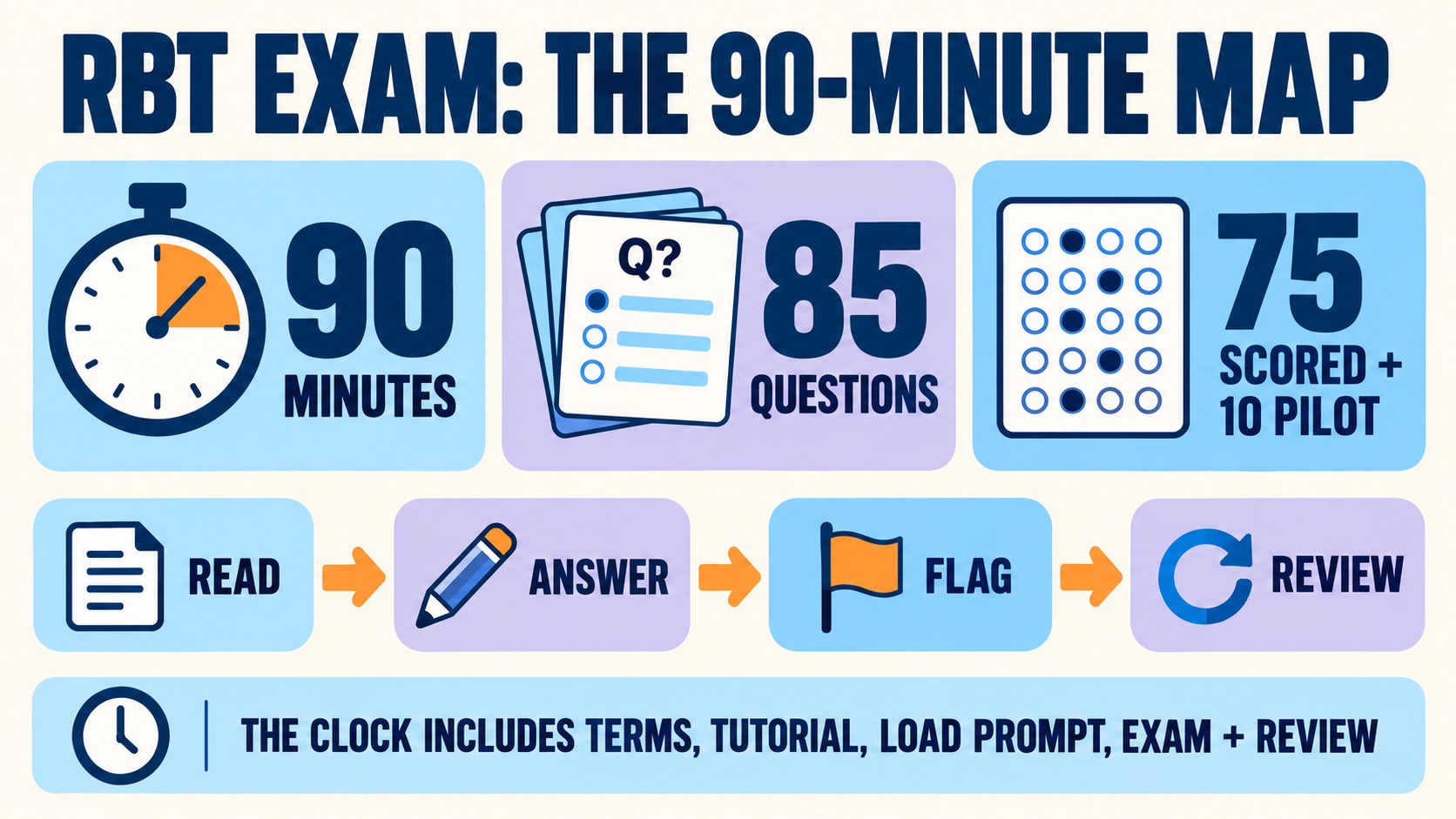
If you are asking how long the RBT exam is, the current official answer is 90 minutes. The examination contains 85 multiple-choice questions: 75 scored questions and 10 unscored pilot questions. The clock is not described as 90 minutes of uninterrupted answer time only. The current RBT Handbook says the allocated time includes the Terms and Conditions, the navigation tutorial, the load-time prompt, the examination, and any review.
That distinction helps you practice realistically. You should prepare to answer questions carefully, but you should not build your plan around an unofficial promise that every candidate will have exactly the same amount of free review time. Use the current BACB sources for the official format and your own practice sessions to learn a comfortable pace.
Quick answer
| Exam detail | Current official information |
|---|---|
| Examination length | 90 minutes |
| Total questions | 85 multiple-choice questions |
| Scored questions | 75 |
| Unscored pilot questions | 10 |
| Answer format | Four answer choices with one correct answer per question |
| Current content outline | RBT Test Content Outline, 3rd ed., beginning in 2026 |
The 90-minute figure comes from current BACB examination information and the RBT Handbook. If you see an older practice page using different domain names or a different edition, check the publication date and compare it with the current RBT Handbook before relying on it.
What the 90 minutes includes
The current Handbook explains that the allocated examination time includes more than reading question stems and choosing answers. It includes reviewing the Terms and Conditions, completing the examination navigation tutorial, waiting through the load-time prompt, working through the examination, and using any available review time. That is why “90 minutes” should be treated as the official examination allocation rather than a simple promise of 90 minutes devoted only to scored questions.
Small administrative screens still deserve attention. Read the instructions carefully, but do not spend your entire mental budget trying to predict how much time each screen will take. A good practice session can include a short start-up routine: settle in, read directions, confirm that you understand the interface, and begin the first question without rushing.
The 10 unscored pilot questions are mixed into the examination and are not a separate section that you can plan to skip. Because you cannot reliably identify them while testing, approach all 85 questions with the same professional care. Your practice materials may label their own experimental items, but that does not mean the official pilot questions will be labeled in the exam.
How many questions are on the RBT exam?
The current RBT exam has 85 multiple-choice questions. Ten are unscored pilot questions used by the BACB for examination development, and 75 contribute to the scored examination result. Every question has four possible answers and one correct answer.
The scored-versus-unscored distinction does not change how you should answer. You do not receive a label telling you which items are pilot questions, and you should not spend time trying to detect them from wording or difficulty. Read each question, identify the task being tested, compare the alternatives, and choose the best-supported answer.
Also keep the exam separate from the RBT initial competency assessment. The examination tests knowledge and skills through multiple-choice items. The competency assessment is a different step in the certification process and is not another name for the 90-minute exam.
How to practice pacing
The BACB states the official duration; it does not give you an official rule that you must spend a fixed number of seconds on every question. Your own pace will vary with the question, the reading load, and whether you need to compare similar procedures. A useful practice goal is not to force every question into an identical time box. It is to avoid getting trapped by one difficult item.
- Practice a first pass: read for the target behavior, condition, procedure, or ethical decision; answer when one option is clearly best.
- Mark uncertainty: if the interface allows review, make a note or flag according to the practice platform’s method and move on after a reasonable attempt.
- Protect review time: build a habit of checking your progress at natural points instead of waiting until the final moment.
- Review reasoning: when you return to a question, change an answer only when you can identify a concrete reason in the stem or rule.
For practice, try a short set first, then a longer mixed set, and eventually a full 85-question rehearsal. Keep the conditions consistent enough to learn from them: use a timer, limit distractions, and record whether errors came from knowledge, reading, discrimination between procedures, or rushing. This turns “I ran out of time” into a problem you can actually repair.
How the 2026 RBT outline changes the content context
The RBT Test Content Outline (3rd ed.) applies to the RBT examination beginning in 2026. It organizes 43 tasks across six domains: Data Collection and Graphing, Behavior Assessment, Behavior Acquisition, Behavior Reduction, Documentation and Reporting, and Ethics.
The outline does not change the basic answer to “how long is the RBT exam?” It gives you a better map for what to practice during that time. Behavior Acquisition has the largest listed share of scored questions, followed by Behavior Reduction; the other domains still matter and should not be ignored. Use the official outline to organize study, then use practice results to decide which task needs attention first.
If your materials still use an older task-list edition, do not assume that the vocabulary and domain labels are current. Compare them with the BACB RBT TCO (3rd ed.). The outline is a content boundary, not a replacement for the RBT Handbook or official application requirements.
A simple test-day checklist
- Confirm your appointment details and arrive according to the current testing-center instructions.
- Bring the identification and follow the personal-belongings rules in the current Handbook.
- Expect the exam to be in English and delivered through the authorized testing process described by the BACB.
- Read the Terms and Conditions and tutorial instructions before starting the questions.
- Answer all 85 questions with equal care; do not try to identify the unscored pilot items.
- Use a calm first pass and reserve attention for reasonable review rather than repeatedly changing answers without evidence.
For concept review, see the ABA Study Online RBT learning route. For practice, use the RBT question library and keep an error log that follows the current outline. The app review loop can help you return to weak concepts after a delay; none of these resources replace the official BACB examination information.
FAQ
How long is the RBT exam?
The current RBT examination allocation is 90 minutes. The Handbook says that allocation includes the Terms and Conditions, navigation tutorial, load-time prompt, examination, and review.
How many questions are on the RBT exam?
There are 85 multiple-choice questions: 75 scored and 10 unscored pilot questions.
Are the 10 unscored questions marked?
Do not assume you can identify them. Treat all 85 questions as important and answer each one carefully.
Is the RBT competency assessment the same as the RBT exam?
No. The competency assessment is a separate practical assessment step. The 90-minute exam is a multiple-choice certification examination.
What if my practice test takes longer than 90 minutes?
First identify why: reading load, uncertainty, content gaps, or repeated answer changes. Then practice shorter sets and gradually increase length. A practice timer is a diagnostic tool, not proof that you will fail the official examination.