How Long Is the BCaBA Exam? Time, Questions, and Pacing
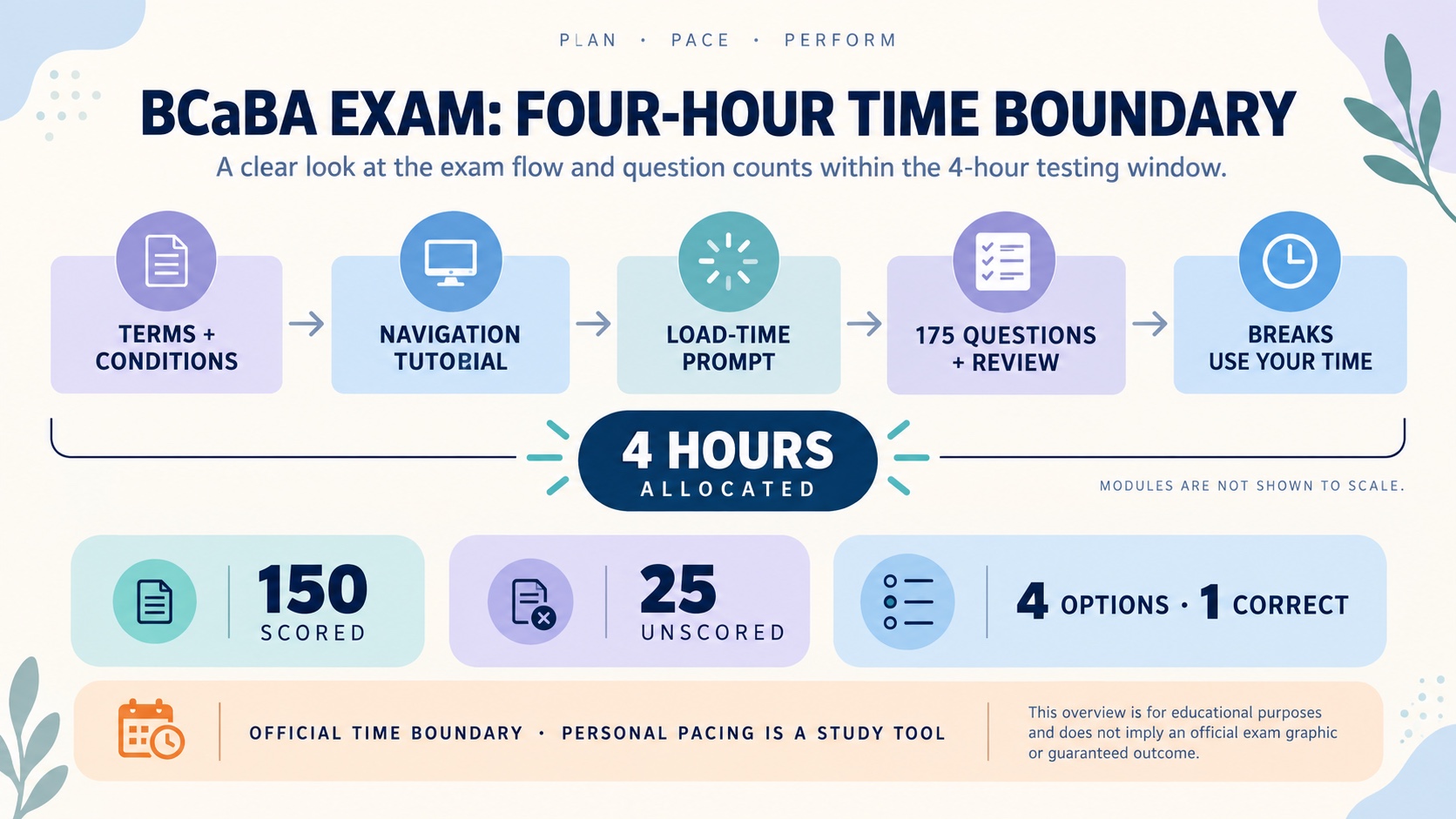
Short answer: the BCaBA examination is allocated four hours. The current exam has 175 multiple-choice questions: 150 scored questions and 25 unscored questions. That four-hour allocation is not simply 240 minutes of uninterrupted answering. The official handbook explains that it includes the Terms and Conditions, the exam-navigation tutorial, a load-time prompt, the examination itself, and any review time.
That distinction matters when you practice. A learner who treats every second of the four hours as question-answering time may plan too tightly. A learner who never rehearses a long sitting may discover a pacing or endurance problem only at the testing center. The goal is to understand the official boundary first, then build a personal practice routine around it.
Table of Contents
The direct answer: four hours
The current BCaBA exam is four hours long and contains 175 questions. Each question has four possible answers, with one correct answer. The examination is based on the current BCaBA Test Content Outline (6th ed.), which organizes the scored content across nine areas. Those content details tell you what to study; the handbook’s examination section tells you how to think about the time boundary.
The 175-question total includes 150 scored questions and 25 unscored questions. You cannot use the question count to identify which items are unscored, so treat every item as a real opportunity to apply your knowledge. The official result is based on overall examination performance rather than a separate pass/fail result for each content area.
Keep those figures separate from RBT and BCBA figures. A page that says “the ABA exam” without identifying the credential can easily combine different question counts or timing rules. For this query, the relevant track is BCaBA.
What the four-hour allocation includes
The four-hour allocation covers more than the moment when the first question appears. The current BCaBA Handbook says the time includes reviewing the Terms and Conditions, completing the exam-navigation tutorial, waiting through the load-time prompt, taking the examination, and reviewing answers. That means your practice plan should leave room for the real testing sequence rather than assuming a clean 240-minute question timer.
Breaks require special attention. The handbook explains that breaks are taken on your own time, and the clock does not stop when you leave the exam. Testing-center procedures and identification rules also matter, so read the current handbook before exam day instead of relying on an old study post or another candidate’s memory.
This is not a reason to panic about the administrative minutes. It is a reason to make your rehearsal honest. Practice sitting for a substantial period, practice returning to a flagged question, and decide in advance whether a short break is worth the time it uses for you.
What the question count means for pacing
A simple planning calculation is 240 minutes divided by 175 questions, which is about 1.37 minutes, or 82 seconds, per question. That is arithmetic, not an official BACB pacing rule. Because the four-hour allocation includes setup and review, your actual average answering time may be lower if you want to protect time for flagged questions.
Use the calculation as a diagnostic. If a 25-question set takes you 45 minutes, the issue may be content uncertainty, rereading, or over-investment in difficult items. If you finish quickly but cannot explain why the distractors are wrong, speed is not yet the skill you need. A good pacing target is one that lets you read the scenario carefully, choose the best-supported answer, mark uncertainty, and keep moving.
How to rehearse the time limit
Do not begin with a full-length timed test every day. That can turn a knowledge gap into fatigue without showing you what to fix. Build the skill in stages:
- Start with short, untimed sets. Read each scenario, choose an answer, and explain the evidence. This gives you a baseline for concepts before speed becomes the main variable.
- Add a gentle time boundary. Use 20–25 mixed questions and record both the finish time and the questions you marked. Review slow-but-correct answers as well as incorrect answers.
- Practice a longer mixed set. Increase the number of questions while keeping the same review method. Notice whether the second half shows rushed reading, loss of discrimination, or avoidable calculation errors.
- Rehearse a full-length sitting. Use a 175-question original practice form only when your content review is ready. Treat the result as diagnostic, not as an official score prediction.
After each rehearsal, sort errors into at least three buckets: content knowledge, question interpretation, and pacing or attention. That classification is more useful than moving every missed question into one large “study more” pile.
A practical pacing routine
On a timed practice form, use a first pass for questions you can answer from the evidence in front of you. If a question requires a long calculation, a careful distinction, or a reread, mark it and move on after a reasonable attempt. Do not turn one uncertain item into a five-minute detour.
At planned checkpoints, ask three questions: Am I moving at a sustainable pace? Am I reading the entire scenario? How many items have I marked for review? The checkpoint is not a demand to guess. It is a prompt to notice whether your process is working while there is still time to adjust.
Reserve a review window when you practice. Revisit marked questions, but do not change an answer simply because it feels uncomfortable. Change it when the scenario, a rule, or a clearer comparison between options gives you a reason. Record that reason in your error log so the review becomes a learning activity rather than a second round of guessing.
What to track after timed practice
A single percentage cannot tell you whether your timing is improving. After each timed set, record four simple numbers: total questions, minutes used, questions marked, and questions changed during review. Then add one sentence about what slowed you down. “I did not know the concept” calls for content review. “I reread every option twice” calls for a reading routine. “I spent too long on one calculation” calls for a skip-and-return rule.
Also compare the first half and second half of the set. If accuracy falls late, endurance or attention may be part of the problem. If accuracy stays stable but the set takes too long, practice recognizing the task before analyzing every possible answer. If accuracy is low from the beginning, more timed work alone will not solve the issue; return to the relevant BCaBA content area, study the distinction, and then try a new set.
This record gives you a better next action than simply taking another full mock exam. The aim is not to make every session feel rushed. It is to make careful answering repeatable inside the official time boundary.
Common timing questions
Is the BCaBA exam exactly four hours of answering questions?
No. The current handbook describes the allocated time as including the Terms and Conditions, navigation tutorial, load-time prompt, examination, and review.
Can I take a break?
Breaks are taken on your own time, and the examination clock does not stop. Check the current handbook and testing-center instructions for the complete procedure.
Should I spend exactly 82 seconds on every question?
No. Eighty-two seconds is an even-distribution calculation across 240 minutes. It is a useful starting point for practice, not an official per-question limit. Some items will be quicker and some will need more careful reading.
Do the 25 unscored questions make the exam shorter?
No. They are included in the 175-question examination, and you cannot identify them during the test. Plan to engage with every question.
Official sources and next study paths
Use the current BCaBA Handbook for examination-day rules, the BCaBA Test Content Outline (6th ed.) for content boundaries, and the BACB’s examination information page for the current high-level exam comparison. For a clean next step inside ABA Study Online, open the BCaBA Theory path, try the free BCaBA questions, or use the ABA Definition Search when one term is slowing you down.
The four-hour answer is simple. Preparing to use that time well is a separate skill: know the official boundary, practice under gradually longer conditions, review the reason behind each error, and keep your timing strategy flexible enough to support careful decisions.