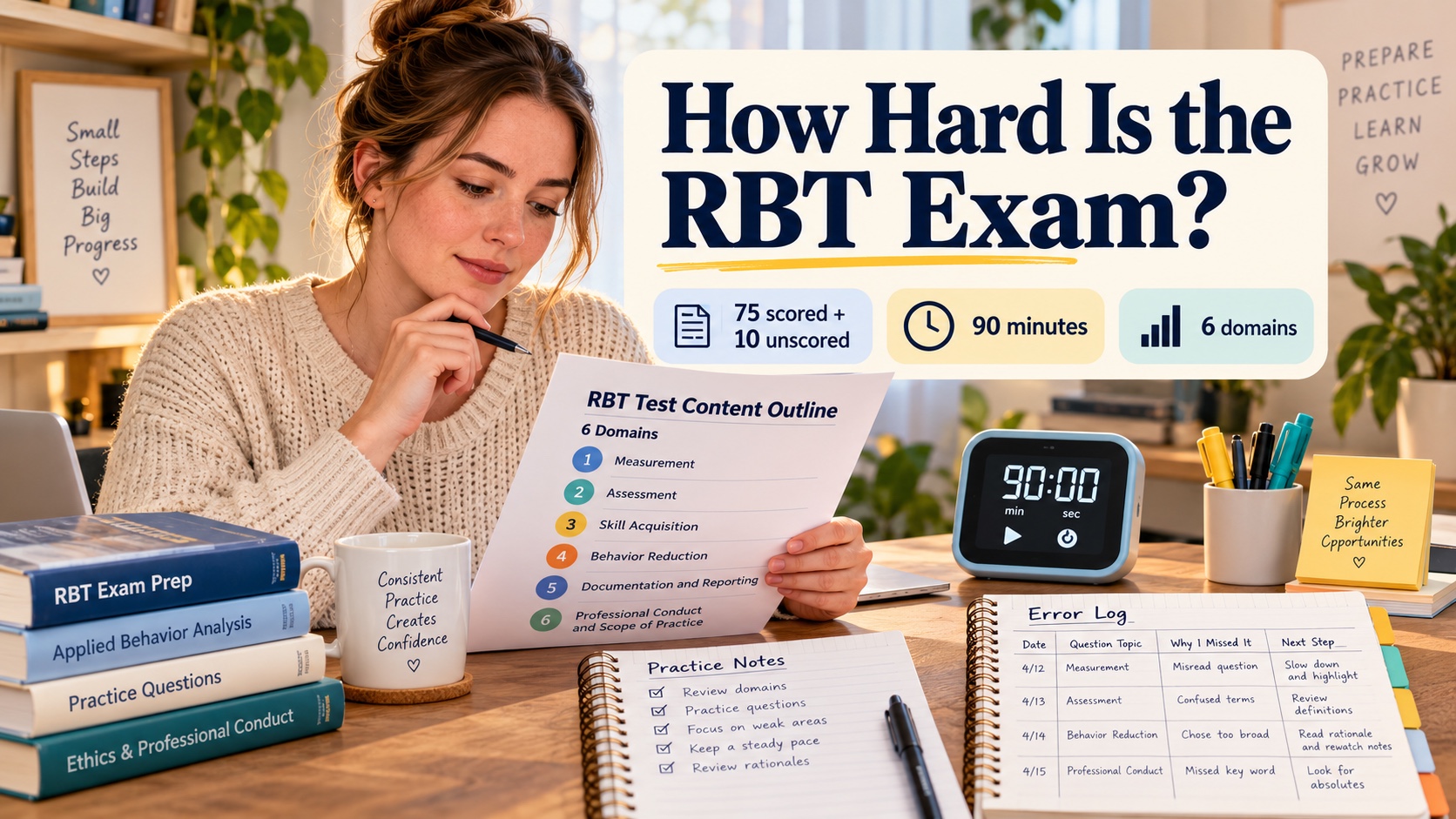
How Hard Is the RBT Exam?
People asking how hard is the RBT exam are usually asking two questions at once: Is the content manageable for an entry-level behavior technician, and will the test feel stressful under time pressure? There is no single difficulty score that answers both. Your experience depends on your preparation, familiarity with ABA language, ability to apply a procedure to a scenario, and comfort making decisions without rushing.
The current RBT examination is based on the RBT Test Content Outline (3rd ed.), which began governing examination content in 2026. It includes 75 scored questions and 10 unscored pilot questions, six content domains, and 90 minutes. That makes the test focused but fast: you need broad coverage and efficient reasoning rather than memorization of one large topic.
The short answer
The RBT exam is not best described as “easy” or “impossible.” It is an entry-level certification examination, but entry-level does not mean that every question is a simple definition. The current outline includes tasks about measurement, assessment, skill acquisition, behavior reduction, documentation, reporting, and ethics. Many questions can require you to identify the relevant fact in a short scenario and choose the response that fits the RBT role.
| Exam element | Current detail |
|---|---|
| Content basis | RBT Test Content Outline, 3rd ed., beginning in 2026 |
| Questions | 75 scored plus 10 unscored pilot questions |
| Time | 90 minutes |
| Question format | Multiple choice; four possible answers and one correct answer |
| Delivery | Computer-based testing through authorized Pearson VUE sites |
The 10 unscored questions are mixed into the examination experience, and candidates are not told which questions they are. Treat every item as important. A practice session should therefore include both content review and pacing, not an attempt to guess which questions do or do not count.
What makes the exam challenging
1. You need coverage across six domains
The largest domain is Behavior Acquisition, but the exam also expects measurement, assessment, behavior reduction, documentation and reporting, and ethics. A learner who studies only prompting and reinforcement may feel prepared until a question asks about a data measure, objective session note, confidentiality boundary, or appropriate supervision response.
2. Similar terms can lead to different decisions
Words such as frequency, duration, rate, prompting, fading, generalization, maintenance, reinforcement, and punishment are not interchangeable. A question may give you a familiar term inside an unfamiliar situation. The challenge is to inspect what changed, what behavior changed, what procedure is authorized, and what the RBT is responsible for doing.
3. The role boundary matters
The BACB describes RBTs as paraprofessionals who assist with behavior-analytic services under the direction and close supervision of an RBT Supervisor and/or RBT Requirements Coordinator. When an answer choice asks the RBT to independently diagnose, rewrite a program, or make a major clinical decision without the appropriate supervision path, the role boundary is part of the reasoning.
4. Ninety minutes rewards steady pacing
You have 90 minutes for 85 questions in the current format, including the unscored pilot items. That is an average of a little over a minute per item, but the best pace is not identical for every question. Read carefully, choose the best-supported answer, mark a genuinely uncertain item if the testing interface permits, and keep moving. Spending several minutes trying to rescue one confusing question can make the final review harder.
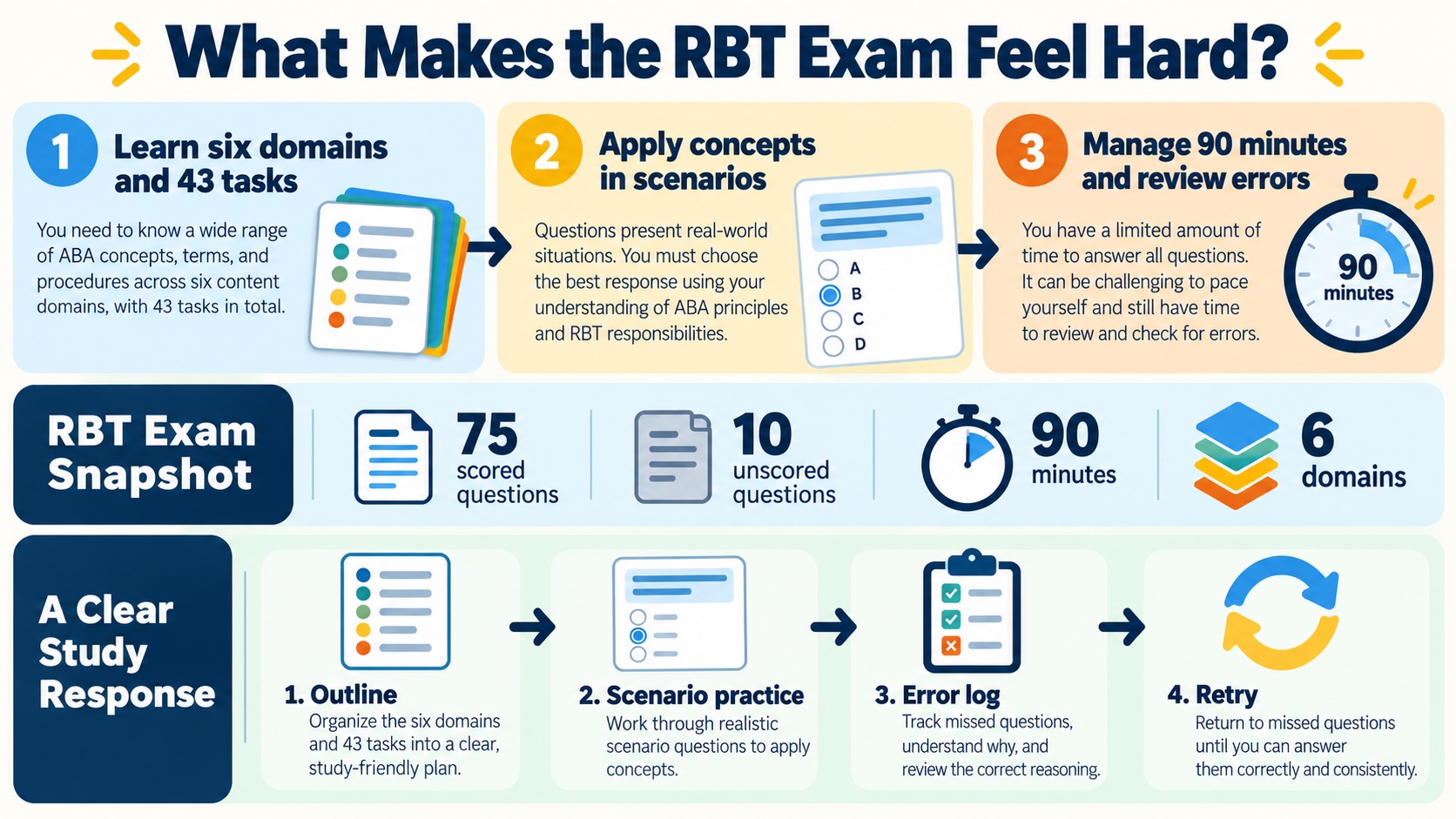
The six domains
The current TCO organizes 75 scored questions across six domains:
- Data Collection and Graphing — 13 questions: selecting and using measures, recording behavior, and representing data.
- Behavior Assessment — 8 questions: participating in assessment activities within the RBT role.
- Behavior Acquisition — 19 questions: implementing teaching, prompting, reinforcement, chaining, shaping, and generalization procedures.
- Behavior Reduction — 14 questions: following approved plans and responding to behavior safely and accurately.
- Documentation and Reporting — 10 questions: objective notes, communication, confidentiality, and reporting concerns.
- Ethics — 11 questions: competence, supervision, boundaries, professional conduct, and protection of confidential information.
The counts should guide study time, not eliminate the smaller domains. You can make a weekly plan that pairs a high-weight topic with a shorter domain: for example, practice acquisition procedures, then finish by writing an objective note or identifying an ethics concern. This helps you switch from one kind of decision to another.
How to read pass-rate context
Pass-rate data can provide context, but it cannot tell you exactly how hard your form will feel. The BACB’s Examination Information page reports historical RBT results, including a 2025 first-time pass percentage of 75% and a retake percentage of 38% for the data shown there. The page also explains that examination forms are statistically equated and that the raw number of correct answers required can vary with form difficulty.
Use that information carefully. A pass rate is a group-level description, not a prediction for one candidate. It should not become a target such as “I only need to know 75%.” Your goal is to understand all six domains well enough to apply the material, recognize the role boundary, and recover from a difficult question without losing your pace.
A practical study plan
- Start with the current TCO. Write the six domains and their tasks. Keep the RBT 3rd edition separate from older task-list materials.
- Make a confidence map. Mark each task as explain, recognize, apply, or review. “I have seen the word” is not the same as “I can use the concept in a scenario.”
- Practice one decision at a time. Ask what happened before the behavior, what consequence followed, which measure fits, or which response stays within the written plan and supervision structure.
- Keep an error log. Tag misses as definition, measurement, procedure, reading, ethics, or role-boundary errors. Write why the best answer fits and why the closest distractor does not.
- Add timed sets later. First build accurate reasoning, then use short timed sets, and finally complete a longer rehearsal with the current format.
- Retry after a delay. Return to missed concepts later rather than immediately memorizing the answer letter.
The ABA Study Online RBT learning route can support concept review alongside the current BACB TCO and handbook. The RBT question library is independent practice, not official BACB content, so use explanations and error tags to strengthen your reasoning instead of chasing a reassuring score.
Pacing and test-day habits
Before the appointment, use the current BACB and Pearson VUE instructions for identification, scheduling, accommodations, and test-center rules. During practice, learn what a steady pace feels like. Read the entire stem, identify the requested decision, eliminate answers that change the facts or exceed the role, and move on when you have made the best supported choice.
Difficulty often feels worse when every question is treated as an emergency. A short reset—slow exhale, reread the final sentence, and identify the task being tested—can be more useful than rereading the entire item repeatedly. Your practice plan should rehearse that reset as well as the content.
FAQ
Is the RBT exam hard for beginners?
It can feel challenging if ABA terminology, scenario reasoning, or timed testing is new. The exam is designed for entry-level RBT knowledge and skills, but you still need coverage across six domains and accurate application.
What is the hardest part of the RBT exam?
That varies. Many learners struggle with applying similar concepts to new scenarios, switching between domains, staying within the RBT role, or pacing 85 questions in 90 minutes. Use an error log to identify your actual pattern instead of assuming one topic is hard for everyone.
Does the 2026 RBT exam use a new outline?
Yes. The BACB says the RBT Test Content Outline (3rd ed.) governs examination content beginning in 2026. Check the official TCO and current RBT Handbook for the version that applies to you.
Can a practice score tell me whether I will pass?
No. A practice score is one study signal. Review the missed tasks, explanations, and delayed retries, and keep preparing across the full outline.