How Hard Is the BCBA Exam? A Practical Difficulty Breakdown
If you are asking how hard the BCBA exam is, the honest answer is that it is a demanding professional certification examination, but “hard” is not one single variable. The exam is four hours and 185 multiple-choice questions, and current BACB data show a 51% first-time pass rate for 2025 and a 23% pass rate for retakes. Those numbers show that preparation matters, but they do not tell you whether you personally are ready.
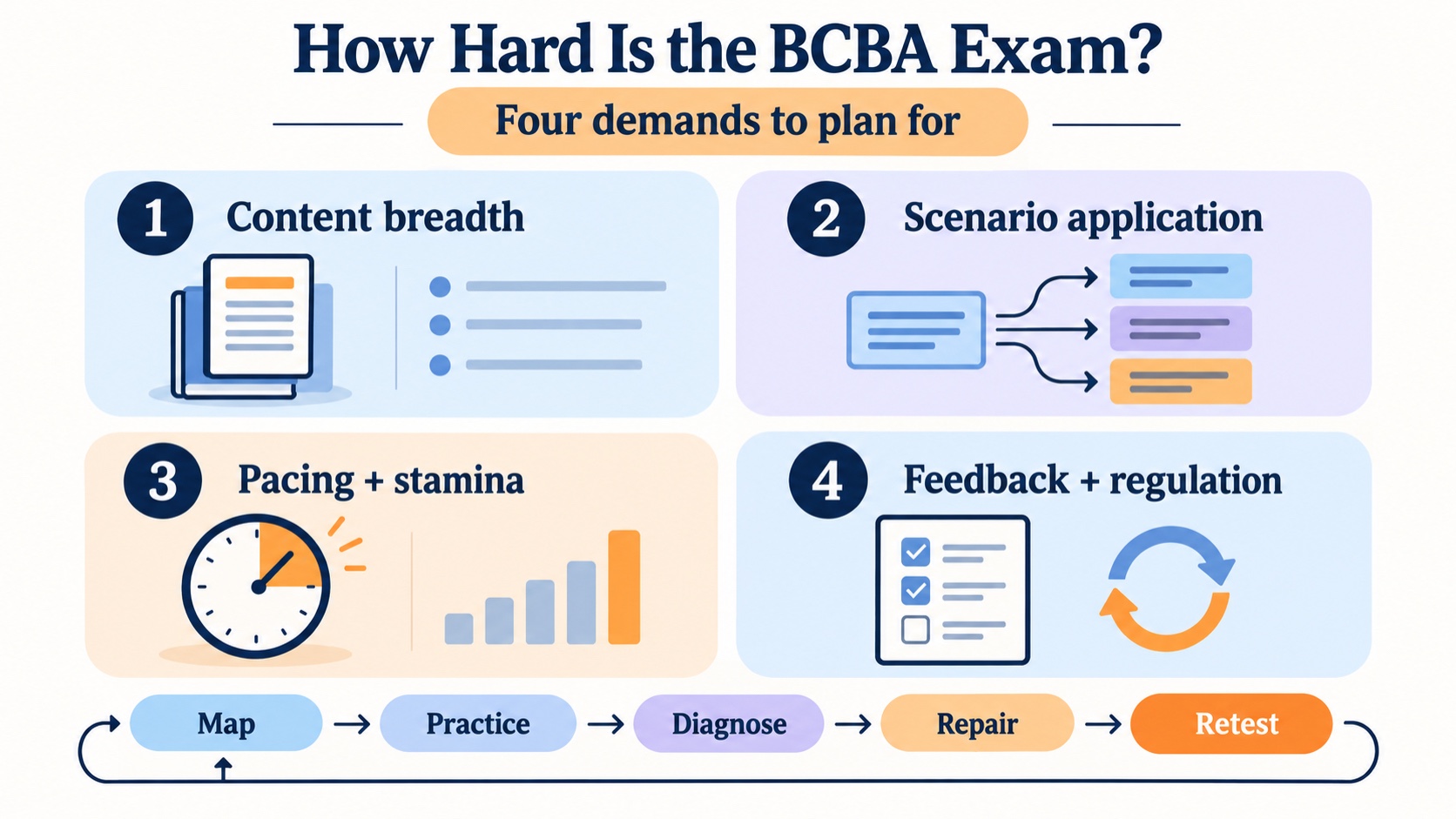
A better way to judge difficulty is to separate the exam into four demands: knowing a broad content map, applying concepts to scenarios, sustaining accuracy under time pressure, and using feedback without turning a practice score into a prediction. This page uses the current BACB examination information and handbook as the source boundary. It is a planning guide, not a pass guarantee.
Table of Contents
Short answer: why the exam feels hard
The BCBA examination is difficult because it asks you to move between vocabulary, measurement, assessment, intervention, ethics, supervision, and research logic without losing the details of the scenario. A person can recognize a definition and still miss a question because the answer depends on the measurement dimension, the function of a behavior, the order of assessment steps, or the ethical boundary around a decision.
The exam also rewards discrimination rather than familiarity. Two answers may both sound behavior analytic, but only one may fit the stated assessment evidence, client context, or question stem. That is why rereading notes can feel productive while leaving a gap in scenario application.
What the official format tells you
The BACB’s current examination information lists the BCBA exam as four hours and 185 questions. The current BCBA Handbook explains that 175 questions are scored and 10 are unscored. Questions are multiple choice, delivered in person through authorized Pearson VUE testing sites, and the examination is only offered in English.
Those facts create practical constraints. Four hours sounds long until you divide attention across 185 questions, reading, reviewing, breaks, navigation, and the need to recover from a difficult item. The goal is not to rush every question. The goal is to build a pace that leaves enough time to read the stem carefully and make a reasoned decision.
The exam uses multiple forms. The BACB explains that forms are equated psychometrically and that the passing standard is criterion referenced. You should therefore avoid claims such as “this form is always harder” or “I need exactly X correct answers.” The raw number needed can vary by form, and the official passing standard is not a simple public percentage target.
The four demands behind difficulty
- Content breadth: You need a current map of the examination content outline, not a memory of one course or one textbook. Track which domains are stable and which concepts still require source review.
- Application: You must identify what the scenario actually gives you, what it does not establish, and which behavior-analytic decision follows. Practice should include examples, non-examples, and contrast questions.
- Pacing and stamina: A correct answer found slowly may still become a problem if the same pace cannot be maintained. Timed sets should train reading, marking, moving on, and returning—not only speed.
- Feedback and regulation: The exam is high stakes, so anxiety and overthinking can affect decisions. A useful review system separates a content gap from a reading error, calculation error, fatigue effect, or answer-changing habit.
How to read pass-rate data
The BACB’s examination-information page reports that 2025 BCBA first-time candidates had a 51% pass rate, while retakes had a 23% pass rate. The table is useful context, not a personal probability. It describes groups of candidates who differ in education, preparation, timing, previous attempts, and other factors that are not captured by one percentage.
Use pass rates for two decisions. First, take the exam seriously enough to build a deliberate preparation system. Second, do not use the rate to conclude that you will fail or pass. A practice test written by an independent provider is also not an official score predictor. Its value is in exposing reasoning patterns, weak domains, and pacing problems.
Be especially careful with program-level pass-rate comparisons. Small candidate counts can make percentages unstable, and a program’s reported outcomes do not automatically describe your preparation or guarantee a result. Read the methodology and source date before turning any ranking into a school or study decision.
A readiness check that is more useful than confidence
Build a readiness record with four columns: content domain, application accuracy, timed performance, and error type. For each practice set, record the question source and current outline reference, whether the answer was correct, how long the decision took, and why an error happened. If you guessed correctly, mark it as uncertain rather than treating it as mastered.
Look for repeated patterns across several sets. A single low score may reflect fatigue or an unfamiliar format. A recurring error in measurement, assessment, ethics, or intervention selection deserves a targeted repair cycle. A good readiness decision is based on repeated evidence from current, track-appropriate practice—not on one good day or a feeling that the notes look familiar.
A practical preparation plan
- Map the current source: start with the current BCBA Test Content Outline and keep 2027 eligibility changes in a separate requirements note.
- Build concept contrasts: for each difficult topic, write a definition, a non-example, the closest competing answer, and the feature that decides between them.
- Practice in layers: begin with untimed explanation, move to short timed sets, then complete longer mixed sets that require switching domains.
- Review every miss: label the error as content, application, measurement, reading, pacing, or regulation. Choose a repair action that matches the label.
- Rehearse the day: use the official examination information for scheduling, identification, site, cancellation, and testing rules. A study plan should include rest and a final source check, not only more questions.
Common mistakes
- Studying only definitions: recognition is not the same as choosing the best answer in a new scenario.
- Chasing a magic pass percentage: official scoring uses equating and a criterion-referenced standard; do not treat a raw percentage as a guarantee.
- Taking only full mocks: long tests reveal stamina, but short targeted sets are often better for repairing one domain.
- Ignoring guessed answers: a correct guess can hide a knowledge or discrimination gap.
- Mixing requirements with exam content: the 2027 eligibility transition is not automatically a new exam edition.
How hard is the BCBA exam FAQ
Is the BCBA exam harder than the RBT exam?
They are different exams for different certification levels, so a simple difficulty ranking is not very useful. The BCBA exam has a longer format and broader professional decision demands; compare each exam with its current official outline and handbook.
What is the BCBA exam pass rate?
The BACB’s examination-information page reports a 51% first-time pass rate and a 23% retake pass rate for 2025 BCBA candidates. Check the official page for later updates and methodology.
How many questions are on the BCBA exam?
The current format lists 185 multiple-choice questions in four hours, with 175 scored and 10 unscored according to the current BCBA Handbook.
Can practice scores tell me whether I will pass?
No. Practice results can show patterns in content, application, pacing, and review, but an independent practice score is not an official prediction or guarantee.