Free RBT Study Guide PDF: How to Check It Before You Study
A free RBT study guide PDF can be convenient: you can print it, mark it during a training session, or keep a short review sheet beside your practice questions. But a PDF is a format, not a quality guarantee. Before you spend hours highlighting pages, check the edition, domain coverage, source boundary, and whether the guide helps you retrieve and apply ideas.
The current RBT examination is based on the RBT Test Content Outline (3rd ed.), which describes examination content beginning in 2026. This guide explains how to audit a free PDF against that outline and turn static notes into a repeatable study loop. It is independent educational guidance, not BACB-endorsed material, official exam content, or a pass guarantee.
Quick answer: check that the guide identifies the RBT TCO (3rd ed.), covers the six current domains, separates official source facts from original teaching notes, and includes questions or prompts that make you retrieve and apply a concept. Then use the PDF as a map, not as your entire study system.
A good first question is “What will I do after I finish this page?” If the answer is only “read the next page,” the guide may be supporting recognition rather than recall. Add a short prompt, an applied example, a confidence mark, or a practice question so the document leads somewhere useful.
The current RBT examination boundary
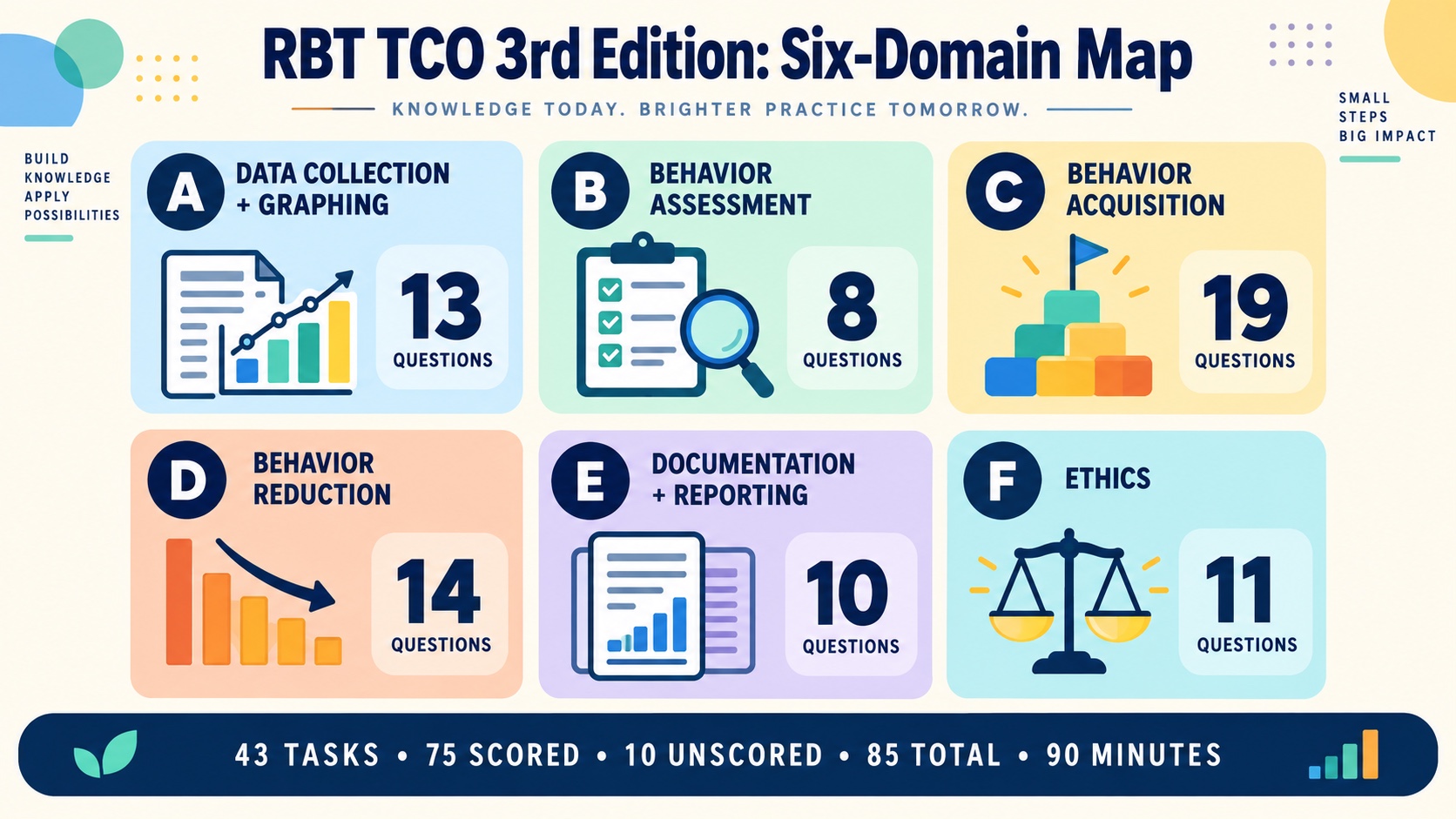
The RBT TCO (3rd ed.) organizes the current examination content into 43 tasks across six domains:
- A. Data Collection and Graphing: 13 questions, rounded to 17%.
- B. Behavior Assessment: 8 questions, rounded to 11%.
- C. Behavior Acquisition: 19 questions, rounded to 25%.
- D. Behavior Reduction: 14 questions, rounded to 19%.
- E. Documentation and Reporting: 10 questions, rounded to 13%.
- F. Ethics: 11 questions, rounded to 15%.
The examination includes 75 scored questions and 10 unscored pilot questions, or 85 total. Candidates have 90 minutes, each question has four answer choices with one correct answer, and the result is based on overall performance rather than a separate pass threshold for every domain. A PDF may use the domain percentages for planning, but it should not turn those percentages into an official score prediction.
A free PDF quality checklist
Use these checks before you print or download a long document:
- Edition: Does the guide name the RBT TCO (3rd ed.) and the relevant examination period?
- Coverage: Can you find all six domains and a sensible route through their tasks?
- Source clarity: Does the guide link to current BACB sources and label original explanations as independent material?
- Application: Does it include observable examples, data decisions, skill-acquisition steps, behavior-reduction boundaries, documentation, and ethics?
- Review: Can you mark uncertainty, record a mistake, and return to the idea after a delay?
- Access: Is the type readable, the contrast usable, and the file easy to navigate or print?
Be wary of a guide that uses an old task list without saying so, mixes certification requirements with examination content, or calls itself “official” without a BACB source. Also be cautious with a guide that promises a pass result. The BACB says it cannot endorse specific study guides, and buying study materials does not guarantee passing.
How to study from a PDF
Use a PDF in three passes:
- Map: skim the headings and write down the six domains. Mark the two areas that feel unfamiliar.
- Retrieve: close the document and explain one concept in observable, practical language. If you cannot, reopen only the section you need.
- Apply: answer a short scenario, calculate or interpret a small data example, or choose the next ethical/documentation step. Record why the answer fits.
Highlighting can help you locate a passage later, but it does not replace retrieval. Write a question in the margin: “What would I record?” “What changes if the setting changes?” “What is the observable definition?” “What would I report to the supervisor?” These prompts make the PDF part of a learning loop rather than a passive packet.
The six current RBT domains
Let the domain map shape your time, not dictate a separate pass score. Behavior Acquisition carries the largest rounded share in the current outline, but the smaller domains still matter because entry-level practice requires accurate data, assessment participation, documentation, and ethical boundaries. A good PDF gives each domain a clear job.
For Data Collection and Graphing, look for measurement examples and graph-reading prompts. For Behavior Assessment, look for the technician’s participation boundary rather than independent interpretation. For Behavior Acquisition and Behavior Reduction, look for implementation decisions, prompting, reinforcement, generalization, and procedural fidelity. For Documentation and Reporting, look for objective language and timely communication. For Ethics, look for scope, confidentiality, supervision, and professional conduct.
Let your own error pattern adjust the order. If you can define reinforcement but cannot choose a measurement procedure from a session description, spend less time copying another definition and more time practicing the measurement decision. If you answer a skill-acquisition question correctly but cannot explain the prompting or fading step, mark it as uncertain rather than mastered. The outline tells you what to cover; your practice record tells you what to revisit.
Keep the scope accurate while you study. An RBT implements procedures within the assigned plan and supervision structure; the study guide should not quietly turn an entry-level task into independent assessment, diagnosis, or treatment-plan design. Clear role boundaries are part of useful preparation, not a side note. They protect both learning accuracy and professional practice for the candidate and the learner.
Common PDF-study mistakes
- Printing first and checking later: verify the 3rd-edition boundary before building a binder.
- Studying only definitions: practice deciding what to do in an observable situation.
- Ignoring the source list: independent notes should not be mistaken for BACB instructions.
- Using domain percentages as cut scores: they help plan review; they do not create official domain pass thresholds.
- Rereading the same pages: close the PDF, retrieve the idea, and apply it to a new example.
- Letting a PDF replace supervision: study material cannot replace required training, competency assessment, supervision, or current official requirements.
A PDF-to-practice study loop
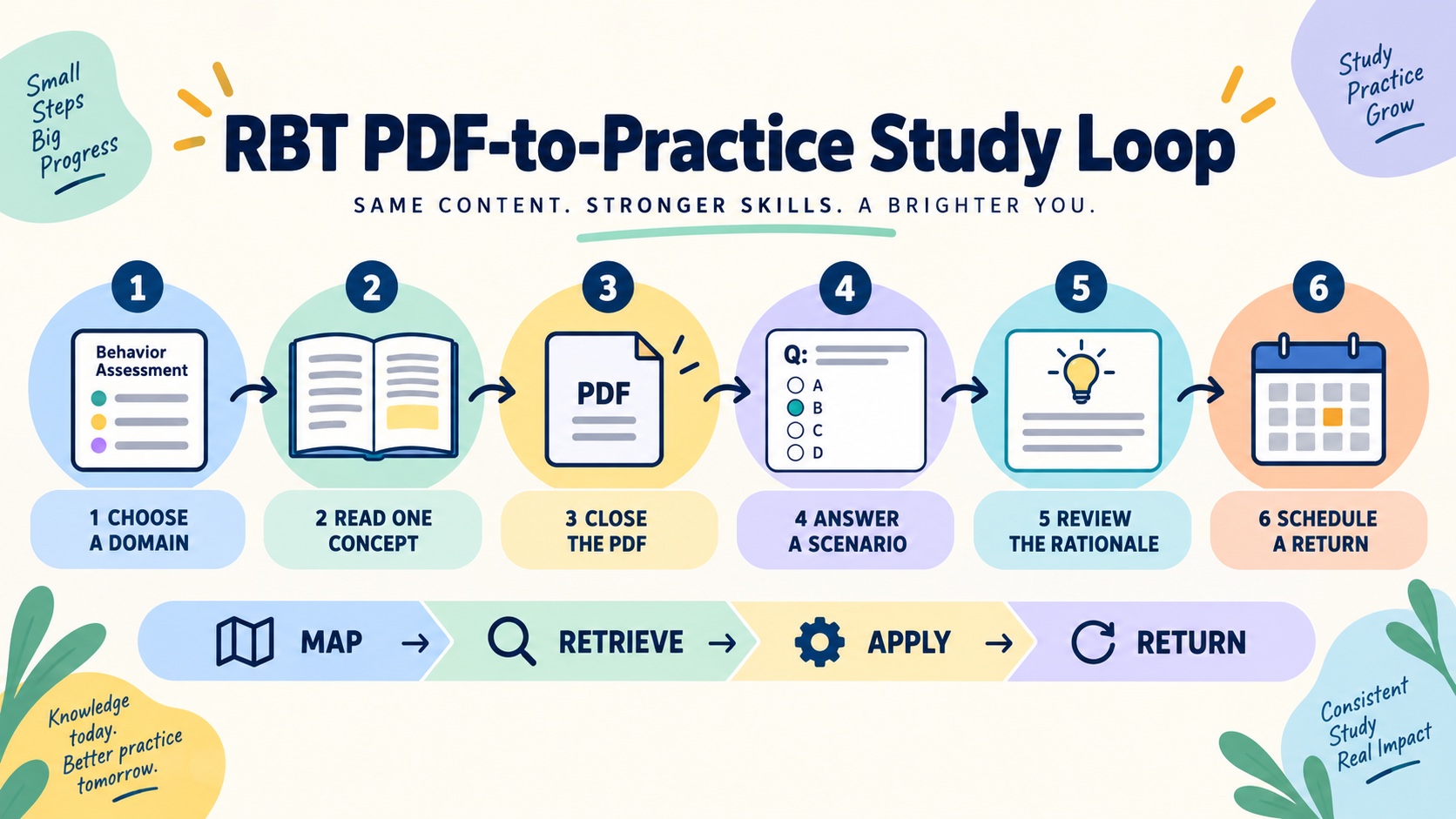
Try this short routine for one session:
- Choose one domain and one narrow task.
- Read the relevant PDF section for five to eight minutes.
- Close the PDF and write the concept from memory.
- Answer three to five original practice questions.
- Review the rationale and label the mistake: concept, wording, data, or process.
- Save the item and schedule a later retrieval session.
This routine keeps a free guide useful even when it is short. You do not need to finish the entire file before you begin practicing. Small, repeated sessions can show you which page or domain deserves the next pass.
Free RBT study guide PDF FAQ
Is a free RBT study guide PDF enough to pass?
No. A PDF is one study aid, not a guarantee. Use the current official outline, required training and competency materials, supervised guidance, practice, and review. No study material guarantees a result.
What edition should an RBT PDF use?
For current examination content beginning in 2026, check that it maps to the RBT TCO (3rd ed.). Verify the edition on the BACB site before relying on a file.
How many RBT exam questions are scored?
The current examination includes 75 scored questions and 10 unscored pilot questions, 85 total, with 90 minutes. Check the current RBT Handbook and examination information for the complete boundary.
Can I study on a phone instead of printing?
Yes, if the format remains readable and you can retrieve, practice, review, and return to mistakes. A phone, printed page, and app each work best when they support the same deliberate loop.
Continue the review in the app
After a PDF session, the RBT study path can provide a domain-level route, the RBT practice questions can give you an applied decision, and the ABA Definition Search can clarify a term. Use the app when you want a repeatable layer for flashcards, section practice, audio review, progress, and tools.