Free RBT Mock Exam: Practice Smarter with the 2026 Outline
A free RBT mock exam can help you rehearse the question format, notice weak areas, and practice choosing an answer under time pressure. It should not be treated as a copy of the BACB examination, an official BACB product, or a guarantee that you will pass. The best way to use a free practice set is to connect every question to the current RBT Test Content Outline, explain your answer, and repair the exact skill that caused the mistake.
That source check matters in 2026. The BACB states that the RBT examination is based on the RBT Test Content Outline (3rd ed.) beginning January 1, 2026. The current outline organizes 75 scored questions across six domains, with 10 additional unscored pilot questions. A practice set that still organizes everything around an older task list may be useful for general review, but it should not be your only map.
The quick answer
Choose a free RBT mock exam that names its source or outline, gives you explanations, and lets you review missed questions. Then use it diagnostically. A high score on one short set may mean that the questions matched material you already know; a low score may reflect unfamiliar wording, a weak domain, or a timing problem. Neither score is an official BACB result.
Before you begin, write down three things: the date, the practice set’s stated outline or version, and your purpose. Are you checking basic recall, practicing application, or rehearsing a timed session? If you do not define the purpose, it is easy to treat a quick quiz as a readiness verdict.
What the 2026 RBT outline covers
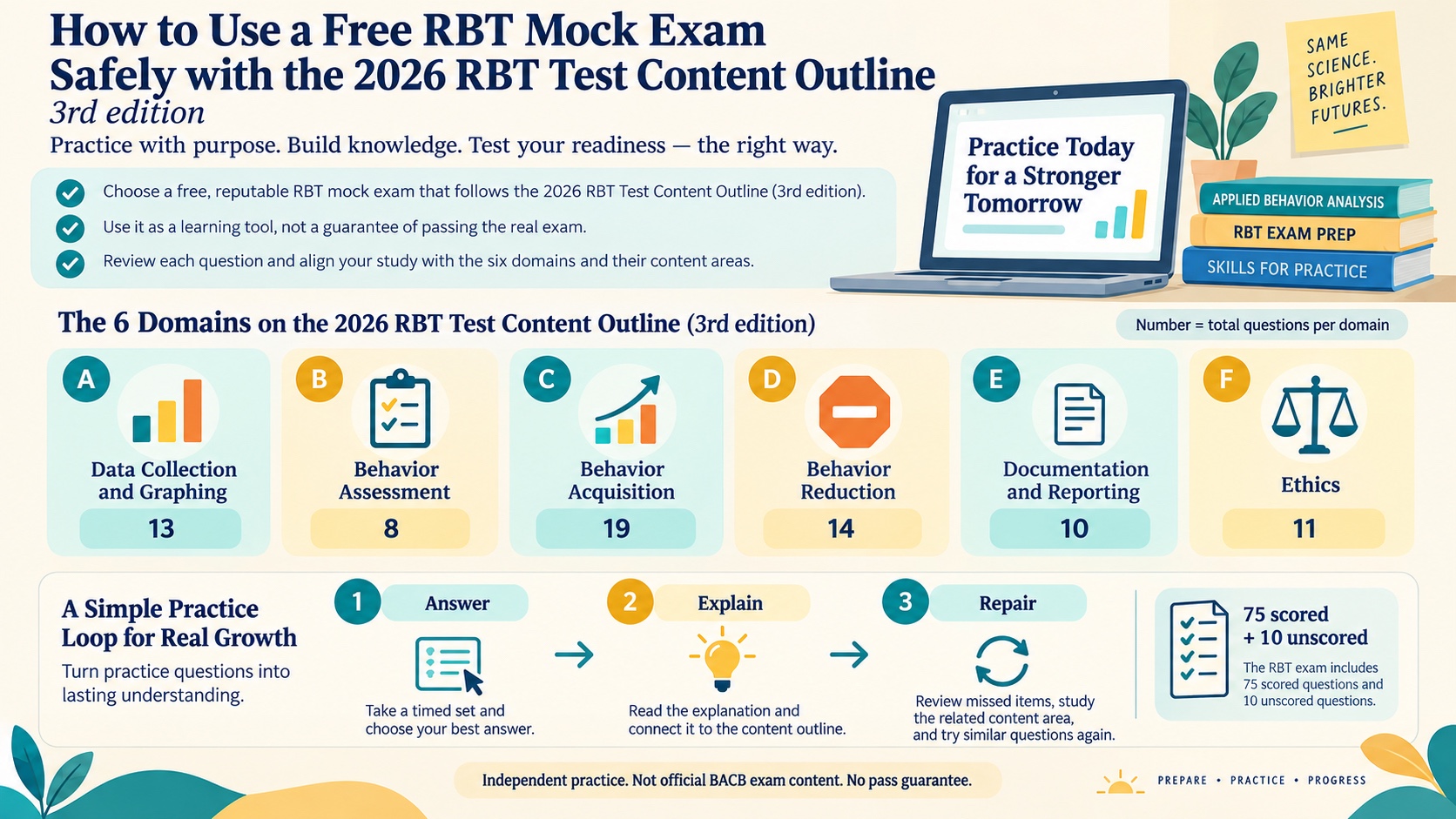
The current RBT Test Content Outline (3rd ed.) lists six domains and 43 tasks. The domain question counts shown by BACB are:
| Domain | Questions | What to practice |
|---|---|---|
| A. Data Collection and Graphing | 13 | Collect, display, and describe data accurately |
| B. Behavior Assessment | 8 | Follow assessment-related procedures within the RBT role |
| C. Behavior Acquisition | 19 | Implement teaching and skill-building procedures |
| D. Behavior Reduction | 14 | Implement reduction procedures safely and as written |
| E. Documentation and Reporting | 10 | Record and communicate information responsibly |
| F. Ethics | 11 | Recognize professional conduct and scope boundaries |
The counts can help you distribute practice, but they do not tell you which individual questions will appear. Treat them as a study-allocation signal. Behavior acquisition has the largest listed count, yet a candidate can still need targeted work in data collection, assessment, documentation, or ethics. A balanced practice routine should expose weaknesses instead of only repeating the most comfortable domain.
How to choose a free mock exam
Start with transparency. A useful practice page should tell you what it is measuring, show the number of questions, explain whether the set is timed, and identify the current content boundary. Look for answer explanations that teach the decision rule rather than only revealing a letter. You should also be able to see what you missed after submitting the set.
Be cautious with pages that use “official,” “guaranteed,” or “real BACB questions” without evidence. The BACB says it does not endorse specific study guides or preparation materials. Independent practice can be valuable, but the distinction should be visible before you begin. Do not copy, request, or share protected examination content. Practice with original questions and clearly labeled explanations.
Check whether the practice set separates the RBT track from BCBA or BCaBA content. A general ABA question may be educational, but it is not automatically an RBT exam question. If the set mixes tracks, use the current RBT outline to label what belongs in your plan and what should be moved to a later, broader study list.
How to use the practice set
On the first pass, answer without opening a textbook for every question. Mark your confidence: certain, unsure, or guessed. Then submit the set and keep the questions you missed, guessed, or answered for the wrong reason. Your goal is not merely to count correct answers; it is to find where your decision process breaks.
For each item, write a short explanation in your own words. Name the relevant domain, identify the cue in the scenario, explain why the best answer fits, and state why the closest alternative does not. If the question depends on a current requirement or scope rule, verify it in the RBT Handbook, Ethics Code, or current BACB resource instead of trusting a practice explanation automatically.
After review, wait before retaking the identical set. Repeating the same questions immediately can measure memory of the answer rather than understanding. Study the related concept, create or find a new example, and then complete a different set that tests the same domain with different wording.
How to review every answer
Sort an error into one of four categories: you did not know the concept; you confused two procedures; you missed a critical detail in the scenario; or you changed an answer without evidence. Each category needs a different repair:
- Did not know: return to the relevant outline task and training material, then explain the concept without notes.
- Confused procedures: build a two-column contrast that names the purpose, steps, cue, and expected outcome of each procedure.
- Missed the scenario cue: underline the detail that changes the answer and practice finding that cue in a new item.
- Changed without evidence: slow down, reread the question, and choose the answer supported by the source and scenario—not by anxiety.
This review is especially important for application questions. RBT preparation should connect terms to implementation: what you do, when you do it, what you record, and when you ask for direction. Stay within the RBT role and follow the plan and supervision structure that applies to your setting. A mock exam cannot authorize a procedure that your training or supervisor has not authorized.
Use timing without turning it into panic
The current BACB examination-information page lists the RBT examination as 90 minutes with 85 total questions, including 10 unscored pilot questions. A timed mock can help you practice steady pacing, but start with accuracy. If you rush before you understand the content, the timer hides whether the problem is knowledge, reading, or decision-making.
Try three stages. First, complete untimed sets and review them deeply. Second, use short timed blocks and note where your pace changes. Third, complete a longer mixed set under realistic conditions, then spend more time reviewing than celebrating the score. If timing remains difficult, practice reading the question stem first, identifying the task, and eliminating answers that exceed the scenario or the RBT scope.
Start a free practice set
When you are ready, start with ABA Study Online’s free RBT practice questions. Use the set as independent study support: answer, explain, repair, and return to a new question set later. If you want to keep the same review loop on the go, continue your RBT practice in the ABA Study Online app. These resources are not official BACB exam content and do not guarantee certification.
FAQ
Is a free RBT mock exam official?
Not automatically. Unless BACB itself identifies a resource as official, treat it as independent practice. A trustworthy page should make that boundary clear and should not claim to provide real or leaked BACB questions.
Which RBT exam outline should I use in 2026?
The BACB says the RBT examination uses the RBT Test Content Outline (3rd ed.) beginning January 1, 2026. Check the current RBT pages and handbook before relying on an older task-list summary.
Does a high mock-exam score mean I am ready?
It is encouraging, but it is not a guarantee. Compare several sets, review guessed answers, and check whether you can explain and apply the relevant tasks without relying on memorized wording.
Should I retake the same free mock exam?
Yes, but not immediately as your only check. First review the missed concepts and practice them in new examples. Then revisit the original set to see whether the underlying reasoning improved, not just whether you remembered the answer.