Free RBT Flashcards: A Current 3rd Edition Study Method
Free RBT flashcards can make a long study session feel manageable: one term, one distinction, one quick retrieval. But a card deck is only as useful as the outline behind it and the practice that follows it. A current deck should reflect the RBT Test Content Outline (3rd ed.), help you notice your personal confusion pairs, and send you back to a scenario when recognition is not enough.
This page explains how to use flashcards with the current RBT examination content beginning in 2026. It is independent educational material, not official BACB examination content, a replacement for training or the Competency Assessment, a supervision guide, or a pass guarantee.
Quick answer: Yes, free RBT flashcards can be useful for active recall, vocabulary review, and short study sessions. Use them as one layer: read the current outline, retrieve a concept, apply it to a short situation, check the rationale, and schedule a later review. Do not treat a large card count as proof that a deck is current or complete.
Keep the current exam boundary visible: the current structure includes 75 scored questions plus 10 unscored pilot questions, or 85 questions total. The exam has four answer choices with one correct answer and 90 minutes of testing time. Those facts describe the exam format; they do not turn flashcards into official BACB materials.
What good free RBT flashcards should cover
A useful card has a small front and a meaningful back. The front might ask, “What is latency?” The back should not stop at a dictionary sentence. It can include the definition, a tiny example, a common contrast, and a cue to choose the right measurement in a scenario.
- One target: keep the prompt narrow enough to answer without guessing what the card wants.
- Plain language: state the concept accurately without hiding it in unnecessary jargon.
- One contrast: show the nearby idea that is most likely to be confused with it.
- One application: add a short session or data example.
- One boundary: remind the learner what an RBT implements, documents, reports, or brings to supervision.
For example, a card about reinforcement should ask what changed in future behavior, not whether the consequence was a reward. A card about a preference assessment should distinguish “selected” from “functioned as a reinforcer.” A card about objective documentation should show the difference between what was observed and an unsupported explanation of why it happened.
The six-domain card map
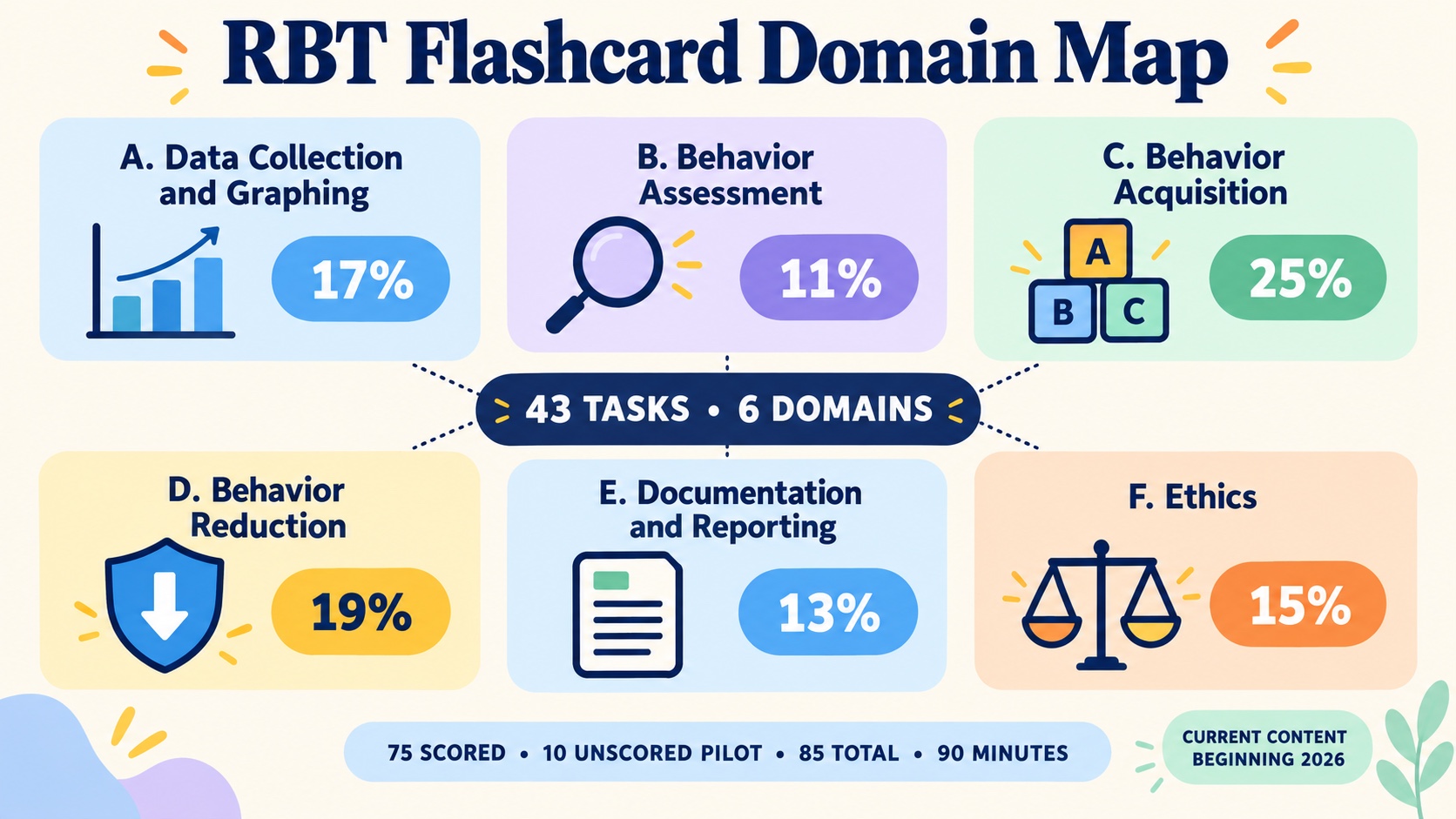
The current RBT Test Content Outline (3rd ed.) contains 43 tasks in six domains. Use the rounded shares as a review signal, not as six separate pass thresholds.
- A. Data Collection and Graphing — 13 tasks, 17%: frequency, duration, latency, interval procedures, permanent product, graphing, trends, and data reliability.
- B. Behavior Assessment — 8 tasks, 11%: preference assessment, skill assessment, descriptive assessment, and participation in functional-assessment components.
- C. Behavior Acquisition — 19 tasks, 25%: reinforcement, conditioned reinforcers, DTT, naturalistic teaching, chaining, discrimination, prompting and fading, shaping, token economies, generalization, and maintenance.
- D. Behavior Reduction — 14 tasks, 19%: following authorized procedures, data collection, function-based reasoning, behavior-reduction plans, integrity, and reporting concerns.
- E. Documentation and Reporting — 10 tasks, 13%: objective notes, data handling, communication, confidentiality, and timely reporting.
- F. Ethics — 11 tasks, 15%: competence, supervision, confidentiality, public statements, boundaries, feedback, collaboration, and cultural humility.
Behavior Acquisition has the largest rounded share, but smaller domains still matter. A deck that only drills familiar teaching terms can leave data, documentation, assessment, and ethics gaps hidden.
How to study with flashcards
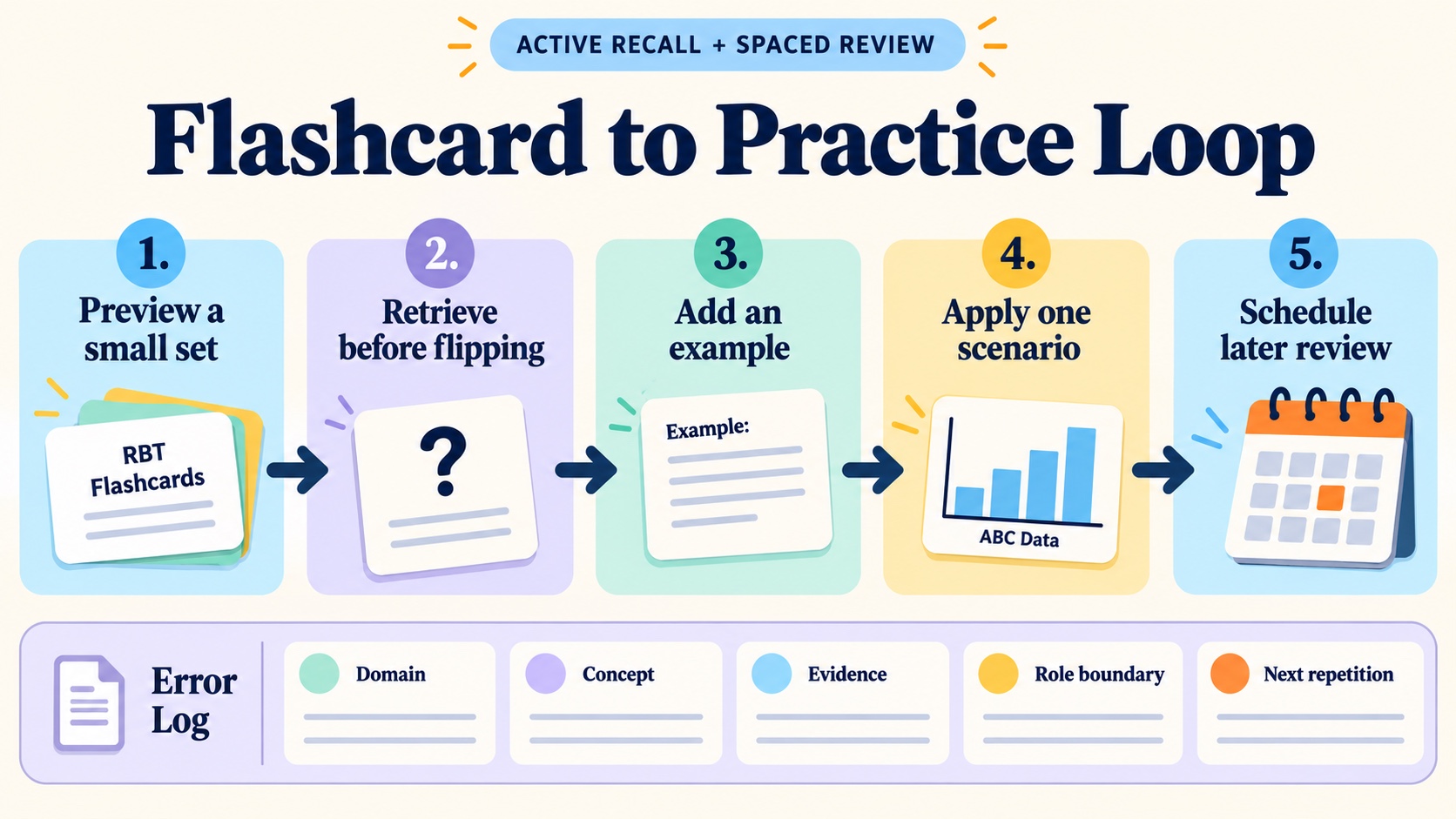
Use a short loop that works on a phone, printed cards, or a notebook:
- Preview: choose one domain and a small set of cards.
- Retrieve: answer before you reveal the back. Say the answer aloud when possible.
- Elaborate: add a workplace example or a contrast pair such as DRA versus DRI.
- Apply: answer one original scenario or interpret a small data example.
- Schedule: mark the card for later retrieval instead of rereading it immediately until it feels familiar.
Keep a personal-confusion deck. If you repeatedly mix up partial-interval and whole-interval recording, make a comparison card. If you confuse an RBT’s implementation role with a supervisor’s plan-design responsibility, make the boundary explicit. Those cards are usually more valuable than adding another hundred unrelated terms.
For a ten-minute session, choose five new cards and five review cards. Spend the first minute naming the domain, the next few minutes retrieving without looking, and the final minutes applying one card to a short example. If the answer feels familiar but you cannot explain the example, keep the card in review. If you can explain it and distinguish it from a nearby term, move it to a later interval instead of seeing it again immediately.
Flashcards versus practice questions
Flashcards answer, “Can I retrieve this idea?” Practice questions ask, “Can I recognize which idea controls this situation?” You need both because a learner can recite a definition and still choose an inappropriate measurement, miss a prompt-fading issue, or write an interpretation as if it were an observation.
A useful bridge question is: “What would this look like during a session?” For frequency, describe the event and count it. For latency, identify the instruction and the start of the response. For prompting, state what help is delivered and how it will be faded. For confidentiality, decide what information can be shared, with whom, and under which policy. These small bridges turn a flashcard into a practice cue.
After a card session, use free RBT practice questions. When you miss an item, do not simply mark the answer. Record the domain, the concept distinction, the evidence in the scenario, the role boundary, and the next card or question you will review. The RBT study path can provide the longer explanation, while the flashcard keeps the retrieval target small.
Common RBT flashcard mistakes
- Using an outdated deck: verify that the cards reflect the RBT Test Content Outline (3rd ed.) and the 2026 examination boundary.
- Counting cards instead of learning: a smaller deck with examples and contrasts can beat a huge list of shallow prompts.
- Studying recognition only: hide the answer, explain it, and apply it to a new scenario.
- Skipping ethics and documentation: professional boundaries and objective reporting belong in the deck, not only in a final-week review.
- Treating every preference as reinforcement: ask whether the consequence changed future behavior in the relevant context.
- Assuming a deck is official: use BACB sources for current certification and examination information.
Free RBT flashcards FAQ
How many RBT flashcards do I need?
There is no official card-count requirement. Start with a compact set that covers all six domains, then add personal-confusion cards from your practice errors. Depth, application, and later retrieval matter more than a large number printed on a landing page.
Are free RBT flashcards official BACB materials?
Not unless the BACB itself identifies them as an official resource. Independent flashcards can organize review, but compare their terminology and edition claims with the current BACB outline and Handbook.
Can flashcards replace RBT practice tests?
No. Flashcards support retrieval; practice tests add scenario discrimination, pacing, and rationale review. Use both, along with the required training, Competency Assessment, supervision, and official instructions.
What should I study first?
Map all six domains first. Then use a baseline question set to choose a starting area. Behavior Acquisition is the largest rounded domain, but data, assessment, documentation, and ethics can still decide whether a study plan is balanced.
Use the ABA Study Online app
If you want your flashcards, section practice, audio review, progress, and teaching tools in one study loop, explore the ABA Study Online app. Start with a small RBT deck, flag the cards you miss, practice a related question, and return later for spaced review. The app is a study companion; always use the current BACB sources for official certification and examination information.
Sources
- BACB RBT Test Content Outline (3rd ed.)
- BACB RBT Handbook, updated January 2026
- BACB Registered Behavior Technician resources
- BACB Test Content Outlines for BACB Certifications
- BACB RBT Ethics Code
- Carpenter, Pan, and Butler (2022), spacing and retrieval practice review
- Dunlosky et al. (2013), effective learning techniques review