Free RBT Certification: What Can Be Free and What Still Costs Money
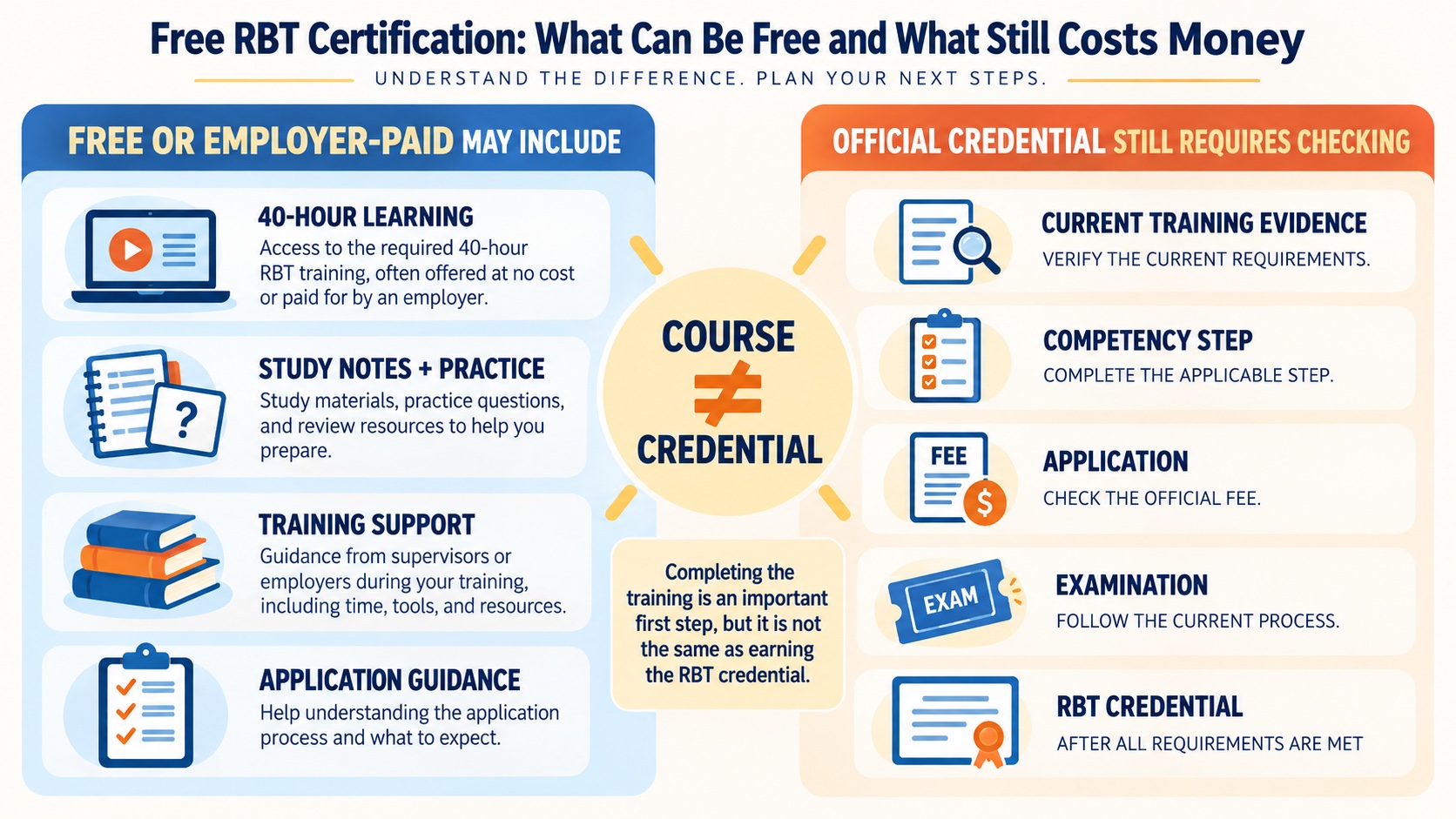
If you search for free RBT certification, you may be looking for a free 40-hour training course, a low-cost path into behavior analysis, or a way to avoid paying for a certificate that does not help with the application. Those are reasonable questions. The phrase becomes confusing when a free class is described as if it automatically grants the Registered Behavior Technician credential.
The safer answer is simple: parts of RBT preparation may be free or employer-paid, but the official credential is a separate process. You must verify the current BACB requirements, complete the applicable training and competency steps, submit an application, and pass the examination. Fees and provider costs can change, so use the current RBT Handbook and official resource pages before making a financial decision.
Table of Contents
What “free” can mean
A free offer can describe several different arrangements:
- Free instruction: videos, readings, quizzes, or a 40-hour course are available without a tuition charge.
- Employer-paid training: an ABA provider pays for training because it wants to recruit or onboard technicians.
- Free preview: a provider gives a few lessons or questions at no cost but charges for the complete course or certificate.
- Free study support: flashcards, practice questions, terminology notes, or review videos help you learn but do not create application evidence.
- Free application advice: a website explains the route, while the official application and examination remain separate steps.
These can all be useful, but they answer different questions. “Can I learn this content for free?” is not the same as “Will the BACB accept this training?” and neither question is the same as “Will I receive the RBT credential?” Keep those three questions visible when you compare an offer.
The official certification cost boundary
The RBT Handbook describes the certification sequence and the fees connected to the official process. The 2026 handbook lists a $65 certification application processing fee paid to the BACB and a $45 examination appointment fee paid to Pearson VUE. Fees are nonrefundable and can change, so treat these as a current orientation point rather than a permanent price promise.
Training is a separate cost category. The BACB sets requirements for qualifying training, but it does not make every provider’s course free or set one universal tuition price. An employer may pay for training, a nonprofit may offer a free course, or a commercial provider may charge for instruction, feedback, a textbook, a competency assessment, or application support. Ask exactly what is included before you rely on the word “free.”
You may also need to plan for services or documentation that are not included in a free course. Depending on the pathway and your circumstances, that can include a competency assessment, supervision, a background check, or employer onboarding steps. Do not assume that a completion certificate covers the entire application.
How to verify a free 2026 training
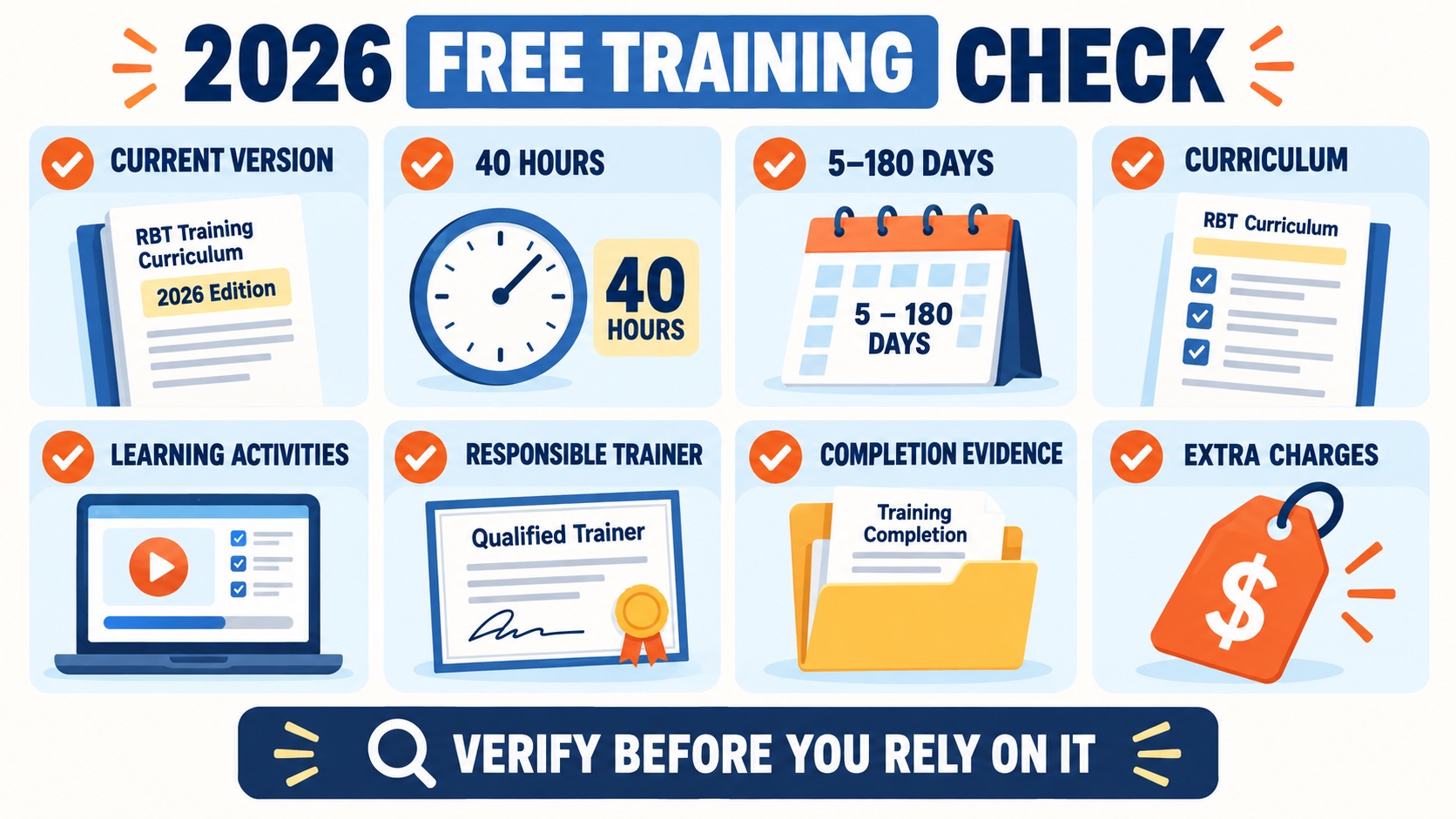
The current BACB 2026 training requirements say that RBT applicants must complete at least 40 hours of training over no fewer than 5 days and no more than 180 days. The training must cover the current curriculum, use permitted delivery activities, and be overseen by a responsible trainer who meets the applicable qualifications. A course page that only says “RBT certified” or “aligned with ABA” has not answered these questions.
Before starting, check these details in writing:
- Current version: does the provider state that the course is designed for the 2026 RBT training eligibility requirements?
- Forty-hour structure: does the course document at least 40 hours and the permitted 5–180 day completion window?
- Curriculum coverage: does it identify the required content areas rather than only listing general ABA topics?
- Learning activities: does it include appropriate instruction, modeling, role-play, quizzes, interactive activities, or discussion as applicable?
- Responsible trainer: does the documentation identify the responsible trainer and the oversight arrangement?
- Evidence: will you receive a completion record that contains the information the application process requires?
- Extra charges: are the competency assessment, feedback, certificate, support, or application services optional paid add-ons?
Questions to ask before you start
A short message to the provider can reveal more than a sales page. Ask: “Which current BACB training requirements does this course follow?” “Who is the responsible trainer?” “How is the 40-hour duration recorded?” “What exactly will the completion documentation say?” and “Which parts of the RBT application pathway are not included?” Save the answers with your enrollment records.
If the course is employer-sponsored, ask a second set of questions. Does the employer pay the application or examination fees? Is a qualified supervisor available after training? Who arranges the competency assessment? What happens if you do not pass the first attempt or leave the organization? These are employment terms, not automatically BACB requirements, so get them in writing from the employer.
Also check the date on every document. A course may have been accurate under an older RBT Task List and still be the wrong evidence for a 2026 application. Current language, a responsible trainer, and a clear record of completion matter more than a large number printed on a landing page.
If the answer remains vague, choose a different provider or ask a supervisor to review the offer before you enroll.
Free study resources versus application evidence
Free study materials are still valuable. You can use them to learn measurement vocabulary, practice identifying behavior and environment variables, review prompting and reinforcement, and prepare questions for your supervisor. The RBT learning path and RBT practice questions can help you build that study habit.
But a study note, flashcard deck, video, or practice quiz normally does not replace an official training certificate, competency assessment, application document, or examination. Label your notes as study support unless the issuing provider gives documentation that matches the current application requirement. This small label prevents a useful free resource from being mistaken for evidence the BACB will accept.
A safer low-cost route
- Read the current RBT Handbook and official 2026 training requirements before enrolling.
- Search for an employer that provides or reimburses qualifying training and clarifies supervision.
- If you choose a free course, save the course description, trainer information, completion record, and version statement.
- Ask who will conduct the competency assessment and what that service costs or includes.
- Budget for official application and examination fees separately.
- Use free practice resources to prepare, but confirm the current exam process on the BACB site before scheduling.
A low-cost route can be responsible; a vague route is not. If a provider will not explain what its certificate means, what version it follows, or which steps remain, pause before submitting personal information or paying an upgrade fee.
Red flags in “free certification” offers
- Credential language without a pathway: the page promises “certification” but never names the BACB application and examination steps.
- Old task-list language: the course does not identify whether it meets the current 2026 training requirements.
- Hidden certificate fee: the lessons are free, but the document needed for an application is only available after payment.
- Unclear trainer: the provider does not identify the responsible trainer or how oversight works.
- Guaranteed job or pass: no course can guarantee an employer’s decision or a certification examination result.
Free RBT certification FAQ
Can I become an RBT without paying anything?
Some training and employer support may be free, but do not assume the full official pathway has no costs. Verify the current application and examination fees, required evidence, competency arrangements, and any services your provider does not include.
Does a free 40-hour course make me an RBT?
No. A qualifying training course is one step. You still need the applicable competency, application, examination, and other current requirements before the credential is issued.
Does the BACB provide a free RBT course?
The BACB publishes requirements and official resources. It does not turn every third-party training course into a free BACB-issued credential. Check the live RBT page and handbook for the current route.
Can an employer pay for RBT certification?
Some employers may pay for or reimburse parts of training and onboarding. Ask what they cover, who provides supervision, what happens if you leave, and which costs remain your responsibility.