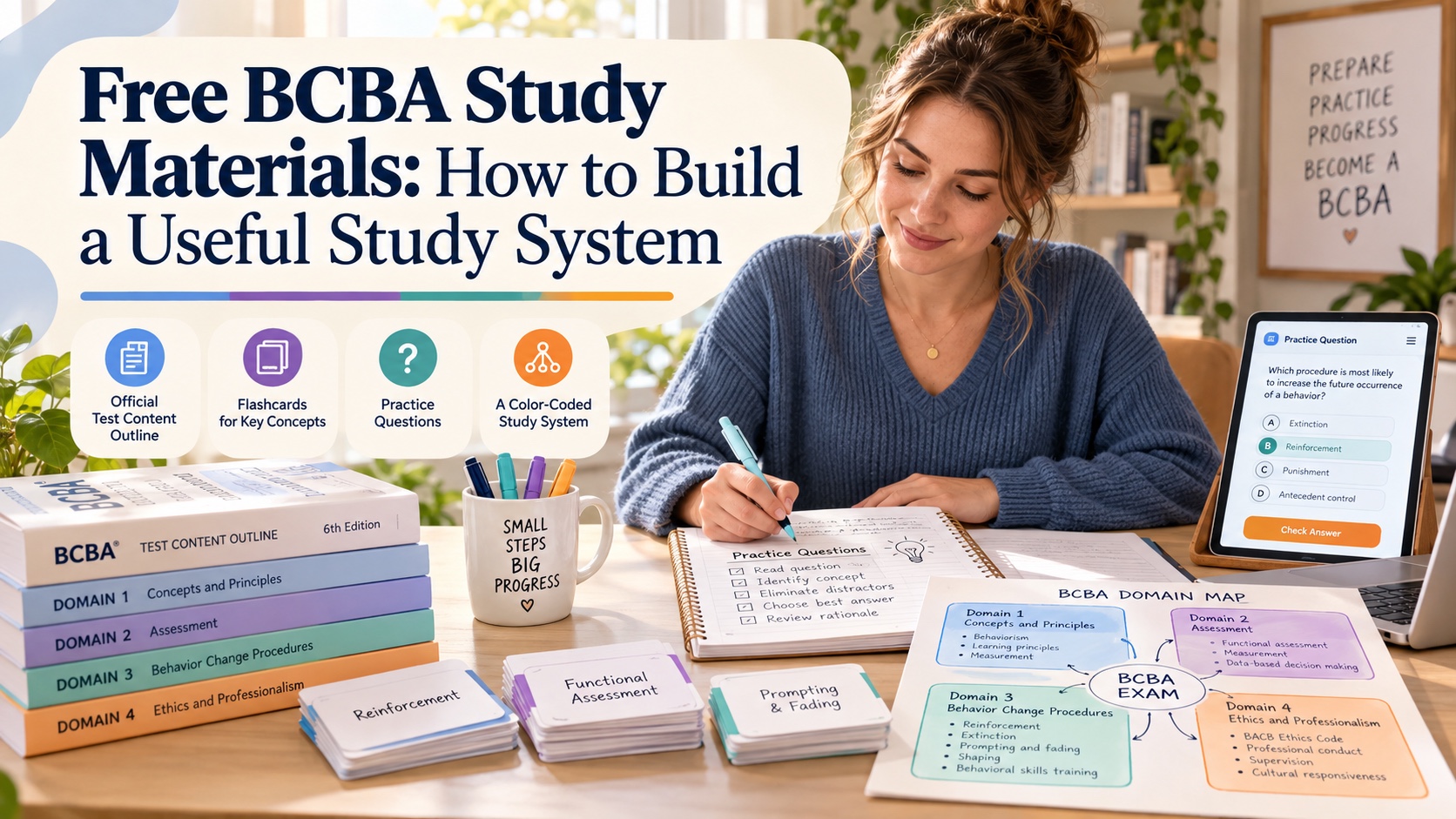
Free BCBA Study Materials: How to Build a Useful Study System
Free BCBA study materials can be a strong starting point, but “free” does not automatically mean current, complete, or official. The useful question is not which download is largest. It is what job each resource performs: mapping the current content outline, learning one concept, practicing an applied decision, or repairing an error.
Use the current BACB BCBA page, handbook, test-content materials, examination information, and transition notices as the source boundary. Free articles, flashcards, videos, and questions can support preparation; they do not determine eligibility, authorize an exam, or guarantee a passing result.
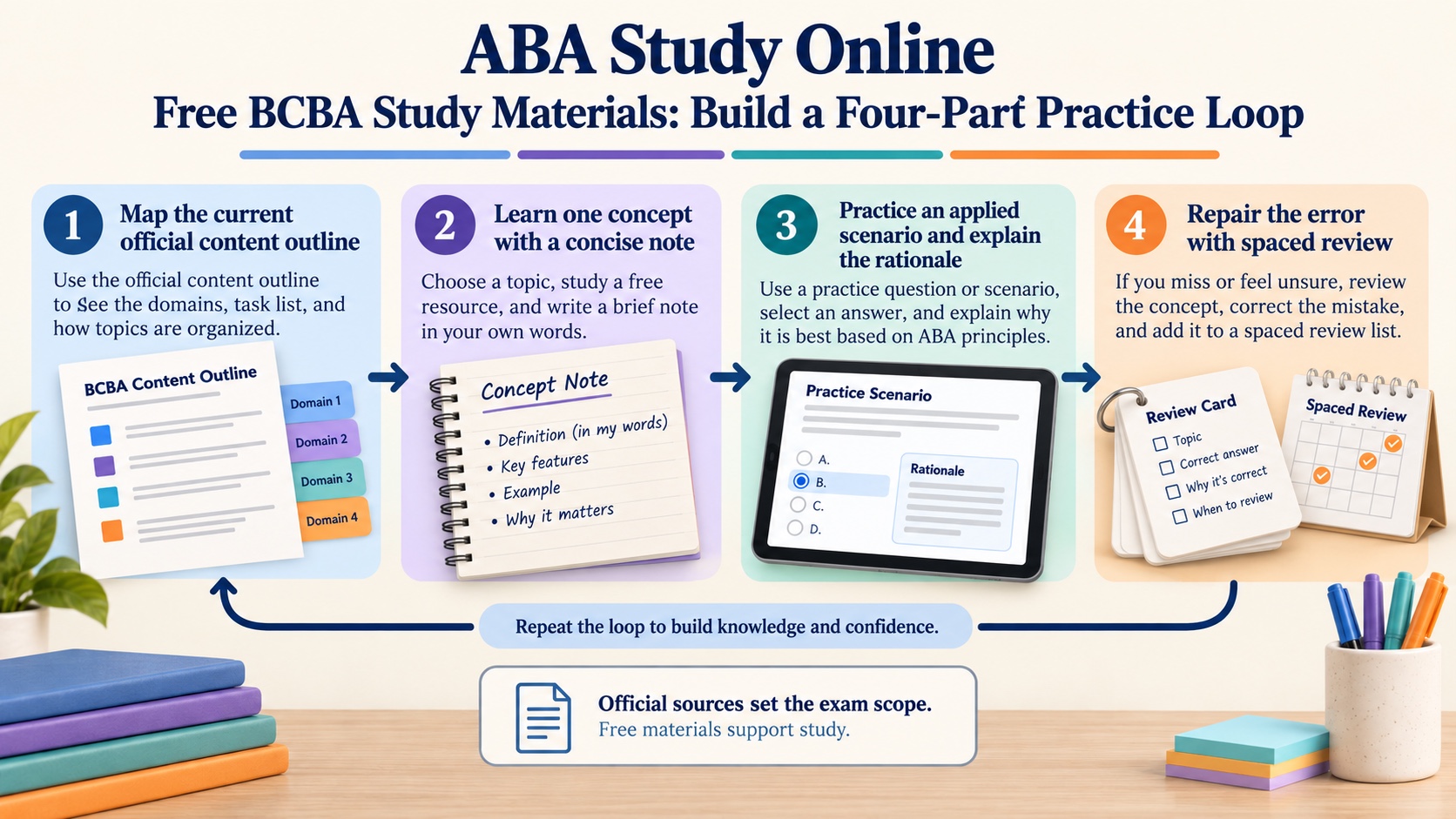
The four jobs of free materials
1. Map the official scope. Begin with the current BCBA content outline or task list. Make a working table with each content area, the task verb, the concept you need to explain, and the type of scenario you need to solve. This prevents a free resource from quietly becoming your definition of what the exam covers.
2. Learn one concept. A free article or short lesson is most useful when it helps you explain one idea in your own words. Add a definition, a boundary, a concrete example, and one “not this” contrast. For example, when studying positive reinforcement, write what is added, what happens to future behavior, and why a preferred item is not reinforcement unless the behavior effect supports that conclusion.
3. Practice an applied decision. Free practice questions can reveal whether you can use a concept in context. Choose questions that identify the setting, behavior, data, role, and decision. A question bank is more useful when it explains why the best answer fits and why the distractors fail.
4. Repair an error. A missed question should produce a next action. Identify whether the problem was vocabulary, discrimination between close procedures, data interpretation, role boundary, or rushing. Restudy the relevant concept, write a corrected rationale, and schedule the item for a later retrieval attempt.
How to choose a free resource
Check the date, track, source list, depth, and feedback. A resource that mixes BCBA, BCaBA, and RBT material may be useful for shared ABA vocabulary, but it should not be treated as track-complete preparation. A page that says “current” without identifying its source is harder to verify. A quiz that gives only a percentage cannot tell you whether you misunderstood a concept or simply made a careless selection.
Prefer resources that show the reasoning path. For a measurement topic, the explanation should connect the dimension to the behavior and observation rule. For assessment or intervention, it should identify what information the decision depends on. For ethics and professionalism, it should keep the role, competence, documentation, and consultation boundary visible.
Keep a source note beside every free download. Record the URL, date checked, credential track, content purpose, and any topics that may change. This small habit prevents an old PDF from silently becoming the anchor for a new study plan.
Also check whether the material teaches recognition or application. A definition list may help you get started, while a scenario asks you to select a measurement, interpret a graph, evaluate a procedure, or identify the most defensible next step. Both have a place, but they should not be scored as if they measure the same skill. Move from recall to explanation and then to decision-making as your preparation develops.
Be careful with attractive promises such as “complete exam coverage” or “guaranteed pass.” A free resource may be excellent and still be narrow. Look for the topics it does not address, the source date, and whether the answer rationales are consistent with the current scope. Honest limitations make a resource easier to use well.
Finally, keep your notes retrievable. A one-page concept map, a short error log, and a small set of questions you can explain are often more useful than a folder of unread downloads. The goal is a repeatable learning loop that shows what you know, what you can apply, and what needs another pass. Keep it simple enough to repeat every week.
Turn free questions into learning
Start with a small set rather than a giant daily score chase. Before looking at the options, identify what the scenario is testing. Then choose an answer and explain it in one or two sentences. After checking the key, tag the result: correct and explained, correct but guessed, incorrect because of concept, incorrect because of discrimination, or incorrect because of reading/pacing.
Do not use one free score as a prediction of the BCBA exam. The result depends on the form, wording, content coverage, rationale quality, and your familiarity with that resource. Use the score as a diagnostic signal. A weak cluster across assessment items calls for targeted learning; scattered misses may call for retrieval and pacing work.
Keep the source current
BACB requirements and transition materials can change. The BACB’s 2027 BCBA and BCaBA transition resource should be checked alongside the current handbook and content-outline index when planning beyond the current cycle. Do not assume that a page mentioning a future edition is already an official exam-content replacement.
Separate stable concepts from time-sensitive rules. Reinforcement, measurement logic, prompting, and graph interpretation can be studied from a well-made explanation, while eligibility, application, fees, examination scheduling, and transition dates should be verified against the current official source before action.
A simple weekly plan
- Choose one current source and one content area.
- Study one concept and write a brief note without copying the wording.
- Complete a small set of applied questions.
- Explain every missed or guessed answer.
- Schedule repaired items for spaced review.
- At the end of the week, compare your notes with the official scope and select the next weak area.
ABA Study Online can support this loop with free theory content, definition search, practice questions, and app-based review. Keep the destination clear: use the website and app for learning and practice, and use the BACB’s current materials for certification rules and official exam information.
FAQ
Are free BCBA study materials enough?
They may support substantial parts of preparation, but “enough” depends on current coverage, depth, feedback, and your ability to apply concepts. Always compare the study system with the current official scope.
What should I download first?
Start with the current official content outline or task list, then choose a concise concept resource and a practice source that provides rationales. Avoid collecting files before you know the job each one will perform.
Do free materials include official BACB questions?
Do not assume that. Independent practice questions are study aids unless the publisher has evidence of an official relationship and permitted content use. They should not be presented as real BACB exam questions.