Free BCBA Study Guide PDF: How to Evaluate a 6th Edition Resource
A free BCBA study guide PDF can be a useful starting point when you want one printable map of concepts, task areas, formulas, and review prompts. But “free” and “PDF” tell you almost nothing about whether the material is current, accurate, or useful for application. Before you build a binder, check the edition, domain coverage, source list, and practice method.
The current BCBA examination is based on the BCBA Test Content Outline (6th ed.). This guide shows you how to evaluate a PDF against that boundary and turn reading into retrieval, scenario practice, and mistake review. It is independent educational guidance, not BACB-endorsed material, official exam content, or a pass guarantee.
Quick answer: a useful free BCBA study guide PDF should name the current BCBA TCO (6th ed.), map all nine domains, distinguish official source facts from original explanations, and give you prompts that require application. Use it as a study map, then practice answering new scenarios and reviewing why the distractors miss.
Do not judge a guide by page count alone. A short document with a clear source list, domain map, retrieval prompts, and error-review space may be more useful than a long file that only repeats definitions. Ask what you will do after each section: explain, calculate, choose, compare, or document.
The current BCBA study boundary
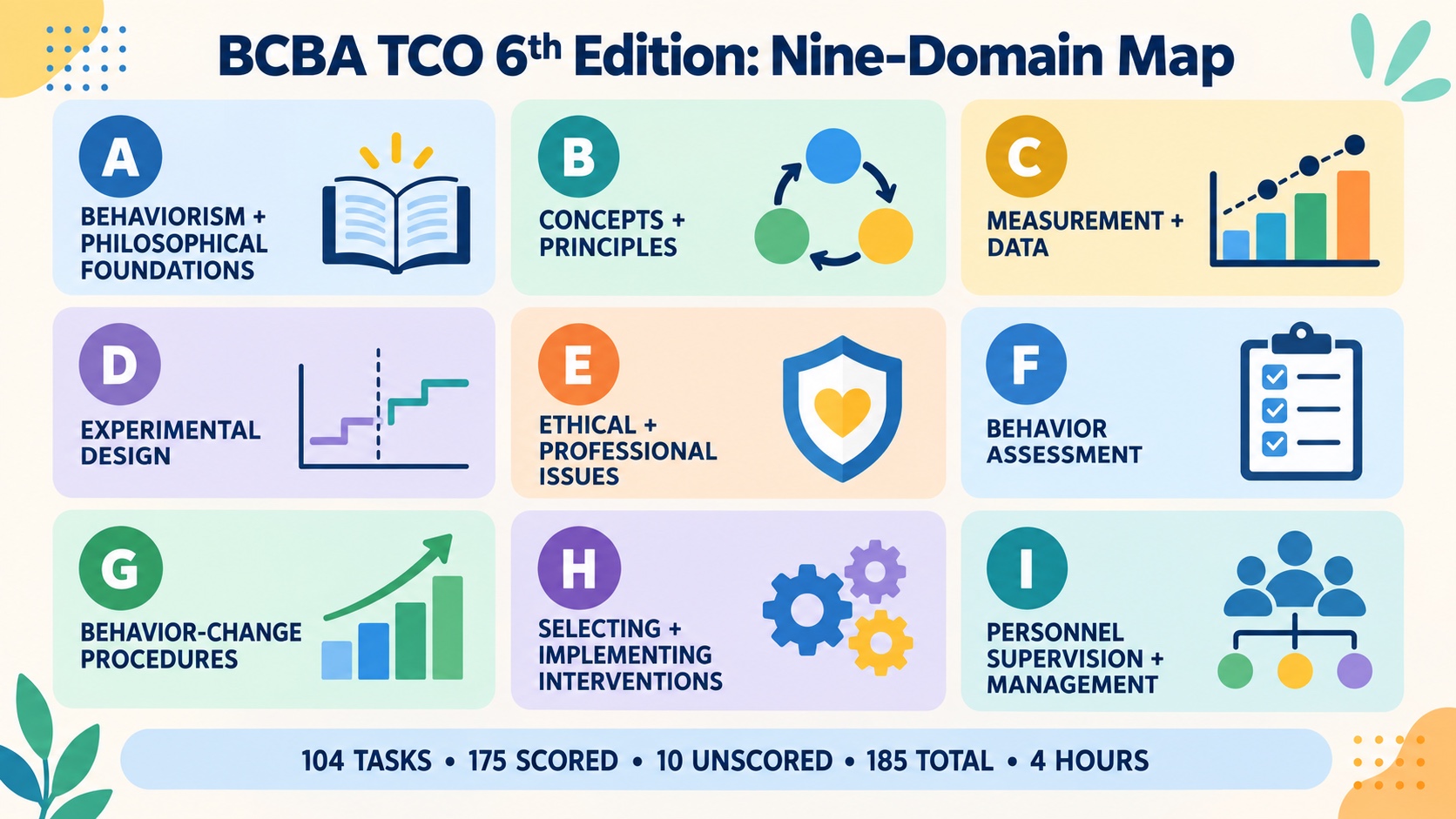
The current BCBA TCO (6th ed.) contains 104 tasks organized into nine domains. The examination includes 175 scored questions and 10 unscored pilot questions, or 185 total. Candidates have four hours, each question has four answer choices with one correct answer, and the official result is based on overall performance.
Those facts give a PDF a quality-control boundary. A guide that still centers an older outline without telling you, mixes exam editions, or treats an app’s readiness percentage as an official result needs careful review. Domain percentages can guide time allocation, but they are not nine separate BACB pass thresholds.
A free PDF audit checklist
- Edition: Does the document identify the BCBA TCO (6th ed.) and the period it is intended to support?
- Coverage: Are all nine domains visible, with a path from broad content to individual task decisions?
- Sources: Does it link to the current BACB outline, Handbook, Ethics Code, and examination information?
- Applied reasoning: Does it include scenarios, data displays, assessment boundaries, intervention choices, supervision, and ethics?
- Rationales: Does it explain why the strongest answer fits and why the distractors miss?
- Review behavior: Can you mark uncertainty, record an error pattern, and return to it later?
- Access: Is the file readable on your device, printable when needed, and navigable without friction?
Look closely at words such as “official,” “guaranteed,” or “exact exam questions.” Independent study material should not borrow official status it does not have. The BACB does not endorse specific study guides, and purchasing a guide cannot guarantee a passing result.
The nine current BCBA domains
A useful PDF gives every domain a distinct job:
- A. Behaviorism and Philosophical Foundations: connect assumptions to behavior-analytic reasoning.
- B. Concepts and Principles: distinguish concepts in applied situations, not only by definition.
- C. Measurement, Data Display, and Interpretation: select, calculate, display, and interpret measurement information.
- D. Experimental Design: identify design logic, control, and the evidence needed for a conclusion.
- E. Ethical and Professional Issues: apply the Ethics Code and professional boundaries to a situation.
- F. Behavior Assessment: match assessment questions, procedures, and interpretation boundaries.
- G. Behavior-Change Procedures: select and implement procedures with attention to context and fidelity.
- H. Selecting and Implementing Interventions: evaluate intervention fit, evidence, feasibility, and stakeholder priorities.
- I. Personnel Supervision and Management: connect supervision, performance, feedback, and ethical responsibility.
Use your errors to change the order. If you can recite a definition but cannot interpret a graph or select a measurement system from a scenario, your next session should be applied. If you choose an intervention but overlook stakeholder context or ethical scope, review the decision boundary rather than rereading every page.
A domain map is also useful for noticing missing links. Measurement should connect to assessment and intervention decisions; ethics should appear inside supervision, documentation, and treatment choices rather than in a final isolated chapter. A PDF does not need to be long to make those connections, but it should give you a way to practice them. Try writing one bridge question after each section: “Where would this show up in a case?” “What evidence would I need?” or “Which professional boundary limits the next step?”
When a resource uses a formula, ask what the number means in context and what decision it supports. When it uses an ethical example, ask what information is missing and who should be consulted. When it uses a behavior-change example, ask whether the procedure fits the function, setting, goals, and stakeholders. These questions keep the study guide connected to applied reasoning during a timed mixed-domain session and later review before you begin the next study block.
How to study from a PDF
Use a PDF in three passes:
- Map: skim the headings and choose one domain and one narrow task for today.
- Retrieve: close the document and explain the concept, formula, or decision rule from memory.
- Apply: answer a new scenario, interpret a small display, compare options, or write the ethical next step.
Use the document to ask better questions. “What is the term?” is a start; “What evidence would change the choice?” or “Which feature of the graph controls the interpretation?” requires more useful retrieval. Mark answers by confidence as well as correctness. A correct guess is still a review target.
Common BCBA PDF-study mistakes
- Choosing by page count: more pages do not prove current, applied, or accurate content.
- Using an older task list silently: check the outline edition before you study.
- Reading without retrieval: close the PDF and produce an answer before reopening it.
- Ignoring rationales: inspect distractors and the evidence that controls the decision.
- Turning domain percentages into pass cutoffs: use them for planning, not prediction.
- Letting a PDF replace practice: the document should lead to questions, explanation, and spaced review.
- Calling independent material official: source labels and scope boundaries matter.
A PDF-to-practice loop
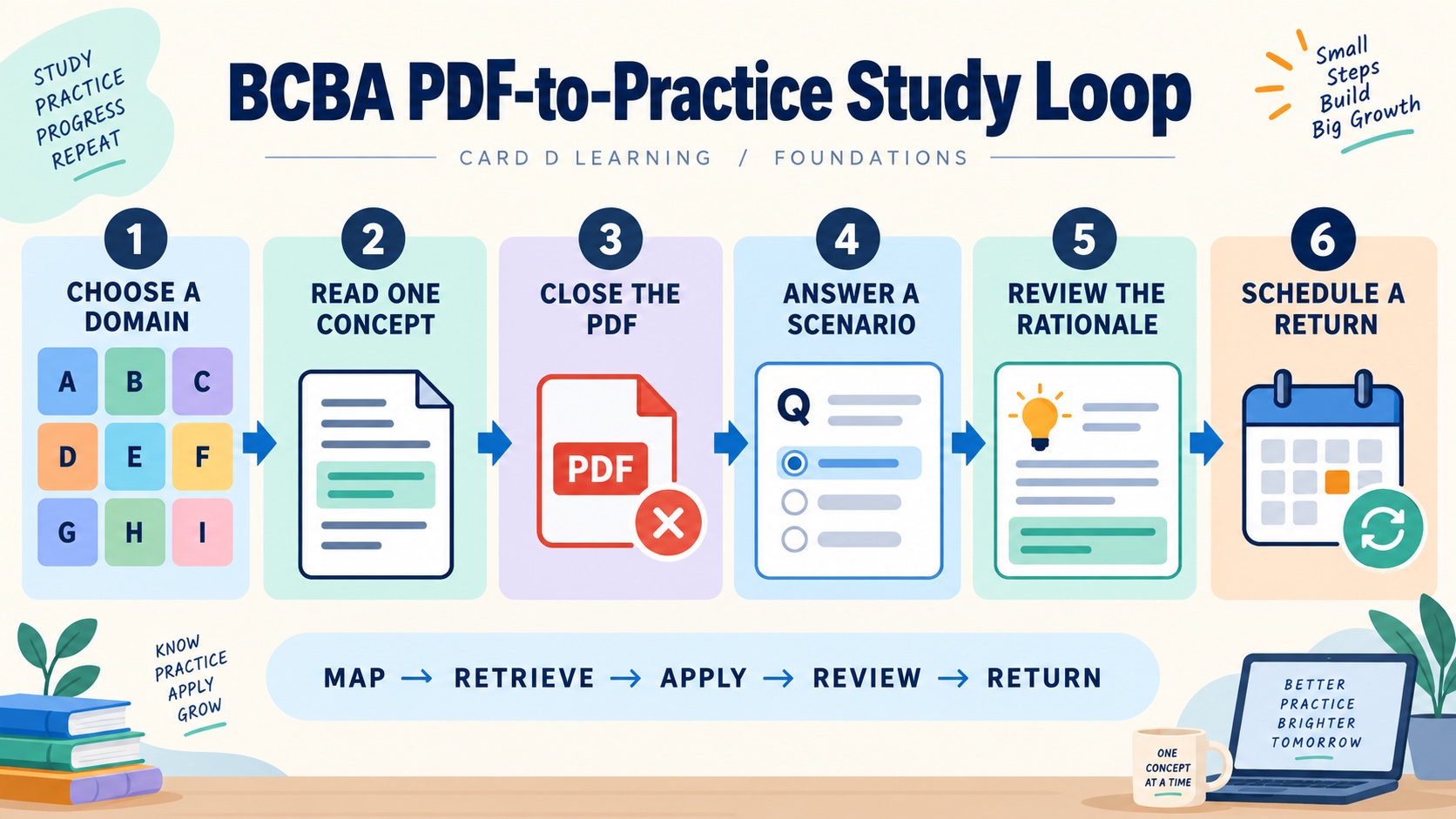
Try a 30-minute session:
- Choose one domain and one task distinction.
- Read the relevant PDF section for eight minutes.
- Close it and write the concept or decision rule in your own words.
- Answer four or five original scenario questions.
- Review every miss and every uncertain correct answer.
- Save one error pattern and schedule it for later retrieval.
Repeat the loop with a mixed-domain session later in the week. Mixing forces you to identify which concept controls a new stem rather than relying on the order of the PDF. Keep the routine small enough to repeat and specific enough to produce an observable next action.
Free BCBA study guide PDF FAQ
What edition should a free BCBA study guide PDF use?
For the current BCBA examination content, check that it maps to the BCBA TCO (6th ed.). Verify the edition on the BACB site instead of trusting a file name.
How many domains should a BCBA PDF cover?
The current outline contains nine domains and 104 tasks. A useful guide should show how its sections map to those domains without pretending that a domain chart is a separate official pass score.
Can a free PDF predict whether I will pass?
No. A study guide can organize preparation and reveal questions to review, but it cannot generate an official BACB result or guarantee passing.
Should a BCBA PDF include a full mock exam?
It may link to practice, but a static guide and a timed mock are different tools. On ABA Study Online, the website is the full mock-exam destination; the app supports the recurring flashcard, section-practice, audio, progress, and tools loop.
Continue the review in the app
After a PDF session, use the BCBA study path for deeper theory, the BCBA practice questions for applied decisions, and the website mock exam when you need a longer diagnostic. The app is useful for short retrieval sessions, section practice, audio review, progress, and tools.