Free BCBA Mock Exam Online: How to Use a 6th Edition Practice Test
A free BCBA mock exam online can answer questions that a glossary cannot: Can you pace yourself? Can you identify the relevant domain inside a long scenario? Can you explain why one answer fits the evidence, ethics, and context better than the distractors?
Use a mock as a diagnostic and practice experience, not as a prediction of your BACB result. The current BCBA examination is based on the BCBA Test Content Outline (6th ed.). This guide explains the format boundary, how to take a practice test, and how to turn misses into a focused repair plan. It is independent educational material, not official BACB examination content or a pass guarantee.
Quick answer: Take a free mock after you have a basic map of the current 6th-edition domains, use the result to find patterns rather than to chase one number, and review every uncertain item. A useful mock gives you pacing information, domain signals, answer rationales, and a next study action. It cannot produce an official BACB scaled score or guarantee that you will pass.
Keep the numbers straight: the current BCBA examination includes 175 scored questions plus 10 unscored pilot questions, or 185 questions total. Candidates have four hours, each question has four answer choices with one correct answer, and the official result is based on overall performance. A third-party mock may imitate the length and structure, but its score is still a practice score.
What a free mock exam is good for
A practice test is valuable when it answers a planning question. Before you begin, choose one:
- Baseline: What do I currently recognize across all nine domains?
- Pacing: Can I make careful decisions through a long timed session?
- Transfer: Can I apply a concept when the wording and setting change?
- Repair: Which distinctions should control my next study block?
Do not treat a mock as a ceremony where you wait for a readiness verdict. If the first attempt feels uneven, that is useful information. A low result may reflect content gaps, rushed reading, weak discrimination among answer choices, or unfamiliarity with timed practice. Your review should distinguish those possibilities rather than attaching a label to your ability.
The current BCBA exam structure
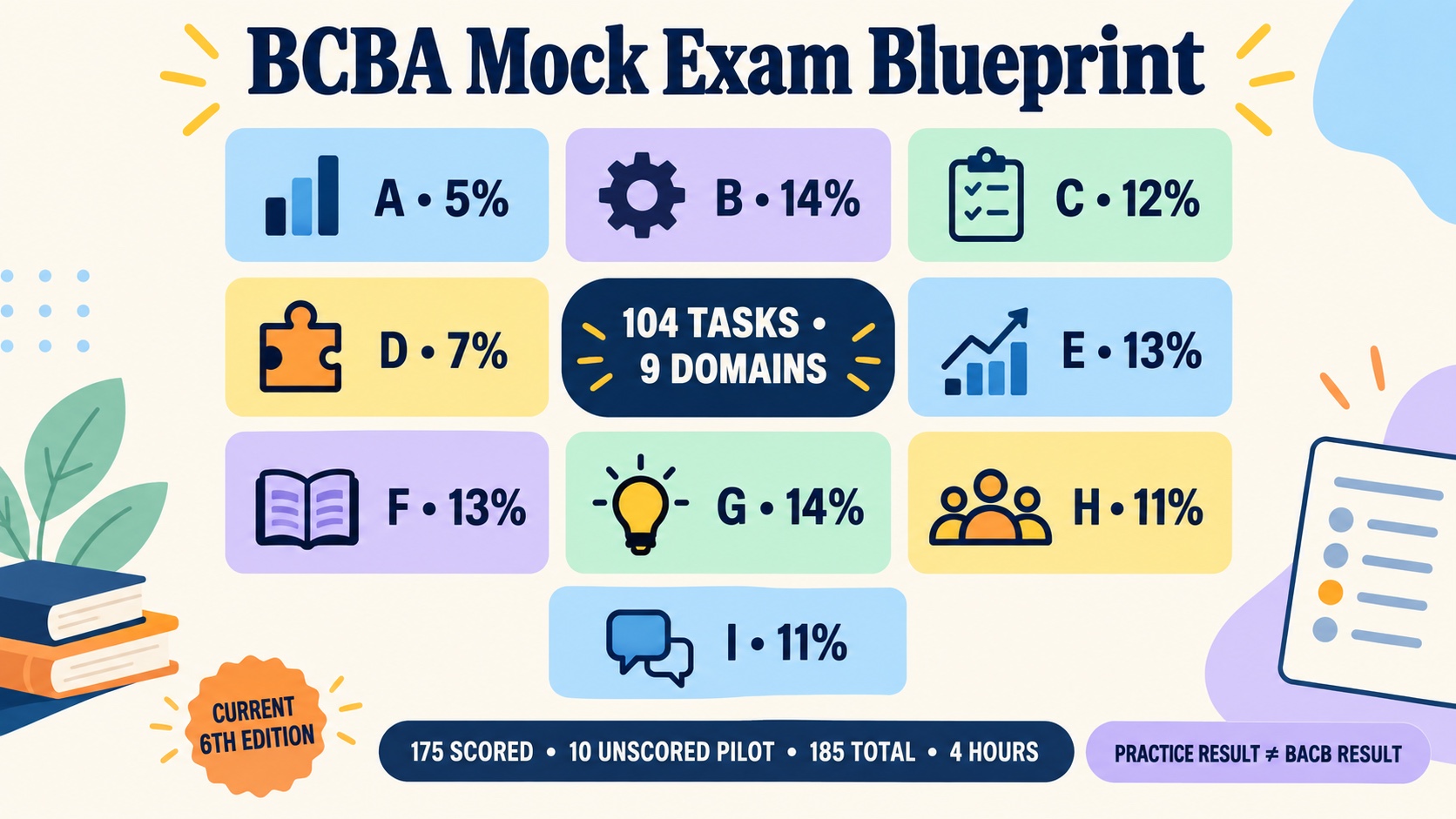
The BCBA Test Content Outline (6th ed.) contains 104 tasks across nine content areas. The rounded domain shares are useful for planning:
- A. Behaviorism and Philosophical Foundations: 8 questions, 5%.
- B. Concepts and Principles: 24 questions, 14%.
- C. Measurement, Data Display, and Interpretation: 21 questions, 12%.
- D. Experimental Design: 13 questions, 7%.
- E. Ethical and Professional Issues: 22 questions, 13%.
- F. Behavior Assessment: 23 questions, 13%.
- G. Behavior-Change Procedures: 25 questions, 14%.
- H. Selecting and Implementing Interventions: 20 questions, 11%.
- I. Personnel Supervision and Management: 19 questions, 11%.
These shares are not nine separate pass thresholds. Use them to notice whether your practice set is balanced and whether a small percentage area is being ignored. The official Handbook and current BACB pages remain the source for examination rules and certification information.
How to take an online mock
Choose the mode that answers your current question. For a baseline, take a mixed set without looking up terms. For pacing, use a timer and a quiet setup. For repair, work in domain blocks and pause after each rationale. Do not call every mode a “full simulation”; a short diagnostic and a 185-question timed test serve different purposes.
- Read the instructions: check the edition, number of questions, timer, answer review, and whether explanations are available.
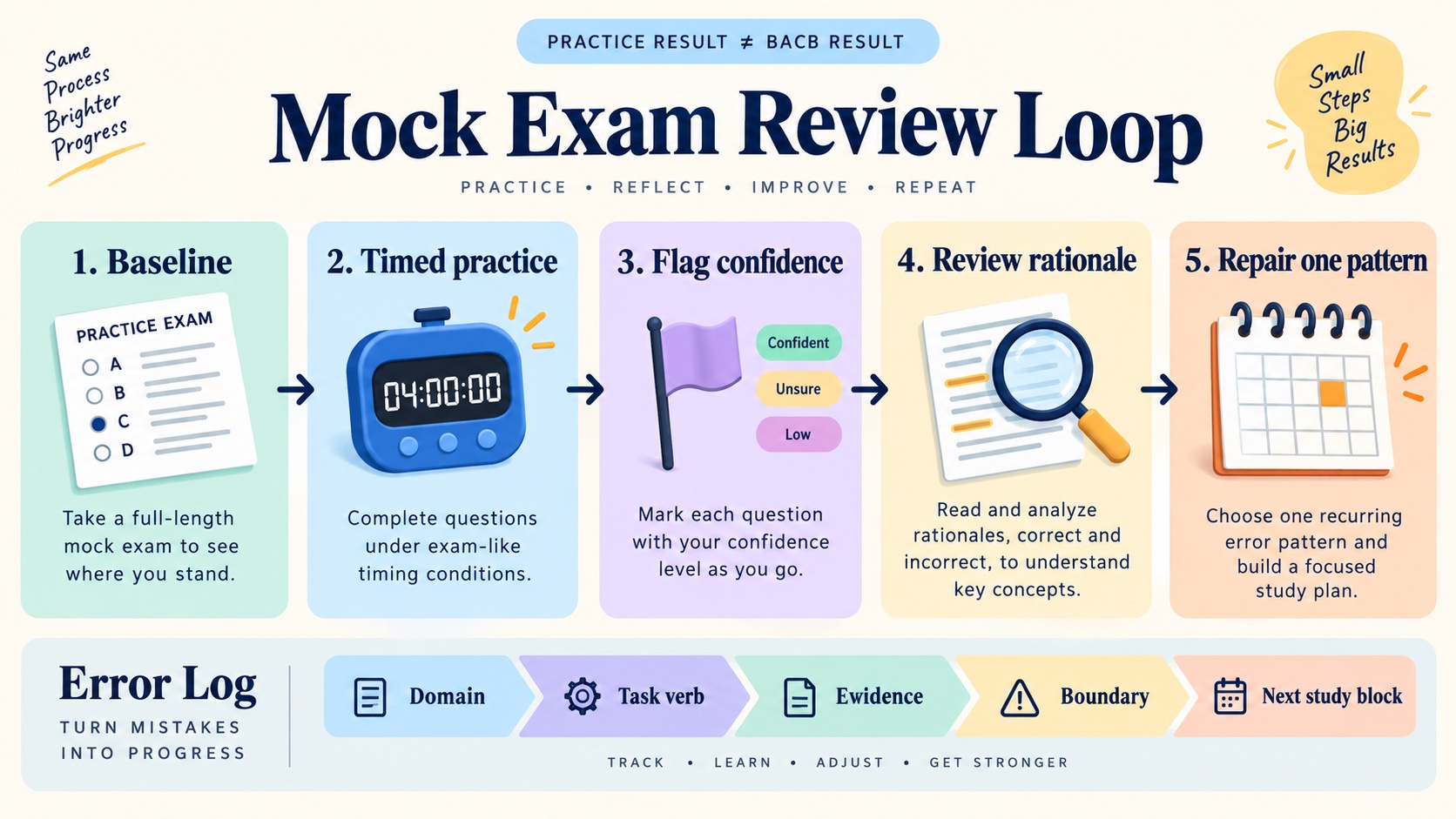
- Commit before revealing: mark your answer and confidence level before opening feedback.
- Flag uncertainty: a correct guess is different from a confident correct decision.
- Record the reason: note the concept, domain, evidence, and distractor that pulled you away.
- Review after finishing: leave time to inspect rationales; the score alone is not the learning event.
For an online practice session, take breaks only when the practice mode allows them and record whether a break changed your pacing. Do not assume the testing-center rules of a third-party tool are identical to the official examination. Check the current BACB Handbook for current testing procedures.
How to read your results
Read results in three layers:
- Overall practice score: a snapshot of this question set, not an official scaled score.
- Domain pattern: a clue about where misses cluster, not a separate BACB pass/fail result.
- Confidence pattern: compare confident errors with uncertain correct answers. Both deserve attention, but for different reasons.
If Domain C errors cluster around visual analysis, return to graphs and measurement distinctions. If Domain F errors come from overclaiming what an assessment demonstrates, review the evidence boundary. If Domain H errors ignore contextual fit or stakeholder priorities, practice selecting an intervention under constraints. The domain label is only the first step; the rationale explains the repair.
Also inspect the question process itself. Did you miss a keyword, answer before identifying the task verb, change a correct choice without evidence, or run out of time? These are different repair targets. A content review will not fix a pacing problem, and a timer will not fix a measurement distinction or evidence problem.
A post-mock repair routine
Use a 24-hour repair cycle:
- Same day: review every missed and flagged item. Write why your answer was attractive.
- Next day: study the narrow concept or task distinction, then answer a different example without looking at the old options.
- Later in the week: mix the repaired domain with two other domains so you must identify the controlling idea.
- Next attempt: retest the same pattern under a new stem, not only the identical question.
Keep an error log with five fields: domain, task verb, evidence, boundary, and next repetition. This turns “I got it wrong” into a study instruction. Retrieval practice and spaced review are general learning recommendations; they are not BACB requirements and they do not predict your result.
Common BCBA mock-exam mistakes
- Taking a mock too early and stopping at the score: a baseline can be useful even when the first result is low.
- Using a 5th-edition mock without checking: verify that the questions map to the current BCBA TCO (6th ed.).
- Confusing 185 total with 175 scored: label the 10 unscored pilot questions in your format notes.
- Ignoring rationales: a correct answer can still reveal a weak reason or lucky guess.
- Treating a domain chart as a pass threshold: use domain results to plan review, not to invent official cut scores.
- Calling a third-party mock official: independent questions are practice, even when aligned to the current outline.
Free BCBA mock exam FAQ
How many questions should a free BCBA mock exam have?
A full-length simulation can mirror the current 185-question structure, while a shorter diagnostic can sample the nine domains. The page should clearly label which format it provides instead of using “full mock” for every quiz.
Can a free mock exam predict whether I will pass?
No. A practice score is not a BACB scaled score or a guarantee. Use it to identify pacing, content, discrimination, and confidence patterns, then repair those patterns.
Should I take a mock exam before studying?
If you can review the results without treating them as a verdict, a short baseline can show where to start. If a full timed test would overwhelm you, begin with domain practice and schedule the full simulation later.
Where should I review after the mock?
Use the BCBA study path for theory, free BCBA questions for targeted practice, and the ABA Study Online app for flashcards, section practice, audio review, progress, and tools.
Start the website mock exam
When you are ready to measure pacing and application, open the ABA Study Online BCBA mock-exam page. Choose a baseline or timed mode, record your confidence, and use the review report to select the next study block. Full mock exams stay on the website; the app supports the flashcard and section-practice loop that follows.